>1. How did Paul use his tent making skills as an illustration of God's promise? (1; Acts 18:3)
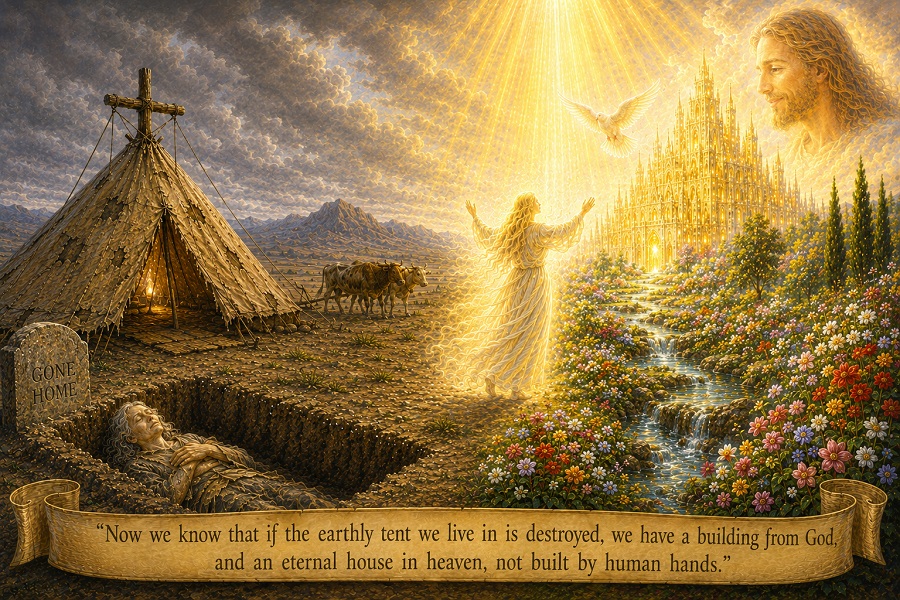
* 2 Corinthians 5:1 "Now we know that if the earthly tent we live in is destroyed, we have a building from God, an eternal house in heaven, not built by human hands."
* Acts 18:3 "and because he was a tentmaker as they were, he stayed and worked with them."
* 2 Peter 1:13-15 "I think it is right to refresh your memory as long as I live in the tent of this body, because I know that I will soon put it aside, as our Lord Jesus Christ has made clear to me. And I will make every effort to see that after my departure you will always be able to remember these things."
* 1 Corinthians 15:42-50 "So will it be with the resurrection of the dead. The body that is sown is perishable, it is raised imperishable; it is sown in dishonor, it is raised in glory; it is sown in weakness, it is raised in power; it is sown a natural body, it is raised a spiritual body.
If there is a natural body, there is also a spiritual body. So it is written: "The first man Adam became a living being"; the last Adam, a life-giving spirit. The spiritual did not come first, but the natural, and after that the spiritual. The first man was of the dust of the earth, the second man from heaven. As was the earthly man, so are those who are of the earth; and as is the man from heaven, so also are those who are of heaven. And just as we have borne the likeness of the earthly man, so shall we bear the likeness of the man from heaven.
I declare to you, brothers, that flesh and blood cannot inherit the kingdom of God, nor does the perishable inherit the imperishable."
* John 3:3 "In reply Jesus declared, 'I tell you the truth, no one can see the kingdom of God unless he is born again.'"
* John 3:5-8 Jesus answered, 'I tell you the truth, no one can enter the kingdom of God unless he is born of water and the Spirit. Flesh gives birth to flesh, but the Spirit gives birth to spirit. You should not be surprised at my saying, 'You must be born again.' The wind blows wherever it pleases. You hear its sound, but you cannot tell where it comes from or where it is going. So it is with everyone born of the Spirit.'"
*
Chapter 5:1-10 Overview.
God created humans with 3 parts; a physical body, a soul, and a spirit. The soul is my emotions, thoughts, and will. My spirit was dead until Jesus gave it new life when I first believed in him many years ago. (John 3:3)
My physical body is like a tent. It temporarily contains my soul and my spirit. Paul was in the tent business, which he drew from to make the analogy in this chapter. His craft consists mostly of mending tents and occasionally making new ones. People use tents as temporary residences. Homes made of wood, brick, and metal are preferred to tents. The physical body is a tent. (1-4)
When I was young, I was in the Boy Scouts. My troop often took trips, usually staying in tents. One late fall, we stayed near a small river winding through my grandparents' dairy farm. Most stayed in tents except my friend and I. We decided to make a tent out of a rope and a large plastic sheet. The ends of the sheet overlapped under our sleeping bags.
The first night, the weather changed from pleasant to bitterly cold, freezing rain. At first, my friend and I were safe and dry in our flimsy tent. However, after 15 minutes, ice-cold water began seeping through the overlap under our sleeping bags. We became shivering cold and wet. We soon escaped the poor tent for the warm, dry shelter of my grandparents' farmhouse.
My physical body is like the plastic tent my friend and I made. When all is pleasant, my physical body adequately houses my soul and spirit. However, from the day I was born, my body has had flaws that do not hold up when life's weather turns for the worse. In bad storms of life, I groan and am burdened. I feel naked, wet, and cold. (2, 4)
However, I have great hope. I believe that Jesus has made something better for me. When my current physical body finally fails, I know that God has made a strong, dry, and warm home for my soul and a new spirit. He will place my soul and my new spirit in a new physical dwelling. (1, 3, 6-8)
When my body dies, I will not be naked. I know this is true because God's Spirit within me spiritually reminds me of all the time. I live by faith, even though I cannot physically see my new spirit, nor God's Holy Spirit, nor have I seen my new resurrection physical body. Like Paul, I make it my goal to please Jesus, who has given me this wonderful hope. (9-10)
Listen to the above Chapter 5:1-10 Overview.
* "Now" -Other English Bible versions translate the Greek conjunction "gar" (a transliteration) as "for". "Gar" is used 1,067 times in the New Testament. It's a primary particle, properly "assigning a reason used in argument, explanations. or intensification", often with other particles. "For" is the most common translation. Many various translations include "and", "as", "because" (that), "but", "even", "indeed", "no doubt", "seeing", "then", "therefore", "verily", "what", "why", and "yet". Here, it is bridging 4:17 to the next point.
* "we" -Paul is speaking of himself but can also mean all believers (4:14; Job 19:25). He has been using plural pronouns to refer to himself in this letter since 1:8. Throughout this letter Paul uses the editorial plural (we, us, our, ourselves) to refer to himself. Except where the context plainly indicates otherwise, these plurals should be understood as referring to Paul alone. See Study 3, question 2a on verse 4:2 for more comments.
* "we know that" -Paul states "we know" in verses 1, 6, 11, and 16. Paul is using "we" to refer to himself. It cannot be said confidently that all in the Corinth congregation knows all these facts nor that Paul taught all these fact for the 18 months he had been there, though it can be said he probably did talk about at least some of these.
* "if the earthly tent we live in" -"If" meaning we do not know when the physical body will cease to function, but we know it will stop. Paul, like the Greek writers, describe the physical body as a vessel like the "jars of clay" in 3:7, a house as some English translate the Greek noun "oikia" (a transliteration), a tent, and the Greek writers often call it a tomb. Paul says that a better body awaits. As a tent is temporary, so the body we now have is temporary.
* "earthly... heavenly" -Drastic contrast. (1 Corinthians 15:47) Earthly implies Adam was made of the dust until the Lord breathed into his nostrils the breath of life. The breath of life, which was the glory of the Spirit, was lost when he sinned. Heavenly, it can be inferred, is a body of the Spirit once more. The Spirit we are given upon accepting Jesus as Savior and Lord in this life is a "deposit", not the full Spirit we receive when the physical body dies and we go to heaven. When that happens we are clothed fully. That is what Paul is speaking of here.
*
Is Destroyed.
The physical body truly will cease to function and will not function as it does now ever again. This will happen one day. This is true for everyone eventually. Just as true is the fact that when a person confesses with their mouth, "Jesus is Lord," and believes in their heart that God raised him from the dead, they are saved and born again with a new spirit as a down deposit. (5; Romans 10:9) The transformation is not noticeable, even with careful observation. (Luke 17:30)
Paul, in verse 1, indicates that another transition occurs immediately when the physical body ceases to function. This transition is the full deposit of the Holy Spirit, a complete clothing (5). Paul is also very clear in the first letter to the Corinthian congregation, chapter 15, that when Jesus comes as King and Judge of his congregation (church), those who died as believers before he comes again to Earth will receive their new, resurrected physical bodies "in a flash". Jesus states a spiritual change is needed in John 3:4-6 and 14:1-3 to be in paradise.
The born again have an interim body which Paul speaks of in verses 4 and 5, "it is God who has made us for this very purpose and has given us the Spirit as a deposit, guaranteeing what is to come", before they go to heaven. A deposit is only a small part of what is to come. The small part guarantees the full amount that comes in the future. The deposit comes with the confession. The full amount comes when the physical body dies, and the soul goes to heaven.
During Jesus' ministry, no one ever asked Jesus what their resurrected body would be like. Only the Gentile believers at Corinth asked this question. Perhaps all the Jews, except the Levites, had the same belief concerning a bodily resurrection, that is, those who believed in the resurrection. The Levites did not believe in the resurrection. Those who did believe did not have a reason to ask Jesus about what the body was going to be like. Still, Jesus did speak of the changes that would happen with those who became his disciples. The Apostles, including Paul, also wrote of these changes.
Three changes will come. The first is a down deposit, a born-again spirit, when we confess Jesus as Lord. The second is a full deposit, a completed spirit when the physical body dies. The last is the new physical body when Jesus comes again.
Listen to the above comments on 5:1, 4-5.
* "we have a building from God" -The "building from God" is an allegory of the full clothing (surrounding in glory) and presence of the Spirit in a Christian when a person's physical body dies and they go to heaven, not the new resurrected body when Jesus descends on the clouds to the Earth. Paul is not referring to a physical place of brick, mortar, wood, clay, and other building materials. Some understand this incorrectly.
Paul, by comparing a tent to a building is using a good allegory that he borrowed from Jesus who said, "Destroy this temple, and I will raise it again in three days." (John 2:19) Jesus compared his body to a temple. Apostle John commented on this, "But the temple he had spoken of was his body. After he was raised from the dead, his disciples recalled what he had said. Then they believed the Scripture and the words that Jesus had spoken." (John 2:21-22) Paul calls the body we have now a "tent" and they body we will have when the "tent" dies a "building".
A building is better than a tent. A building is made of better, more permanent materials. The craftsmanship is better and last much longer. A building weathers better and can withstand more harsher conditions. The protection provided to the occupants inside is more assured in a building compared to a tent.
* "an eternal house in heaven, not built by human hands." -Paul claims that the new "body" is for when we are in heaven just as Jesus told Nicodemus (John 3). So, when Jesus comes again at the physical body resurrection, when we get our new physical body, and we will meet him in the air when he descends what will happen? Will we remain on earth in the Millennial kingdom? Or will he and us in our resurrected body go to heaven? Passages exist that speak of both. This verse says the new body, the new home of our spirit and soul, is a heavenly body, but that is during the interim, between the old physical body and the new physical body when Jesus comes gain. The details of the Millennial Kingdom of few and not well studied. Another subject to look into.
* The artwork is from Easton's Illustrated Dictionary.
>What do we wait for? (2)
* 2 Corinthians 5:2 "Meanwhile we groan, longing to be clothed with our heavenly dwelling,"
* John 14:2-3 "In my Father's house are many rooms; if it were not so, I would have told you. I am going there to prepare a place for you. And if I go and prepare a place for you, I will come back and take you to be with me that you also may be where I am."
* Romans 8:22-27 "We know that the whole creation has been groaning as in the pains of childbirth right up to the present time. Not only so, but we ourselves, who have the firstfruits of the Spirit, groan inwardly as we wait eagerly for our adoption as sons, the redemption of our bodies. For in this hope we were saved. But hope that is seen is no hope at all. Who hopes for what he already has? But if we hope for what we do not yet have, we wait for it patiently.
In the same way, the Spirit helps us in our weakness. We do not know what we ought to pray for, but the Spirit himself intercedes for us with groans that words cannot express. And he who searches our hearts knows the mind of the Spirit, because the Spirit intercedes for the saints in accordance with God's will."
* "Meanwhile we groan" -The current body at times causes us to groan; all Christians express the stress and strain within our physical body from unpleasant and painful experiences. This is not indwelling sin or the results of indwelling sin. Rather, the groaning is because our transformation is incomplete, as explained in verse 4.
* "longing to be clothed" -The longing is by the Christians only, though some other religions teach the resurrection. Those who do not believe and have their hope in Christ will continue, but they will not have a body nor a new spirit for they are not born again in the Spirit. They will only be a soul or using the old English word "ghost".
* "with our heavenly dwelling" -The Greek phrase Paul uses contains "ouranos", "ho ek", and "oiketerion" (transliterations). "Ouranos" base is "oros" (through the idea of elevation). "Dwelling" is the Greek noun "oiketerion" (a transliteration), neuter of a presumed derivative of the Greek verb and related noun translated "tent" and "house" in verse 1, "oikeo" and "oikia" (transliterations).
* "Before going away, Jesus promised to make provision of a dwelling place for His disciples (John 14:2). The Greek noun means "abiding places" and "dwelling places," implying permanence. KJV translated this as "mansions," which meant a dwelling place, but has come to represent an elaborate, expensive house in English. Thus, modern translations read, "dwelling places" or "rooms." Christian theology holds that Christ's followers will abide with Him eternally in heavenly dwelling places." (Holman Bible Dictionary)
>How are we clothed? (3; Revelation 7:14)
* 2 Corinthians 5:3 "because when we are clothed, we will not be found naked."
* Revelation 7:14 "I answered, 'Sir, you know.' And he said, 'These are they who have come out of the great tribulation; they have washed their robes and made them white in the blood of the Lamb.'"
* "because when we are clothed" -Future tense. "Clothed" is the Greek verb "endyo" (a transliteration) from a compound of the preposition "en" and the verb "duno" in the sense of "sinking" and "going down" into a garment, to "invest" with clothing (literal and figurative).
* "we will not be found naked." -Paul is referring to Adam and Even, after they sinned saw that they were naked. The glory of the Spirit, as Paul said believers in Jesus now have, had left them. The visible light of glory of the Spirit was gone. (Genesis 3:7) And so, Adam and Eve were found naked, with no glory.
* When Adam and Eve were found naked after they sinned, they made their own clothes which though impressing were inadequate. Therefore, the Lord God killed a spotless lamb to make suitable coverings for them (Genesis 3:7, 10-11, 21. Note: the lamb part is assumed and not in Genesis.). This was a symbol of what was to come through Christ, the Lamb of God who was slain and became for us a proper covering.
* "Pharisees accepted both the immortality of the soul and the future resurrection of the body, and many Jewish writers described the experience of heaven after death as a proleptic experience to be completed in paradise after the resurrection. Unlike some modern readers, Paul has no problem accepting both the soul's continuance after death and bodily resurrection. (Those who think Paul's view changed after 1 Cor. 15 should compare Phil. 1:21-23 with Phil. 3:20-21, where Paul includes both views in what is almost certainly the same letter.)
Although Paul finds some common ground with his Greek readers on the righteous soul's endurance (2 Cor. 4:16-18), he is quick to bring them back to the future hope that is the basis for it. Like the Greek sages, Paul is ready to face death; unlike them, he has a hope of future bodily life." (Bible Background Commentary - The IVP Bible Background Commentary - New Testament)
*
The Eternal Heavenly Body.
Are you tired of your present body? Does your current state cause you to groan at times, and are burdened at times? Do you want a better body, a permanent body, a body that will not weaken, droop, bruise, break, die, or decay? How does it sound to have a heavenly body, a body with powers and abilities that no human has possessed, currently or previously? Does an immortal body in paradise excite your heart? If all these are things you desire, they can be yours in Jesus Christ.
The believer in Jesus has a grand resurrection from death in store for them. Adam and Eve, because they sinned, lost the glory and eternal life that was theirs. (Genesis 3:7). They became merely a flimsy tent that wore out and dissolved back into dust. Jesus came to provide the glory that they lost by removing the sin they introduced into human existence through his spilled blood.
Apostle Paul compares our present body, which is like a tent that will be destroyed, to the new Christian's body, which is like a building from God, an eternal house in heaven, not built by human hands. (1) Our present frail body causes us to groan. Our new body will cause us to rejoice. In Christ, we will not be found naked as Adam and Eve were when they sinned (3; Genesis 3:7). Those who believe and hope in Christ will be clothed in glory as he is in glory. Seek Jesus, and you will live.
Listen to the above comments on 5:1-3.
>2. When will our mortal body be swallowed up by life? (4; 1 Cor 15:42-44)
* 2 Corinthians 5:4 "For while we are in this tent, we groan and are burdened, because we do not wish to be unclothed but to be clothed with our heavenly dwelling, so that what is mortal may be swallowed up by life."
* 1 Corinthians 15:42-44 "So will it be with the resurrection of the dead. The body that is sown is perishable, it is raised imperishable; it is sown in dishonor, it is raised in glory; it is sown in weakness, it is raised in power; it is sown a natural body, it is raised a spiritual body. If there is a natural body, there is also a spiritual body."
* "For while we are in this tent" -The present physical body is not permanent, though it was originally meant to be. The soul (mind, heart, will) is eternal. The spirit is dead until we accept Jesus as Savior and Lord of our existence and life. (John 3:3, 5-8) The new spirit we are given is not visible. Paul here states it is only a down deposit to what is to come when the physical body dies. (5)
* "we groan and are burdened" -Paul already said we groan in verse 2. Now he ads that we are burdened. Jesus told people to follow him because his burden is light. (Matthew 11:30)
* "because we do not wish to be unclothed but to be clothed with our heavenly dwelling," -Paul clearly states the reason for the groaning and burden.
* "so that what is mortal may be swallowed up by life" -John 1:4 speaking of Jesus says, "In him was life, and that life was the light of men." And John 1:9 continued to truth with, "The true light that gives light to every man was coming into the world."
* Jewish accounts of the righteous dead in heaven portrayed them as experiencing a measure of the future glory now, while awaiting the resurrection. Although this state was inferior to the resurrection (2 Cor. 5:4), it meant an end to the present toils-and Paul's continual experience of gradual martyrdom (2 Cor. 4:8-10). (Bible Background Commentary - The IVP Bible Background Commentary - New Testament)
>What is a deposit and why are they given? (5)
* 2 Corinthians 5:5 "Now it is God who has made us for this very purpose and has given us the Spirit as a deposit, guaranteeing what is to come."
* "Now it is God who has made us for this very purpose"
* "has given us the Spirit as a deposit"
* "guaranteeing what is to come."
* The term translated "pledge" (NASB) or "deposit guaranteeing" (NIV) was used in business documents for "down payment," a first installment. Because the Old Testament (e.g., Isaiah 44:3; Ezekiel 39:29) and much of early Judaism associated the outpouring of the Spirit with the future age, the present experience of the Spirit is the Corinthians' initial experience of the resurrection life to come, "guaranteeing" (cf. NRSV, TEV) its fulfillment (2 Cor. 1:22). (Bible Background Commentary - The IVP Bible Background Commentary - New Testament)
>3. How does the presence of the Holy Spirit assure us of our future? (6)
* 2 Corinthians 5:6 "Therefore we are always confident and know that as long as we are at home in the body we are away from the Lord."
* "Therefore we are always confident" -We are confident because of what Paul wrote in verses 1 through 5, we know we have a heavenly place that our soul will reside in because of the Holy Spirit's deposit now experienced in the existence and being of Jesus' disciple.
* "always" -Even when things go from bad to worse.
* "and know that as long as we are at home in the body" -By stating "the body" Paul clearly is linking the "tent" in verses 1-5 to our present physical bodies. By saying we "are at home" he means that our soul (mind, emotions, conscience, and will) is within our body.
* "we are away from the Lord." -Jesus is in his resurrected body in heaven. The Apostles saw Jesus ascend to heaven (Acts 1:9). The apostles John and Paul both went to heaven and saw Jesus there.
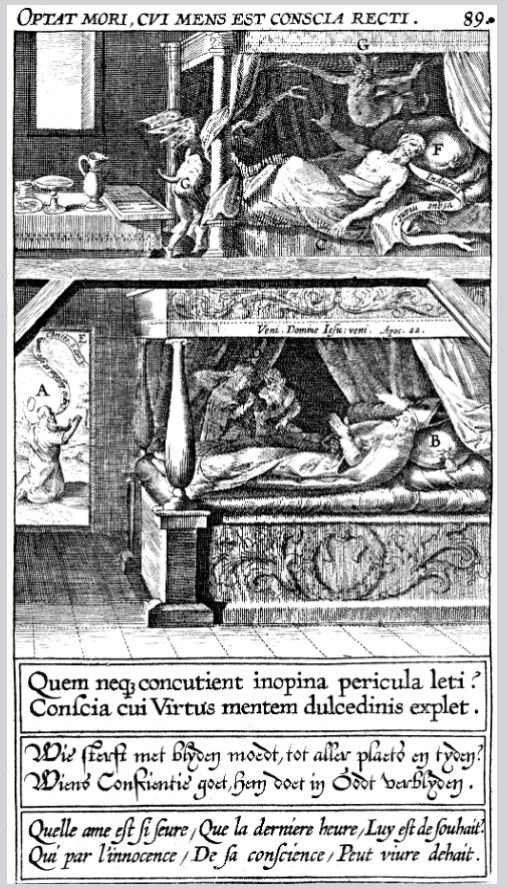
* The artwork "The Good Death" is from a book by David, Jan (1545?-1613). It's titled translated from the west Germanic-Dutch language Limburgish is, "Christian fortune-tellers : the main pieces of the Christian faith and Leuen in short understanding. With a role of virtue there on serving. End a shield-guard against the false fortune-tellers, etc. / It's four people. Mr. P. John David, priest of the Society of Jesus", now in public domain.
In the upper half, a dying man is harassed by demons; a table nearby bears serving dishes, a jug and a backgammon board and a banner reads "Remain until the end." Below, a man dressed in vestments and a bishop's mitre dies peacefully, with two people looking on and a sign over the bed that reads "Come, Lord Jesus, come. Apoc. 22" (Revelation 22:20)." Outside, a haloed man kneels with a banner that reads "I wish to be released and to be with Christ, 2. Cor. 5." The Latin superscription reads, "He wishes for death, whose mind is conscious of right," and the text below, "Who should not shake before the helplessness and danger of death? The one whose conscience virtue fills with sweetness".
Courtesy of the Digital Image Archive, Pitts Theology Library, Candler School of Theology, Emory University.
>What does it mean to live by faith? (7; Gal. 2:20)
* 2 Corinthians 5:7 "We live by faith, not by sight."
* Galatians 2:20 "I have been crucified with Christ and I no longer live, but Christ lives in me. The life I live in the body, I live by faith in the Son of God, who loved me and gave himself for me."
* While we are in the present state faith supplies the place of direct vision. In the future world we shall have sight-the utmost evidence of spiritual and eternal things; as we shall be present with them, and live in them. Here we have the testimony of God, and believe in their reality, because we cannot doubt his word. And to make this more convincing he gives us the earnest of his Spirit, which is a foretaste of glory. (Adam Clarke's Commentary)
* Hebrews 11:1-2 "Now faith is being sure of what we hope for and certain of what we do not see. This is what the ancients were commended for."
>How does faith in Jesus give Christians a different perspective than people in the world? (8)
* 2 Corinthians 5:8 "We are confident, I say, and would prefer to be away from the body and at home with the Lord."
* "We are confident, I say" -The confidence from the the Holy Spirit who has given us a covering.
* "and would prefer to be away from the body" -The physical body we now have ceased to function and our soul and born again spirit has left it.
* "and at home with the Lord." -The situation of the Christian after death, when he is no longer living in his "earthly tent" (1). This is an intermediate state between death and resurrection and, apparently, a disembodied state; but it is not a limbo of oblivion, for the believer who had died is at home with this Lord, and that is preferable to our present life in the body. (Philippians 1:23)
* Philippians 1:23-24 "I am torn between the two: I desire to depart and be with Christ, which is better by far; but it is more necessary for you that I remain in the body."
>4. What aspect of life is no different whether in this world or in heaven? (9)
* 2 Corinthians 5:9 "So we make it our goal to please him, whether we are at home in the body or away from it."
* "So we make it our goal to please him" -The "well done my faithful servant," in Jesus' parable. The Greek adjective for "please" is "euarestos" translated in some English Bibles as "accepted", "acceptance", and "well pleasing".
* "whether we are at home in the body or away from it." -The life we have been given, no matter where we are, on earth or in heaven, is to please Jesus.
* The endings of verse 6 and 8 are mirrored opposites. Verse 9 constructs the two parts in the same sentence, "...whether we are at home in the body or away from it".
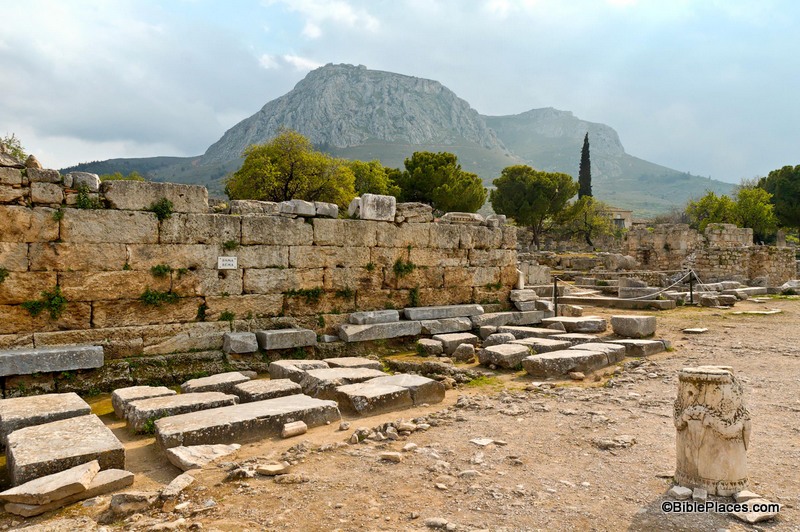
* The Bema (judgment) Seat in ancient Corinth is an elevated blue and white marble platform located in the center of the city's agora (public square). Magistrates and governors used it to address the public, announce official judgments, award the winner of games, and observe the square. The site is where the Apostle Paul was tried by the Roman proconsul Gallio in 51-52 A.D. (Acts 18:12-17) Jesus' coming judgement is sometimes compared to the Corinth Bema Seat.
>5. What should Christians always remember about their future? (10; Luke 9:26)
* 2 Corinthians 5:10 "For we must all appear before the judgment seat of Christ, that each one may receive what is due him for the things done while in the body, whether good or bad."
* Luke 9:26 "If anyone is ashamed of me and my words, the Son of Man will be ashamed of him when he comes in his glory and in the glory of the Father and of the holy angels."
* "For we must all" -All English translations that I have state the Greek phrase, "Gar hemas dei pas" this way except GW and YLT which have "all of us". Previous study's commentaries has stated that Paul that "throughout this letter Paul uses the editorial plural (we, us, our, ourselves). Except where the context plainly indicates otherwise, these plurals should be understood as referring to Paul alone." Well, this is one place it indicates otherwise. The Greek adjective "pas" (a transliteration), used 1,243 times in the New Testament, is a plural word meaning first and foremost "all". After that it means "all things" (or every thing), "every", "all men" (or man), "whosoever", "everyone", and "whole".
* "For we must all appear before the judgment seat of Christ" -Jesus spoke several passages that relay this truth.
* "that each one may receive what is due him for the things done while in the body" -Jesus' parable of the talents directly illustrate this truth. (Matthew 25:14-30)
* "whether good or bad." -"Whether" is a translation of the Greek conjunction "eite" (a transliteration). "Good" is a translation of the Greek adjetive "agathos", a primary word, in any sense, often as a noun. "Or" is a translation of the Greek conjunction "eite". "Bad" is a translation of the apparently primary Greek adjective "kakos" broadly described something intrinsically worthless, depraved, or of a poor nature that fails to be what it ought to be. It typically served as the polar opposite of "kalos" (noble, beautiful, or morally upright).
Jesus' parable "The Wise and Foolish Builders" illustrates this principle. (Matthew 7:24-29)
* As the Corinthians know, Paul had appeared before their governor's "judgment seat" (Acts 18:12), but Paul's allusion here is directly to the standard Old Testament and Jewish image of the day of judgment, in which God's throne became the ultimate judgment seat. Paul's emphasis on judgment for deeds in the body reiterates his opposition to any remaining elements of common Greek ideas disparaging the body, which Paul had refuted in 1 Cor. 6:12-14. (Bible Background Commentary - The IVP Bible Background Commentary - New Testament)
>How will some who claimed to believe in Jesus and yet their life did not reflect their faith be shocked when they stand before Jesus' judgement seat? (Matt. 25:28-30)
* Matthew 25:28-30 "'Take the talent from him and give it to the one who has the ten talents. For everyone who has will be given more, and he will have an abundance. Whoever does not have, even what he has will be taken from him. And throw that worthless servant outside, into the darkness, where there will be weeping and gnashing of teeth.'"
*
The Judgement Seat of Christ.
Apostle Paul utilizes clever word crafting by altering the use and meaning of "at home", "body", and "away". While "home" always means where we dwell, in one sentence, the place of occupation is the physical body, and in another, the place of occupation is in paradise with the Lord. The meaning all depends on which side of the grave we exist. Paul stresses that, no matter where home is, this world or the next, the Lord Jesus is the source and focus of our existence and heart.
While I am "in the body", my source and focus can reside in Jesus because I live by faith, not by sight. Like the ancients were commended for, I am sure of what I hope for and certain of what I do not see. (Hebrews 11:1) This is my faith expressed in the knowledge that one day I will appear before the judgment seat of Christ to give an account of what I did while "in the body". While my home is in this body, I work on my character, practicing love for others as Jesus teaches me to do.
Jesus teaches me to be a wise builder, placing my home on the rock where rain, flood, and winds will not destroy. He also teaches me not to be a foolish builder, placing my home on sand where the torments and troubles of this world tear down faith and a good character. (Matthew 7:24-29)
Jesus also teaches me to be a man who uses the talents he gave me to increase his investment. Jesus has gone away to the home I will occupy with him. A day is coming when I will stand before Jesus' judgment seat to settle the account with me. I want to hear his pleased word, "Well done, good and faithful servant! You have been faithful with a few things while in the body." I do not want to hear his displeased word, "You wicked, lazy servant! Take the talent from his and give it to someone else. And throw that worthless servant outside, into the darkness, where there will be weeping and gnashing of teeth." (Matthew 25:14-30)
Listen to the above comments on 5:6-10.
II. A New Creation (5:11-6:2)
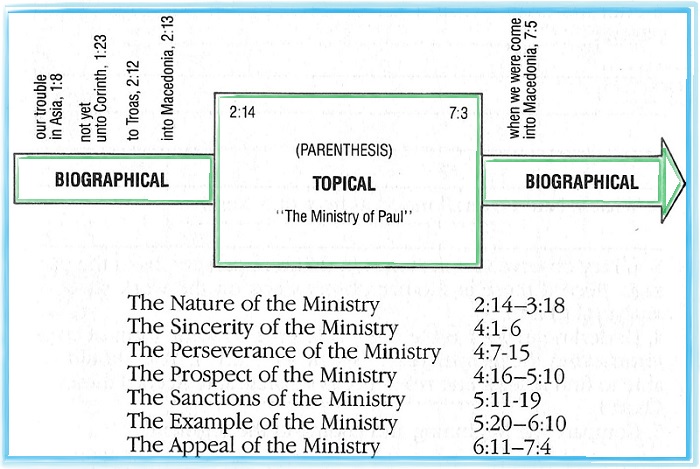
* "2 Corinthian Flow Chart" is from "2 Corinthians, A Self-Study Guide" by Irving L. Jensen published by The Moody Bible Institute of Chicago, 1972. Used by permission.
>6. What is fear of the Lord? (11a)
* 2 Corinthians 5:11a "Since, then, we know what it is to fear the Lord, we try to persuade men. What we are is plain to God, and I hope it is also plain to your conscience."
* Matthew 28:18-20 "Then Jesus came to them and said, 'All authority in heaven and on earth has been given to me. Therefore go and make disciples of all nations, baptizing them in the name of the Father and of the Son and of the Holy Spirit, and teaching them to obey everything I have commanded you. And surely I am with you always, to the very end of the age.'"
*
Chapter 5:11-6:2 Overview.
I had estranged myself from God. I did this by not believing he loves me and that his ways are best. I harbored lust, envy, greed, and other kinds of godlessness in my heart. I thought about these and occasionally acted on those thoughts. God told me not to do these for it was harmful. Yet I did not accept his direction. I had a form of religion without the true God leading me. I sinned.
Then I read about Jesus. God showed me that Jesus reconciled me to God (19). Through Jesus God does not hold my sins against me. He takes them away through Jesus (14-15).
Jesus had no sin. Yet when he was on the cross he accepted my and everyone else's sin into himself (21). So he who had no sin was punished and died. I accept his selfless sacrifice for me. Because of Jesus, I will not be punished. The old me is gone. The new me is now and forevermore (17).
Now I live for God (15). Living for God for me means more than doing what God says is best for me. It is to try to persuade others of what God revealed to me and has done for me. I try to show that he can so also do this for them (21). Jesus's love causes me to lovingly share the good news with others through actions and when appropriate also in word (14). I share only when they are ready to listen.
Listen to the above Chapter 5:11-6:2 Overview.
* "Since, then" -Paul will summarize his previous point and move onto the next. He uses the Greek particle "oun" which is translated "since, then" and "therefore". The summary is "we know what it is to fear the Lord". The next point is "we try to persuade me".
* "to fear the Lord" -Paul says we all will come before Jesus' judgement and so we know what it is to fear the Lord. We are accountable for the charge given us. (10) 1:14b states, "...you can boast of us just as we will boast of you in the day of the Lord Jesus." Paul cannot boast if they fall because he was lazy and did not keep to helping them in their walk of faith.
*
Fear.
Apostle Paul continues his logic with a transitional statement, "Since, then, we know what it is to fear the Lord, we try to persuade men." "Fear" is the Greek noun "phobos". The English words "fear" and "terror" are used to translate several Hebrew and Greek words. In the Old Testament, the most common word used is "yirah". (Isa. 7:25; Jonah 1:10,16). In the New Testament, the word used most often is "phobos" which means "fear", "dread", and "terror" (Matt. 28:4; Luke 21:26) Religious fear, unlike secular fear, is the fallen human response to the presence of God.
Some Christians tend to de-emphasize the fear of God in the New Testament by placing the love of God above the fear of God. There is indeed a greater emphasis on the love of God in the New Testament. However, the element of fear was part of the proclamation of the early church.
Paul admonished believers to work out their salvation "with fear and trembling" (Phil. 2:12). The early church grew in number as they lived "in the fear of the Lord" (Acts 9:31). The fear of God is related to the love of God. The revelation of God to people in the New Testament contains the element of God's mysterious otherness calling for reverent obedience. The New Testament church stands in awe and fear in the presence of a holy God, for fear is "the whole duty of man" (Eccl. 12:13).
Paul's summary statement about knowing what it is to fear the Lord relates back to all standing before the judgment seat of Christ to give an account of the thoughts and actions committed while in this life (10). Paul says "we," including himself. Does your confession of faith in Jesus include knowing the fear of the Lord? (Some from Claude F. Mariottini, Holman Bible Dictionary)
Listen to the above comments on 5:11.
>How does understanding of God's judgment compel us to preach the gospel?
* "we try to persuade men" -The NIV Bible Study states, perhaps considering the second half of the verse (what we are), "Paul needs to persuade some members of the Corinthian congregation that he, not any of the false teachers who have invaded their ranks, is the authentic apostle." Yet, Paul's statement is more than persuading them he is the authentic apostle is the cause of fear, because appearing before the judgement seat of Christ is because he must account for those he has been entrusted to preach and teach the gospel. Upon his conversion on the road, Jesus sent a disciple to Paul. Jesus told the disciple Paul's mission and the disciple no doubt told Paul. Paul knew his mission and so he feared. He knew he would have to give an account. Did he or did he not keep to this given mission to the end?
* Speaking of all under sin, Jew and Gentiles, Paul quoted Psalm 36:1 in Romans 3:18, "There is no fear of God before their eyes." The psalmist and Paul are saying the unrighteous do not fear the Lord God and the righteous do.
* 1 Peter 1:17 "Since you call on a Father who judges each man's work impartially, live your lives as strangers here in reverent fear."
* Jude 1:22-23 "Be merciful to those who doubt; snatch others from the fire and save them; to others show mercy, mixed with fear--hating even the clothing stained by corrupted flesh."
* "Bengel, Estius, and Alford explain: 'Persuade men (by our whole lives in verse 13), namely, of our integrity as ministers. But this would have been expressed after 'persuade', had it been the sense. The connection seems as follows: He had been accused of seeking to please and win men, he therefore says (compare Galatians 1:10), 'It is as knowing the terror (fear) of the Lord that we persuade men; but (whether men who hear our preaching recognize our sincerity or not) we are made manifest unto God as acting on such motives (4:2); and I trust also in your consciences.' Those so 'manifested' need have no 'terror' as to their being 'manifested (English Version, 'appear') before the judgment seat' (10)." (A Commentary: Critical, Experimental, and Practical on the Old and New Testaments)
>7. What is more important; that which is seen or in the heart? (11b-12)
* 2 Corinthians 5:11b-12 "What we are is plain to God, and I hope it is also plain to your conscience. We are not trying to commend ourselves to you again, but are giving you an opportunity to take pride in us, so that you can answer those who take pride in what is seen rather than in what is in the heart."
* Matthew 23:25-28 "Woe to you, teachers of the law and Pharisees, you hypocrites! You clean the outside of the cup and dish, but inside they are full of greed and self-indulgence. Blind Pharisee! First clean the inside of the cup and dish, and then the outside also will be clean. Woe to you, teachers of the law and Pharisees, you hypocrites! You are like whitewashed tombs, which look beautiful on the outside but on the inside are full of dead men's bones and everything unclean. In the same way, on the outside you appear to people as righteous but on the inside you are full of hypocrisy and wickedness."
* Luke 11:39-41 "Then the Lord said to him, 'Now then, you Pharisees clean the outside of the cup and dish, but inside you are full of greed and wickedness. You foolish people! Did not the one who made the outside make the inside also? But give what is inside [the dish] to the poor, and everything will be clean for you.'"
* "What we are is plain to God, and I hope it is also plain to your conscience." -What is plain to God? Understanding that "we" means Paul, then Paul is referring to the fact that he is an apostle appointed by Christ. That would be plain to God, and as he wrote earlier, should be plain to the Corinthian congregation's conscience. (1:12, 4:2; 1 Corinthians 4:4) Paul wanted the Corinthians as a church to believe the apostle and believe the gospel he preached.
* "We are not trying to commend ourselves to you again" -Meaning "to represent as worthy and qualified. He had done this in the first letter and earlier in this one.
* "but are giving you an opportunity to take pride in us" -Paul is answering a request/question to those who knew him and were converted to Christ because of him. They believed the gospel he preached. But when others spoke against him, they did not know a good way to respond. They were ashamed of some thing that were going said about Paul. Paul said they can take pride in him.
* "so that you can answer those who take pride in what is seen" -Paul's detractors take pride in what can be physically seen, the tangible, things of the world. They were handsome and well dressed with credentials and a strong Jewish background according to what Paul wrote in the first letter. Externally, Paul was "wasting away" (4:16-18) because of his harsh living conditions and persecutions.
* "rather than in what is in the heart."
>How does verse 12 point out the different between false and true religion?
* False religion is outward appearance including dress, handsomeness, buildings, and shrines. True religion is Jesus on the inside.
* The artwork "Crucifixion" is from a book by Beaulieu, Luke (1644 or 5). It's titled "Claustrum animae, the reformed monastery, or, The love of Jesus : a sure and short, pleasant and easie way to Heaven in meditations, directions, and resolutions to love and obey Jesus unto death : in two parts", now in public domain.
Jesus nailed to the cross wearing the crown of thorns with the verse from John 3: 16 at the top and the verse from 2 Corinthians 5:14 at the bottom.
Courtesy of the Digital Image Archive, Pitts Theology Library, Candler School of Theology, Emory University.
>What should compel us to preach the gospel? (13-14)
* 2 Corinthians 5:13-14 "If we are out of our mind, it is for the sake of God; if we are in our right mind, it is for you. For Christ's love compels us, because we are convinced that one died for all, and therefore all died."
* "If we are out of our mind, it is for the sake of God; if we are in our right mind, it is for you." -Paul's detractors were probably saying he was out of his mind, as some commentators say. But perhaps it can also be said they were saying, "Paul is talking nonsense, things that are not in the Holy Scriptures (Old Testament)." Jesus was accused of the same thing by his family and the Jewish religious establishment. (Mark 3:21-22) When Peter was released by miracle from prison he went to the house where the disciples were praying. A young servant girl wouldn't let him in and told those who were praying inside. They told her, "You're out of your mind." (Acts 12:15) Rejection and doubt block the truth. I have watch videos of debates where, when the truth is clearly and plainly presented with facts, those who are trying to spread lies and distort the truth, rather than admitting the truth, will resort to derogatory and demeaning statements without presenting any facts to back it up.
* Probably Paul's enemies were asserting that he was suffering from religious mania, pointing perhaps to the sensational conversion he claimed to have experienced on the road to Damascus and to what they regarded as his insane way of life. If this is to be out of his mind, Paul does not deny it, for this whole letter shows how willingly and joyfully he endured affliction for the gospel (12:10). That, however, was essentially a meter between him and God. On the other hand, there was nothing that could be called eccentric about his manner of presenting the gospel to the Corinthians, for in this he had been, and continued to be, sensible and sober-minded, avoiding flowery rhetoric and all forms of sensationalism (1 Corinthians 2:1-5) (NIV Study Bible saying the basic same thing as all the commentaries I have.)
* "For Christ's love compels us" -Paul will specifically recall the sacrificial death of Jesus.
* "William Tindal (1494-1536), a pioneering English scholar, linguist, and translator who became a leading figure in the Protestant Reformation, renders this whole passage, 'For if we be too fervent, to God we are too fervent; if we keep measure, for our cause keep we measure.' The sense seems to be, 'If we are esteemed to be sane, and sober-minded, as we trust you will admit us to be, it is for your sake. Whatever may be the estimate in which we are held, we are influenced by love to God, and love to man. In such a cause, we cannot but evince zeal and self-denial which may expose us to the charge of mental derangement; but still we trust that by you we shall be regarded as influenced by a sound mind. We seek your welfare. We labor for you. And we trust that you will appreciate our motives, and regard us as truly sober-minded.'" (Barnes' Notes on the New Testament)
>Why?
* "we are convinced that one died for all" -Jesus' death was for all the saints, those who God called and who accepted God's call. We do not know who they are that will believe. So, we preach to all mankind and we were sent by Jesus to preach to all mankind. Some may say that perhaps the "all" Jesus died for is all mankind. God did so love all the world that he sent his One and Only Son, but it continues, "...that whoever believes in him shall not perish but have eternal life." (John 3:16) God sent Jesus who stayed mostly where the Jews lived, though on a few occasions he went into Gentle lands. After his death and resurrections he sent his disciples to "Jerusalem, Judea, Samaria, and the ends of the earth" and in this Jesus' gospel of salvation went to "all" mankind, but most of mankind has not accepted the invitation. So, the "all" that Jesus died for is "all" that Jesus died for are those who accept the call. Consider Jesus's parable of the four types of soil.
* "and therefore all died" -Again, all the saints, those who God called and who believed, reinforced by the next verse. They are the only ones who died with Christ.
* 1 Timothy 2:6, Matthew 20:28, and 1 John 2:2.
>Who do we live for? (15)
* 2 Corinthians 5:15 "And he died for all, that those who live should no longer live for themselves but for him who died for them and was raised again."
* "for all" -The word "for" in Greek means "in the place of" and "in the stead of". It means that Jesus took the place of sinners, and died in their stead; that he endured what was an ample equivalent for all the punishment which would be inflicted if they were to suffer the just penalty of the law; that he ensured so much suffering.
* Here, Paul confirms that the "all" he is referencing, those that Jesus died for, is the saints, those who believe and live for Jesus. Calvin and other commentators agree on this. A few commentaries do not.
* Romans 10:7-9 is a similar passage.
*
Am I Part of Jesus's All?
Jesus, Paul reminds, died for all. (14-15) But who are the "all"? Are they everyone who has ever lived, is living, and will live? Is it all who say, "I believe in a god?" or "I believe in God?" Is it all who attend a congregation and/or a religious group? Is it the kind-hearted, those who love their family and friends, those who are charitable? Is the "all" Jesus died for those who celebrate their freedom to make choices and are grateful for this? The definition of "all" does not contain any of these.
Defining just who Jesus died for is understanding why he died and what his death did. Jesus died so all could die to sin and self. Jesus died "that those who live should no longer live for themselves but for him who died for them and was raised again." (15) Jesus, in a sense, died for all mankind, but not all mankind dies to sin and self. Most deny the presence and work of Jesus' Spirit, and so his death bears no fruit in their life. "Away from me" means all mankind won't be affected by the actions of his death. They do not die, and thus, will not live with Christ. They were dead, remain dead, and will physically die.
Paul said in the previous chapter, "We always carry around in our body the death of Jesus, so that the life of Jesus may also be revealed in our body. For we who are alive are always being given over to death for Jesus' sake, so that his life may be revealed in our mortal body. So then, death is at work in us, but life is at work in you." (2 Corinthians 4:10-12) Jesus died for all, but not all die for Jesus.
Listen to the above comments on 5:12-15.
>8. What is to be our perspective? (16)
* 2 Corinthians 5:16 "So from now on we regard no one from a worldly point of view. Though we once regarded Christ in this way, we do so no longer."
* "So from now on" -Paul is moving onto his next point in his logic. "So from now on" or "wherefore henceforth" are from the Greek particle phrase "hoste apo" (a transliteration) where "apo" is a preposition. The former statement results in the next statement. See notes on verse 1 "Now" in question 1a, and "Since then" in verse 11, question 6a.
* "we know" -Paul states "we know" in verses 1, 6, 11, and 16. Paul is using "we" to refer to himself. It cannot be said confidently that all in the Corinth congregation knew all these facts, nor that Paul taught all these facts for the 18 months he had been there, though it can be said he probably did talk about at least some of these.
The word "know" in Greek is used in the sense of, we form our estimate of, we judge, we are influenced by. Our estimate of man is formed by other views than according to the flesh.
*
We regard no one from a worldly point of View.
Many interpretations exist on the phrase "worldly point of view", but not too unlike each other. By it, Paul means he had taken God and what God said out of his thoughts regarding a person, people, and/or a subject before he knew Christ, but not after. Other places use the phrase "according to the flesh," and some English translations, such as the KJV, ASV, and YLT, have "after the flesh" or "according to the flesh" here. Theologically, the flesh is viewed as the created and natural humanity, not automatically sinful, but weak, limited, temporal, prone to sin, and driven away from God. Jesus said of his sleeping disciples in the Garden of Gethsemane, "The spirit is willing, but the body is weak." (Matthew 26:41) The disciples' bodies were weak due to fatigue and succumbed to sleep. (Romans 6:19, 7:5, 8:4-12) Paul, though, uses the term here to mean that he has a new point of view on Christ and his disciples.
In saying this, Paul was indirectly warning the congregation to not judge those who diminish him based on what he looks like compared to what they look like from a worldly point of view. This was his indirect point in the former sections too. Paul is saying, "See people as I see people, for I see people as Christ showed me to see people."
Here, Paul states he does not see people according to worldly thinking, meaning:
He was not influenced in his estimate by a regard to birth or country, he did not form an attachment to a Jew because he was a Jew, or to a Gentile because he was a Gentile. He had learned that Christ died for people of all nationalities and ethnic groups, and he felt disposed to regard all alike.
He was not influenced in his estimate by rank, wealth, and office. Before his conversion he had been; but now he learned to look on their moral character, and to regard that as making the only permanent and really important distinction among men. He did not esteem one man highly because he was of elevated rank, or of great wealth, and another less because he was of a different rank in life.
He was not influenced in his preferences and presupposed concepts. Before his conversion, he would be with people like himself and people who liked what he liked, and judge them according to this. He, like all, has prejudices, meaning we prefer to hang around with people like us and keep away from those who are not. "Birds of a feather, flock together," the old saying goes.
He was not influenced in his estimate of what is outwardly worthy of praise by men, but rather by what is inward and praiseworthy by God.
Listen to the above comments on 5:16.
* "Though we once regarded Christ in this way" -Before Christ meet Paul on the road to Damascus where he was converted, he only saw Jesus as a Jewish man who taught wrong things about the Bible and Jewish customs. He did not see Jesus as God's anointed Messiah, the Son of God, and the Son of Man.
* "we do so no longer." -Upon conversion, Paul accepted Jesus was the anointed Messiah who fulfilled the Law given through Moses, the law of the Old Covenant.
>How does verse 17 help us understand the difference between an world point of view and a godly point of view?
* 2 Corinthians 5:17 "Therefore, if anyone is in Christ, he is a new creation; the old has gone, the new has come!"
* "Therefore" -Another use of a particle in the Greek original, same word, "hoste", as in verse 16. See comments in question above. Paul quickly moves on to a new point, and will so again in verse 20.
* "if anyone is in Christ" -United with Christ through faith in him and commitment to him.
* "he is a new creation" -A summary of what was stated and explained in the first half of the chapter. "New creation" here is the "Spirit as a deposit" in verse 5.
* "the old has gone, the new has come!"
*
In Christ = New Creation.
The Holy Spirit, through Paul, repeats astonishing truths that Jesus and the prophet Isaiah had proclaimed. Jesus tells his disciples, "I am the true vine, and my Father is the gardener... Remain in me, and I will remain in you." (John 15:1, 4) The Lord, through Isaiah, foretold, "Behold, I will create new heavens and a new earth. The former things will not be remembered, nor will they come to mind. But be glad and rejoice forever in what I will create, for I will create Jerusalem to be a delight and its people a joy. I will... take delight in my people." (Isaiah 65:17-19a)
Now, through Paul, the Spirit says, "Therefore, if anyone is in Christ, he is a new creation; the old has gone, the new has come!" (17; Galatians 6:15) Jesus was the first-fruit of the new creation. (1 Corinthians 15:50) "...we ourselves, who have the first-fruits of the Spirit, groan inwardly as we wait eagerly for our adoption as sons, the redemption of our bodies." (Romans 8:23)
God has not counted the sins against those who approach him with humble and contrite hearts through the grace available through Jesus. When God sees anyone in Christ Jesus, he makes them a new creation, a new person, and provides a new beginning. In Jesus are new beginnings.
Listen to the above comments on 5:17.
>9. What does it mean to be reconciled to God? (18-19)
* 2 Corinthians 5:18-19 "All this is from God, who reconciled us to himself through Christ and gave us the ministry of reconciliation: that God was reconciling the world to himself in Christ, not counting men's sins against them. And he has committed to us the message of reconciliation."
* "All this" -The redemption, being in Christ, and the new creation. The new creation is a total change of heart, soul, spirit, and life by the power of God. Verse 14b-15a states the redemption, "...one died for all, and therefore all died. And he died for all..."Romans 5:8 stated, "But God demonstrates his own love for us in this: While we were still sinners, Christ died for us." And John 3:16-17 states, "For God so loved the world that he gave his one and only Son, that whoever believes in him shall not perish but have eternal life. For God did not send his Son into the world to condemn the world, but to save the world through him."
* "All this is from God" -God takes the initiative, sustains, and brings to completion a person's redemption.
* "who reconciled us to himself through Christ" -God's purpose in reconciliation was to bring us to him. He is the center. He is the purpose. He is the source. He is the destination.
* "the world" -The original Greek noun is "kosmos", probably from the base of "komizo", used 187 times in the New Testament, in general refers to world, including all its inhabitants (literal or figurative). The "world" evidently means the human race generally, without distinction of nation, age, or rank for all are alienated from him, and he sought to have them reconciled to him. Matthew Poole states, "it is manifest from a multitude of scriptures, that world is many times taken in a much more limited and restrained sense; so there is nothing here that guides us to interpret it in such a latitude; nay, that which followeth, doth manifestly so restrain it; for God was not in Christ, reconciling the world to himself, that is, every man and woman in the world, so as not to impute their sins to them. This the apostle here affirmeth; which makes it manifest, that by world here is meant many, some of all sorts, as well Gentiles as Jews; even so many as he pleaseth not to impute their sins unto." (Matthew Poole's Commentary on the Holy Bible)
>How did God do it?
* "that God was reconciling the world to himself in Christ, not counting men's sins against them."
* "reconciling" -The original Greek verb, also used in verse 18, is "katallasso" (a transliteration) used six times in the New Testament, a compound from "kata" and "allasso". "Reconciliation" is the Greek noun from "katallasso". "Allasso" means shifting into a completely different state (to change, alter, and exchange). For example, in 1 Corinthians 15:51-52, the apostle Paul uses it to describe the physical bodily resurrection, where believers instantly "exchange" mortal, perishable bodies for immortal, imperishable ones.
* Romans 5:11 "Not only is this so, but we also rejoice in God through our Lord Jesus Christ, through whom we have now received reconciliation."
* Colossians 1:21-23 "Once you were alienated from God and were enemies in your minds because of your evil behavior. But now he has reconciled you by Christ's physical body through death to present you holy in his sight, without blemish and free from accusation-- if you continue in your faith, established and firm, not moved from the hope held out in the gospel. This is the gospel that you heard and that has been proclaimed to every creature under heaven, and of which I, Paul, have become a servant."
* The whole of this important doctrine was short, simple, and plain. Let us consider it in all its connections:
You believe there is a God.
You know he has made you.
He requires you to love and serve him.
To show you how to do this he has given a revelation of himself, which is contained in his law, etc.
You have broken this law, and incurred the penalty, which is death.
Far from being able to undo your offenses, or make reparation to the offended majesty of God, your hearts, through the deceitfulness and influence of sin, are blinded, hardened, and filled with enmity, against your Father and your Judge.
To redeem you out of this most wretched and accursed state, God; in his endless love, has given his Son for you; who has assumed your nature, and died in your stead.
In consequence of this he has commanded repentance towards God, and remission of sins, to be published in his name in all the earth.
All who repent, and believe in Christ as having died for them as a sin-offering (21), shall receive remission of sins.
And if they abide in him they shall have an eternal inheritance among them that are sanctified.
Adam Clarke's Commentary.
>How do we participate in this work of God?
* "and gave us the ministry of reconciliation" -God does not take us to him right away. He gives all who are in Christ a mission, just as Jesus and the apostles received a mission.
* "And he has committed to us the message of reconciliation." -Paul repeats what was in verse 18, but adds the word "committed". The original Greek verb is "tithemi" a prolonged form of a primary "theo" Phonetic Pronunciation, "theh-o" (which is used only as alternate in certain tenses). "Tithemi" means "to place" (in the widest application, literal and figurative, properly in a passive or horizontal posture), and often translated "to put," "to place," or "to set". Paul is using it here meaning ordaining, establishing, or assigning someone to a role, duty, or specific office.
* "ministry... message" -Paul uses these interchangeably. The first is the Greek noun "diakonia" and the second is the Greek noun "logos" (transliterations). Our ministry is sharing the word.
* Jesus commands his disciples to share the gospel to the whole world.
>10. How are Christians like ambassadors? (20)
* 2 Corinthians 5:20 "We are therefore Christ's ambassadors, as though God were making his appeal through us. We implore you on Christ's behalf: Be reconciled to God."
* "We are therefore" -The Greek particle is "oun" used before in verse 11. See comments in question 6a comments.
* "Christ's ambassadors"
* "as though God were making his appeal through us"
* "We implore you on Christ's behalf: Be reconciled to God."
>Who does verse 21 refer to? (Heb. 4:14-15)
* 2 Corinthians 5:21 "God made him who had no sin to be sin for us, so that in him we might become the righteousness of God."
* Hebrews 4:14-15 "Therefore, since we have a great high priest who has gone through the heavens, Jesus the Son of God, let us hold firmly to the faith we profess. For we do not have a high priest who is unable to sympathize with our weaknesses, but we have one who has been tempted in every way, just as we are--yet was without sin."
* Jesus the Son of God had no sin. While on the cross he received our sin.
>How could a person received God's grace in vain? (6:1-2)
* 2 Corinthians 6:1-2 "As God's fellow workers we urge you not to receive God's grace in vain. For he says, "In the time of my favor I heard you, and in the day of salvation I helped you." I tell you, now is the time of God's favor, now is the day of salvation."
* "As God's fellow workers we" -Paul includes the congregation at Corinth as God's workers.
* "in vain" -The original Greek adjective is "kenos" is a primary word meaning "empty", "void", and "without substance". Rooted in physical depictions like an empty vessel or arriving somewhere empty-handed, the term was heavily used in a metaphorical and spiritual sense to describe something that lacks value, truth, or a successful outcome. Metaphorical it means being completely destitute of spiritual wealth. For example, first-century philosophical and religious writings-like the New Testament-used kenos to describe hollow deceit, or faith that is completely devoid of good works. 5:15 gives one way to do this, "...those who live should no longer live for themselves but for him who died for them and was raise again."
* Isaiah 49:8a is quoted, "This is what the LORD says: "In the time of my favor I will answer you, and in the day of salvation I will help you..."
>What then should all do?
*
Do Not Receive God's Grace in Vain.
God is very clear concerning why his people are in the world after reconciliation. In other words, God tells us why he doesn't take us to him in heaven after we come to be in Jesus Christ. (17)
First, what is reconciliation? Reconciliation is God establishing a close relationship with us by not counting our sins against us. (19) God made him who had no sin to be sin for us, so that in him we might become the righteousness of God. (21) We heard the message, "We reconciled to God," and we believed. (20)
Now we are one with God in Christ. Yet, we are still in this world. Why? God has made us his ambassadors. God is making his appeal to others through us. (20) The ministry of reconciliation, with the message of reconciliation, is ours. (18b, 19b) Jesus commands, "Go into the world and preach the good news to all creation." The good news is the message of reconciliation. Go. Do not receive God's grace in vain. Now is the time to preach salvation, God's favor. (6:1-2)