>1. How is it that all Christian's have their ministry? (1)
* 2 Corinthians 4:1 "Therefore, since through God's mercy we have this ministry, we do not lose heart."
* Various doctrines are taught from this paragraph. Therefore, it is difficult to identify any one doctrine as the prominent one. Analyze the paragraph carefully and try to arrive at some outline. Here is an example of an outline centered on the subject of the gospel:
Witness of the gospel
Intended Hearers of the gospel
Person of the gospel
What phrases in the paragraph stand out as key ones? (2 Corinthians, A Self-Study Guide" by Irving L. Jensen)
*
Chapter 4 Overview. (See chart in question 5 of Study 2.)
Life with Jesus is a split identity existence while in this world. The dual existence is not like that of the fictional Dr. Jekyll and Mr. Hyde, who had a good and a bad side. Nor is it like a split personality disorder where two entirely different personalities exist in one body. Also, it is not my spiritual body versus my physical body.
The dual aspect of life in Jesus is a matter of death and life in my body. The death and life of Jesus are always alive and at work in my body (11).
Every day brings the possibility of new challenges, troubles, baffling circumstances, and hardships (8). I am not affected now when these come the way I was affected before I knew Jesus. Rather than lose heart, will, strength, and obtain despair, confusion, and regrets, Jesus' life in me does the opposite. I am not crushed, I do not despair, I am not abandoned, and I am not destroyed (1b, 8-12).
The new God-given positive reactions to adverse life events are similar to the God-given reaction my body does when it mends a broken bone. When I was around 13, a rope that my brother and I were swinging on snapped. I plummeted to the ground and landed on a bed of stones and clay. My wrist snapped. A doctor set it, and the bone fully mended in a few weeks.
Six months after the wrist cast was taken off, I broke it again. This time I was sledding down a hill with my friends. They challenged me to stand on my Red Rider sled as I sped down the steep hill. I accepted the challenge. When I came to the bottom of the hill, the sled's front rails embedded into a snow ramp, causing it to abruptly stop. I was catapulted into the air and landed on the same wrist as before.
When I arrived at the ER, they took an X-ray of my wrist. The doctor reviewing the X-ray exclaimed, "It looks like the bone is broken in the exact same place. That is impossible because the mended bone is always stronger than the bone around it." After enlarging the X-ray, he was proven right. The wrist bone was broken in a new place.
Similar to the mended wrist bone, Jesus in me is stronger than my old self in me. Though strained, I will not break as I might have done in the past. My "light and momentary troubles are achieving for (me) an eternal glory that far outweighs them all."
Listen to the above Chapter 4 Overview.
* "Therefore" -Paul moves on from the conclusion of the previous subject in the previous chapter to the next which is "we do not lose heart". Paul develops the new subject from verses 2 through 15 and concludes it in verse 16 by repeating the subject, "we do not lose heart". Verses 17 and 18 summarize the argument he will develop.
* "since through God's mercy" -The original Greek verb "eleeo" used 31 times in the New Testament, from the Greek noun "eleos" (a transliteration) used 28 times in the New Testament. The "eleos" family means mercy, but is also related to compassion in the Bible.
"The most common words in the New Testament for mercy belong to the Greek "eleos" family. In secular Greek, the word was often viewed as a sign of weakness, a sentimental inclination to be overly lenient. The New Testament does not share in this assessment, having more in common with the Old Testament perspective on God's mercy.
To be sure, the negative aspect appears. Drawing on Exodus 33:19, Paul showed how God in His sovereign purposes can withdraw His mercies (Rom. 9:15-16,18,23). The total New Testament picture is much brighter. Jesus brought the good news of a merciful, forgiving God. He embodied that good news in Himself, and everywhere He was met by cries and expectations for mercy." (The last two paragraph's are part of Holman Bible Dictionary definition of mercy)
* "we have this ministry" -The previous subject was comparing the Old Covenant ministry of Moses (and the teachers that followed him) to the New Covenant ministry of Jesus' disciples, especially the apostles. The old faded and ended, being replaced by the new which has more glory that the old ever had. The old was a ministry of death. The new a ministry of life. Paul, by stating the gospel (ministry) of the Lord (Spirit) previously, now in the first paragraph (1-6) will state that what he preaches is far better, sincere, and faithful than what his detractors are preaching for they preach the Old Covenant, are not sincere, and are not faithful.
* "we do not lose heart." -Jesus told us even though we will have trouble in this world, we are to take heart. (John 16:31-33) Jesus equated taking heart to having his peace. When God through his mercy calls and commissions his servants, he also supplies the strength necessary for them to persevere in the face of hardshps and persecutions.
* God gives the gospel ministry because of his mercy.
>What is the ministry that we have? (3:6)
* 2 Corinthians 3:6 "He has made us competent as ministers of a new covenant--not of the letter but of the Spirit; for the letter kills, but the Spirit gives life."
* We are ministers of the New Covenant in the blood of Jesus. We have the ministry of the Spirit. (3:8-9)
>What are some reasons a person loses heart while serving in the ministry given by God? Why shouldn't we loose heart?
* Cause Us to Loose Heart:
Trouble and Trials
Persecutions
Worries of Life
Burdens of Everyday Life
Family and Friend Problems
*
Do Not Lose Heart.
Today's Bible Daily Bread Devotional (BDBD) is for those who are weak from serving in Jesus' name. These are the volunteers, faithfully ministering from infants to the elderly. They are men and women of the Spirit, who continually walk the streets talking to strangers about Jesus. They are displaying the image of the Son of Man, Jesus of Galilee, through their words and acts. They are non-profit royal priests who get more harassment and persecution than recognition. These are practical ministers of the New Covenant, the gospel of Jesus.
Paul, in the previous chapter, said that yours is the freedom, reflecting the Lord's glory. You are being transformed into his likeness with ever-increasing glory. (3:17-18). Your ministry brings righteousness. Your glory is surpassing and will last the ages. (3:9-11) Your competence comes from God. (3:5)
The great ministry you have, though all the troubles and trials of life, is God's mercy to you in the ministry he has given you. (1) Jesus said, "I have told you these things, so that in me you may have peace. In this world you will have trouble. But take heart! I have overcome the world." (John 16:33) Be in the words Jesus told us and be in the living Word, Jesus, the Prince of Peace. Take heart. He who has overcome the world is with you in the ministry he has given you.
Listen to the above comments on 4:1.
>2. Why is this ministry given by God not a secret affair? (2)
* 2 Corinthians 4:2 "Rather, we have renounced secret and shameful ways; we do not use deception, nor do we distort the word of God. On the contrary, by setting forth the truth plainly we commend ourselves to every man's conscience in the sight of God."
* "Rather" -The KJV, YLT, and ASV translate the Greek conjunction "alla" (a transliteration) as "but". The HCSB, CSB, and GW translate it as "Instead". The Greek word has many uses as a conjunction, and therefore many translations work.
* "we" -Paul is still using editorial plural pronouns when referring only to himself. As stated in study 1 question 6 for verse 8, Paul uses editorial plural pronouns throughout this letter to only refer to himself per NIV Study Bible. Still, we have to wonder why? Could he be indirectly include unnamed others, while distancing himself? The NIV Study Bible does not believe so. However, I am reminded of myself and others in common vocal speech. We still do as Paul is doing here. We use "we", "us", "our", and "ourselves" instead of saying "I", "me", and "mine".
* "we have renounced secret and shameful ways" -The Greek verb "apeipon" (a transliteration) is translated as "renounced" in every English translation I have except God's Word (GW) which has "refused". "Apeipon" is a reflexive past of a compound of "apo" and "epo" meaning "say off" for oneself, i.e. "to disown", "to spurn", or "scorn with aversion". Quoting Barnes, "It occurs nowhere else in the New Testament; and the sense here is, that the apostles had such a view of the truth of religion, and the glory of the Christian scheme (3:13-18), as to lead them to discard everything that was disguised, and artful, and crafty; everything like deceit and fraud. The religions of the heathen were made up mainly of trick, and were supported by deception practised on the ignorant, and on the mass of men. Paul says, that he and his fellow-labourers had such views of, the truth, and glory, and holiness of the Christian scheme, as to lead them solemnly to abjure and abhor all such dishonest tricks and devices. Truth never needs such arts; and no cause will long succeed by mere trick and cunning." (the later part is from "Barnes' Notes on the New Testament".)
Paul implies that he had not always been this way. He had practiced secret and shameful ways before Christ Jesus came to him on the road to Damascus to persecute Christians. He renounced those ways and did not look back. So now, he knew when someone was living that way. What are those ways? Deception and distorting the word of God.
* "secret and shameful ways" -The KJV translates this as "the hidden things of dishonesty" and places in the margin "shame". The Greek word most commonly means "shame" or "disgrace".
* "we do not use deception" -The original Greek noun for "deception" is "panourgia" (a transliteration). It means "craftiness, cunning, or unscrupulous trickery". It describes a deceptive cleverness-someone willing to use any manipulative or deceitful means to achieve their own selfish goals.
* "nor do we distort the word of God" -The original Greek verb for "distort" is "doloo". It means "to deceive, ensnare, or corrupt". Rooted in the noun dolos (meaning bait, trickery, or guile), the word was metaphorically used in antiquity to describe the adulteration or watering down of valuable commodities, like diluting wine or mixing base metals with gold.
>How is the clear preaching of the word of God linked to our ministry?
* "On the contrary" -Paul contrasts those who are corrupting and misleading the Corinthian congregation and attempting the belittle and ruin Paul's name with himself and his character displayed in his actions.
* "by setting forth the truth plainly"
* "we commend ourselves to every man's conscience"
* "in the sight of God"
* Paul refers to the false teachers in Corinth. He contrasts, thus is able to appeal to the conscience of every one of them and also to his integrity in the sight of God, because his practice was always that of setting forth the turht plainly, without veiling it or resorting to deception. (1:12, 18-24)
>What is the gospel? (3; and 1 Cor. 15:1-4)
* 2 Corinthians 4:3 "And even if our gospel is veiled, it is veiled to those who are perishing."
* 1 Corinthians 15:1-4 "Now, brothers, I want to remind you of the gospel I preached to you, which you received and on which you have taken your stand. By this gospel you are saved, if you hold firmly to the word I preached to you. Otherwise, you have believed in vain. For what I received I passed on to you as of first importance: that Christ died for our sins according to the Scriptures, that he was buried, that he was raised on the third day according to the Scriptures,"
* "gospel" -The original Greek noun is "euangelion" (a transliteration), from the same root as the Greek verb "euaggelizo" (a transliteration) used elsewhere. They mean "to announce good news" and "a good message".
>Even though we preach the gospel clearly, what happens to some people? (Luke 8:11-12)
* Luke 8:11-12 "This is the meaning of the parable: The seed is the word of God. Those along the path are the ones who hear, and then the devil comes and takes away the word from their hearts, so that they may not believe and be saved."
* "And even if our gospel is veiled" -Paul is using a clever phrase. He says, "my message is not veiled," referring to the prior chapter, then says, "if our gospel is veiled". Clever play on words to catch their attention. Paul detractors said Paul was veiling his words. Paul, uses the false claim against them be stating he is not the problem "if my gospel is veiled", it is the listeners problem", referring back to what he had already stated in the former chapter (3:13-18).
* "it is veiled to those who are perishing." -Paul is repeating what was said in 3:15. The original Greek verb for "perishing" used in most modern English translations is "apollymi" (a transliteration). The KJV alone translates it "lost". GW translates it "dying".
*
Plain and Clear.
Apostle Paul, not losing heart, though some attacked his character and motives, continued to preach the gospel, the very ministry given him by the Lord. Jesus tells all his disciples that opposition is sure to come. Paul contrasted his methods to accomplish the mission given to him with those of his detractors. We can learn how to proceed with our missions.
Paul's detractors used secret and shameful ways. They were deceptive, hiding their true motives. Their methods were to distort the word of God. (2a) They were like Oz behind the curtain in "The Wizard of Oz".
Paul, however, did not do as they did, though before he became a believer, he was like them. When the Lord called him, he put those shameful ways behind him. Opposite to them, Paul presented God's truth plainly and clearly. (2b) Those who heard him or read his letters knew in their conscience that what he said had no hidden agenda. They knew it to be true and of God. (2c)
Referring back to what he wrote in 3:13-15, like Moses' veil, if anyone did not understand the gospel he preached, it was not his doing nor fault. Rather, it was because they did not believe. The veil covers their hearts. (3)
As the apostle wrote Timothy, "Do your best to present yourself to God as one approved, a workman who does not need to be ashamed and who correctly handles the word of truth." (2 Timothy 2:15) And the writer of Hebrews, "For the word of God is living and active. Sharper than any double-edged sword, it penetrates even to dividing soul and spirit, joints and marrow; it judges the thoughts and attitudes of the heart." (Hebrews 4:12)
Listen to the above comments on 4:2-3.
>3. What is an "age"? (4)
* 2 Corinthians 4:4 "The god of this age has blinded the minds of unbelievers, so that they cannot see the light of the gospel of the glory of Christ, who is the image of God."
* "age" -The original Greek noun is "aion" (a transliteration) from the same as "aei" (a transliteration), properly an "age", by extension "perpetuity" (also past), by implication the "world" of a specific period of time and/or generation, i.e. Jewish Messianic period. The Greek noun "chronos", by contrast is an unspecific period of time.
* "this age" -The age Paul is referring to started with Jesus' ministry and continued today.
* In respect to whom; among whom; or in whose hearts. The design of verse 4 is to account for the fact that the glory of the gospel was not seen by them. It is to be traced entirely to the agency of him whom Paul here calls "the god of this world." (Barnes' Notes on the New Testament)
* "This age" is used in contrast to the future eternal age when God's creation will be forever purged of all that now mars and defiles it. In Galations 1:4 it is called the "present evil age."
>Why is the devil referred to as "the god of this age"?
* "the god of this age" -There can be no doubt that Satan is here designated by this appellation; though some of the Fathers supposed that it means the true Gods and Clarke inclines to this opinion. In John 12:31, he is called "the prince of this world." In Ephesians 2:2, he is called "the prince of the power of the air." And in Ephesians 6:1,2, the same bad influence is referred to under the names of "principalities and powers," "the rulers of the darkness of this world," and "spiritual wickedness in high places." The name "god" is here given to him, not because he has any divine attributes, but because he actually has the homage of the men of this world as their god, as the being who is really worshiped, or who has the affections of their hearts in the same way as it is given to idols. By "this world" is meant the wicked world; or the mass of men. He has dominion over the world. They obey his will; they execute his plans; they further his purposes, and they are his obedient subjects. He had subdued the world to himself, and was really adored in the place of the true God. 1 Corinthians 10:20. "They sacrificed to devils and not to God." Here it is meant by the declaration that Satan is the god of this world (age).
That the world at large was under his control and direction. He secured the apostasy, of man, and early brought him to follow his plans; and he has maintained his sceptre and dominion since. No more abject submission could be desired by him than has been rendered by the mass of men.
The idolatrous world particularly is under his control, and subject to him, 1 Corinthians 10:20. He is worshipped there; and the religious rites and ceremonies of the heathen are in general just such as a mighty being who hated human happiness, and who sought pollution, obscenity, wretchedness, and blood, would appoint; and over all the heathen world his power is absolute. In the time of Paul, all the world, except the Jews and Christians, was sunk in heathen degradation.
He rules in the hearts and lives of all wicked men-and the world is full of wicked men. They obey him, and submit to his will in executing fraud, and rapine, and piracy, and murder, and adultery, and lewdness; in wars and fighting; in their amusements and pastimes; in dishonesty and falsehood. The dominion of Satan over this world has been, and is still, almost universal and absolute; nor has the lapse of eighteen hundred years rendered the appellation improper as descriptive of his influence, that he is the god of this world. The world pursues his plans; yields to his temptations; neglects or rejects the reign of God as he pleases; and submits to his scepter, and is still full of abomination, cruelty, and pollution, as he desires it to be.
(Barnes' Notes on the New Testament)
>What is his objective and what are some ways he does this?
* "blinded" -The original Greek verse is "typhloo" (a transliteration" from the Greek adjective "tuphlos" (blind). "Typhloo" means "to make blind", i.e. figuratively "to obscure". The term traces its etymological roots back to smoke or haze, capturing the idea of vision that is clouded or obscure.
* "blinded the minds of unbelievers" -Paul continues to use the imagery of the veil that covers the divine glory from the previous chapter, so that those who reject the gospel fail to see in their minds that glory (3:12-18). They cannot perceive in their mind's eye. The Greek word translated "mind" is the noun "noema". It is a perception, i.e. "purpose" or by implication, the "intellect" and "disposition" itself. "Noema" primarily meant "a mental perception," "a thought," or "a purpose". Derived from the root word "noieo" (to think) and related to "nous" (the mind or intellect), it represents the active exercise of understanding or the product of that thinking process. Modern day saying would be, "That person is fixed in their belief or thoughts so that they can see and believe no other way. They are closed to all other possible thoughts."
* "so that they cannot see the light of the gospel" -Because they rejected God and his Messiah, God closed off the glory of the gospel.
>How is Jesus described in verse 4?
* "the glory of Christ" -"Glory" is a translation of the Greek noun "doxa", used 168 times in the New Testament.
* "who is the image of God" -Christ, who is both the incarnate Son and the Second Person of the Trinity, authentically displays God to us, for he is the very radiance of divine glory (Hebrews 1:3). He is the image of God in which man was originally created and into which redeemed mankind is being gloriously transformed (3:18), until at last, when Christ comes again at the end of this age, we who believe will be like him (1 John 3:2).
* Hebrews 1:3 "The Son is the radiance of God's glory and the exact representation of his being, sustaining all things by his powerful word. After he had provided purification for sins, he sat down at the right hand of the Majesty in heaven."
>4. Who is the focus of the ministers of the gospel?
* 2 Corinthians 4:5 "For we do not preach ourselves, but Jesus Christ as Lord, and ourselves as your servants for Jesus' sake."
* "For we do not preach ourselves" -Paul, by using "we" is referring to himself. Though the other apostles and true disciples also preached the true gospel.
* "but Jesus Christ as Lord" -The gospel included the truth that Jesus is the anointed Lord. Christ, "Christos" (a transliteration) in Greek, means anointed one. Lord, "Kyrios" (a transliteration" in Greek, means supremacy in authority.
* "and ourselves as your servants for Jesus' sake." -Jesus showed and taught us to be servants.
* Christians preach (proclaim) Christ Jesus.
>When did God say, "Let light shine out of darkness"? (6; Gen. 1:3; John 1:1-5, 9-10, 14)
* 2 Corinthians 4:6 "For God, who said, "Let light shine out of darkness," made his light shine in our hearts to give us the light of the knowledge of the glory of God in the face of Christ."
* Genesis 1:3 "And God said, "Let there be light," and there was light."
* John 1:1-5 "In the beginning was the Word, and the Word was with God, and the Word was God. He was with God in the beginning. Through him all things were made; without him nothing was made that has been made. In him was life, and that life was the light of men. The light shines in the darkness, but the darkness has not understood it."
* John 1:9-10 "The true light that gives light to every man was coming into the world. He was in the world, and though the world was made through him, the world did not recognize him."
* John 1:14 "The Word became flesh and made his dwelling among us. We have seen his glory, the glory of the One and Only, who came from the Father, full of grace and truth."
* "Let light shine out of darkness," -Genesis 1:3 says, "And God said, 'Let there be light,"
>What knowledge turns out to be the light in a dark heart?
* "made his light shine in our hearts" -Light us often used the describe God's glory.
* "to give us" -God's grace is to give us the light.
* "the light of the knowledge of the glory of God in the face of Christ" -Because of God's grace and mercy we know Jesus and who is is.
* He has given our hearts the glorious light of the Gospel, as he has given the world the glorious light of the sun. As sure, therefore, as God is the author of the light and the creator of the universe, so sure is he the author of the Gospel; it is no human invention; and is as far beyond the power of man's wisdom and might, as the creation of the world is beyond all created power, energy, and skill. (Adam Clarke's Commentary)
* This shows the object, or the effect of enlightening the mind. It is that Christians may behold the Divine glory. The meaning is, that it is for the purpose of enlightening and instructing them concerning the knowledge of the glory of God.-Bloomfield. Doddridge renders it, "The luster of the knowledge of God's glory." Tindal, "To give the light of the knowledge of the glorious God." The sense is, that the purpose of his shining into their hearts was to give light, i.e., unto the enlightening; and the purpose of that light was to acquaint them with the knowledge of the Divine glory. (Barnes' Notes on the New Testament)
* In the face of Jesus Christ; that is, by which we attain the clear and certain knowledge of God: as a man is distinctly known by or from his face, God is clearly and distinctly known only in and by Christ. (Matthew Poole's Commentary on the Holy Bible)
>How is Jesus the glory of God?
*
Light Transcends Darkness.
Light overcomes darkness. Darkness cannot overcome light. Light penetrates darkness. Darkness cannot penetrate light. Light is glory. Darkness is not glory. A mind can be blinded so that it cannot see light. The light of the gospel is the glory of Christ. The light cannot be stopped, but it can be rejected.
The god of this age is the devil, for most people follow his ways and in doing so worship him. The devil's followers do not believe in Christ. They reject Jesus as Lord and his gospel of glory. Their unbelief enables the devil to blind their minds. They cannot see the glory of Christ, who is the image of God. (4)
John 3:19-21 says, "This is the verdict: Light has come into the world, but men loved darkness instead of light because their deeds were evil. Everyone who does evil hates the light, and will not come into the light for fear that his deeds will be exposed. But whoever lives by the truth comes into the light, so that it may be seen plainly that what he has done has been done through God."
God said, "Let light shine out of darkness in my heart." God gave me the light of Jesus Christ as Lord. He made me a servant of his light. He gave me the light of the knowledge of the glory of God in the face of Christ. I am the servant of the light of Jesus. Anyone can be brought out of darkness and placed in the light. Jesus gives sight to the blind.
Listen to the above comments on 4:4-6.
II. All-Surpassing Power From God (4:7-12)
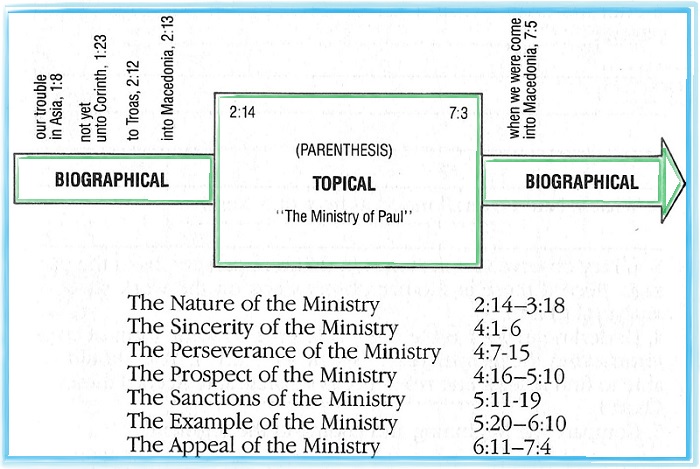
* "2 Corinthian Flow Chart" is from "2 Corinthians, A Self-Study Guide" by Irving L. Jensen published by The Moody Bible Institute of Chicago, 1972. Used by permission.
>5. How is our body described in verse 7?
* 2 Corinthians 4:7 "But we have this treasure in jars of clay to show that this all-surpassing power is from God and not from us."
* "But we" -This statement applies to all Christians. Paul could be referring to himself and to the Corinthian congregation, or he could be referring to only himself.
* "this treasure" -The gospel of the New Covenant in Jesus' blood and the "light of the knowledge of the glory of God".
* "in jars of clay" -The physical body, which is frail, expressed in poetic form. Only the KJV, ASV, and YLT have "earthly vessels". The Greek adjective/noun phrase means a "tile equipment" (specially a wife as contributing to the usefulness of the husband), i.e. "terra cotta". Strongs point out that the root word also means shells. Thus, the basic meaning is an hollow opening with harden fragile shell.
In ancient times people stored valuables in common clay jars of little value and plain looks. They were frail and throw away items hiding invaluable often strong and non-tarnishing.
>How does God giving us knowledge of his glory prove his power?
* "to show that this all-surpassing power is from God and not from us." -The absolute human insufficiency reveals the total sufficiency of God underlines this letter.
* The fact that we continue to enjoy such unspeakable glory in our mortal body is one of the most marvelous proofs of God's power. (4:10, 16)
* The glory is then given to God, not us.
>How is God's power manifested in our day to day life? (8-9)
* 2 Corinthians 4:8-9 "We are hard pressed on every side, but not crushed; perplexed, but not in despair; persecuted, but not abandoned; struck down, but not destroyed."
* Paul presents six destructive scenarios that do not end in failure in verses 6-11 "so that Jesus' life may be revealed in our mortal body". Four are in verses 8 and 9. One is in verse 10 and another in verse 11.
* "We are hard pressed on every side, but not crushed" -We are many ways, indeed every way, afflicted, afflicted with all sorts of afflictions; yet not distressed; but yet we are not like persons cooped up into a strait place, so as they are not able to turn them, nor know which way to move (so the word signifies). (Matthew Poole's Commentary on the Holy Bible)
* "perplexed, but not in despair" -"The Greek verb "aporeo", meaning "to be in perplexity", is fit for the wrestler, who being puzzled by his antagonist's skill knows not what to do: so in Hesychius, they that are not able to do or attempt any thing, they miscarry not finally, stand after all upright; despair not, nor are they overcome, but find a happy issue out of all, being at last conquerors." (Adam Clarke's Commentary)
"Despair" is the Greek verb "exaporeo" meaning utterly at a loss.
* "persecuted, but not abandoned" -We at times, like our Lord while he walked this earth, "are violently pursued and prosecuted by such as are the adversaries of the gospel, and enemies to our Lord Jesus, because of our profession of him, and preaching his gospel; but yet not forsaken of God, nor wholly of men; God, by the inward influences of his Holy Spirit, supporting, upholding, and comforting us; and also, by his providence, raising us up some friends that stick by us." (Matthew Poole's Commentary on the Holy Bible)
* "struck down, but not destroyed." - We are, either in our own thoughts, (as it is the nature of worldly troubles and afflictions to sink men's thoughts), or cast down by the violence of men, thrown to the earth; but not destroyed; but yet we live, and are by the mighty power of God preserved, that we are not utterly destroyed. (Matthew Poole's Commentary on the Holy Bible)
>6. How do Christians carry around in our body the death of Jesus? (10)
* 2 Corinthians 4:10 "We always carry around in our body the death of Jesus, so that the life of Jesus may also be revealed in our body."
* "We always carry around in our body the death of Jesus" -4:11, 1:5, and 1 Corinthians 15:31 have the same point. "The Greek for 'the dying' (KJV, YLT, and ASV. Greek "nekrosis".) is literally, 'the being made a corpse,' such Paul regarded his body, yet a corpse which shares in the life-giving power of Christ's resurrection, as it has shared in His dying and death." (A Commentary: Critical, Experimental, and Practical on the Old and New Testaments)
* Romans 6:4-6 says we are buried with Christ.
* Verse 11 appears to mean the same as 10.
>And why? What else is revealed in our body?
* "so that the life of Jesus may also be revealed in our body."
* Romans 6:7 says "because anyone who has died have been freed from sin." And verse 8 continued, "we will also live with him."
>7. How long do we carry around the death of Jesus? (11)
* 2 Corinthians 4:11 "For we who are alive are always being given over to death for Jesus' sake, so that his life may be revealed in our mortal body."
* "For we who are alive are always being given over to death for Jesus' sake"
* "so that his life may be revealed in our mortal body."
* We carry around Jesus' death as long as we are in a mortal body.
>How is this death linked to other's life? (12; John 12:24-26)
* 2 Corinthians 4:12 "So then, death is at work in us, but life is at work in you."
* John 12:24-26 "I tell you the truth, unless a kernel of wheat falls to the ground and dies, it remains only a single seed. But if it dies, it produces many seeds. The man who loves his life will lose it, while the man who hates his life in this world will keep it for eternal life. Whoever serves me must follow me; and where I am, my servant also will be. My Father will honor the one who serves me."
* "So then" -The Greek particle "hoste" followed by the Greek particle "men". They were two distinct grammatical particles used to connect thoughts, indicate cause, and build contrasts. They rarely appeared together as an isolated phrase, but rather operated as independent discourse markers structuring sentences. Here they are together.
* "death is at work in us" -"Us" here means "Paul". Paul is using the plural to refer to himself again.
* "but life is at work in you." -"You" here is the Corinthian congregation.
*
This Reveals God's All-Surpassing Power.
The human body is like a jar of clay, a fragile shell made of the ground we walk on, meant to store goods. When closed, it is without light. Ancient cultures used plain clay jars to conceal valuable treasures - sacred scrolls, hard jewels, and untarnished precious metals. The wonderful treasure in Christians is God's light of the knowledge of the glory of God in the face of Christ. (6)
Though a hard, fragile shell, pressed on every side, Christians are not crushed. Though wrestled about like a sports ball, not knowing what is happening and what to do about it, we are not without hope and deliverance. (8) Though persecuted, we are not abandoned. Though thrown down like a wrestler, we are not destroyed. We are lifted up and move on. (9)
Like a jar full of valuables is buried, our body is buried with Christ. (Romans 6:4-6) We die every day. (1 Corinthians 15:31) We always carry around in our clay body the death of Jesus. (10a, 11a). Why? So that the life of Jesus may also be revealed in our body. (10b). We die for Jesus' sake, so that his life may be revealed in our mortal body. (11b) Death is at work in this clay body, but life is at work in those we minister to. (12) We have this treasure in jars of clay to show that this all-surpassing power is from God and not from us. (7)
Listen to the above comments on 4:7-12.
III. I Believe, I Speak (4:13-18)
>8. If we believe the gospel of Jesus Christ what will we do? (13)
* 2 Corinthians 4:13 "It is written: "I believed; therefore I have spoken." With that same spirit of faith we also believe and therefore speak,"
* "It is written" -Psalm 116:10 "I believed; therefore I said, 'I am greatly afflicted.'"
* "With that same spirit of faith" -Paul knew he was not quote the whole passage. He was quoting in the spirit it was written. Paul has the same faith as the psalmist. Paul, like the psalmist was hard pressed and rescued. Both kept on speaking of the Lord's deliverance (Psalm 116:13). The whole Psalm is recalling what Paul experienced, as many other experience to this day in the name of the Lord.
* "we also believe and therefore speak," -Paul uses "we" speaking of himself. However, the statement applies to many saints too. Faith in troubles leads to deliverance and testimony follows. Paul, therefore, tirelessly labored and journeyed to bring the gospel message to others. So do many others.
>What hope is in the gospel? (14)
* 2 Corinthians 4:14 "because we know that the one who raised the Lord Jesus from the dead will also raise us with Jesus and present us with you in his presence."
* "because we know that the one who raised the Lord Jesus from the dead" -God the Father. When Jesus died he said, "Father into your hands I commit my spirit." Then he breathed his last. (Luke 23:46)
* "will also raise us with Jesus"
>What does it mean to be presented to God?
* "and present us with you in his presence."
>9. When some of the people hear the gospel what do they do? (15)
* 2 Corinthians 4:15 "All this is for your benefit, so that the grace that is reaching more and more people may cause thanksgiving to overflow to the glory of God."
* "All this is for your benefit"
* "so that the grace that is reaching more and more people"
* "may cause thanksgiving to overflow to the glory of God."
>With sureness in God's promise of our future what should we do? (16)
* 2 Corinthians 4:16 "Therefore we do not lose heart. Though outwardly we are wasting away, yet inwardly we are being renewed day by day."
* "Therefore" -Conclusion to the point started in verse 1 with "Therefore, since through God's mercy we have this ministry, we do not lose heart."
* "we do not lose heart." -Paul open the subject with these exact words in verse 1.
* The paragraphs and verses between verses 1 and 16 explain why the apostle continues to have a cheerful heart, and the remaining verses , 17 and 18, summarize the argument he has developed in verses 2-16 concerning not losing heart.
>What two facts are true about Christians?
* "Though outwardly we are wasting away" -An extension of verse 10, "carry the death of Jesus" and 11 "given over to death". The wasting away is the physical body, not the spiritual body, nor the soul.
* "yet inwardly we are being renewed day by day" -The regeneration that raised Jesus from the dead. Paul's statement was started in verses 14.
* Romans 8:11 "And if the Spirit of him who raised Jesus from the dead is living in you, he who raised Christ from the dead will also give life to your mortal bodies through his Spirit, who lives in you."
*
Raise Us With Jesus.
Believing in Jesus, faith in him, leads a person to give testimony about him. Jesus, who entered Jerusalem riding on a donkey, was given great praise. The Jewish religious leaders told him to stop the praise. His reply was, "I tell you, if they keep quiet, the stones will cry out." (Luke 19:40). "I believe," Paul and the Psalmist say, "therefore I have spoken." Testimony about Jesus is a natural compulsion to those who believe.
Why? "Because we know that the one who raised the Lord Jesus from the dead will also raise us with Jesus and present us with the saints in his presence" (14). The grace of God in this gives rise to thanksgiving and praise to the glory of God. Paul points out that the good news was also reaching many people, not just the Jews. More and more were added as people testified to Jesus.
We were made to testify. Jesus said, "You did not choose me, but I chose you and appointed you to go and bear fruit - fruit that will last. Then the Father will give you whatever you ask in my name." (John 15:16) "Go!" If you are as stubborn as a rock and remain still. Then a rock will show more life than you when you are still.
Listen to the above comments on 4:13-15.
>10. Do the troubles that Christian's face happen by accident?
* 2 Corinthians 4:17 "For our light and momentary troubles are achieving for us an eternal glory that far outweighs them all."
* "For our light and momentary troubles" -Compared to eternity, especially eternity with paradise with Christ in glory.
* "are achieving for us an eternal glory" -
>Why then does God allow them to come into our life?
* "that far outweighs them all."
>Is it right to concentrate on our troubles? (18)
* 2 Corinthians 4:18 "So we fix our eyes not on what is seen, but on what is unseen. For what is seen is temporary, but what is unseen is eternal."
* "So we fix our eyes not on what is seen"
* "but on what is unseen"
* "For what is seen is temporary"
* "but what is unseen is eternal."
* Hebrews 12:2-3 "Let us fix our eyes on Jesus, the author and perfecter of our faith, who for the joy set before him endured the cross, scorning its shame, and sat down at the right hand of the throne of God. Consider him who endured such opposition from sinful men, so that you will not grow weary and lose heart."
* Matthew 14:28-31 "Lord, if it's you," Peter replied, "tell me to come to you on the water."
"Come," he said. Then Peter got down out of the boat, walked on the water and came toward Jesus.
But when he saw the wind, he was afraid and, beginning to sink, cried out, "Lord, save me!"
Immediately Jesus reached out his hand and caught him. "You of little faith," he said, "why did you doubt?""
>What can be said of a person who professes Jesus and yet always complains to others about their troubles?
* They are not satisfied on how God is ruling their life. They are saying God has failed them.
<
*
Fix Our Eyes On...
"It's coming for us Simon Peter. A bad mountain wind storm."
"I see Andrew. This one's not going to be easy," Peter said, intensely looking at the waves. He quickly grabbed Andrew's shoulder and the mast when the first large wave rocked the boat, throwing its tentacles into and over the boat.
"You guys know what you're doing, right?" Matthew said, looking up worried. He ended up lying on the floor. "I mean, we have a boatload of lifetime fishermen." No one answered.
"We can't go back, can we, brother?" John said to Peter on the starboard side, more as a statement than a question. "He told us to go to the other shore.
After the feeding of the 5,000, Jesus told the disciples to go on ahead of him to Bethsaida by boat. After they left, Jesus went up a mountainside by himself to pray. Jesus waited till the boat was in the middle of the lake and the storm. Then, Jesus walked on the lake and began passing his disciples, who were buffeted by the waves attacking the boat. (Matthew 14:22-25; Mark 45-48; John 6:16-18) Some, with John's statement, began considering that they were in this precarious situation because Jesus told them to go by boat while he stayed behind on the mountainside.
"Look! It's a ghost," they said, and cried out in fear. They had seen Jesus walking on the lake. Stepping atop one wave cap to the next, looking like he was floating in the air.
"Take courage! It is I. Don't be afraid," Jesus said immediately.
Looking intently at Jesus, Peter replied, "Lord, if it's you, tell me to come to you on the water." Jesus permitted him. As long as Peter kept his eyes on Jesus, he stood on the water. However, when his gaze turned away from Jesus and towards the turbulent waves, he began to sink.
When "we fix our eyes not on what is seen", the storms we are in, but "on what is unseen", the light of the knowledge of the glory of God in the face of Christ (6b), we are given grace to walk on water. That is, "we do not lose heart. Though outwardly we are wasting away, yet inwardly we are being renewed day by day." (16) As the story goes, Jesus sent his disciples, who were later seen for what they are, "light and momentary troubles". So, are the storms we are in. Jesus sends us into such storms for they are achieving for us and eternal glory that far outweighs them all. (17)