>1. What does it mean to put a stumbling block in someone's path? (3)
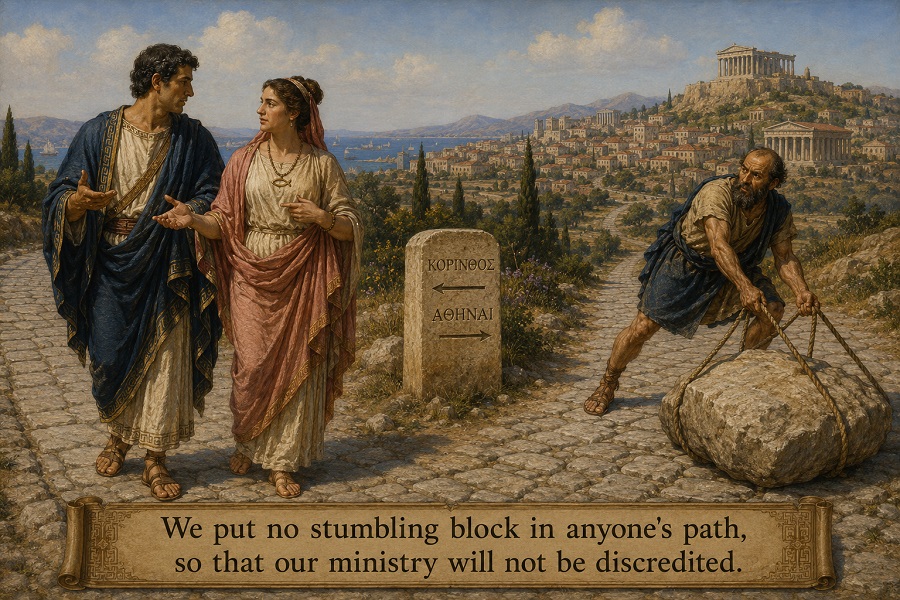
* 2 Corinthians 6:3 "We put no stumbling block in anyone's path, so that our ministry will not be discredited."
*
Chapter 6:3-13 Overview.
Every human who has ever lived has experienced events they never wanted to happen, whether self-imposed or due to nothing they had done or failed to do. In this world, everyone has troubles. Added to that some suffer from frequent depression. Troubles rebuff even the strongest souls.
Jesus' apostles experienced perhaps some of the worst life events. Paul lists some of his life pains here. They included troubles, hardships, distress, beatings, imprisonment, riots, hard work, sleeplessness, hunger, dishonor, bad report, being regarded as an impostor, being unknown, dying, sorrow, poverty, and having nothing. Paul lists his responses in these verses.
My response to everything that happens to me, whether wanted or unwanted, is important. I can choose now not to let future events dictate my response to them. I could attempt to train my will to be set to positive and my mind to be alert ahead of time. I could commend my soul to be preset to "great endurance" (4). I would do this as a mental and emotional wall to guard against attacks on my positive inner well-being.
As wise as that sounds, I have come to realize that an attitude of no surrender to any future troubling hardships is sometimes not enough. Some mornings, I wake up feeling refreshed and strong-willed. The wall of defense is strong.
Other mornings, I wake up feeling like buttered popcorn left out all night. I wake up fatigued and melancholy. I have never been a morning person. Even on the mornings when I am raring to take on and overcome any obstacle, there is always the possibility that a major unexpected tragedy that no one could muscle up a strong will to overcome will transpire. What then?
Paul wrote here that he endured, "in the Holy Spirit and in sincere love" (6) and "in the power of God" (7). I have discovered that every morning, especially the melancholy ones, when I turn my mind, my emotions, and my will to God even for a minute or 30, the soul's wall of defense is built on solid rock. It is less likely to fall, and I will be less likely to be overrun by deadly emotions and thoughts.
Jesus taught in a parable that he is a solid rock to build on. Going daily to Jesus before troubles come, I will not be overcome because my wall of defense is built on solid ground. I will not be destroyed. (Matt. 7:24-27) "The Lord is my rock, my fortress, and my deliverer; my God is my rock, in whom I take refuge, my shield and the horn of my salvation, my stronghold." (Psalms 18:2, 27:5, 40:2, 62:4)
Listen to the above Chapter 6:3-13 Overview.
* Romans 14:13 "Therefore let us stop passing judgment on one another. Instead, make up your mind not to put any stumbling block or obstacle in your brother's way."
* Luke 17:1-3 "Jesus said to his disciples: 'Things that cause people to sin are bound to come, but woe to that person through whom they come. It would be better for him to be thrown into the sea with a millstone tied around his neck than for him to cause one of these little ones to sin. So watch yourselves.'"
* 1 Peter 2:11-12 "Dear friends, I urge you, as aliens and strangers in the world, to abstain from sinful desires, which war against your soul. Live such good lives among the pagans that, though they accuse you of doing wrong, they may see your good deeds and glorify God on the day he visits us."
* "We... our" -Paul is using the plural to refer to himself as commented on in previous studies.
* "We put no stumbling block in anyone's path" -Sounds like a motto to a Roman road construction crew that Paul came across in his many travels. The KJV has "giving no offense" and the CSB uses "not giving anyone an occasion for offense", and YLT has "in nothing giving any cause of offense". Other translations have similar meaning while using different phrasing. Commentators agree that "stumbling block" is a better translation of the Greek noun.
"The Greek noun signifies a stumbling block in general, or any thing over which a man stumbles or falls; and here means any transgression or scandal that might take place among the ministers, or the Christians themselves, whereby either Jews or Gentiles might take occasion of offense, and vilify the Gospel of Christ." (this paragraph from Adam Clarke's Commentary)
* "so that our ministry will not be discredited." -Paul had just stated that the ministry was the ministry of reconciliation. (5:18)
* The long list from 4b-10, perhaps 11 too, is what Paul endured so that they would not be offended and his ministry of reconciliation would not be discredited.
>What is the nature of servitude? (4a)
* 2 Corinthians 6:4 "Rather, as servants of God we commend ourselves in every way:"
* "as servants of God" -Jesus taught us to be servants as he came to serve.
* "we commend ourselves in every way:" -The verse commend means "to represent as worthy, qualified, or desirable". Paul follows this with multiple general examples. He does not give specifics on any details or examples.
Paul commends himself again inasmuch as the gospel he preached in Corinth is at stake; but, in contrast to the false apostles who were no better than self-servers, he does so as God's servant. His life, with all its trials and afflictions, could not have been more starkly different from that of these intruders whose concern was for their own comfort and prestige. (this paragraph from the NIV Study Bible)
*
No Stumbling Block.
Paul wanted to live an exemplary life so as not to discredit the ministry of reconciliation he was called to. (4, 5:18) If I talk the talk but do not walk the walk, then, as people notice my contradictory walk, they will not listen to my reconciliatory talk. When I repeat Jesus' message of turning to God, but show that I have not turned to God, then why would they turn to God?
Living the walk that Jesus taught in a world that continues to fall into the pit of hate towards those who live to please Christ is one that faces troubles, hardships, and distress. The world shames us for doing the right thing. We are tempted to leave stumbling blocks in their path. However, Jesus says, "Things that cause people to sin are bound to come, but woe to that person through whom they come. It would be better for him to be thrown into the sea with a millstone tied around his neck than for him to cause one of these little ones to sin. So watch yourselves." (Luke 17:1-3)
So, as servants of God, we commend ourselves in every way. (4a) The apostles not only gave no offense in anything, but they labored to manifest themselves to be the genuine ministers of God, in much patience, bearing calmly up under the most painful and oppressive afflictions. Jesus tells us, "All men will hate you because of me, but he who stands firm to the end will be saved." (Matthew 10:22; Mark 13:13; Luke 21:17; John 15:20-21)
Listen to the above comments on 6:3-4a.
* The illustration is from the Art Bible, 1896, comprising the Old and New Testaments, with numerous illustrations. Publisher, London: G. Newnes. The cited verse is 2 Corinthians 6:5 from the KJV, a mistaken meaning of "watching" as being self-imposed. However, 11:27 indicates that his sleepless nights and going without food was not to fast and pray, but was imposed on him because of his ministry. Paul is giving three examples of the "hardships" stated in 4b. (See comments below.) The artists signature is in the bottom right.
>What are some things that may happen in the life of a servant of God? (4b-5)
* 2 Corinthians 6:4b-5 "in great endurance; in troubles, hardships and distresses; in beatings, imprisonments and riots; in hard work, sleepless nights and hunger;"
* Paul will follow common Semitic presentation; give a short outline, then go back and expand upon each point in the outline. Triads, as Paul does here, are common in Semitic oral and written presentations. Some of Paul's words are essentially synonyms; as in ancient rhetorical style, they are repeated for effect.
* Compare Paul's list in 4:8-12.
* "in great endurance; in troubles, hardships and distresses" -Endurance is the act, quality, or ability to withstand troubles, hardships, and distress. Stamina is an alternative word, though not used in any other English Bibles that I have. The KJV, ASV, and YLT are the only one's that do not translate the original Greek noun "hypomone" as endurance. They translate it as "patience". The commentaries I have correct the KJV, ASV, and YLT saying the Greek rather means "endurance".
* "troubles" -The original Greek noun is "thlipsis" (a transliteration) from the verb "thlibo". The general meaning is "pressure" (literal or figurative), "compressing", or "squeezing" as in pressing grapes to make wine. "Thlipsis" was used figuratively to describe being hemmed in by circumstances, resulting in profound tribulation, affliction, or distress.
* "hardships" -The original Greek noun is "ananke" (a transliteration) from the preposition "ana" and the base of the noun "agkale". The general meaning is "constraint" (literal or figurative), "necessity", "compulsion", or "inevitability". It described a pressing need or an unavoidable situation that one was obligated to endure or act upon, often completely outside of human control. Sometimes it was used to mean times of severe hardship, affliction, or crisis that are unavoidable and cause great distress. Paul also used "ananke" in Romans 13:5 and 1 Corinthians 7:26.
* "distresses" -The original Greek noun is "stenochoria" (a transliteration) from a compound of the adjective "stenos" and the noun "chora". The general meaning is "narrowness of room" and "confined, tight place". Metaphorically, it describes the emotional and spiritual anguish of being trapped by oppressive circumstances with no room to move or escape, resulting in feelings of severe distress or calamity. Paul also used "stenochoria" in chapter 12:10 and Romans 2:9, 8:35. In classical and Hellenistic literature, the term was also used to describe the harsh realities of physical confinement, such as a city under a strict siege, or a fleet of ships crammed into a tight, inescapable harbor.
* "in beatings, imprisonments and riots" -These are a three different troubles Paul endured.
* "in hard work, sleepless nights and hunger" -These are three hardships Paul endured.
* Paul gives three different troubles and three different hardships, but he does not give three different distresses. In fact, he gives none. Rather next is a quartet (6) that concerns the purity and sincerity of his Christian life, the opposite of distresses. Distresses are internal strains, anxiety, and suffering often caused by troubles and hardships. Paul often links the two Greek words in the same passage.
>2. What are some blessings of a servant of God? (6)
* 2 Corinthians 6:6 "in purity, understanding, patience and kindness; in the Holy Spirit and in sincere love;"
* Paul continues commending himself. Rather than giving examples of distresses, which are internal, Paul gives examples of the opposite or opposing weapons to distresses, the internal gifts of God.
* "in purity, understanding, patience and kindness" -Opposing forces within a believer from God to distresses from troubles and hardship from without.
* "in the Holy Spirit and in sincere love" -Opposing forces from God to distresses from troubles and hardships. Sincere love is as much from God as the Holy Spirit for love is the fruit of the Spirit within us.
* Galatians 5:22-23 "But the fruit of the Spirit is love, joy, peace, patience, kindness, goodness, faithfulness, gentleness and self-control. Against such things there is no law."
*
Not a Coward's Gospel.
If Apostle Paul was a coward in his youth, the power of God overcame his cowardice as a servant of God. Paul did not show ignoble fear in the face of troubles, hardships, and distress. (4b) God enabled Paul to have great endurance.
Three troubles Paul lists that he endured are beatings, imprisonments, and riots. (5a) Only a few months earlier, while in Ephesus, a riot broke out due to a silversmith named Demetrius, who made silver shrines of the idol Artemis. Demetrius was losing money because people were renouncing paganism and becoming Christians. Paul was forced to leave the city he had made his home for several years. (Acts 19:1-20:1. See also Acts 16:22 for beatings.)
Three hardships Paul lists here are hard work, sleepless nights, and hunger. (5b) Paul was a layman missionary. (Acts 18:1-4) His often forced travels caused him to sleep in the wilderness, which left him sleepless and hungry. (Acts 16:6-12, 17:10, 14-15)
Apostle Paul does not detail the distress he endured. The Greek noun Paul used for distress describes the emotional and spiritual anguish of being trapped by oppressive circumstances with no room to move or escape, resulting in feelings of severe distress or calamity. Rather than stating the distresses he endured due to the troubles and hardships, Paul states the opposing forces God gave him to combat the distress. Verse 6 states some of the gifts of the Holy Spirit: purity, understanding, patience, kindness, and love. (John 14:26, 15:26; Galatians 5:22-23)
God does not raise up cowards who watch as others propagate hate, subvert the truth, and deceive people into believing lies, as some were doing in Corinth. God does not abandon his children to troubles, hardships, and distresses without means to overcome. To many who proclaim the name among those they trust, are quiet and cower among those they do not know.
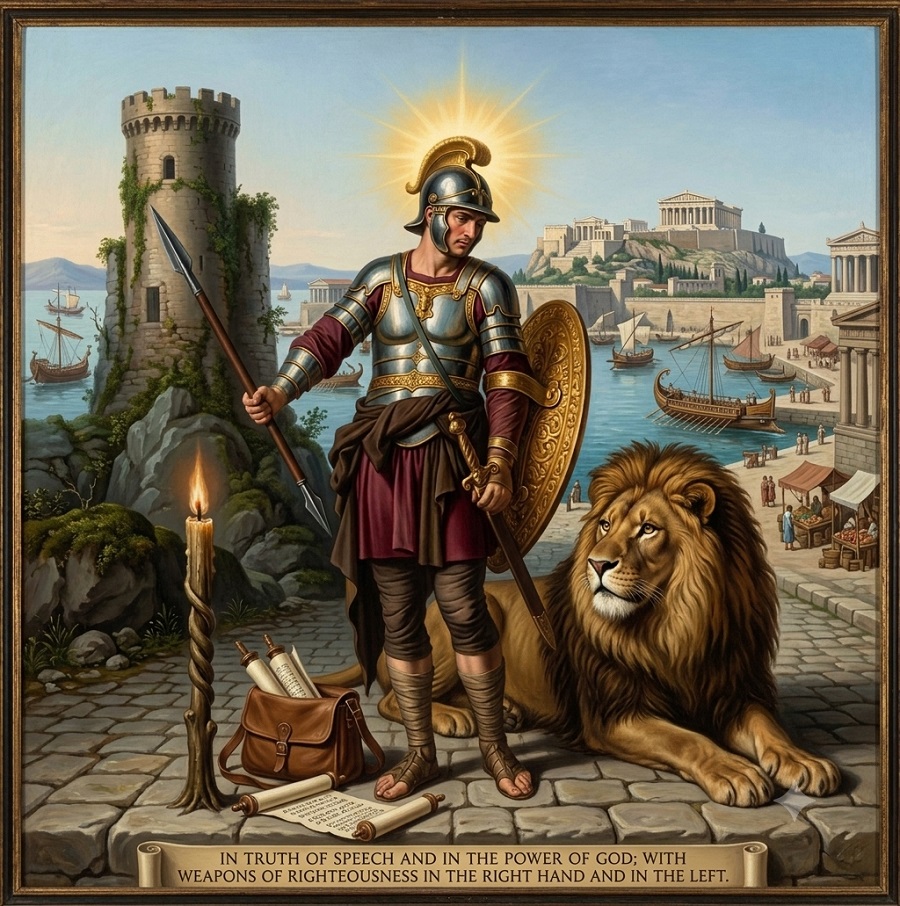
* 2 Corinthians 6:7 "in truthful speech and in the power of God; with weapons of righteousness in the right hand and in the left;"
* Paul moves onto the active ministry of reconciliation as he continues to commend himself.
* "in truthful speech and in the power of God" -The ministry of reconciliation involves witnessing, preaching, and teaching. Without God's power a person can minister till they die and produce no fruit for it is God in power who makes the ministry to grow.
* "with weapons of righteousness in the right hand and in the left" -God gives of weapons to fight with. Paul defines them as weapons of righteousness. A Roman soldier would carry a shield with his left hand and a spear or sword with is right hand.
* Ephesians 6:13-17 has a more detailed illustrations using a soldier with a full armor of God. It starts out, "Finally, be strong in the Lord and in his mighty power. Put on the full armor of God so that you can take a stand against the devil's schemes."
>What are some contrasts in a servant of God's life? (8-10)
* 2 Corinthians 6:8-10 "through glory and dishonor, bad report and good report; genuine, yet regarded as impostors; known, yet regarded as unknown; dying, and yet we live on; beaten, and yet not killed; sorrowful, yet always rejoicing; poor, yet making many rich; having nothing, and yet possessing everything."
*
The Art of Christian Combat.
Apostle Paul speaks of the "power of God" and "weapons of righteousness" (7) as part of his God-given "ministry of reconciliation" (5:18). In verses 8 through 10, Paul continues to unpack this ministry by describing his experiences as God's soldier, ensuring he puts no stumbling block in anyone's path (3). To do this, he employs a powerful series of nine contrasting opposites.
"through glory and dishonor"
"bad report and good report"
"genuine, yet regarded as impostors"
"known, yet regarded as unknown"
"dying, and yet we live on"
"beaten, and yet not killed"
"sorrowful, yet always rejoicing"
A comment on verses 8-10a from the IVP Bible Background Commentary. "Paul relates to issues that other speakers on moral issues faced in Greco-Roman society. Paradox, contrasting apparently irreconcilable opposites, was a standard literary and rhetorical technique. Some philosophers (particularly Cynics) often used paradox and a similar technique of irony, especially for turning the comments of their accusers (insane, foolish, shameful) against them, proclaiming themselves truly wise and rich (1 Cor. 4:8). They proclaimed that the opinions of foolish men (non-philosophers) did not bother them; Stoics often reflected on their lack of worldly honor.
But many philosophers avoided unnecessary criticism when possible, lest their message be dishonored; moralists often even sought to learn some truth from false accusations leveled against them. Both Greek and Jewish traditions stressed being honorable and irreproachable, and most people cared about public opinion. 'Known' here presumably means known to the one who counts -God. On 'dying' and 'living', see 4:10-12 and perhaps Psalm 118:17-18."
"poor, yet making many rich"
"having nothing, and yet possessing everything"
A comment on verse 10b from the IVP Bible Background Commentary. "Although usually better off than peasants, artisans (Paul had earned his living as a leatherworker -Acts 18:3) toiled, remained poor, and had little social status; this was especially true of those who moved around, as Paul did. Cynic philosophers gave up all possessions to pursue their lifestyle but considered themselves spiritually rich. Cynic and Stoic philosophers claimed that, although they owned little or nothing, all the world belonged to them, because they were friends of the gods who owned it; as a servant of the true God, Paul has all the more reason to apply the phrase 'possessing all things' to himself."
So, I examine my life. Jesus commanded, "Carry your cross." Thus is the mission of his soldiers. How many of these nine apply to my life?
Listen to the above comments on 6:3-4a.
>3. What example can we learn from Paul's ministry? (11)
* 2 Corinthians 6:11 "We have spoken freely to you, Corinthians, and opened wide our hearts to you."
* "We have spoken freely to you, Corinthians"
* "opened wide our hearts to you."
>What problem had existed between Paul and the Corinthian believers? (12)
* 2 Corinthians 6:12 "We are not withholding our affection from you, but you are withholding yours from us."
* "We are not withholding our affection from you"
* "but you are withholding yours from us."
>What did Paul ask of them? (13)
* 2 Corinthians 6:13 "As a fair exchange--I speak as to my children--open wide your hearts also."
* "I speak as to my children"
* "As a fair exchange... open wide your hearts also."
>How can we apply this to our own life?
*
Living, Loving Relationships.
What comprises a living, loving relationship? Words spoken freely and hearts opened. Trust in the other's love is required. These must be exchanged for a loving relationship to grow. If only one side expresses love, what will happen to the relationship?
Paul spoke freely and opened his heart. However, the Corinthians withheld their affection. False teachers were spreading lies about Paul, the founder of the congregation. Everything Paul had done for the Corinthian congregation was out of love. He sacrificed greatly for them, as the previous verses and others reveal. Yet, the split tongues of the impostors were digging into their hearts like worms into an apple.
A relationship with God through the grace and love of Jesus can have the same problem. God expresses his love for us in many ways. Yet, the devil influences us to look away from that love. We close our hearts to God and open them up to lies. I believe God is speaking to me through Paul, "I am not withholding my affection from you, my child, open wide your heart also."
can be found in the comments for 1 Corinthians chapter 7, study 5, at the bottom of the web page. This manuscript has more information concerning what the Bible says about men, women, relationships, marriage, and sex.
>4. What does it mean to be yoked to someone? (14; Deut. 22:10)
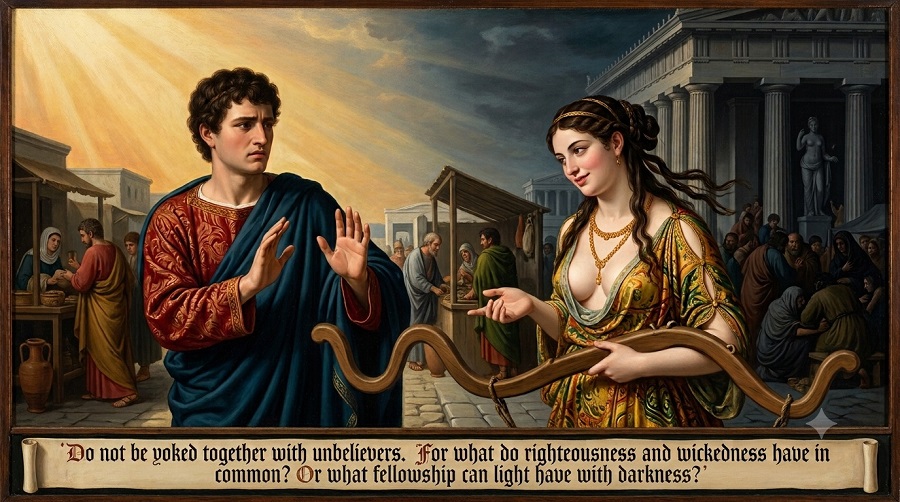
* 2 Corinthians 6:14 "Do not be yoked together with unbelievers. For what do righteousness and wickedness have in common? Or what fellowship can light have with darkness?"
* Deuteronomy 22:10 "Do not plow with an ox and a donkey yoked together."
*
Chapter 6:14-7:1 Overview.
All my brothers and sisters in Christ and I are the temple of the living God as Paul wrote in the first letter to Corinth. (1 Corinthians 6:19) The Holy Spirit, Jesus, and the Father live in me. I am a son of the Lord Almighty. God dwelling in his people is only by grace. No matter the life circumstances nor my past, present, or future God will never leave his people.
I have a choice to who I will be with, not just friends, but especially a spouse. The choice a person makes concerning their spouse is important.
Paul says not to yoke with someone who does not believe in Jesus. Yoking is a farm term. Two oxen or another beast of burden are joined together by a board or iron so together they can plow a field. Yoking makes the work easier and quicker. Marriage is equated with yoking.
Paul instructs that Jesus's people should marry each other instead of an unbeliever. This is wise because eventually different religious beliefs will be a source of contentions in marriage. Historically people of God will eventually compromise their relationship with either God and/or the spouse if the one they marry does not have faith in Jesus.
Finding a fellow believer in today's age is not easy. It takes faith in God's provision and love. Some find a loving Christian mate right away. Other's find that they have to have the faith of Abraham who waited 25 years to have a son.
Knowing just exactly what another truly believes is not easy and perhaps is impossible. However, after some time we can make a reasonable conclusion that the person we are dating has similar beliefs or not. Searching can be fun and daunting at the same time.
Much conflicting advice exists and is confusing. Several years ago I asked a man I respected why people who are generally the same in beliefs will express so many different options about dating, weddings, marriage, and sex. He said, "You know why? It's because it is just that. It's their opinion. In the end, the man and woman have to decide what they believe is right and best and what they want."
Listen to the above Chapter 6:14-17:1 Overview.
* "Do not be yoked together with unbelievers."
* "For what do righteousness and wickedness have in common?"
* "Or what fellowship can light have with darkness?"
>Why shouldn't believers be yoked with unbelievers? (15; Matt. 11:29-30)
* 2 Corinthians 6:15 "What harmony is there between Christ and Belial? What does a believer have in common with an unbeliever?"
* Matthew 11:29-30 "Take my yoke upon you and learn from me, for I am gentle and humble in heart, and you will find rest for your souls. For my yoke is easy and my burden is light."
* "What harmony is there between Christ and Belial?" -Greek "Belair", a variant of "Belial", the transliteration of a Hebrew common noun meaning, "useless" or "worthless." KJV interprets it as a proper name sixteen times, but modern translations translate it as a common noun, "worthless" or "wicked." It is a term of derision (Deut. 13:13). In Nahum 1:15, where the King James Version translates it as "the wicked," Belial appears to be the name of some specific malevolent power.
In the New Testament the word occurs one time (2 Cor. 6:15). There Paul the apostle declared the mutual irreconcilability of Christ and Belial, who thus appears to be equated with Satan. (Holman Bible Dictionary)
* "What does a believer have in common with an unbeliever?"
>How is God's word consistent when it comes to who marry? (Gen. 6:1-3; Deut. 7:3-4; Ezra 9:10-12)
* Genesis 6:1-3 "When men began to increase in number on the earth and daughters were born to them, the sons of God saw that the daughters of men were beautiful, and they married any of them they chose. Then the LORD said, "My Spirit will not contend with man forever, for he is mortal; his days will be a hundred and twenty years."
* Deuteronomy 7:3-4 "Do not intermarry with them. Do not give your daughters to their sons or take their daughters for your sons, for they will turn your sons away from following me to serve other gods, and the LORD's anger will burn against you and will quickly destroy you."
* Ezra 9:10-12 "But now, O our God, what can we say after this? For we have disregarded the commands you gave through your servants the prophets when you said: 'The land you are entering to possess is a land polluted by the corruption of its peoples. By their detestable practices they have filled it with their impurity from one end to the other. Therefore, do not give your daughters in marriage to their sons or take their daughters for your sons. Do not seek a treaty of friendship with them at any time, that you may be strong and eat the good things of the land and leave it to your children as an everlasting inheritance.'"
>5. What is true about believer's inner being? (16)
* 2 Corinthians 6:16 "What agreement is there between the temple of God and idols? For we are the temple of the living God. As God has said: "I will live with them and walk among them, and I will be their God, and they will be my people."
* "What agreement is there between the temple of God and idols?"
* "For we are the temple of the living God."
* Leviticus 26:12 "I will walk among you and be your God, and you will be my people."
* Jeremiah 32:38 "They will be my people, and I will be their God."
* Ezekiel 37:27 "My dwelling place will be with them; I will be their God, and they will be my people."
*
Christ, Not Belial.
Paul, in the first letter to the Corinthian congregation, had told them not to marry an unbeliever (chapter 7). Since he repeats it here, some must have disregarded his direction at the direction of false apostles who were undermining Paul's ministry of reconciliation.
Paul contrasts a believer in Jesus with those who reject Jesus. A believer is righteous, light, filled with Christ, and a temple of the living God. An unbeliever in Jesus is wickedness, darkness, filled with Satan, and the temple of useless idols. Belial means useless, of Hebrew origin, and refers to the devil.
As water and oil do not mix, a believer and an unbeliever will never mix. Eventually, the devil will ignite the unbeliever, and the believer will be left alone, most likely heated to a boil as a result. Water cannot clean oil. We cannot change people. Only God can do that. Don't get burned waiting for the unbeliever to change.
Listen to the above comments on 6:14-16a.
>How is verses 17 and 18 to be taken? (Acts 10:27-29; John 17:15-19)
* 2 Corinthians 6:17-18 "Therefore come out from them and be separate, says the Lord. Touch no unclean thing, and I will receive you. I will be a Father to you, and you will be my sons and daughters, says the Lord Almighty."
* Acts 10:27-29 "Talking with him, Peter went inside and found a large gathering of people. He said to them: "You are well aware that it is against our law for a Jew to associate with a Gentile or visit him. But God has shown me that I should not call any man impure or unclean. So when I was sent for, I came without raising any objection. May I ask why you sent for me?"
* John 17:15-19 "My prayer is not that you take them out of the world but that you protect them from the evil one. They are not of the world, even as I am not of it. Sanctify them by the truth; your word is truth. As you sent me into the world, I have sent them into the world. For them I sanctify myself, that they too may be truly sanctified."
* Isaiah 52:11 "Depart, depart, go out from there! Touch no unclean thing! Come out from it and be pure, you who carry the vessels of the LORD."
* Ezekiel 20:34, 41 "I will bring you from the nations and gather you from the countries where you have been scattered--with a mighty hand and an outstretched arm and with outpoured wrath....
"...I will accept you as fragrant incense when I bring you out from the nations and gather you from the countries where you have been scattered, and I will show myself holy among you in the sight of the nations."
* 2 Samuel 7:14 (i.e. verse 8) "I will be his father, and he will be my son. When he does wrong, I will punish him with the rod of men, with floggings inflicted by men."
* Also Isaiah 43:6 and Jeremiah 3:19.
* "Therefore" -A bridge from the previous point, a believer in Jesus should not marry someone who does not believe for they have nothing in common, to the next.
* "come out from them and be separate, says the Lord." -The command that was given to Israel at Mount Sinai is given to the church.
* "Touch no unclean thing, and I will receive you" -Straight to the point and clear in understanding. This is a condition to God being their Father. The condition also falls on a Christian and the church in general.
>How does this relate to the subject of marriage in previous verses? (Gen. 2:24)
* Genesis 2:24 "For this reason a man will leave his father and mother and be united to his wife, and they will become one flesh."
* The married man and woman are to be a separate identity. They are united and separated for the Lord's purpose. If one isn't a believer, then neither are dedicated to the Lord.
>How does this relate to our inner being? (7:1)
* 2 Corinthians 7:1 "Since we have these promises, dear friends, let us purify ourselves from everything that contaminates body and spirit, perfecting holiness out of reverence for God."
* 1 Corinthians 6:18-20 "Flee from sexual immorality. All other sins a man commits are outside his body, but he who sins sexually sins against his own body. Do you not know that your body is a temple of the Holy Spirit, who is in you, whom you have received from God? You are not your own; you were bought at a price. Therefore honor God with your body."
* "Since we have these promises" -God being our Father.
* "let us purify ourselves from everything that contaminates body and spirit" -An act we much engage in. We do not have control over our spirit. But we do have control over our body.
* "perfecting holiness out of reverence for God." -1 Thessalonians 4:7; 1 John 3:3. "Reference" is the Greek "phobos" (a transliteration). Other English Bibles translate this as "fear". The HCSB has a text note stating no single English word exists which conveys the meaning of this Greek word.
>How does verses 14-16 confirm these truths?
* Mark 7:14-16 "Again Jesus called the crowd to him and said, "Listen to me, everyone, and understand this. Nothing outside a man can make him 'unclean' by going into him. Rather, it is what comes out of a man that makes him 'unclean.'"
* Abstain from sin.
>What has happened in our generation of believers in regard to purity of heart and purity of marriage and how can the trend stop?
* I tend to stay away from such open ended questions, but the need for this is great.
* Sex and sexual orientation has become more important to many people who say they are Christians than purity and obeying Jesus.
*
Pure Temple.
Paul repeats what he stated in 1 Corinthians 6:18-20 (which precedes the chapter concerning marriage): we are the temple of God (16b). The point he makes is the same: "let us purify ourselves from everything that contaminates body and spirit, perfecting holiness out of reverence for God." The subject is the same: who to bond with. Marriage and sex are important to God. Purity is important.
The temple purification procedures were rigorous, containing many steps and procedures. Every corner and cranny was to be purified. Similarly, every aspect of our body and spirit is to be pure. The reason is that God is in his believers. We are the temple.
Modern people who claim to know Christ are fixated on sex and sexual orientation, more than purity and devotion to Christ. Genesis 2:24 is clear: "For this reason a man will leave his father and mother and be united to his wife, and they will become one flesh." Any union outside of this is impure. Clean up, and God will be your Father. Then, preach Christ, not sex and sexual orientation.
Listen to the above comments on 6:16b-7:1.
III. Paul's Joy (7:2-16)
>7. What had apparently happened in the Corinthian congregation after they received Paul's first letter? (2)
* 2 Corinthians 7:2 "Make room for us in your hearts. We have wronged no one, we have corrupted no one, we have exploited no one."
* "Make room for us in your hearts."
* "We have wronged no one" -Implies that Paul had been accused of this. Most likely some of the congregation agreed, those who Paul had rebuked. The divisions Paul addressed in the first letter persisted.
* "we have corrupted no one" -Same as above, implies that Paul was accused of this. This indicates that that the accusers for Pharisees who were pretend Christians.
* "we have exploited no one" -Same as above. The accusers were doing this, but they accused Paul of this. Jesus experienced this with the religous leaders. I have seen this my whole life with political matters. Those who hate God and his people accused them of things they themselves are doing.
>How did Paul respond? (3-4)
* 2 Corinthians 7:3-4 "I do not say this to condemn you; I have said before that you have such a place in our hearts that we would live or die with you. I have great confidence in you; I take great pride in you. I am greatly encouraged; in all our troubles my joy knows no bounds."
* "I do not say this to condemn you" -He was not judging and condemning. He was trying to help them change their ways.
* "I have said before that you have such a place in our hearts that we would live or die with you" -Paul again expresses his affection for the Corinthian believers and appeals to them to respond, contrary to the wishes of the false reachers, by dislaying their love for him, their renuine apostle (5:11-13) (NIV Study Bible)
* "I take great pride in you. I am greatly encouraged; in all our troubles my joy knows no bounds." -The pride was their growth in Christ, the very congregation God used him to found.
"Knows no bounds" -The original Greek verb is used in only one other place, Romans 5:20, "grace increased all the more". It is even rarer in any Greek author.
* Paul started the dialogue, a digression, at 2:14 and concludes it at 7:4. 2:12-13 Paul said he was looking for Titus. 7:5-6 Paul said Titus had come. Paul didn't find Titus is Troas, but he did find him in Macedonia.
>How had he practiced Jesus teaching on forgiveness? (John 13:34-35; Luke 11:4)
* John 13:34-35 "A new command I give you: Love one another. As I have loved you, so you must love one another. By this all men will know that you are my disciples, if you love one another."
* Luke 11:4 "Forgive us our sins, for we also forgive everyone who sins against us. And lead us not into temptation."
>8. What kind of gospel work ethic was compelled by Paul's love for them? (5)
* 2 Corinthians 7:5 "For when we came into Macedonia, this body of ours had no rest, but we were harassed at every turn--conflicts on the outside, fears within."
* "For when we came into Macedonia" -Paul left Ephesus, passed through Troas, and arrived in Macedonia on his way to Corinth.
* "this body of ours had no rest" -Paul again uses the plural to refer to himself.
* "but we were harassed at every turn--conflicts on the outside" -From pagans, false Jewish prophets, and false Christians.
* "fears within" -Not knowing the outcome of the letter he sent to Corinth.
>How had God blessed his faith? (6)
* 2 Corinthians 7:6-7 "But God, who comforts the downcast, comforted us by the coming of Titus, and not only by his coming but also by the comfort you had given him. He told us about your longing for me, your deep sorrow, your ardent concern for me, so that my joy was greater than ever."
* "But God, who comforts the downcast, comforted us by the coming of Titus"
* "and not only by his coming but also by the comfort you had given him"
* "He told us about your longing for me, your deep sorrow, your ardent concern for me"
* "so that my joy was greater than ever."
*
God Comforts the Downcast.
Lately, I have come to passages in this letter that I find hard to apply or make fresh. This is one of them. Paul tends to repeat himself, as he does in 2-4. Added to that, the subject matter started in 2:12-13; Paul has deviated from it until now, when he returns to it in 7:5-7.
So, here is a synopsis of worthy points from verses 2-4: wrong no one, corrupt no one, exploit no one, and condemn no one. Opposing these are: live and die for others, have great confidence in believers, be greatly encouraged by another's faith, and in all our troubles our joy knows no bounds.
Concerning the last declaration, "in all our troubles our joy knows no bounds," Paul expands upon that in verses 5-7. Paul stated in 2:14-15 that after he wrote the first letter to the congregation at Corinth, he began his circular trip to the congregations to collect the aid offering for the poor in Jerusalem. He had no peace of mind then because he was hoping to get a report about Corinth's reception of the first letter from Titus. However, Titus was not in Troas, so he lacked peace.
Also, he says his body had no rest, but was harassed on every turn (5). Yet, here Paul declares that, despite these and other troubles, his joy knows no bounds. This reminds me of the peace that surpasses understanding (Philippians 4:7). God comforts the downcast (6). The takeaway to personalize is a contradiction believers experience, as Jesus said, "In this world you will have trouble... my peace I give you. I do not give you as the world gives. Do not let your hearts be troubled and do not be afraid... take heart, I have overcome the world." (John 14:27, 16:33)
Listen to the above comments on 7:2-7.
>9. How can unwanted feelings lead to good in our life? (8-9)
* 2 Corinthians 7:8-9 "Even if I caused you sorrow by my letter, I do not regret it. Though I did regret it--I see that my letter hurt you, but only for a little while-- yet now I am happy, not because you were made sorry, but because your sorrow led you to repentance. For you became sorrowful as God intended and so were not harmed in any way by us."
* "sorry" -The key word in verses 8-11, repeated 8 times. The original Greek verb is "lypeo" (a transliteration) in all 5 places in verses 8 and 9 and once in verse 11, from the Greek noun "lupe" or "lype" (a transliteration) used twice in verse 10.
* "Even if I caused you sorrow by my letter" -He rebuked them in his former letter for several sinful practices within the congregation.
* "I do not regret it" -Even Jesus exposed sin so that others may accept, confess, and ask for forgiveness. (Mark 1:14-15)
* "Though I did regret it--I see that my letter hurt you, but only for a little while" -Their hurt lead to rejoicing. Paul regretted the hurt, but when they repented he did not regret that they were hurt. A good parent regrets scolding and punishment for their beloved child, but applies them for the child's improvement. The improvement is not guarantied, even for the best parent.
* "our sorrow led you to repentance. For you became sorrowful as God intended and so were not harmed in any way by us." -Sorry is needed for repentance. Without sorrow there is no repentance. Sorry leading repentance is God's intent.
"Repentance" in verses 9 and 10 is the Greek noun "metanoia" (a transliteration) used 24 times in the New Testament meaning "guilt, reformation, and think differently afterwards".
>What is the condition that makes this good? (10)
* 2 Corinthians 7:10 "Godly sorrow brings repentance that leads to salvation and leaves no regret, but worldly sorrow brings death."
* "sorrow" -The original Greek noun is "lype" (a transliteration) in both places in verse 10, related to the Greek word for sorry in verses 8, 9, and 11.
* "repentance that leads to salvation" -See comment in the question above for definition of "repentance". The outcome is only obtained by the repentance caused by sorry for sins committed.
"Salvation" is the Greek noun "soteria" (a transliteration) used 45 times in the New Testament from the Greek noun "Soter" always translated "Savior" meaning deliverer referring to Jesus and God.
* "worldly sorrow brings death." -Sorry that they were caught in sin and the consequences of sin, but not repetitive of that sin, and not always with belief of the need of forgiveness for that sin.
* The parchment is one of many from "The Sayings of the Desert Fathers", this one found in modern Iraq dating from pre-5th century A.D. They are typically in the form of a conversation between a younger monk and his spiritual father, or as advice given to visitors. Beginning as an oral tradition in the Coptic language (pre-modern Egyptian), they were only later written down as Greek text.
The codices, an ancient hand-written manuscript in the format of a modern book, were extremely popular among early Christian monks starting from men forced to hide from Roman persecutions against Christians in Egypt. They appeared in various forms and collections for several hundred years.
The Egyptian Desert Fathers were early Christian hermits, ascetics, and monks who fled to the wilderness to escape persecutions while others later dedicated their lives solely to God. While monasticism gained massive traction in the third and fourth centuries, figures like St. Paul of Thebes (227-341 A.D.), considered the first Christian monk/hermit began retreating to the Egyptian desert to escape Roman persecutions as early as the mid-third century. Other's include Saint Anthony the Great (251-356 A.D.), Paul the Simple (225-339 A.D.), Saint Pachomius the Great (292-348 A.D.), and Saint Hilarion (291-371 A.D.). Saint Jerome wrote about these and other early monks/hermits.
>How does this highlight the process of salvation?
*
Godly Sorrow Leads to Life.
Ancient Christian Steps (see comments on the parchment above)
Below is based on John Cassian's (360-435 A.D.) "The Rule of the Master" (5th century A.D.), the source of St. Benedict's (480-530 A.D.) "12 Steps of Humility", chapter 7, in his book "The Rule" (6th century A.D.). John Cassian's concepts are drawn from the ascetic traditions of the "Egyptian Desert Fathers," monks who date back to the 2nd century A.D., which are based on Luke's Gospel (oldest found copy is ~125 A.D. in codex format), Proverbs (oldest copy is a Dead Sea Scroll dating to 3rd-century B.C.), and 2 Corinthians 7:8-11 (oldest copy of 2 Corinthians is dated 175-225 A.D.).
Receive the Gospel
Accept the Gospel
Accept and be sorry for self induced sinned, separating oneself from the Loving God, and inability to do anything to remove that sin with one's own ability. Fear God's judgment of my guilt.
Accept that only the Benevolent God can remove my sin and guilt through Jesus' selfless sacrifice in my place. Accept the Gracious God's unmerited forgiveness.
Admit my sin and helpless state to Merciful God, knowing Righteous God is just in his judgment. Humble yourself before Almighty God.
Ask Righteous and Loving God to remove my sin and give hope for eternal life in union with Christ Jesus. Ask for forgiveness for all sin. Ask Just God to establish a righteous relationship with him through his One and Only Son, Jesus.
Ask Omnipotent God to take absolute and total control of my life. State, "I submit all control of my life totally over to the One and Only Lord God Almighty and his One and Only Son, Jesus. I will obey God's will and word."
Begin Active Change
Pray, read and study the Holy Bible, meditate on God and the Bible, and worship God your Father regularly.
Attend a Bible believing and loving congregation for corporate worship and fellowship.
Persevere in the strength of God's Spirit during hardship, persecution, and trouble. Remember the hope of eternal life in Christ Jesus.
Take a moral inventory according to the Bible, admitting wrong especially regarding your actions toward other people. Morality's basis is Jesus' love and righteousness.
Ask God to help working to stop doing wrong and start doing right. Make positive changes especially regarding love towards others and hating sin in yourself.
Ask God to help make needed character changes as you make positive changes.
Seek to make amends with people harmed because of your sinful and selfish ways, but only when they are open to it.
Help people in love and respect as God directs. Find God's place for you to serve his church, even in minimal tasks, not for self-benefit, but for the benefit of others, whether all or for one.
Be ready to kindly and respectfully share your faith in Jesus and what you believe, defend the weak and helpless, and refrain from selfish praise.
Dress and appear modestly while not being eccentric so that your presentation does not hinder your witness about Jesus and what you believe.
Listen to the above comments on 7:8-11.
>How does the response of the Corinthians tells us about a true Christian's attitude when they are wrong? (11)
* 2 Corinthians 7:11 "See what this godly sorrow has produced in you: what earnestness, what eagerness to clear yourselves, what indignation, what alarm, what longing, what concern, what readiness to see justice done. At every point you have proved yourselves to be innocent in this matter."
* "See what this godly sorrow has produced in you" -"I shall not enter into any dispute as to whether the things that Paul enumerates are effects of repentance, or belong to it, or are preparatory to it, as all this is unnecessary for understanding Paul's design, for he simply proves the repentance of the Corinthians from its signs, or accompaniments. At the same time he makes sorrow according to God to be the source of all these things, inasmuch as they spring from it - which is assuredly the case; for when we have begun to feel self-dissatisfaction, we are afterwards stirred up to seek after the other things." (Calvin's Commentaries)
* "what earnestness" -Opposite of no apprehension of sin and inactive to change.
* "what eagerness to clear yourselves" -Asking for pardon of sin, wanting to be cleared.
* "what indignation" -"More intense than sorrow, for the first step is, that evil be displeasing to us. The second is, that, being inflamed with anger, we press hard upon ourselves, so that our consciences may be touched to the quick. It may, however, be taken here to mean the indignation, with which the Corinthians had been inflamed against the sins of one or a few, whom they had previously spared. Thus, they repented of their concurrence or connivance. (Calvin's Commentaries)
* "what alarm" -The KJV renders "fear" meaning fear of divine judgement.
* "what longing" -The KJV renders "vehement desire" which is more voluntary their fear, for fear is the response of our nature before the holy God. A longing and desire is the willing response to not be punished.
* "what concern" -The KJV renders "zeal" leading to confuse some. The Greek noun "zelos" is from the verb "zeo" properly meaning "heat" as in the jealousy of a husband or an enemy. They were began sharing the concern Paul had that the false prophet(s) and/or misleading sinner(s) would pull some away from love and obedience of Christ.
* "what readiness to see justice done" -The KJV renders "revenge". Their tolerance turned into righteous judgment against the continue offender(s).
* "At every point you have proved yourselves to be innocent in this matter." -Meaning, they did as they should have, thus correcting the errors previously made. They proved to be clear in this manner.
* "But it is asked, whether the Corinthians had an eye to Paul, or to God, in this revenge, as well as in the zeal, and desire, and the rest. I answer, that all these things are, under all circumstances, attendant upon repentance, but there is a difference in the case of an individual sinning secretly before God, or openly before the world. If a person's sin is secret, it is enough if he has this disposition in the sight of God; on the other hand, where the sin is open, there is required besides an open manifestation of repentance. Thus the Corinthians, who had sinned openly and to the great offense of the good, required to give evidence of their repentance by these tokens." (Calvin's Commentaries)
>10. What was Paul's objective when he wrote to them about their unwillingness to deal with a serious problem in their congregation? (12)
* 2 Corinthians 7:12 "So even though I wrote to you, it was not on account of the one who did the wrong or of the injured party, but rather that before God you could see for yourselves how devoted to us you are."
* "So even though I wrote to you" -Assumed to be the first letter, but may have been another letter. See comments on 2:3-4, study 1, question 10c.
* "it was not on account of the one who did the wrong"
* "or of the injured party"
* "but rather that before God you could see for yourselves how devoted to us you are."
>How did everyone benefit from their proper response? (13)
* 2 Corinthians 7:13 "By all this we are encouraged. In addition to our own encouragement, we were especially delighted to see how happy Titus was, because his spirit has been refreshed by all of you."
* "By all this we are encouraged."
* "In addition to our own encouragement, we were especially delighted to see how happy Titus was"
* "because his spirit has been refreshed by all of you."
>What can we learn about a mature Christian community (Paul, Titus, and the congregation) from verses 14-16?
* 2 Corinthians 7:14-16 "I had boasted to him about you, and you have not embarrassed me. But just as everything we said to you was true, so our boasting about you to Titus has proved to be true as well. And his affection for you is all the greater when he remembers that you were all obedient, receiving him with fear and trembling. I am glad I can have complete confidence in you."
* "I had boasted to him about you, and you have not embarrassed me."
* "But just as everything we said to you was true"
* "And his affection for you is all the greater when he remembers that you were all obedient, receiving him with fear and trembling."