>1. What questions were some Corinthians raising about the body Christians will have at the resurrection?
* 1 Corinthians 15:35 "But someone may ask, 'How are the dead raised? With what kind of body will they come?'"
* "But someone may ask" -Probably asked by the scoffers within the congregation teaching false doctrine.
* "How are the dead raised?" -Meaning, from the grave, in Greek Hades.
* "With what kind of body will they come?" -They had the idea of a human body just like they had when they were alive, so can be deduced from Paul's explanation in verses that follow: 36-38 by similitude, 39-41 by application, and 42-50 by explication.
* Ancient Judaism taught the resurrection of the body, not just the immortality of the soul; Paul agrees but defines the nature of the new body differently from many of his contemporaries.
* The teaching that the dead are raised after death is in most of the large religions of today. Only Judaism and Christianity speak of a bodily resurrection. Christianity difference from Judaism's resurrection in that Christianity teaches that we will be changed to by like Christ as Paul describes here. Many point out that when Adam and Eve sinned they noticed they were naked, not that they were without coverings, but that they had been clothed with glory and lost it when they sinned. Jesus is going to restore that glory when he comes again.
>Why was their line of thinking foolish and their understanding of the resurrected body deficient?
* 1 Corinthians 15:36 "How foolish! What you sow does not come to life unless it dies."
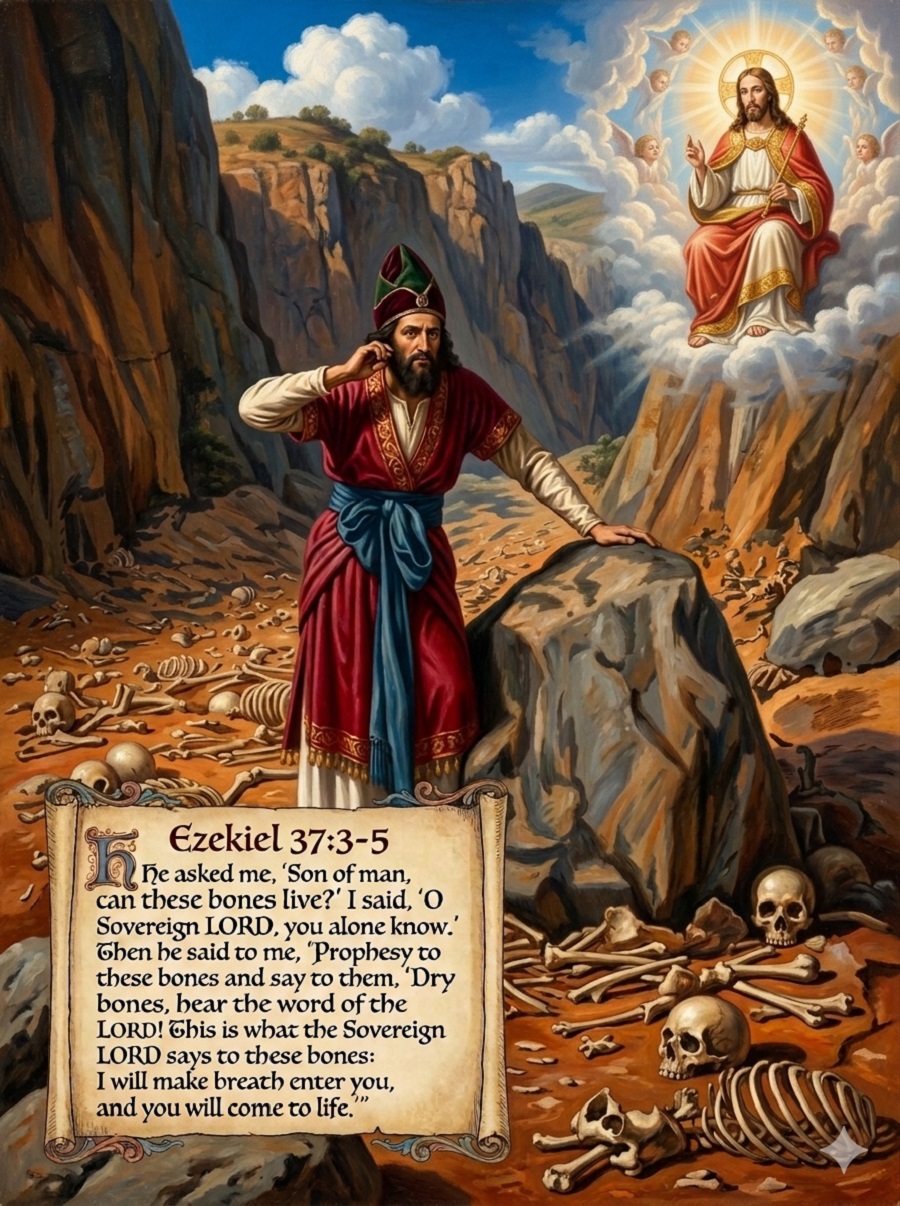
* "How foolish!" -Paul is not tolerant of this ignorance. Some measure God's power by their imagination. However, God's power is greater than we can imagine. When Ezekiel was asked, "Son of Man, can those bones live?" He wisely answered, "Oh Sovereign Lord, you alone know." (Ezekiel 37:3)
* "What you sow does not come to life unless it dies." -Paul is using the illustration of a seed. Jesus used the illustration of a seed to help describe his kingdom.
* Questions, Doubts, or Subterfuge?
Apostle Paul, still countering a claim coming from some in the Corinthian congregation that there is no resurrection of the dead (12), presents and addresses two questions that the "bad company" (33) was using as a clever mind trap, a disguised lie. They asked questions that most could not answer due to ignorance of God and the Bible (34).
"How are the dead raised? With what kind of body will they come?" they asked with a sly smile.
The corrupters implied that they knew the answer because they believed themselves gifted with knowledge. Their answer was, "You do not know, nor do you know anyone who does, because no one has ever seen anyone who has died come back to life and walk around. Yep, no zombies here. Therefore, resurrection from death does not exist."
Apostle Paul responds, "How foolish!" He then proceeds to give the illustration of a seed. It dies, transforms, and amazingly becomes a healthy plant. How? God designed it to be that way.
Where did Paul get this? Jesus, who said, "I tell you the truth, unless a kernel of wheat falls to the ground and dies, it remains only a single seed. But if it dies, it produces many seeds." (John 12:24) Beware, for the devil talks through many split tongues who try to humiliate and deceive God's chosen people. (1 Peter 5:8)
Listen to the above comments on 1 Corinthians 15:35-38.
>2. How does plant life illustrate the nature of the resurrected body?
* 1 Corinthians 15:37-38 "When you sow, you do not plant the body that will be, but just a seed, perhaps of wheat or of something else. But God gives it a body as he has determined, and to each kind of seed he gives its own body."
* "When you sow, you do not plant the body that will be" -Crops are everywhere in the world. Jesus used farming illustrations to convey spiritual truth.
* "but just a seed, perhaps of wheat or of something else." -The illustration of one of transformation of a radical kind.
* "But God gives it a body as he has determined" -God's sovereignty, power, and creativity.
* "and to each kind of seed he gives its own body." -Plant organisms, though organized similarly in their own order, are different; the seed down is related to the new plant that sprouts, but the new sprout has a different and genuinely new body that God has given it. (NIV Study Bible)
>And animals' bodies?
* 1 Corinthians 15:39 "All flesh is not the same: Men have one kind of flesh, animals have another, birds another and fish another."
* Consider how a caterpillar changes its body into a butterfly.
* "All flesh is not the same" -Paul is addressing the appearance, not the functional aspects of the flesh.
>How do the different kinds of flesh and their respective glories serve the purpose of their creation?
* "Men have one kind of flesh, animals have another, birds another and fish another." -Men have skin. Animals he is thinking of are with fur. Birds have feathers. Fish he is thinking of have scales. Of course, some animals like reptiles do not have fur and some fish like wales do not have scales.
* Paul is responding to the objection some have to the resurrection, "What kind of body will they have?" Paul is answer this, "What will they the dead look like if they were to rise from the dead?" "What kind of body will the have?" Paul is demonstrating that God makes all kinds of bodies. Just look at creation to see how many bodies.
>3. How are earthly bodies differentiated?
* 1 Corinthians 15:40 "There are also heavenly bodies and there are earthly bodies; but the splendor of the heavenly bodies is one kind, and the splendor of the earthly bodies is another."
* "There are also heavenly bodies and there are earthly bodies" -Paul now takes a turn to something most would not even consider, items in the sky. Most in the ancient world did not know what the lights in the night and day were. They only considered them. The telescope was not invented until 1608 AD. So humans could only look with natural eyes. First-century Greek philosophers (primarily Stoics and Middle Platonists) viewed the sun, moon, and stars as massive, divine, living beings made of either pure, intelligent fire or aether. They believed these celestial bodies were spherical and traveled in circular orbits around the Earth (more below). The Bible taught God created them, don't worship them, but nothing more (Deuteronomy 4:19; Job 9:7; Psalm 19:4, 74:16, 104:19, 148:3).
* "but the splendor of the heavenly bodies is one kind" -God has made them this way.
* "and the splendor of the earthly bodies is another." -God has made them this way.
* As God gave living beings different appearances, so God made the sun, moon, stars, and planets have different appearances.
>Describe and compare the splendor of the sun, the moon, and the stars. Consider the organization and beauty of creation and how they all point to God and his love for mankind, then consider how he also has a plan for you.
* 1 Corinthians 15:41 "The sun has one kind of splendor, the moon another and the stars another; and star differs from star in splendor."
* "The sun has one kind of splendor, the moon another" -Man had deduced by 5 century BC that the sun produced light and the moon reflected light of the sun. They also concluded that the moon traveled around the earth causing the moon to wax and wane. In the 3rd century BC, the mathematician Aristarchus even estimated the distance from the earth to the moon, placing it at about 60 times the earth's radius-a highly accurate calculation. However, even into the first century AD Greek philosophers believed earth was the center of the universe.
* "and the stars another; and star differs from star in splendor." -By the first century, the dominant philosophical school was Stoicism. Stoics treated the stars as semi-divine, conscious entities made of pure, concentrated fire. They believed the stars (along with the planets, sun, and Earth) were animated by pneuma, a "divine breath" or cosmic intelligence that connected all things in the universe.
A few outliers made startlingly accurate guesses. The pre-Socratic philosopher Anaxagoras (500-428 BC) suggested that stars were actually giant burning rocks. The astronomer Aristarchus of Samos (310-230 BC) proposed a heliocentric (sun-centered) model and deduced that the stars were, in fact, other suns so distant that their movement could not be seen from Earth.
* Will I Recognize and Be Recognized?
When conversations and Bible studies address the coming bodily resurrection of the dead, a question of recognition is always brought up: "Will I recognize my family and friends? Will they recognize me?" It appears that the question is asked because of Paul's three illustrations concerning the resurrection body. In reality, the person is afraid of being alone for eternity, forever searching for people they love.
Paul's three illustrations are meant to answer the questions in verse 35, their disguised objection to the resurrection. The first illustration, the seed illustration, was considered in yesterday's BDBD. The other two are in these verses: the vast array of animal bodies and all the bodies in space, what ancient writings, including the Bible, refer to as one of the heavens.
Apostle Paul's point is that God has an infinite imagination and inexhaustible and irresistible power. He is not saying we will be like a seed, an animal, or one of the lights in the sky. He is only pointing out the foolishness of the people asking silly questions like the ones in verse 35. (2:6-10a; Romans 1:19-10, 6:6; 1 John 3:2)
Today, people ask questions about recognition. The question of recognition has the same root problem as the questions of some in the Corinthian congregation. They do not trust God. Therefore, do they know God? Worse yet, are they more concerned about recognition between them and their family and friends than Jesus and his Father?
The intimate presence of God takes all fear and sadness away. Jesus is the Prince of Peace. Isn't his loving recognition better than a, "I don't know you. Away from me?"
Furthermore, do you need to see your loved one to know they are in the next room? If they wear a costume, how long would it take you to recognize your spouse, children, and parents? A person is more than their looks. We will recognize the ones we love no matter their appearance. Paul defined love in chapter 13. Appearance is not in the long definition. Love remains no matter the appearance. God will not let us down. He knows us better than we know ourselves. He was the one who designed for use to be in a community with those we love.
Listen to the above comments on 1 Corinthians 15:39-41.
>4. What analogy does the resurrected body and its splendor provide to the nature and splendor of the heavenly bodies?
* 1 Corinthians 15:42-44 "So will it be with the resurrection of the dead. The body that is sown is perishable, it is raised imperishable; it is sown in dishonor, it is raised in glory; it is sown in weakness, it is raised in power; it is sown a natural body, it is raised a spiritual body. If there is a natural body, there is also a spiritual body."
* "The body that is sown is perishable, it is raised imperishable"
* "it is sown in dishonor, it is raised in glory"
* "it is sown in weakness, it is raised in power"
* "it is sown a natural body, it is raised a spiritual body"
* "If there is a natural body, there is also a spiritual body."
* The frontispiece, now in public domain titled "The New Adam" is in a book by Wright, Paul, d. 1785. The books title is "The new and complete family prayer-book, or, Church of England man's divine library : being an universal illustration, commentary, exposition, and paraphrase on the Book of Common-Prayer and administration of the sacraments, and other rites, ceremonies, and offices of the Church, according to the use of the Church of England, together with the psalter or Psalms of David ... also, a companion to and preparation for the altar, the new and old versions of the Psalms ... the whole forming a valuable work, very useful for all Christian families, to excite devotion, and enable one to pray with the understanding / by Paul Wright ; ... embellished with ... copper-plate engravings".
This frontispiece depicts the fallen Adam and Eve, as indicated by the skeleton (representing death), the serpent, and the piece of forbidden fruit at their feet, looking into the heavens at the resurrected Christ enthroned among the clouds. Across from Jesus is the cross presented by angels. A dove representing the Holy Spirit is to Jesus' upper left, center picture. The inscription from 1 Corinthians 15:22 and expounded on in verses 45-49, invokes Christ as the "new" Adam.
Courtesy of the Digital Image Archive, Pitts Theology Library, Candler School of Theology, Emory University.
>5. In what way do human beings have both human (or physical) glory and spiritual glory (or splendor)?
* Believers will be raised in glory per verse 43 and Philippians 3:21. Glory is given by Christ (John 17:22). Is given by God (Psalm 84:11). Is the work of the Holy Spirit (2 Corinthians 3:18). Worldly glory is given by God and temporal (Daniel 2:27). Worldly glory passes away (1 Peter 1:24). Worldly glory of the noble and masses ends in destruction (Isaiah 5:14). It is in their shame (Philippians 3:19).
Glory is defined by the American Heritage Dictionary as:
Great honor, praise, or distinction.
Something conferring honor or renown.
A highly praiseworthy asset.
Adoration, praise, and thanksgiving offered in worship.
Majestic beauty and splendor.
The splendor and bliss of heaven.
A height of achievement, enjoyment, or prosperity.
A halo, nimbus, or aureole. In this sense, also called a gloriole.
Glory is defined by Easton's Illustrated Dictionary as:
Abundance, wealth, treasure, and hence honor (Psalm 49:12); glory (Genesis 31:1; Matthew 4:8; Revelation 21:24, 26).
Honor, dignity (1 Kings 3:13; Hebrews 2:7; 1 Peter 1:24); of God (Psalm 19:1; Psalm 29:1); of the mind or heart (Genesis 49:6; Psalm 7:5; Acts 2:46).
The glorious moral attributes, the infinite perfections of God (Isaiah 40:5; Acts 7:2; Romans 1:23, 9:23; Ephesians 1:12). Jesus is the "brightness of the Father's glory" (Hebrews 1:3; John 1:14, 2:11).
The bliss of heaven (Romans 2:7, 10, 5:2, 8:18; Hebrews 2:10; 1 Peter 5:1, 10).
The phrase "Give glory to God" (Joshua 7:19; Jeremiah 13:16) is a Hebrew idiom meaning, "Confess your sins." The words of the Jews to the blind man, "Give God the praise" (John 9:24), are an adjuration to confess. They are equivalent to, "Confess that you are an impostor," "Give God the glory by speaking the truth;" for they denied that a miracle had been wrought.
>What is the human or physical glory that physically-oriented people pursue?
* Several exist, but all revolve around ego.
* Appearance, intellect, sexual appeal, physical grace, social paralysis or persuasion, etc..
>What is the spiritual glory that spiritual men must pursue?
* The image of Jesus Christ.
>6. What is the seed of the resurrected body?
* The seed is Christ in the physical body.
* God gives all seed life. Without God a seed dies and remains dead.
>How will the spiritual man attain this spiritual body, which will be honorable, glorious, powerful and imperishable?
* Born again through the Holy Spirit planted by God the Father, sent by the Son, Jesus.
* Jesus taught by parable that God planted the seed. Paul, using Jesus' parable, wrote in 3:5-9 "What, after all, is Apollos? And what is Paul? Only servants, through whom you came to believe--as the Lord has assigned to each his task. I planted the seed, Apollos watered it, but God made it grow. So neither he who plants nor he who waters is anything, but only God, who makes things grow. The man who plants and the man who waters have one purpose, and each will be rewarded according to his own labor. For we are God's fellow workers; you are God's field, God's building."
>What is meant by the expressions 'sow' and 'raised'?
* "sown" -The original Greek verb is "speiro" (a transliteration) used 54 times in the New Testament meaning "to scatter", the way seeds were sown in the ancient world. Jesus used parables of a farmer scattering seeds to illustrate his kingdom.
* "raised" -The original Greek verb is "egeiro" (a transliteration) used 141 times in the New Testament meaning "to waken" (transitive or intransitive), i.e. "rouse" (literal from sleep, from sitting or lying, from disease, from death; or figurative from obscurity, inactivity, ruins, nonexistence).
* Sown Verses Raised.
Do you want or need a part of your body changed, something that no matter what you do, you cannot seem to change, or simply, there is no way to change? Perhaps it is a matter of perspective. And one of these perspective changes is with believing and understanding the coming change for the believer in Christ.
Apostle Paul uses two phrases concerning the resurrected bodies awaiting the disciples of Jesus: "it is sown" and "it is raised". As seeds are cultivated, so our bodies undergo cultivation. When we die, we are usually buried, and someday we will come forth from the earth with a new body. Though the average cell lifespan is seven to ten years, there is no need to be concerned about which cell it will be. That is just as silly a question to ask as the Corinthian congregation's questions.
The present state of our resurrected body is as we are now: perishable, dishonorable, weak, and natural. The regenerated resurrected body will be raised imperishable, glorious, powerful, and spiritual. Most likely, the human cell will be perfected, though the cell we have now, with self-replication, membrane-skin, a skeleton, micromachines-organs, and a nucleus containing the supercomputer code DNA, is rather remarkable.
The resurrected body will be more than physical. It will also be spiritual. Apostle John wrote, "Dear friends, now we are children of God, and what we will be has not yet been made known. But we know that when he appears, we shall be like him, for we shall see him as he is." (1 John 3:2)
We who believe in Jesus shall be like him. How is he? After writing this, John saw Jesus and gave an account of it in the book of Revelation. "I turned around to see the voice that was speaking to me. And when I turned, I saw seven golden lampstands, and among the lampstands was someone "like a son of man," dressed in a robe reaching down to his feet and with a golden sash around his chest. His head and hair were white like wool, as white as snow, and his eyes were like blazing fire. His feet were like bronze glowing in a furnace, and his voice was like the sound of rushing waters. In his right hand, he held seven stars, and out of his mouth came a sharp double-edged sword. His face was like the sun shining in all its brilliance. When I saw him, I fell at his feet as though dead. Then he placed his right hand on me and said: 'Do not be afraid. I am the First and the Last. I am the Living One; I was dead, and behold I am alive for ever and ever! And I hold the keys of death and Hades.'" (Revelation 1:12-18)
A change is coming. And that change will be you; your body will change.
Listen to the above comments on 1 Corinthians 15:42-44.
II. The Glorious Image of the Man From Heaven (15:45-49)
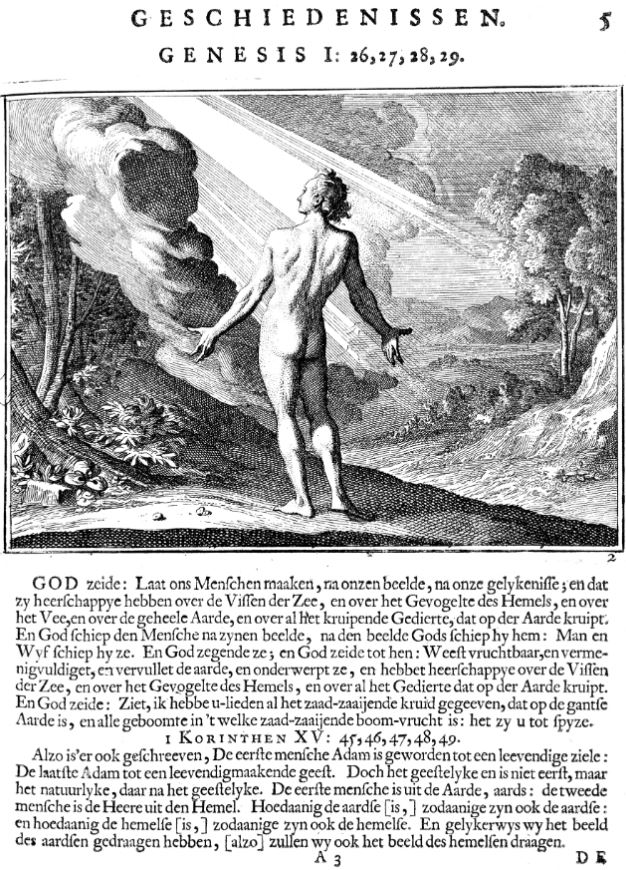
* The book print, now in public domain, titled "The Creation of Man" is in a book by Luiken, Jan (1649-1712). The books title is "De schriftuurlyke geschiedenissen en gelykenissen van het Oude en Nieuwe Verbond / Vertoonende drie honderd zeven en dertig konstige figuuren ; verrykt met bybelse verklaaringen en stichtelyke verzen, door Joannes Luiken, met het leven van den dichter".
Adam shown in the Garden of Eden, Paradise after God created him. The Dutch artist and poet Johannes Luyken drew and etched this emblem and wrote the accompanying poem. 1 Corinthians 15:45-49 is quoted below the poem. Genesis 1:26-29 is noted at the top.
Courtesy of the Digital Image Archive, Pitts Theology Library, Candler School of Theology, Emory University.
>7. In what way is Adam the ancestor of all men on earth?
* 1 Corinthians 15:45a "So it is written: 'The first man Adam became a living being'..."
* "So it is written" -The quote is from Genesis 2:7 "the LORD God formed the man from the dust of the ground and breathed into his nostrils the breath of life, and the man became a living being."
* "man Adam" -Adam is "man" in Hebrew. Adam was his name, and all bear his name since. "Man" in Greek is "anthropos" (a transliteration). The passage has both the Greek word for man and the Hebrew name for the first man.
* Adam and Eve's DNA are in all humans.
>How do his descendants receive their natural, earthly bodies?
* God created within Adam and Eve the ability to reproduce. Both give DNA to their child, a transfer of genetic code.
> Why is he called "a living being"?
* "'The first man Adam became a living being'..."
* Paul quotes Genesis 2:7. Genesis is written in Hebrew. However, Paul writes the verse in Greek because they would not know Hebrew.
* "being" -The original Greek noun is "psyche" (a transliteration). In Genesis the Hebrew "being" is "nephesh" (a transliteration). It is similar to "breath" and "breathed", as in God breathed into Adam life. Both mean "a breathing creature, i.e. animal" while also implying a spirit and soul.
>Who is the man from heaven?
* 1 Corinthians 15:45b "the last Adam, a life-giving spirit."
* 1 Corinthians 15:47b "the second man from heaven."
* "the last Adam" -Paul is referring to Jesus. Like Adam, Jesus had no human father. Jesus' father was God for Mary was a virgin. She knew no man sexually.
* "the second man from heaven" -Jesus descended from heaven, entered Mary's womb, was born, died, rose from the dead, ascended to heaven, presented himself risen from dead to God his Father, and descended to earth again. Jesus is the man from heaven.
>How is he different from the first man, Adam?
* Adam and Eve transferred physical life to their descendant. They did not created life nor did they give spiritual life. Jesus gave Adam and Eve life, the ability to transfer life to their children, and gave spiritual life.
* Jesus is the only author of life. Adam is not the author of life.
>Why is he called "the last Adam" and "a life-giving Spirit"?
* "the last Adam" -No other person will come who will have no father.
* "a life-giving Spirit" -No other will be able to give spiritual life. Jesus is both physical and Spirit. He is Creator.
>8. How did the man from heaven who became incarnate in a human body receive a glorified, spiritual body?
* 1 Corinthians 15:46-47 "The spiritual did not come first, but the natural, and after that the spiritual. The first man was of the dust of the earth, the second man from heaven."
* "The spiritual did not come first" -Adam was before Jesus. Paul is countering the false teachers in the Corinthian congregation.
* "the natural" -From the earth.
* "after that the spiritual" -From the Spirit, or perhaps better said, in the Spirit.
* "The first man was of the dust of the earth" -Genesis 2:7.
* "the second man from heaven." -After Jesus walked out of the grave, he went to his Father and presented himself as the perfect sacrifice. He was transformed into a spiritual body, came back to earth for 40 days and appeared to his disciples, then ascended to his Father and seated at his right hand until he will come a second time.
>How will his redeemed people similarly receive their own spiritual bodies?
* 1 Corinthians 15:48-49 "As was the earthly man, so are those who are of the earth; and as is the man from heaven, so also are those who are of heaven. And just as we have borne the likeness of the earthly man, so shall we bear the likeness of the man from heaven."
* "As was the earthly man, so are those who are of the earth" -Made of dust and mostly water.
* "as is the man from heaven, so also are those who are of heaven." -Will have a physical body, but the predominate element is spiritual.
* "And just as we have borne the likeness of the earthly man" -The form and soul are in general, like Adam and Eve. Genesis 1:27 has "man", then "him" and then, "make and female he created them" pointing back to "man". Paul earlier in this letter refers back to Genesis when talking about the order of male and female in congressional meetings.
>What does it mean that we shall bear the likeness of the man from heaven?
* "so shall we bear the likeness of the man from heaven." -Fact.
* Dirt Adam and Life Giving Adam.
God created the first man. "Man" is "Adam" in Hebrew (45; Genesis 1:26-27). Adam was formed from the dust of the earth and became a living being when the Lord God breathed life into his nostrils (Genesis 2:7). All people come from him and his wife, Eve.
Apostle Paul, led by the Spirit, reveals that Jesus is the last Adam. Jesus is in a newly created spiritual body, a life-giving spirit (45). When Jesus rose from the grave, he went to his Father (as presented in earlier BDBD) and was transformed into a glorious spiritual body, as he was transformed on the mount of transfiguration before Peter, James, and John (Matthew 17:1-8; Mark 9:2-8; 9:28-36). After his heavenly transformation, Jesus came from heaven (47) and appeared to his disciples, as mentioned in verses 5-8. Then he ascended into heaven, where he has been to this day.
Jesus is new life for those who have faith in him, for he is a life-giving spirit (45). We are born again, born of the Spirit (John 3:3-8, 16-21). When he comes from heaven, we will bear his likeness, as he is now in heaven (49). The contrast between the natural body and the spiritual body follows from their two representatives: Adam and Jesus.
Jesus promised, "For as the Father has life in himself, so he has granted the Son to have life in himself. And he has given him authority to judge because he is the Son of Man. Do not be amazed at this, for a time is coming when all who are in their graves will hear his voice and come out--those who have done good will rise to live, and those who have done evil will rise to be condemned." (John 5:26-29)
Listen to the above comments on 1 Corinthians 15:45-49.
III. The Glory of the Second Coming of Christ (15:50-58)
>9. Why did Paul call the resurrection of the dead a mystery? (Ephesians 3:3, Revelation 10:7)
* 1 Corinthians 15:50-51 "I declare to you, brothers, that flesh and blood cannot inherit the kingdom of God, nor does the perishable inherit the imperishable. Listen, I tell you a mystery: We will not all sleep, but we will all be changed--"
* Ephesians 3:2-6 "Surely you have heard about the administration of God's grace that was given to me for you, that is, the mystery made known to me by revelation, as I have already written briefly. In reading this, then, you will be able to understand my insight into the mystery of Christ, which was not made known to men in other generations as it has now been revealed by the Spirit to God's holy apostles and prophets. This mystery is that through the gospel the Gentiles are heirs together with Israel, members together of one body, and sharers together in the promise in Christ Jesus.
* Revelation 10:7 "But in the days when the seventh angel is about to sound his trumpet, the mystery of God will be accomplished, just as he announced to his servants the prophets."
* Paul speaks of mysteries in Romans 11:25, 16:25; Ephesians 1:9, 3:3-9, 5:32, 6:19; Colossians 1:26-27, 2:2, 4:3; and 1 Timothy 4:3 mainly in regard to the gospel which almost all did not understand or even know about before Christ came in the flesh. Apostle John uses it is Revelation 1:20, 10:7, and 17:5-7.
* "I declare to you, brothers" -Paul, again refers to the Corinthian congregation as brothers.
Calvin's Commentaries states, "This clause intimates, that what follows is explanatory of the foregoing statement. "What I have said as to bearing the image of the heavenly Adam means this - that we must be renewed in respect of our bodies, inasmuch as our bodies, being liable to corruption, cannot inherit God's incorruptible kingdom. Hence there will be no admission for us into the kingdom of Christ, otherwise than by Christ's renewing us after his own image." Flesh and blood, however, we must understand, according to the condition in which they at present are, for our flesh will be a participant in the glory of God, but it will be - as renewed and quickened by the Spirit of Christ."
* "mystery" -2:7 is a good definition where it says "God's secret wisdom... hidden". So, we cannot know unless God reveals the wisdom to us. The original Hebrew noun is "mysterion" (a transliteration) used 27 times in the New Testament from a derivative of "muo" which means "to shut the mouth". "Mysterion" means "secret" or "mystery" through the idea of "silence" imposed by "initiation" int0 religious rites.
* "I tell you a mystery" -Daniel is said to have been revealed mysteries (Daniel 2:18-30, 47, 4:9)
* Verses 51b through 57 are rendered as a poem in the Holman Christian Standard Bible (HCSB).
>What will happen at the time of the resurrection?
* "that flesh and blood" -Philippians 3:3 says we put no confidence in the flesh. Flesh here is not the skin, but the worldly body that is corrupted by sin, cursed with the ground when Adam sinned. The original Greek noun for "flesh" is "sarx" (a transliteration) used over 150 times in the New Testament usually translated "flesh", but also translated "carnal", "carnally minded", and "fleshly". "Blood" is translated from the Greek noun "haima" (a transliteration) used almost 100 times in the New Testament, always translated "blood".
* "cannot inherit" -The original Greek verb is "kleronomeo" (a transliteration) from "kleronomos" meaning "to be an heir (literally or figurative)". It is proceeded by the negative particle "ou" and "ouk" and "ouch" used over 1,500 times.
* "the kingdom of God" -Adam Clarke's Commentary states, "This is a Hebrew periphrasis for man, and man in his present state of infirmity and decay. Man, in his present state, cannot inherit the kingdom of God; his nature is not suited to that place; he could not, in his present weak state, endure an exceeding great and eternal weight of glory. Therefore, it is necessary that he should die, or be changed; that he should have a celestial body suited to the celestial state. The apostle is certainly not speaking of flesh and blood in a moral sense, to signify corruption of mind and heart; but in a natural sense; as such, flesh and blood cannot inherit glory, for the reasons already assigned."
A Commentary: Critical, Experimental, and Practical on the Old and New Testaments states, "The kingdom of God - which is not at all merely animal, but altogether spiritual. Corruption doth not inherit, though it is the way to, incorruption." (1 Corinthians 15:36, 52, 53).
The Believer's Future - Hope that Inspires found on this website states (see link on top), "Chapter 13 of Matthew records seven of Jesus' parables concerning the Kingdom of Heaven. Mark chapter 4 also has some of them. A few facts are understood from Jesus' parables in Matthew 13; the Kingdom of God starts with the preaching of the good news (sowing of the Word), the Kingdom of God can grow in hearts of different quality and character though only one is true, the people of the Kingdom of God produce fruit, there is opposition to the Kingdom of God from the world and the flesh and the devil, the people of the Kingdom of God have to make daily choices, the people of the Kingdom of God are in this world among the people of this world's kingdom (false imitations), the people of the two kingdoms look the same with the exception of producing fruit, this world's kingdom will end and its people sorted out and cast out at the end of the age, the Kingdom of God will start small, grow to be large and continue on forever."
* "nor does the perishable inherit the imperishable." -Like oil and water do not mix, so perishable and imperishable cannot mix. If perishable is in an imperishable kingdom, it would still perish. It needs to be like its surroundings and thus needs to change.
* "We will not all sleep" -"Fallen Sleep" is used in 11:30. Sleep is a word Jesus used for the physical body ceasing to function, but the soul and spirit continuing on.
* "we will all be changed" -The original Hebrew noun is "allasso" (a transliteration) used 6 times in the New Testament from "allos" meaning "to make different", "alter", "transform", or "exchange one thing for another". "Allos" implies making something "other than it is" or causing one thing to cease while another takes its place, signifying a radical shift rather than minor adjustment.
* Flesh and Blood Cannot Inherit.
The Holy Spirit inspired Apostle Paul to declare that flesh and blood cannot inherit the kingdom of God. "Flesh and blood" refers to people who are descendants of Adam and Eve, but are not born a second time, in Christ Jesus through the Spirit. As Jesus told Nicodemus, "No one can see the kingdom of God unless he is born again." (John 3:3)
The "kingdom of God" is where God rules in sovereignty, more specifically it this chapter, it is refering to Jesus' second coming with his people following him, and establishing his rule on earth (Matthew 6:9-10, 13:24, 31, 33, 44-45, 47, 20:1, 22, 25:1-46).
The Holy Spirit reveals through Paul that we "inherit" the kingdom of God. An inheritance comes only when someone dies. And so Christ died. With Jesus' resurrection in glory, we inherit the kingdom of God. The author of Hebrews wrote, "For this reason Christ is the mediator of a new covenant, that those who are called may receive the promised eternal inheritance--now that he has died as a ransom to set them free from the sins committed under the first covenant." (Hebrews 9:15)
Know this: if you accept and live by the gospel, then whether you are alive or asleep (physically dead) when Jesus comes, you will be changed, see Jesus as he is, and inherit the earth. Jesus has a place for you, and that place is very good, and that place is with him forever in a glorious resurrection body. You have an inheritance that will never spoil, rust, fade, or be stolen (Matthew 6:19-21).
Listen to the above comments on 1 Corinthians 15:50-51.
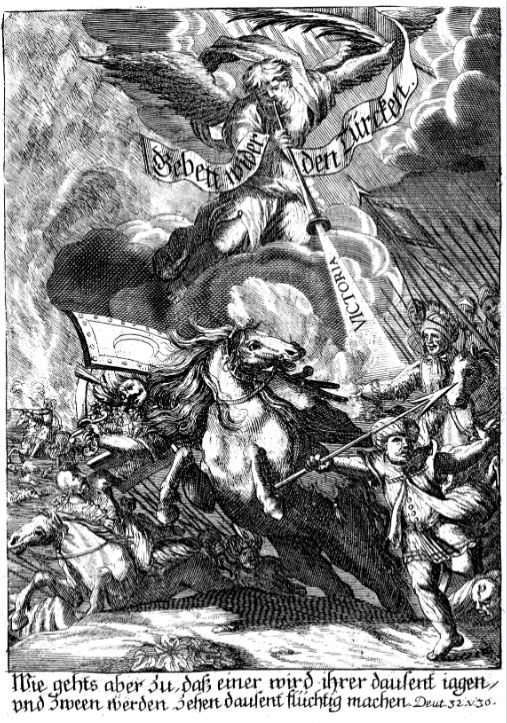
* The image is part of a two page historiated border in a book by Fortunat, F. The book's title is "Hochschätzbarer Seelen Ehren Thron : das ist Ein wahrhafftes Formular, oder allbewerteste Richtschnur ... die Seel ... in allweg sicher zu stellen". This phrase is a 17th/18th-century German religious title, translating to: "Highly Estimable Throne of Honor for Souls: That is a true formula, or most valuable guide... to secure the soul in all ways [in this transient life and that fatherland]."
A battle scene in which an angel blows a trumpet victorious. Deuteronomy 32:30 is written below the image. Deuteronomy 32:30-31 reads, "How could one man chase a thousand, or two put ten thousand to flight, unless their Rock had sold them, unless the LORD had given them up? For their rock is not like our Rock, as even our enemies concede."
Courtesy of the Digital Image Archive, Pitts Theology Library, Candler School of Theology, Emory University.
>How will the resurrection of the dead occur?
* Matthew 24-25, Mark 13, and Luke 21:5-36 record Jesus' teaching his disciples about the end of the age. See Matthew study 29 comments, Mark studies 25 and 26 comments, and Luke study 37 comments.
* 1 Corinthians 15:52 "in a flash, in the twinkling of an eye, at the last trumpet. For the trumpet will sound, the dead will be raised imperishable, and we will be changed."
* "in a flash" -Paul was thinking of lightning according to Jesus' analogy in Luke 17:24. "For the Son of Man in his day will be like the lightning, which flashes and lights up the sky from one end to the other."
* "the twinkling of an eye" -The original Greek noun for "twinkling" is "rhipe" (a transliteration) from the verb "rhipto" (a transliteration) meaning "jerk (of the eye, i.e. by analogy an instant"). This can also be thought of as a sudden movement such as a blink. "Rhipe" is only used here in the New Testament. "Rhipto" is used 7 times.
* "at the last trumpet. For the trumpet will sound" -The original Greek noun for "trumpet" is "salpinx" (a transliteration) perhaps from the noun "salos" through the idea of "quavering" or "reverberation". Of the 11 times "salpinx" is used in the New Testament it is always translated trumpet. A "salpinx" primarily referred to a long, straight, bronze war trumpet with a flared bell, used for military signals, athletic events, and public gatherings. It was a tactical instrument rather than a melodic one, designed to produce loud, piercing sounds to signal troops. The same is true for Israel's trumpets.
* Numbers 10:1-10 and Joshua 6:1-20 state the reasons to blow a trumpet. Reasons for blowing the shophar are; to call the community together (Psalm 150:3), to call the elders together, to have the Israel camp set out, before going into battle (Judges 6:34), during a battle, taking a city, at the beginning of each month (new moon), during the time of rejoicing (1 Kings 1:34), during the holy feasts, over burnt offerings and fellowship offerings, and the presence of God (Exodus 19:16).
* The Feast of Trumpets (Yom Terium) proclaims the bride's resurrection, God's judgment on the wicked, and Jesus' second coming. (Numbers 29:1-6; Leviticus 23:23-24, 25:8-9)
* Revelation records seven trumpets sounding. Revelation 8:6-13 are the first four, 9:1-21 are the fifth and sixth, and 11:15-19 is the seventh, last trumpet. When the last of the seven trumpets sounds several things will happen including Jesus physically arriving on earth as King. Revelation 11:15-18 states, "The seventh angel sounded his trumpet, and there were loud voices in heaven, which said: "The kingdom of the world has become the kingdom of our Lord and of his Christ, and he will reign forever and ever." And the twenty-four elders, who were seated on their thrones before God, fell on their faces and worshiped God, saying: "We give thanks to you, Lord God Almighty, the One who is and who was, because you have taken your great power and have begun to reign. The nations were angry; and your wrath has come. The time has come for judging the dead, and for rewarding your servants the prophets and your saints and those who reverence your name, both small and great-- and for destroying those who destroy the earth."
* Revelation 10:7 "But in the days when the seventh angel is about to sound his trumpet, the mystery of God will be accomplished, just as he announced to his servants the prophets."
* Isaiah 18:3 also states, "All you people of the world, you who live on the earth, when a banner is raised on the mountains, you will see it, and when a trumpet sounds, you will hear it."
* Isaiah 27:12-13 records worshipers being gathered at a trumpets sounding. It states, "In that day the Lord will thresh from the flowing Euphrates to the Wadi of Egypt, and you, O Israelites, will be gathered up one by one. And in that day a great trumpet will sound. Those who were perishing in Assyria and those who were exiled in Egypt will come and worship the Lord on the holy mountain in Jerusalem." This seems to be the threshing Jesus spoke of in Matthew 13.
* 1 Thessalonians 4:13-18 also speak of the sounding of trumpets during the tribulation.
* The above note on trumpets is from "The Believer's Future -Hope That Inspires" found on this site.
* The sound of the trumpet in ancient Israel provoked fear in the hearts of all.
* "the dead will be raised imperishable" -All saints before, from the time of Adam on.
* "we will be changed." -Apostle Paul and the other apostles believed that Jesus could come in their lifetime because Jesus taught his coming was immanent with words like "watch" and "be ready" and "do not let your candles go out". They, as the rest of the church had experienced persecution to the point of death. Their lives included suffering, trouble, and tribulations as Jesus told them. They were listening and waiting for the trumpets to begin.
* Post-tribulation rapture (the church will experience the seven year tribulation and be caught up to meet Christ at His second coming) is considered the historic, orthodox view held by early church fathers and prominent reformers. It was not "first taught" in a specific year, but rather is the default, original view of the early church prior to the rise of pre-tribulation theories in the 1800s.
Premillennialism (a belief that Christ would return before the millennium) was dominant in the first few centuries, with teachers looking for a return of Christ after tribulations, not before. Historically, theologians such as Martin Luther, John Calvin, and later leaders like John Bunyan and Charles Spurgeon held to post-tribulation viewpoints, seeing the rapture (or "catching up") as occurring when Christ returns to Earth in glory.
* Pre-tribulation rapture, (the saints taken from earth before the seven years tribulation) is less than a 300 years old idea. None of the earlier church leaders wrote about it. The earliest isolated ideas regarding a "pre-tribulation" rapture existed no more than 300 years ago. The first to do so were a few men who were not pastors, nor had any prominate position in any denomination or congregation (e.g., Morgan Edwards in 1744). The systematic creation of charts and graphs representing the modern tribulation timeline was popularized by John Nelson Darby (1800-1882), a 19th-century Anglo-Irish Plymouth Brethren leader. Darby's movement is widely credited as the father of "modern dispensationalism" and the creator of the theological framework for pre-tribulation rapture charts and timelines. His teachings, which separated the destinies of Israel and the Church, were later popularized through graphic charts by followers like Sir Edward Denny and popularized in America by C.I. Scofield (1843-1921), especially by his 1909 Scofield Bible.
* William Miller (1782-1849), an American Baptist preacher, greatly influenced by John Nelson Darby in the early 1800s, twice predicted that Jesus Christ would return to Earth, the first between March 1843 and March 1844. Miller's followers, or "Millerites," grew to 100,000, with many selling their belongings, expecting an imminent return of Jesus. His followers widely believed this prediction, leading to the "Great Disappointment" when the world did not end as expected, specifically after a second revised date of October 22, 1844.
After both dates passed without incident, many left the movement. Miller stopped predicting dates, but held onto and taught his ideas until his death as a Baptist in December 1849. Several groups formed from amoung Miller's followers. One is the Seventh-day Adventist Church (SDA), a cult, not a Christian congregation or denomination. The Jehovah Witness, a cult, founder Charles Taze Russell in the 1870s believed in and followed William Miller's teachings and charts. Other religious groups include The Advent Church of Christ, and Church of God (Seventh Day). All of these groups try to hide the fact that they are founded based on the false prophet William Miller.
* The cult group Jehovah Witnesses have falsely predicted Jesus' return four times in their magazine "Watchtower", reworded their false predictions and stole all the copies of the "Watchtower" that have the false predictions from all public libraries that shows their errors. I have seen the original publications.
1875, founder Charles Taze Russell, greatly influenced by John Nelson Darby and William Miller, taught that Jesus returned. When proven wrong he later claimed Jesus was invisible. This was based on Adventist chronology (Adventist chronology is the prophetic and eschatological timeline maintained by the Adventist started by the predictions and teachings of William Miller. See above.) and remained official teaching until approximately 1930.
1914, was originally predicted as the visible end of "Gentile Times" and the total destruction of earthly governments. After WWI began on July 28, 1914, the interpretation shifted; the organization now teaches that Jesus began ruling invisibly from heaven in October 1914.
1925, second president J.F. Rutherford predicted the literal resurrection of biblical "patriarchs" (i.e. Abraham, David, etc.) and the start of the Millennium. When every asked to present the patriarchs and asked how many were resurrected since they also taught at the time that only 144,000 will be saved, no evidence, of course, or proper reply is presented. They do not like discussing this.
1975, high expectations were sent in "Watchtower" literature several times that 1975 would hark 6,000 years of human history and thus start Christ's millennial physical reign on earth. When they did not happen, they again stole all the copies from public libraries, and claim they said their claim was "... potentially the start..."
present Jehovah witnesses say they never taught only 144,000 will be saved. They said they always taught only 144,000 will go to heave. They also said their predictions were not wrong, just wrongly understood. Yet, they will never present the Watchtowers that made those predictions because they reveal that they are not telling the truth.
* Edgar C. Whisenant, a former NASA engineer and self-taught Bible teacher, sold 4.5 million copies of the booklet, "88 Reasons Why the Rapture Will Be in 1988". The booklet claimed Jesus would return to rapture Christians during the modern (not Biblical) Jewish holiday of Rosh Hashanah in 1988 (September 11 through 13). Edgar was indirectly influenced by Darby and Miller. Some pastors took it seriously and some pointed out most of the 88 points were not Biblical. When the dates passed without the event occurring, Whisenant released subsequent books with revised dates for 1989 and the early 1990s, though none reached the same level of notoriety. His last prediction is believed to be 1994. I read the first pamphlet. Most of the 88 reasons had little or nothing to do with the Bible, but many church attending people believed his false predictions. He is not known to start any group.
* Harold Camping, influenced by John Nelson Darby and William Miller, was the Christian radio broadcaster and civil engineer who owned a massive network of FM radio stations in the 1960s into the early 2000s, predicted the rapture. As the president of the California-based Family Radio network, Camping grew his independent media empire to broadcast in over 150 markets across the United States. He famously used his network and millions of dollars in donations to blanket the country with billboards and advertisements predicting the Rapture would occur on May 21, 2011, followed by the end of the world later that year. I did not believe him, but saw the billboards and heard him speak about it on the radio. When the apocalyptic dates passed without incident Camping said, "It must have been a spiritual rapture, and spiritual return." Though he owned the network, his son turned off his father's microphone and refused him to speak online any more. Eventually, Camping stepped down from active broadcasting, and Family Radio scaled back operations.
* At the Last Trumpet.
When will Jesus come again? A question that the prophets and even the apostles asked. Jesus' reply was, "No one knows about the day or hour, not even the angels in heaven, nor the Son, but only the Father." (Matthew 24:36; Mark 13:32) So, the apostles watched believing Jesus could come any minute for Paul wrote, ".when we will be changed", including himself in the group who will still be alive when Jesus comes. Over 2,000 years have passed. Are you still watching?
Many false prophets since the early 1800s, in grave error, have predicted either Jesus' second coming or the sound of the trumpet at the rapture -many in my lifetime. Sadly, the followers of those false prophets remain in the cults that formed around their false prophecies.
Apostle Paul repeats what Jesus taught. The saints' change to an imperishable body will occur instantly, "in a flash", at his coming. Jesus told a Pharisee who asked about the coming of the Kingdom of God, "For the Son of Man in his day will be like the lightning, which flashes and lights up the sky from one end to the other." (Luke 17:24).
Apostle Paul also refers to Jesus and the prophets' references to "the last trumpet". (Leviticus 23:24, 25:9; Isaiah 18:3; Jeremiah 4:5, 31:27; Ezekiel 7:14; Joel 2:1, 15; Zechariah 9:14) Jesus said, "And he will send his angels with a loud trumpet call, and they will gather his elect from the four winds, from one end of the heavens to the other." (Matthew 24:31). Paul had already wrote this to the congregation in Thessalonica. (1 Thessalonians 4:14-18)
Several years after Paul's letters, Jesus revealed to the Apostle John that he would send seven angels with seven trumpets, "the last trumpet" blown is our transformation, when he comes again. (Revelation 11:15-19) The verses contain, "The time has come for judging the dead, and for rewarding your servants the prophets and your saints and those who reverenced your name, both small and great -- and for destroying those who destroy the earth." (Revelation 11:18)
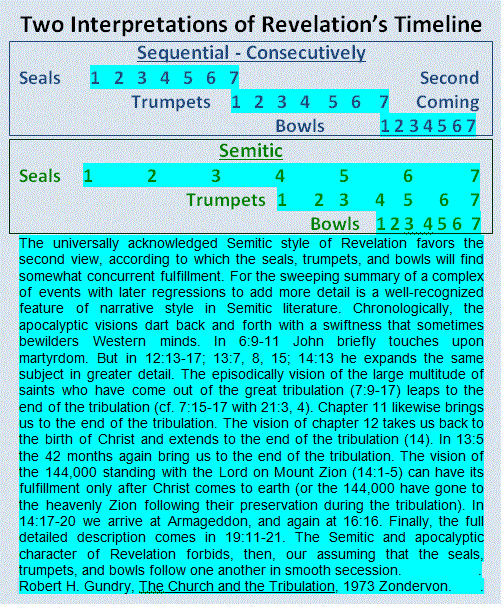
Do not be confused or misled. The book of Revelation is presented from a Semitic view, not a Western, consecutive, sequential view. On the day that Jesus comes, whenever that will be, "the last trumpet" will sound, "the dead in Christ will rise imperishable", those who are alive "will be changed," we will all meet Jesus in the sky as he descends to earth to establish his kingdom. (Revelation 8:1-5, 11:15-19, 16:17-21, 18:1-19:21 are all referring to the same time, the end). Therefore, keep aleart, keep watch, always be ready for we do not know the day or the hour.
Listen to the above comments on 1 Corinthians 15:52.
>10. What is the meaning of verse 53?
* 1 Corinthians 15:53 "For the perishable must clothe itself with the imperishable, and the mortal with immortality."
* "the perishable" -The physical body"
* "must clothe itself" -The physical body remains, but is underneath. The glory is wrapped around like a long clothing.
* "the imperishable" -The spiritual body is visible as light, another word is glory.
* "the mortal with immortality" -The exact mechanism and/or manner of natural mortality is debated, because the slow decay of the body is complicated, brought on by the curse. Science defines this as entropy, meaning an inevitable and steady deterioration of a system.
>What will be the ultimate victory of the risen Jesus at his second coming?
* 1 Corinthians 15:54 "When the perishable has been clothed with the imperishable, and the mortal with immortality, then the saying that is written will come true: "Death has been swallowed up in victory."
* 1 Corinthians 15:57 "But thanks be to God! He gives us the victory through our Lord Jesus Christ."
>What will this mean to believers?
* 1 Corinthians 15:55 "Where, O death, is your victory? Where, O death, is your sting?"
* Isaiah 25:8 is 54b. Verse 55 is Hosea 13:14.
>To unbelievers?
* 1 Corinthians 15:56 "The sting of death is sin, and the power of sin is the law."
* "The sting of death is sin,"
* "the power of sin is the law."
* What are These?
Are eternal questions worthy of never-ending, deep thoughts? Perishable and imperishable? Mortality and immortality? Death, sin, law, and victory unto eternal life? Does a never-ending seeker desire to know the answer? Or does he love seeking so much that he refused to find the joy of meeting and embracing truth? Listen for the shout of truth.
Knowledge has no real satisfaction if it has no love of truth. Truth is the word that has been spoken from the beginning. But man does not love the truth. They are afraid of the truth. They hid and ran from the truth. The truth swallows up death in victory with one word. And the word is "It is finished."
Another word will soon be spoken. I listen for that word. Deep thought is not needed. Concentration and cross-references need not be employed. Listen for the truth to speak again. "Rise up!" Truth will trumpet in victory, "Rise up!" Truth will sting, "Rise up!" I love the truth. The simple-minded find truth easier to accept than those who get lost in deep thoughts.
Listen to the above comments on 1 Corinthians 15:53-57.
>11. In light of the resurrected body and Christ's ultimate victory, why shouldn't Christians be moved by any worldly temptation but rather give themselves full to the work of the Lord?
* 1 Corinthians 15:58 "Therefore, my dear brothers, stand firm. Let nothing move you. Always give yourselves fully to the work of the Lord, because you know that your labor in the Lord is not in vain."
* "my dear brothers" -Paul addressed them as "brother" in the beginning of the chapter (as well as four times in chapter 14. Now, even more dearly.
* "stand firm. Let nothing move you."
* "fully to the work of the Lord"
* "your labor in the Lord"
* "is not in vain." -The original Greek adjective for "vain" is "kenos", apparently a primary word meaning, "empty", "void", and "vain", used 18 times in the New Testament. Literally, kenos was used to describe physical objects that contained nothing. For example, it could refer to an empty vessel, an empty-handed person arriving without a gift, or a person having no possessions. More commonly in first-century philosophical and biblical texts, kenos was used metaphorically to describe things that lacked substance, value, or lasting effect.
* Stand Firm, Work for the Lord.
In light of Jesus' resurrection, our bodily resurrection, and Christ's ultimate victory, Christians should not be moved by worldly temptation. Rather, we should give ourselves fully to the work of the Lord.
Jesus sternly tells his disciples, "It's like a man going away: He leaves his house and puts his servants in charge, each with his assigned task, and tells the one at the door to keep watch. Therefore, keep watch because you do not know when the owner of the house will come back--whether in the evening, or at midnight, or when the rooster crows, or at dawn. If he comes suddenly, do not let him find you sleeping. What I say to you, I say to everyone: 'Watch!'" (Mark 13:34-37)
Yes, each one of Jesus' disciples has been assigned work of the Lord. The work is "of the Lord", not work for our food, shelter, and clothing. The Lord's work is not for essential living needs, for our Father knows what we need. That is why Jesus told us, "Seek first God's kingdom and his righteousness, and all these things will be given to you as well." (Mark 6:32).
The Lord's work is not in vain. Kingdom work is not pointless, does not lack substance, value, or lasting effect. The work that we do for King and Kingdom will last for eternity. Keep up the good fight.
Listen to the above comments on 1 Corinthians 15:57-58.