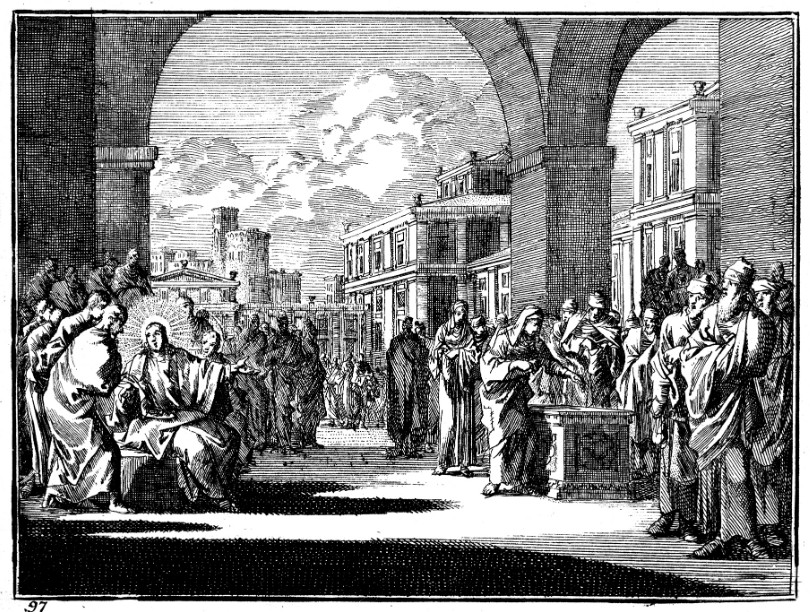
* Jesus shows his disciples the widow who put her last penny in the collection box. The Dutch artist and poet Johannes Luyken (1649-1712) drew and etched this emblem and wrote the accompanying poem.
The artwork titled is "Jesus Sits Across from the Collection Box" and the ascribed Biblical passages are Mark 12, 2 Kings 12, and 1 Corinthians 16. The book's author is Luiken, Jan (1649-1712) and its title, "De schriftuurlyke geschiedenissen en gelykenissen van het Oude en Nieuwe Verbond / Vertoonende drie honderd zeven en dertig konstige figuuren ; verrykt met bybelse verklaaringen en stichtelyke verzen, door Joannes Luiken, met het leven van den dichter".
The online edition of this work in the public domain, i.e., not protected by copyright, has been produced by Pitts Theology Library, Emory University.
>1. What is the last subject for the congregation to take care of?
* 1 Corinthians 16:1 "Now about the collection for God's people: Do what I told the Galatian churches to do."
*
Chapter 16 Overview.
Paul concludes his letter to the congregation at Corinth with an instruction, a personal request, and final greetings.
The Corinthian congregation met on the first day of the week, the day after the Sabbath, our Sunday, the day Jesus rose from the grave and the day of Pentecost when the Holy Spirit was sent. (2; Acts 20:7; Revelation 1:10) Paul told them to gather together money to help the believers in Jerusalem and collect it during their regular Sunday meetings. (1-2) Judah, where poor persecuted Christians lived, was experiencing a severe drought. (Acts 8:1, 11:28, 44 or 46 A.D.) They were to plan and prepare according to their income to help fellow Christians. Helping other believers is a good part of life in Jesus. (1 Peter 4:9; 3 John 1:8)
Paul also encouraged hospitality toward traveling believers, such as Timothy who he was sending to them to deliver this letter. (10-11, 15-17) At times I was stationary for many years and accepted others into my abode. Other times I moved here and there often. Once in 15 months, I stayed at 8 different places. Some for a few days, others longer and still others I visited more than once. Some of these times the Lord's people and family welcomed me in. Most of the time I was alone renting. A few times I had guests. It is good to open my home and share time with believers.
Listen to the above Chapter 16 Overview.
* "Now about" -Answering another question from the Corinthians. (7:1, 8:1, 12:1) Paul had exchanged letters with Corinth that we do not have, already discussed in an earlier commentary for this letter. See below for more information.
* Paul first arrival at Corinth is recorded in Acts 18:1. Silas and Timothy came to Paul in Corinth according Acts 18:5, and 1 Thessalonians 3:6. Paul wrote 1 Thessalonians and sent it to that church during his first stay at Corinth. About six months later in late 51 or early 52 A.D. Paul wrote 2 Thessalonians. Most believe that Paul wrote Galatians while in Corinth or perhaps when he arrived back at Antioch at the end of his second mission trip (late 52 A.D.)
Paul wrote this letter and the second while in Ephesus where he first planned to collect money for the believers in Jerusalem and Judea where there was a drought. Paul stopped at Corinth on the looped end to his third missionary journey where he penned the letter to the believers in Rome. He made a short stop in Ephesus and then went to Jerusalem. (56 A.D., Acts 20:2-38) Paul ended the third missionary trip in Jerusalem. He presented a gift that was collected for the poor and needy in Jerusalem. (57 A.D., Acts 20:39-21:16)
* "Do what I told the Galatian churches to do." -Apostle Paul had sent letters to all the congregations in Europe and Asia, including Galatia and Corinth, telling them to prepare charitable gifts. Paul's letters would have required a response. With the response the Corinthian's agreed to collect money, but they also had questions, thus starting an exchange of letters of which we have two. See below for more information.
>Who is Paul referring to and why was he making a collection for them?
* "the collection" -Charity. Not part of offering to support their congregation.
* "for God's people" -The book of Acts of the Apostles has Paul delivering this gift to the leaders in Jerusalem. (Acts 21:17-25)
* Acts 8:1 "And Saul was there, giving approval to his death. On that day a great persecution broke out against the church at Jerusalem, and all except the apostles were scattered throughout Judea and Samaria. "
* Acts 11:28 "One of them, named Agabus, stood up and through the Spirit predicted that a severe famine would spread over the entire Roman world. (This happened during the reign of Claudius.)"
* Emperor Claudius reigned over the Roman Empire from January 24, 41 A.D., until his death on October 13, 54 A.D. Paul wrote this letter less than a year after Claudius' death.
The Roman historian Suetonius recorded that Emperor Claudius expelled Jews from Rome in 49-50 A.D. because they were constantly rioting at the "instigation of Chrestus". It has been called The Roman Expulsion. The majority of scholars interpret "Chrestus" as a misspelling of "Christus" (Christ), meaning these disturbances were likely caused by conflicts between traditional Jews and Jewish Christians (Messianic Jews) over the identity of Jesus as the Messiah.
This event is recorded in Acts 18:2, which notes Apostle Paul while at Corinth meet Aquila and Priscilla, who had just fled Rome because Claudius ordered all Jews to leave Rome. Because Christianity was still viewed by the Roman government as a sect of Judaism, Christian believers were caught in this ban and expelled from the capital alongside non-Christian Jews.
Claudius also issued edicts regulating the Jewish community in Alexandria, which some historians believe were early attempts to suppress the spread of the new Christian movement in Egypt. In general Emperor Claudius was greatly concerned about any new religion incursion into the Empire and expelled time, money, and energy to advance and reawaken ancient Roman religious practices, even to the point of executions.
See study 5 comments, question 7b for a list of major first-century Christian persecutions including the execution of James, the brother of John during Claudius' reign.
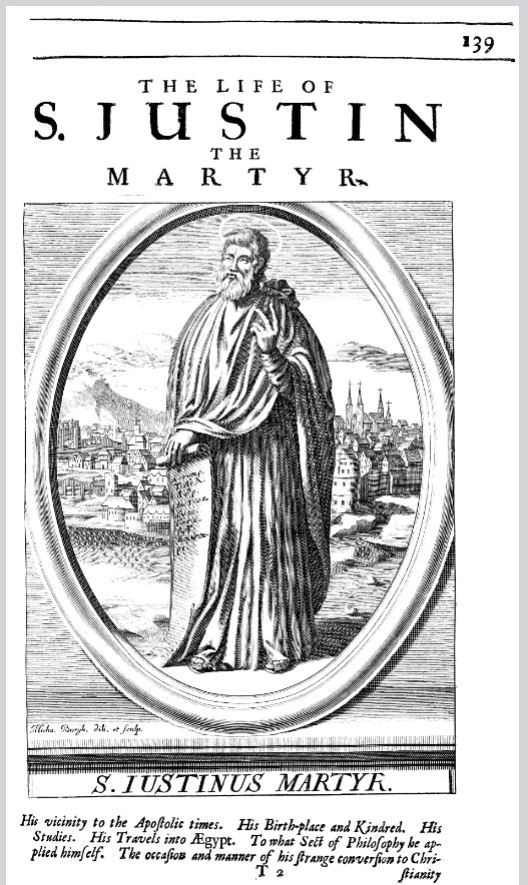
* Justin Martyr (c. 100-165 AD) was an early Christian apologist and philosopher born in Flavia Neapolis (modern Nablus, Palestine). The image shows him holding a Greek scroll. This engraving is the work of Michael Burghers. The image is in a book by Cave, William (1637-1713). The title of the book is "Apostolici: or, The history of the lives, acts, death, and martyrdoms of those who were contemporary with, or immediately succeeded the apostles. : As also the most eminent of the primitive fathers for the first three hundred years. To which is added, a chronology of the three first ages of the church".
The online edition of this work in the public domain, i.e., not protected by copyright, has been produced by Pitts Theology Library, Emory University.
>What day of the week were the congregation meeting on a regular basis? (2a; Acts 20:7; Revelation 1:10)
* 1 Corinthians 16:2 "On the first day of every week, each one of you should set aside a sum of money in keeping with his income, saving it up, so that when I come no collections will have to be made."
* "On the first day of every week" -According to Jewish calendar this is the day after the Sabbath, which we now call Sunday. The Jewish calendar name for all days were numbers with the exception for the seventh day which is call the Sabbath. The first day of the week is the actual Jewish name for the day we now call Sunday. The first church in Asia usually meet on Sunday, the day Jesus rose from the dead and walked out of the tomb. (Matthew 28:1; John 20:1, 7; Acts 20:7) Pentecost also falls on Sunday, the day the promised Holy Spirit came upon the church, the day to disciples began boldly proclaiming the gospel, the birth of the church. (Acts 2:1-2)
* Matthew 28:1 "After the Sabbath, at dawn on the first day of the week, Mary Magdalene and the other Mary went to look at the tomb."
* Acts 20:7-12 records a miracle during one of their typical Sunday meeting at the time. Verse 7 records, "On the first day of the week we came together to break bread. Paul spoke to the people and, because he intended to leave the next day, kept on talking until midnight."
* Revelation 1:10 "On the Lord's Day I was in the Spirit, and I heard behind me a loud voice like a trumpet,"
* Acts 2:1-2 "When the day of Pentecost came, they were all together in one place. Suddenly a sound like the blowing of a violent wind came from heaven and filled the whole house where they were sitting."
* Pentecost (Hebrew "Shavout"), the Greek word means fiftieth, is always on the first day of the week, Sunday. The church was "born" on Shavout (Pentecost, the Feast of First Fruits) when the Holy Spirit came down with what looked like tongues of flame (Acts 2:1-5). Leviticus 23:15-16 says, "'From the day after the Sabbath, the day you brought the sheaf of the wave offering, count off seven full weeks. Count off fifty days up to the day after the seventh Sabbath, and then present an offering of new grain to the LORD." See commentary 15 concerning the Feast of First Fruits.
* Justin Martyr indicates in his "Apology" that in his time, 150 A.D. offerings were brought to the church on Sundays. (NIV Study Bible)
>What was the plan Paul presented so they could collect money with as little of an impact to their needs?
* "each one of you should set aside a sum of money in keeping with his income" -Collect a little at a time. "In keeping with his income" does not mean a tithe, for the tithe was for supporting the local congregation.
* "save it up" -Shows intent and responsibility.
* "so that when I come no collections will have to be made." -Waiting to the day he arrived would have created confusion and complications. Paul is organized. When Solomon's temple was built, the people brought money and possession similar to this.
>2. What was Paul planning to do he arrived back in Corinth? (3-4)
* 1 Corinthians 16:3-4 "Then, when I arrive, I will give letters of introduction to the men you approve and send them with your gift to Jerusalem. If it seems advisable for me to go also, they will accompany me."
* "Then, when I arrive" -The apostle again states that he plans on visiting them. According to Acts he did, but not the long stay he wanted. See above.
* "If it seems advisable for me to go also, they will accompany me." -This seems to indicate that Paul didn't at time time plan to go to Jerusalem with the funds. If is probable that he wanted to go to Corinth, stay a while, then go to Rome. He changed his mind because, as he said to the Ephesus elders he was "compelled by the Spirit" to go to Jerusalem though "in every city the Holy Spirit warns me that prison and hardships are facing me." (Acts 20:17, 22-23)
* Apostle Paul was not a dictatorial overseer. His plan gave them authority of choose of how much to give and the men to be selected.
>Why might they need to send men with letters when the collection was taken to Jerusalem?
* "I will give letters of introduction to the men you approve and send them with your gift to Jerusalem." -Auditors and guardians of the funds for proper financial accountability and responsibility.
* When Jewish people from around the world were ready to send the required annual temple tax to Jerusalem, they would choose respected and trustworthy members of their own communities as representatives to take the money to Jerusalem. Jewish travelers often bore letters indicating their authorization, which would allow them to receive hospitality wherever they went; Christians seem to have continued this practice. (Bible Background Commentary - The IVP Bible Background Commentary - New Testament)
* About the Collection.
Paul addresses the Corinthian congregation's final question. They wanted to know how to collect money for God's people in Israel. Paul had asked them for this charity in an earlier letter that we do not have. Those in need were poor, persecuted Jewish Christians in Jerusalem, Judea, Samaria, and Galilee. (Acts 8:1, 11:28, 44 or 46 A.D.)
Corinth was a Greek city in the Roman province of Achaia in Europe. Galatia, also involved in the charitable collection, was not (1). Galatia was a Roman province in central Anatolia (modern-day Turkey) in Asia. 2 Corinthians 8:1 and 9:1-2 reveal that the congregations in Macedonia were also collecting a charitable donation for the Jews in Israel. Macedonia in Europe was a Roman province north of Achaia province. Thessalonica was located in Macedonia. Cross-cultural giving was purposely prepared.
Paul wrote to them, "And over all these virtues put on love, which binds them all together in perfect unity." (3:19) To the Roman congregation, he wrote, "Share with God's people who are in need. Practice hospitality." (Romans 12:13) Expressing love is to provide charity to fellow believers who are persecuted and/or in troubles not brought on by themselves.
Listen to the above comments on 1 Corinthians 16:1-4.
* 1 Corinthians 16:5-7 "After I go through Macedonia, I will come to you - for I will be going through Macedonia. Perhaps I will stay with you awhile, or even spend the winter, so that you can help me on my journey, wherever I go. I do not want to see you now and make only a passing visit; I hope to spend some time with you, if the Lord permits."
* "After" -Paul wrote this letter in Ephesus. His plan was to go to northern Greece to Macedonia, no doubt to visit the congregations there, including the capital Thessalonica and Philippi. From there he planned to go to Corinth and stay awhile.
* "go through Macedonia" -Macedonia in Europe was a Roman province north of Achaia province where Corinth was. Thessalonica was Macedonia's capital city.
* "or even spend the winter" -Acts 20:2-4 says that Paul with some others including Timothy, traveled through Macedonia before arriving in Greece, where he stayed three months before returning to Macedonia, specifically Philippi, after the Feast of Unleavened Bread (spring). So it appears Acts 20:1-6 records the three winter months mentioned here.
* "so that you can help me on my journey" -Emotionally and financially. Rest stops are important today, now much they were back then. Traveling all the time is hard on the body and soul.
* "if the Lord permits." -The Lord did not permit everything the way Paul planned. See comments in Section I above. We have our plans. God has his plans. It is best not to resist God's plan.
* "The common opinion is, that this epistle was sent from Philippi. Persons coming thence to Corinth by land, required to pass through Macedonia; for that colony is situated in the farthest extremity, towards the Emathian mountains. Paul, it is true, might, instead of going by land, have gone thither by sea, but he was desirous to visit the Macedonian Churches, that he might confirm them in passing.
So much for the common opinion. To me, however, it appears more probable, that the epistle was written at Ephesus; for he says a little afterwards, that he will remain there until Pentecost, (1 Corinthians 16:8) Paul salutes the Corinthians, not in the name of the Philippians, but of the Asiatics. (1 Corinthians 16:19.)
Besides, in the second epistle he explicitly states, that, after he had sent away this epistle, he passed over into Macedonia. (2 Corinthians 2:13.) Now after passing through Macedonia, he would be at a distance from Ephesus, and in the neighborhood of Achaia. Hence I have no doubt that he was at Ephesus at that time: thence he could sail by a straight course to Achaia. For visiting Macedonia, a long circuit was needed, and a more disagreeable route. Accordingly he lets them know that he will not come to them by a direct course, as he required to go through Macedonia." (Calvin's Commentaries)
>Why did Paul want to stay in Ephesus instead of traveling right away to Corinth? (8-9)
* 1 Corinthians 16:8-9 "But I will stay on at Ephesus until Pentecost, because a great door for effective work has opened to me, and there are many who oppose me."
* "Pentecost" -Pentecost is also called Shavuot, though the Mosaic Law requiring the holy day does not give it a name. The feast was the last of the spring holy days, a count of fifty days from the Feast of First Fruits when Jesus rose from the dead (see above and previous studies for more information).
* "a great door for effective work has opened to me" -The congregation of Ephesus grew and became an outreach center to surrounding Roman cities and territories.
* "there are many who oppose me" -As recorded in the book of Acts, almost every city he went to eventually rose people who opposed the gospel work, and particularly through Apostle Paul.
* Nothing Ever Goes My Way.
An inciter to a depressing gray day is manifested in the mumbled thought, "Nothing ever goes my way." A person makes plans that have good, right, and pleasant goals. When the goals are blocked, moved, and prove inadiquit, the mood turns from sunny rays to an overcast soul. We feel alone, perhaps even abandoned by God or good fortune. How can a bright, hopeful heart return?
Paul reveals his travel plans. He intended to strengthen the congregations and collect the charitable offerings for the suffering poor Christians in Israel. This seemed like a good plan. His plans allowed for unforeseen problems, for he used phrases like, "Perhaps I will..." and "if the Lord permits." Paul knew from past oppositions against the Lord's work through him, that even the best laid out plans, go ways we do not want and perhaps never expected.
Paul was correct in his expectation of troubles that would cause his plans to change. Verses 3 and 4 indicate that, at this time, Paul did not intend to return to Jerusalem with the offering. The letter to the Roman congregations, written while in his future brief stay in Corinth, indicated that his desire after bringing all the offerings together was to visit Rome. This did not happen for he said to the Ephesus elders he was "compelled by the Spirit" to go to Jerusalem, though "in every city the Holy Spirit warns me that prison and hardships are facing me." (Acts 20:17, 22-23)
"Many are the plans in a man's heart, but it is the LORD's purpose that prevails." (Proverbs 19:21). I make plans. I have intent. So, is it plausible to answer, "How then can anyone understand his own way?" while ignoring, "A person's steps are directed by the LORD."? (Proverbs 20:24) Can I say, "I make plans with intent, so yes, I know my own way?" I cannot when I understand, accept, and live by humble faith. Did I plan without asking God's leading in time past to be where I am now, doing what I am doing now? Is this truly my construct? Am I now what I intended before? No. Absolutely not. I am now what my loving God intended before. Accept this, invites a bright, hopeful heart's return.
Listen to the above comments on 1 Corinthians 16:5-9.
>4. Who was thinking about delivering the letter? (10) What was Paul's concern about him and resulting request?
* 1 Corinthians 16:10-11 "If Timothy comes, see to it that he has nothing to fear while he is with you, for he is carrying on the work of the Lord, just as I am. No one, then, should refuse to accept him. Send him on his way in peace so that he may return to me. I am expecting him along with the brothers."
* "If Timothy comes" -Timothy delivered the letter. (4:17)
* Apostle Peter wrote, "Offer hospitality to one another without grumbling. Each one should use whatever gift he has received to serve others, faithfully administering God's grace in its various forms." (1 Peter 4:9-10) And Apostle John wrote, "Dear friend, you are faithful in what you are doing for the brothers, even though they are strangers to you. They have told the church about your love. You will do well to send them on their way in a manner worthy of God. It was for the sake of the Name that they went out, receiving no help from the pagans. We ought therefore to show hospitality to such men so that we may work together for the truth." (3 John 1:5-8)
* "Timothy" -Timothy was from Derbe and Lystra located in the Roman province Cilicia, the same region Paul was from. Timothy was similar to Paul. Paul was also half Jew by his mother. Perhaps Paul saw in Timothy a younger version of himself. Timothy would be Paul's companion, scribe, and aid for a long time. Paul wrote to Timothy, "I have been reminded of your sincere faith, which first lived in your grandmother Lois and in your mother Eunice and, I am persuaded, now lives in you also." (2 Tim. 1:5)
* Bible passages besides the two in 1 Corinthians that mention Timothy include Acts 16:1, 17:14-15, 18:5, 19:22, 20:4; Romans 16:21 2 Corinthians 1:1, 19; Philippians 1:1, 2:19-22, 1 Thessalonians 1:1, 3:2-6, Paul's two letters to Timothy, Philemon 1:1, and Hebrews 13:24.
>Who else had Paul hoped would go to Corinth? Why? (Acts 18:24-28, 19:1a)
* 1 Corinthians 16:12 "Now about our brother Apollos: I strongly urged him to go to you with the brothers. He was quite unwilling to go now, but he will go when he has the opportunity."
* Acts 18:24-28 "Meanwhile a Jew named Apollos, a native of Alexandria, came to Ephesus. He was a learned man, with a thorough knowledge of the Scriptures. He had been instructed in the way of the Lord, and he spoke with great fervor and taught about Jesus accurately, though he knew only the baptism of John. He began to speak boldly in the synagogue. When Priscilla and Aquila heard him, they invited him to their home and explained to him the way of God more adequately. When Apollos wanted to go to Achaia, the brothers encouraged him and wrote to the disciples there to welcome him. On arriving, he was a great help to those who by grace had believed. For he vigorously refuted the Jews in public debate, proving from the Scriptures that Jesus was the Christ."
* Acts 19:1a "While Apollos was at Corinth, Paul took the road through the interior and arrived at Ephesus."
* "Now about our brother Apollos" -Some suggest that the Corinthian congregation had either asked about Apollos, or most probable, they requested he come for with every new response to questions Paul began, "Now about..." (7:1, 8:1, 12:1, 16:1)
* "he will go when he has the opportunity." -Paul is stating Apollos said he was to busy to visit them.
* Courage to Deal with Problems.
Paul wanted to send Timothy with his letter to Corinth per 4:14-17. However, it appears that neither he nor Apollos (12) were compelled to return to the congregation, for Paul used the phrases, "if Timothy comes..." and speaking of Apollos, "I strongly urged him to go to you with the brothers. He was quite unwilling to go now..."
Timothy and Apollos had been there a few years earlier when the congregation was new. (Acts 18:5, 27, 19:1; 1 Thessalonians 3:6) They had friends in the Corinthian congregation. But now, they did not want to visit their friends. Why?
The two most probable reasons both did not want to visit Corinth were first, because the environment was hostile, with infighting and corruption, and second, because Timothy was timid and Apollos was more interested in an undefined opportunity than in dealing with the complicated issues at Corinth. They defaulted on the human impulse to avoid and put off the problem.
The result was Paul's very long and detailed letter. I envision Paul, upon receiving the Corinthian delegation's ill report (17), going first to Apollos to request him to go to help with their problems, then, when Apollos refused, Paul went to Timothy to go, and when he refused, and Paul himself was unable to go, Paul's last resort was to answer them with a long, detailed rebuke in the form of this letter.
Life is weary enough without big problems stressing us even more. So, we ignore big problems, hoping they will either solve themselves, go away, or hope and pretend they are not as big a problem as we imagine. Perhaps they are not. Usually they are. No simple direction exists when they come except one: pray, pray, pray, and trust God. Be in his peace. Psalm 107:29-30 says, "He stilled the storm to a whisper; the waves of the sea were hushed. They were glad when it grew calm, and he guided them to their desired haven."
Listen to the above comments on 1 Corinthians 16:10-12.
>5. What directive does Paul give them in verses 13 and 14? Why might this be called a good summery of the entire letter?
* 1 Corinthians 16:13-14 "Be on your guard; stand firm in the faith; be men of courage; be strong. Do everything in love."
* "Be on your guard"
* "stand firm in the faith"
* "be men of courage"
* "be strong"
* "Do everything in love."
* Encouraging Directive.
Apostle Paul delivers five encouraging and heartening directives at the conclusion of this bitter scolding letter. "Be on your guard" was a phrase Paul received from Jesus. (Matthew 10:17, 16:6, 11-12; Mark 13:9, 23, 33; Luke 12:1, 15) I am a soldier on the wall of my soul and body seeking to repel the enemy's spies, soldiers, seducers, and thieves.
"Stand firm in the faith" was a common call among the first church. (15:38; 2 Corinthians 1:21, 24; Galatians 5:1; Ephesians 6:14; Philippians 1:27, 4:1; Colossians 4:12; 2 Thessalonians 2:15; James 5:8). I am assigned to the front line, facing the enemy who has weapons in hand, anger and hate in their countenance, and threatening with forward charges.
"Be men of courage; be strong" was the Lord's message to Joshua and Israel as they were about to cross into the promised land. (Deuteronomy 31:6-7, 23; Joshua 1:6-7, 9, 18, 10:25). I am a soldier sent out into the world to fight the good fight. Not with weapons of this world, but with faith, hope, and love. (1 Thessalonians 1:3, 5:8; 1 Timothy 1:18, 6:12; 2 Titus 4:7).
"Do everything in love" is Jesus' command, "Love one another. As I have loved you, so you must love one another" (John 13:34). Paul went into great detail about the nature of love in chapter 13. The battles are fought in love. The war was won by love. In all these, a Christian differentiates themselves from the world. Be encouraged as we continue onward and upward.
Listen to the above comments on 1 Corinthians 16:13-14.
III. Final Greetings (16:15-24)
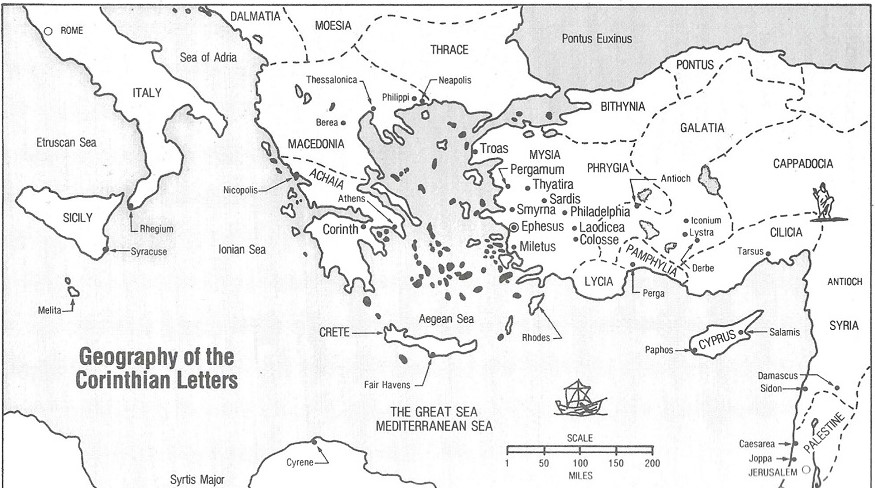
* The map "Geography of the Corinthian Letters" is from "1 Corinthians, A Self-Study Guide" by Irving L. Jensen published by The Moody Bible Institute of Chicago, 1972. Used by permission.
>6. Why might Paul bring up the household of Stephanas? (1:16, 16:15-16) What had he apparently come within the congregation?
* 1 Corinthians 16:15-16 "You know that the household of Stephanas were the first converts in Achaia, and they have devoted themselves to the service of the saints. I urge you, brothers, to submit to such as these and to everyone who joins in the work, and labors at it."
* "the household of Stephanas" -Stephanas' household is only directly mentioned in this letter. His name appears in no other letter nor Acts. Paul baptized the household of Stephanas. (1:16) His household were among the first converts in Achaia (Greece). Acts 17:34 records the first converts in Achaia (Greece) were in Athens Greece, about 42 miles (68 km) east of Corinth. "A few men became followers of Paul and believed. Among them was Dionysius, a member of the Areopagus, also a woman named Damaris, and a number of others." (Acts 17:34) Luke did not mention Stephanas, but did note that there were "a number of others" who believed and followed. There is a possibility that the one's Luke mentions were younger members of Stephanas' household whom Luke befriended and the readers of Acts would be more likely to know, if Stephanas had passed by the book's finish. The book of Acts was written around 6 years after 1 Corinthians.
Stephanas is with the Corinthian delegation delivering the letter. Since Stephanas' household were among the first converts in Greece (Achaia), and Athens congregation was founded before Corinth, then either Stephanas moved his household to Corinth from Athens, or he joined the Corinthian delegation delivering their letter to Paul. Both are just as probable. He may have moved from Athens to Corinth because Corinth was more prosperous. He may have been a part of the delegation because Athens was on the way to Ephesus for the Corinthians. Both would explain why the Corinthian congregation held little regard for him and his household. Stephanas was not "one of us more gifted with knowledge".
* "Achaia" -Achaia was a Roman province now known as Greece. Athens and Corinth are in Greece. Athens and the Aegean Sea were between Corinth and Ephesus, where Paul had sent his letters to gather together a collection for the poor in Jerusalem. The letter to and from Corinth from Ephesus may have come via Athens if the letters traveled by boat.
In the first century AD, Corinth was significantly more prosperous and commercially active than Athens. While Athens remained the cultural and intellectual capital of Greece, Corinth served as the wealthy administrative capital of the Roman province of Achaia.
* "they have devoted themselves to the service of the saints" -The wording implies the whole household was serving the church.
* "I urge you, brothers, to submit to such as these and to everyone who joins in the work, and labors at it." -Apparently, they were not submitting to his authority. Quite the opposite. They have little respect for his household that Paul had baptized (1:16). Considering the letter and this statement, it is easy to conclude that Stephanas' household held onto the beliefs as Paul taught, but the malcontents and dissidents would not listen to Stephanas.
>Who else had brought the Corinthian congregation's letter to Paul? What did they bring besides the letter?
* 1 Corinthians 16:17-18 "I was glad when Stephanas, Fortunatus and Achaicus arrived, because they have supplied what was lacking from you. For they refreshed my spirit and yours also. Such men deserve recognition."
* "Stephanas, Fortunatus and Achaicus" -Stephanas is Greek. Fortunatus is Latin. Achaicus is Latinized Greek. They are only mentioned in this letter. Nowhere else. They delivered the Corinthian letters (7:1).
* "supplied what was lacking from you... refreshed my spirit" -Paul was not refreshed by finances. Rather, by the attention and affection that Paul desired from the whole area of Achaia, especially Corinth for he founded the congregations in that area.
* "and yours also" -Through being willing to personally deliver the letter, a sacrifice, the congregation would be refreshed with Paul's advice and direction.
>7. What churches were in Asia at this time? Who were Aquila and Priscilla? (Acts 18:2, 18-19, 26; Romans 16:3) How does them opening their house so the congregation had a meeting place show the condition of the first-century church?
* 1 Corinthians 16:19 "The churches in the province of Asia send you greetings. Aquila and Priscilla greet you warmly in the Lord, and so does the church that meets at their house."
* "The churches in the province of Asia" -Asia was a Roman province, present day western Turkey. This is not to be confused with the continent now called Asia. Ephesus (Paul's current location), Colosse, Laodicea, Philadelphia, Sardis, and other congregations were located in Asia (Colossians 4:13-16; Revelation 1:11).
* "churches" -The original Greek noun is "ekklesia" (a transliteration) used 118 in the New Testament from the compound of "ek" and a derivative of "kaleo". The meaning is "a calling out", i.e. a popular "meeting", especially a religious "congregation" (Jewish synagogue or Christian community of members on earth or saints in heaven or both). The word is mostly translated as "church" in English Bibles. Church is used so frequently in so many ways that the original meaning is lost. Therefore, "congregation" is a better translation and one that I prefer because of it.
* "Aquila and Priscilla" -The two are mentioned often. They were important to the early church and Apostle Paul's ministry. The Jewish couple are always mentioned together. (Acts 18:2-3, 18-19, 26; Romans 16:3; 2 Timothy 4:19) Both are Latin names used by Jews living in Roman provinces in the first century. Aquila means "eagle" and Priscilla means "elder". A NIV text note says, "Prisca, a variant of Priscilla". Neither are ever referred to by their Jewish names. All but twice Priscilla, the wife is mentioned first, here and Acts. They were tent makers like Paul, which is how Paul came to know them. It seems they were converts before Paul meet them when Paul first arrived in Corinth. They had moved from Rome to Corinth, and then moved to Syria and Ephesus (Acts 18:1-19)
* "so does the church that meets at their house." -House churches do to sudden outbreaks of persecution throughout Roman provinces in the first three centuries, were the norm. (Romans 16:3-5; Philemon 2) Recent archaeological discoveries of Christian gathering places, like the Megiddo Mosaic, confirm this.
* First-Century Christians.
Five more believers in Jesus are mentioned in Paul's closing remarks: Stephanas and his household, Fortunatus, Achaicus, Aquila, and Priscilla. Stephanas, Fortunatus, and Achaicus delivered the letter containing the Corinthian congregation's questions to Paul (17, 7:1). Stephanas is Greek. Fortunatus is Latin. Achaicus is Latinized Greek. Aquila and Priscilla were a Messianic Jewish couple who at one time lived in Corinth, Greece (then called Achaia). They moved to Ephesus and maintained a house church there (19), where Paul was currently located.
The household of Stephanas were the first converts in what is modern-day Greece, then called Achaia (15). Acts records that the first converts in Greece were at Athens, Greece. Athens is around 42 miles (68 km) east of Corinth, Greece (Acts 17:34). Athens is on the route of Paul's letter requesting the financial gift collection for the impoverished Jerusalem believers. So, the letter arrived at Athens first, where Stephanas lived, and then went to Corinth. The Corinthian reply retraced the trip through Athens back to Paul in Ephesus.
Apostle Paul says that Stephanas' household is devoted to the service of the saints, and those at Corinth should submit to them. It seems that many in the Corinthian congregation who were proud of their gift of knowledge looked down on Stephanas and his household. Such a shame, but this is still common in congregations today. Flashy, proud perishiners look down on humble servants.
Paul purposely mentioned Aqula and Priscilla. Most likely, they were still respected by the Corinthian congregation because they housed the beginning of the Corinthian congregation, just like they were still doing in Ephesus, and just like Stephanas' household was doing in Athens. As Paul told them, "God has combined the members of the body and has given greater honor to the parts that lacked it, so that there should be no division in the body, but that its parts should have equal concern for each other." (12:24b-25)
Listen to the above comments on 1 Corinthians 16:15-21.
>What is a "holy kiss"? What does this say about how some cultural practices do not go against living by faith in Christ?
* 1 Corinthians 16:20 "All the brothers here send you greetings. Greet one another with a holy kiss."
* "All the brothers here send you greetings"
* "Greet one another with a holy kiss." -Not romantic or sexual. Not homosexual, which is a sin. Greek culture greeting others with a kiss on the cheek or and "air" kiss on the side of the cheek.
>8. Why do you think Paul thought it was important to tell they he was not dictating this greeting?
* 1 Corinthians 16:21 "I, Paul, write this greeting in my own hand."
* Paul would have written the letter in Greek since most of the believers in Jesus in Corinth were Greek. A few may have been Jewish according the Acts 18. Greek was the common written language, even for Jews.
* Biblical Hebrew, also called Classical Hebrew, is an archaic form of the Hebrew language, a language in the Canaanite branch of Semitic languages spoken by the Israelites in the area known as the Land of Israel, roughly west of the Jordan River and east of the Mediterranean Sea. The term "Hebrew" was not used for the language in the Hebrew Bible. Rather, it was referred to as the language of Canaan or Judaean in Ancient Greek and Mishnaic Hebrew texts.
The Hebrew language is attested in inscriptions from about the 10th century BC, when it was almost identical to Phoenician and other Canaanite languages, and spoken Hebrew persisted through and beyond the Second Temple period, which ended in the siege of Jerusalem (70 AD). It eventually developed into Mishnaic Hebrew, spoken until the fifth century AD.
>9. Why might the strict pronouncement be a fitting way to end this letter? (22)
* 1 Corinthians 16:22 "If anyone does not love the Lord - curse be on him. Come, O Lord!"
* "If anyone does not love the Lord" -The person has declared himself not believing in Jesus by lack of love, and therefore, God's wrath remains on him (John 3:36). Paul is still addressing the Corinth congregation. He does not distinguish between those who may or may not be within the congregation here.
* "curse be on him." -The KJV and ASV kept the original phrase which is of Aramaic (Chadian) orign, "anathea marana tha" (a transliteration). The direct translation is "our Lord has come", an exclamation of the approaching "divine judgement".
* "Come, O Lord!" -NIV translation that goes with "cure be on him". Paul's belief in Jesus' second coming a judge expressed in this short prayer.
>10. What does he also include in his final greeting? (23)
* 1 Corinthians 16:23 "The grace of the Lord Jesus be with you. My love to all of you in Christ Jesus. Amen."
* "The grace of the Lord Jesus be with you." -Galatians 6:18; Ephesians 6:24; Philippians 4:23 also have.
* "My love to all of you in Christ Jesus" -Paul was severe, but still loved them.
* "Amen." -Of Hebrew origin meaning "firm", "trustworthy", "surely", and "so be it".