>1. Why hold firmly to the gospel? (1-2, 12, 33, 35)
* 1 Corinthians 15:1-2 "Now, brothers, I want to remind you of the gospel I preached to you, which you received and on which you have taken your stand. By this gospel you are saved, if you hold firmly to the word I preached to you. Otherwise, you have believed in vain."
* 1 Corinthians 15:12 "But if it is preached that Christ has been raised from the dead, how can some of you say that there is no resurrection of the dead?"
* 1 Corinthians 15:33 "Do not be misled: "Bad company corrupts good character.""
* 1 Corinthians 15:35 "But someone may ask, "How are the dead raised? With what kind of body will they come?"
*
Chapter 15 Overview.
Apostle Paul addresses misconceptions about the resurrection of the dead in chapter 15. He counters a false belief that there is no resurrection of the dead.
People live after the body dies. It's a fact. Jesus bodily died and was buried. It's a fact. Jesus rose from death bodily. It's a fact. Those who believe in Jesus will die, rise from the dead, and when Jesus comes again, will receive a physical resurrection body. It's a fact. The resurrection body is far better than the current physical body. It's a fact. The current body is a weak flesh earthly body. The resurrection body for those who believe in Christ will be a powerful spiritual body like Jesus' body when he rose from the grave. These are facts.
When I think of the resurrection to come I think of several illustrations from this world, like a caterpillar. They have a long fussy body with many feet that traverse on plants and the ground. They eat and grow, eat and grow, and eat and grow. Then one day they form a cocoon around them. In hiding their worm body is amazingly transformed into a colorful delicate flying body. They are the same creatures on the inside. Yet outside they are something entirely new. Somewhere in a caterpillar's DNA is an old body and a new better body. For me it's an amazing picture of what God can do and will do.
Listen to the above Chapter 15 Overview.
* "Now brothers" -Paul has been calling them brothers all throughout this letter (1:10, 11, 26, 2:1, 3:1, 4:6, 7:24, 29, 10:1, 11:33, 12:1, 14:6, 20, 26, 39, 15:1, 31, 50, 58, 16:15). See previous Study 10 commentary, where he calls them brother four times, as he does four times in this chapter, for more information.
* "I want to remind you of the gospel" -Paul first preached the gospel in Corinth in a Jewish synagogue. He follows the standard argument technique of beginning with an agreed-on premise. The Corinthians must agree with the very gospel by which they were converted.
* "the gospel" -The original Greek noun is "euangelion" or "evangelion" meaning "a good message" from "euaggelizo" (transliterations) meaning "announce good message".
"Easton's Illustrated Bible Dictionary" says the English word, "gospel" is of Anglo-Saxon origin meaning "God's spell", i.e., word of God, or rather, according to others, "good spell", i.e., good news. It is the rendering of the Greek "euangelion" i.e., "good message." (See above for more on the Greek word.) It denotes:
The welcome intelligence of salvation to man as preached by our Lord and his followers.
It was afterwards transitively applied to each of the four histories of our Lord's life, published by those who are therefore called 'Evangelists', writers of the history of the gospel (the "evangelion").
The term is often used to express collectively the gospel doctrines; and 'preaching the gospel' is often used to include not only the proclaiming of the good tidings, but the teaching men how to avail themselves of the offer of salvation, the declaring of all the truths, precepts, promises, and threatening of Christianity.
It is termed "the gospel of the grace of God" (Acts 20:24), "the gospel of the kingdom" (Matthew 4:23), "the gospel of Christ" (Romans 1:16), "the gospel of peace (Ephesians 6:15), "the glorious gospel," "the everlasting gospel," "the gospel of salvation" (Ephesians 1:13).
From, "Illustrated Bible Dictionary: And Treasury of Biblical History, Biography, Geography, Doctrine, and Literature".
* "I preached to you" -Paul repeats he preached and delivered the gospel to them - once in verse 1, another in verse 2, and then again in verse 3. Verse 11 can be considered the fourth time. Thus, Paul stresses the point to help them remember their first encounter with him for he was delivering the gospel to them.
* "which you received and on which you have taken your stand" -Paul presents that no matter what else they believe, the basis of their belief is the gospel of Jesus Christ. They took their stand on it. I am not sure where the imagery of taking a stand comes from, except that it may come from Paul's earlier illustration of the congregation of Jesus being a body. If so, then the church stands on the gospel. Take away the gospel and the church falls. (1 Peter 5:12)
* "By this gospel you are saved" -Not that it is a spell or incantation. Rather, the people who hears it must accept it, believe it, and live it, as Paul says, "...on which you have taken your stand.".
* "Otherwise, you have believed in vain." -The reason to hold firmly to the gospel is because if they don't, their confession of faith is vain, even if they hold onto other aspects of Christ's teaching and church doctrine. Without full acceptance and continually living the gospel a person is not a true disciple of Jesus.
The original Greek adjective for "vain" is "eike" (a transliteration). "Eike" is based in the idea of failure, i.e. without reason or effect. It comes from the Greek verb "eiko" meaning "give way", "be weak", and "yield".
>What does it mean to hold firmly to the gospel? (Rom. 6:5,6,11,12; and 1 Cor. 15:31a; Phil. 3:10-14; Heb. 10:22)
* 1 Corinthians 15:31a "I die every day--I mean that, brothers--just as surely as I glory over you in Christ Jesus our Lord.
* Romans 6:5-6 "If we have been united with him like this in his death, we will certainly also be united with him in his resurrection. For we know that our old self was crucified with him so that the body of sin might be done away with, that we should no longer be slaves to sin:
* Romans 6:11-12 "In the same way, count yourselves dead to sin but alive to God in Christ Jesus. Therefore do not let sin reign in your mortal body so that you obey its evil desires."
* Philippians 3:10-14 "I want to know Christ and the power of his resurrection and the fellowship of sharing in his sufferings, becoming like him in his death, and so, somehow, to attain to the resurrection from the dead. Not that I have already obtained all this, or have already been made perfect, but I press on to take hold of that for which Christ Jesus took hold of me. Brothers, I do not consider myself yet to have taken hold of it. But one thing I do: Forgetting what is behind and straining toward what is ahead, I press on toward the goal to win the prize for which God has called me heavenward in Christ Jesus."
* Hebrews 10:22 "let us draw near to God with a sincere heart in full assurance of faith, having our hearts sprinkled to cleanse us from a guilty conscience and having our bodies washed with pure water."
* "if you hold firmly" -The KJV has "if ye keep in memory" but some KJV put in the margin "if ye hold fast", and the ASV only translates it this way. The idea is, that they were saved by the gospel, or would be, if they faithfully retain or held the doctrine as he delivered it;if they observed it, and still believed it, notwithstanding all the efforts of their enemies, and all the arts of false teaching to wrest it from them. There is a doubt delicately suggested here, whether they did in fact still adhere to his doctrine, or whether they had not abandoned it in part for the opposite. (Barns' Notes on the New Testament)
* Hold Firmly to the Gospel
The gospel saves if held onto firmly. The gospel saves from sin and its consequences, which is death. The gospel is a message preached. Some receive it. Others reject it, and still others are contemplating it. Those who receive it must hold firmly to the gospel. Salvation is evidenced by continuing in faith to the end. Such perseverance reveals those who share in Christ. (Hebrews 3:14) Otherwise, you have believed in vain.
Everyone needs to prove their love for God. Noah's proof was building an ark completely. Abraham's proof was being willing to offer his one and only son. Hannah's proof was bringing her son to live with the priests. David's proof was keeping his faith while on the run in the wilderness from Saul's pride and greed. Mary's proof was believing the angel's message of the immaculate conception. All these kept their faith till the end. God looks to see if all keep their faith in his promises to the end.
Listen to the above comments on 1 Corinthians 15:1-2.
>What is sin? (3-4a; Gen. 3:6; and 1 Sam. 15:23; Rom. 3:12, 23)
* 1 Corinthians 15:3-4a "For what I received I passed on to you as of first importance: that Christ died for our sins according to the Scriptures, that he was buried,"
* Genesis 3:6 "When the woman saw that the fruit of the tree was good for food and pleasing to the eye, and also desirable for gaining wisdom, she took some and ate it. She also gave some to her husband, who was with her, and he ate it."
* 1 Samuel 15:23 "For rebellion is like the sin of divination, and arrogance like the evil of idolatry. Because you have rejected the word of the LORD, he has rejected you as king."
* Romans 3:12 "All have turned away, they have together become worthless; there is no one who does good, not even one."
* Romans 3:23 "for all have sinned and fall short of the glory of God"
* "For what I received I passed on to you" -Paul does not tell the Corinthian congregation how or from whom he received the gospel in this letter. He does make clear that he is not the originator as a few have claimed. Some speculate as if they know for sure. Here, as in 11:23, Paul links himself with early Christian tradition, "I received... I pass on." Paul, in his letter to the Galatian congregation said he did not go to Jerusalem after conversion to talk to the apostles. He said he went into Arabia, the desert. (Galatians 1:11-24) A very slight possibility exists that Paul was told some things concerning the gospel by the disciples in Damascus and/or he might have heard some things before his conversion. Stephen's speech, if Paul heard it, did not reveal the gospel. (Acts 7) Still, for sure he told the Galatian congregation, "I want you to know, brothers, that the gospel I preached is not something that man made up. I did not receive it from any man, nor was I taught it; rather, I received it by revelation from Jesus Christ." (Galatians 1:11-12) "By revelation" could have been through the Holy Spirit or directly by the voice of Jesus Christ. If the later, which is what I believe, then Jesus would not have placed his feet on earth for the other apostles were told he will not stand on earth again until he comes in glory and power.
Paul, will reveal this to the Corinthian congregation in his second letter written in approx. 55 A.D. He is humbly referring to himself in the third person when he recalls his visit(s) to Jesus to hear revelations. During his "caught up to the third heaven" experience Jesus taught him. "I must go on boasting. Although there is nothing to be gained, I will go on to visions and revelations from the Lord. I know a man in Christ who fourteen years ago (that would be around 40-41 A.D., around 5-6 years after Paul's conversion) was caught up to the third heaven. Whether it was in the body or out of the body I do not know--God knows. And I know that this man--whether in the body or apart from the body I do not know, but God knows-- was caught up to paradise. He heard inexpressible things, things that man is not permitted to tell. I will boast about a man like that, but I will not boast about myself, except about my weaknesses. Even if I should choose to boast, I would not be a fool, because I would be speaking the truth. But I refrain, so no one will think more of me than is warranted by what I do or say. To keep me from becoming conceited because of these surpassingly great revelations, there was given me a thorn in my flesh, a messenger of Satan, to torment me." (2 Corinthians 12:1-7)
Listen to the above comments on 1 Corinthians 15:3a.
* "Christ died for our sins" -Sin is any want of conformity unto or transgression of the law of God (1 John 3:4; Romans 4:15), in the inward state and habit of the soul, as well as in the outward conduct of the life, whether by omission or commission (Rom 6:12-17, 7:5-24). It is not a mere violation of the law of our constitution, nor of the system of things, but an offense against a personal lawgiver and moral governor who vindicates his law with penalties. The soul that sins is always conscious that his sin is:
Intrinsically vile and polluting.
That it justly deserves punishment, and calls down the righteous wrath of God. Hence sin carries with it two inalienable characters.
Ill-desert, guilt (reatus).
Pollution (macula).
(Hodge's Outlines)
* "that he was buried," -Jesus was buried in a new tomb, never used, owned by a rich man in a garden. (Matthew 27:57-60; Mark 15:42-47; Luke 23:50-56; John 19:40) Recent excavations has revealed the current believed tomb was indeed in a garden.
>What are it's consequences? (Gen. 4:13-14; Rom. 5:12, 19a, 2:6-8, 6:23a; Heb. 9:27; and 2 Cor. 5:10; James 1:15; Rev. 21:8)
* Genesis 4:13-14 "Cain said to the LORD, "My punishment is more than I can bear. Today you are driving me from the land, and I will be hidden from your presence; I will be a restless wanderer on the earth, and whoever finds me will kill me."
* Romans 5:12 "Therefore, just as sin entered the world through one man, and death through sin, and in this way death came to all men, because all sinned--"
* Romans 5:19a "For just as through the disobedience of the one man the many were made sinners"
* Romans 2:6-8 "God "will give to each person according to what he has done." To those who by persistence in doing good seek glory, honor and immortality, he will give eternal life. But for those who are self-seeking and who reject the truth and follow evil, there will be wrath and anger."
* Romans 6:23a "For the wages of sin is death"
* Hebrews 9:27 "Just as man is destined to die once, and after that to face judgment,"
* 2 Corinthians 5:10 "For we must all appear before the judgment seat of Christ, that each one may receive what is due him for the things done while in the body, whether good or bad."
* James 1:15 "Then, after desire has conceived, it gives birth to sin; and sin, when it is full-grown, gives birth to death."
* Revelation 21:8 "But the cowardly, the unbelieving, the vile, the murderers, the sexually immoral, those who practice magic arts, the idolaters and all liars--their place will be in the fiery lake of burning sulfur. This is the second death."
* Death.
>How does Jesus' death bring salvation? (John 1:29; Rom. 5:19, 6:23b; and 1 Peter 2:24)
* John 1:29 "The next day John saw Jesus coming toward him and said, "Look, the Lamb of God, who takes away the sin of the world!"
* Romans 5:19 "For just as through the disobedience of the one man the many were made sinners, so also through the obedience of the one man the many will be made righteous."
* Romans 6:23b "but the gift of God is eternal life in Christ Jesus our Lord."
* 1 Peter 2:24 "He himself bore our sins in his body on the tree, so that we might die to sins and live for righteousness; by his wounds you have been healed."
* Jesus died in our place.
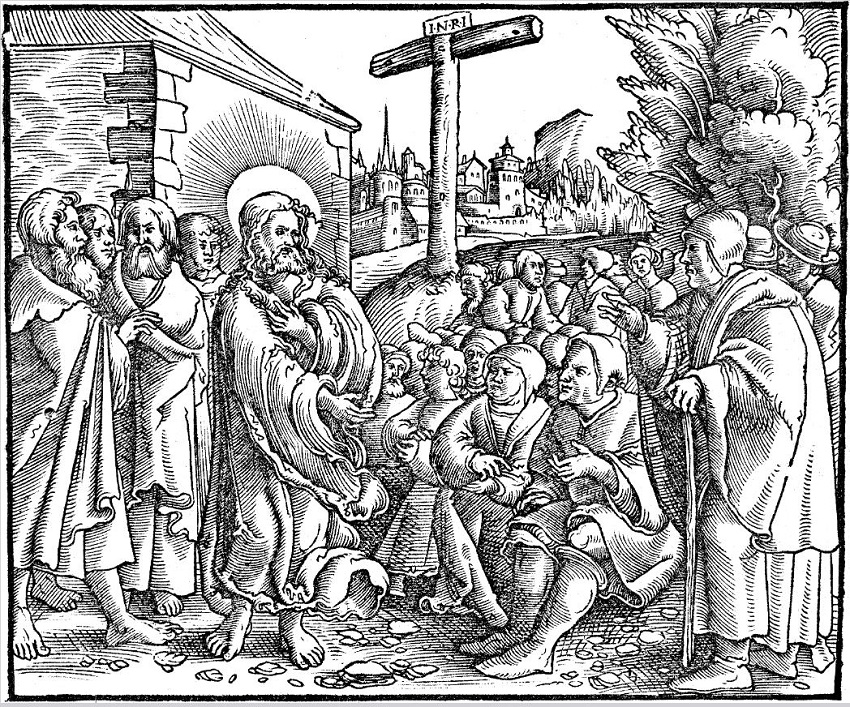
* The artwork titled "Post-Resurrection Appearance" was in a book by Luther, Martin (1483-1546) titled, "Kirchen Postilla, das ist, Auslegung der Episteln vnd Evangelien, von Aduent bis auff Ostern / D. Mart. Luth. ".
Jesus appears to a crowd after his resurrection. A cross stands in the background.
Courtesy of the Digital Image Archive, Pitts Theology Library, Candler School of Theology, Emory University.
>Why can only Jesus' blood cleanse sins? (Gal. 3:13; Matt. 26:28; Rom. 3:25; Heb. 9:22; and 1 Peter 1:18-19)
* Galatians 3:13 "Christ redeemed us from the curse of the law by becoming a curse for us, for it is written: "Cursed is everyone who is hung on a tree."
* Matthew 26:28 "This is my blood of the covenant, which is poured out for many for the forgiveness of sins."
* Mark 14:24 "This is my blood of the covenant, which is poured out for many," he said to them."
* Romans 3:25 "God presented him as a sacrifice of atonement, through faith in his blood. He did this to demonstrate his justice, because in his forbearance he had left the sins committed beforehand unpunished--"
* Hebrews 9:22 "In fact, the law requires that nearly everything be cleansed with blood, and without the shedding of blood there is no forgiveness."
* 1 Peter 1:18-19 "For you know that it was not with perishable things such as silver or gold that you were redeemed from the empty way of life handed down to you from your forefathers, but with the precious blood of Christ, a lamb without blemish or defect."
* Christ Died and Was Buried.
The four Gospels, in great detail, answer the questions of who, what, when, and where concerning Jesus' death and burial. (Matthew 26:47-27; Mark 14:43-15; Luke 22:54-23; John 18-19) Apostle Paul directly answers the "why," whereas the Gospels indirectly answer the why through Jesus' predictions of his death and burial. (Matthew 12:40; 26:28, 61; John 1:29, 2:19; Mark 10:33-34, Mark 14:24; Luke 9:21-22; 17:25; 18:31-33, 20:13-18; etc.)
Apostle Paul reminds the Corinthian congregation that Christ died for our sins and was buried according to the Scriptures. The why is that Jesus died for our sins. Paul passed that on as of first importance. Even before the first century AD ended, Jesus' death for our sins and burial were part of our tradition of the highest importance.
Apostle John records a seemingly strange, insignificant fact we might overlook concerning Jesus' death for our sins, "The soldiers therefore came and broke the legs of the first man who had been crucified with Jesus, and then those of the other. But when they came to Jesus and found that he was already dead, they did not break his legs. Instead, one of the soldiers pierced Jesus' side with a spear, bringing a sudden flow of blood and water. The man who saw it has given testimony, and his testimony is true. He knows that he tells the truth, and he testifies so that you also may believe." (John 19:32-35)
John then states that Jesus' legs were not broken to fulfill scripture. Why then tell us of the sudden flow of blood and water when Jesus' side was pierced, a seemingly strange, insignificant fact? Not so. It undoubtedly shows Jesus had been dead for at least half an hour, perhaps even one whole hour, before his heart, which is in the center, slightly on the left side of our chest, was pierced. His heart was pierced at the bottom.
When the heart stops pumping, the blood stops circulating. Blood consists of translucent plasma, white blood cells, clear platelets, and red blood cells. When stagnant, these separate. The heavy red blood cells sink to the bottom of the heart, the lightest translucent plasma rises to the top of the heart, and the white blood cells and clear platelets are in between. The separation in the heart begins immediately upon death and is visible within half an hour and complete by two hours, considering crucifixion. Even if Jesus were completely healthy at his age, the appearance of a flow of blood and water would have happened no later than an hour after the heart stopped pumping, a part of postmortem lividity. The blood looks like blood, then water flows out.
Jesus was dead, dead, dead, his heart emptied of blood, and any left in his body completely separated when he was buried. There was no chance of recession, to the shame and ignorance of those who suggest it. Jesus indeed died for our sins according to the Scriptures.
Listen to the above comments on 1 Corinthians 15:3b-4a.
>2. How does Jesus' resurrection demonstrate the power of God? (4; Rom. 1:4, 16; Acts 2:24; and 1 Cor. 6:14; Heb. 2:14-15)
* 1 Corinthians 15:4 "that he was buried, that he was raised on the third day according to the Scriptures"
* "on the third day" -Hebrew days, not Roman days. Our days are Roman days. The Hebrew day starts/ends at sunrise/sunset (Genesis 1:8b, 13, 19, 23, 31), and according to Genesis 1:5b God called the bright part "day" and the dark part "night". Roman days start and end at mid-night. Jesus died and was buried before sunset, the first day. When the sun rose on Sunday (the Hebrew first day of the week) it was the beginning of a new day, the third day. See the gospels commentaries concerning this subject for a day/night chart and a better explanation. Everyone, including the Romans of that time knew this according to Matthew 27:62-65.
* Romans 1:4 "and who through the Spirit of holiness was declared with power to be the Son of God by his resurrection from the dead: Jesus Christ our Lord."
* Romans 1:16 "I am not ashamed of the gospel, because it is the power of God for the salvation of everyone who believes: first for the Jew, then for the Gentile."
* Acts 2:24 "But God raised him from the dead, freeing him from the agony of death, because it was impossible for death to keep its hold on him."
* 1 Corinthians 6:14 "By his power God raised the Lord from the dead, and he will raise us also."
* Hebrews 2:14-15 "Since the children have flesh and blood, he too shared in their humanity so that by his death he might destroy him who holds the power of death--that is, the devil-- and free those who all their lives were held in slavery by their fear of death."
* Some Greek philosophers, Epicurean and Stoic, discredited the resurrection. (Acts 17:18) Some attending the Corinthian congregation held onto these false beliefs and tried to convince others that there is no physical resurrection of the dead.
* Not the death only, but the burial of Christ, and his resurrection again from the dead, were (though more darkly) revealed in the Scriptures of the Old Testament. Jonah and Isaac were both of them types of this; David prophesied, that God would not leave his soul in hell, nor suffer his Holy One to see corruption, Ps 16:10; which Peter applieth to Christ, Ac 2:31: so Ac 13:35. So that the doctrine of the New Testament in these things agreeth with the doctrine of the Old; with this only difference, that the Old Testament contained the New Testament in a mystery, and the New Testament was the Old Testament more fully and plainly revealed. (Matthew Poole's Commentary on the Holy Bible)
>How is it our hope? (1 Cor. 15:20, 51-54; and 1 Peter 1:3,4; John 5:24, 11:25,26)
* 1 Corinthians 15:20 "But Christ has indeed been raised from the dead, the firstfruits of those who have fallen asleep."
* 1 Corinthians 15:51-54 "Listen, I tell you a mystery: We will not all sleep, but we will all be changed-- in a flash, in the twinkling of an eye, at the last trumpet. For the trumpet will sound, the dead will be raised imperishable, and we will be changed. For the perishable must clothe itself with the imperishable, and the mortal with immortality. When the perishable has been clothed with the imperishable, and the mortal with immortality, then the saying that is written will come true: "Death has been swallowed up in victory."
* 1 Peter 1:3-4 "Praise be to the God and Father of our Lord Jesus Christ! In his great mercy he has given us new birth into a living hope through the resurrection of Jesus Christ from the dead, and into an inheritance that can never perish, spoil or fade--kept in heaven for you"
* John 5:24 "I tell you the truth, whoever hears my word and believes him who sent me has eternal life and will not be condemned; he has crossed over from death to life."
>What is the significance of "according to the scriptures" in regards to God's faithfulness? (Acts 3:18, 22; Rom. 3:21, 4:21-25; John 3:16)
* Acts 3:18 "But this is how God fulfilled what he had foretold through all the prophets, saying that his Christ would suffer."
* Acts 3:22-23 "For Moses said, 'The Lord your God will raise up for you a prophet like me from among your own people; you must listen to everything he tells you. Anyone who does not listen to him will be completely cut off from among his people.'"
* Romans 3:21 "But now a righteousness from God, apart from law, has been made known, to which the Law and the Prophets testify."
* Romans 4:21-25 "being fully persuaded that God had power to do what he had promised. This is why "it was credited to him as righteousness." The words "it was credited to him" were written not for him alone, but also for us, to whom God will credit righteousness--for us who believe in him who raised Jesus our Lord from the dead. He was delivered over to death for our sins and was raised to life for our justification."
* John 3:16 "For God so loved the world that he gave his one and only Son, that whoever believes in him shall not perish but have eternal life."
* See all the verses above, and also Isaiah 53:5-12 and Psalm 16.
* "according to the Scriptures," -Scriptures here is the Old Testament, Isaiah 53:9. The New Testament was not written yet with the possible exception of the letter of James, perhaps Galatians, both Thessalonian letters, and perhaps parts of the four gospels.
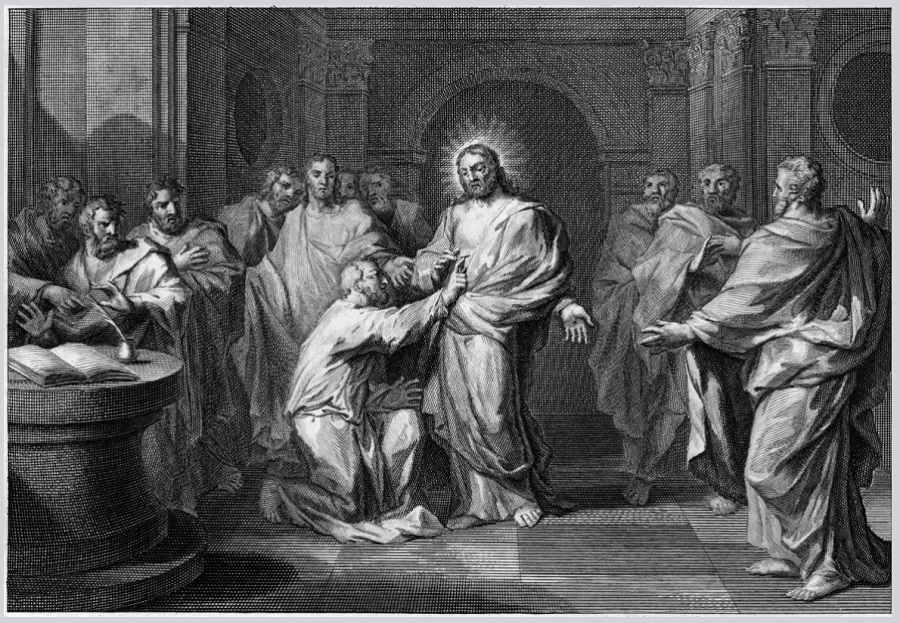
* The artwork titled "Doubting Thomas" was in a book by Martin, David (1639-1721) titled, "Historie des Ouden en Nieuwen Testaments : verrykt met meer dan vierhonderd printverbeeldingen in koper gesneeden".
This engraving by Otto Elliger depicts Jesus appearing to the disciples, including Thomas, whose doubt is removed when he places his hand in the wound in Jesus' side.
Courtesy of the Digital Image Archive, Pitts Theology Library, Candler School of Theology, Emory University.
>3. Who are the resurrection witnesses mentioned here? (5-7)
* 1 Corinthians 15:5-7 "and that he appeared to Peter, and then to the Twelve. After that, he appeared to more than five hundred of the brothers at the same time, most of whom are still living, though some have fallen asleep. Then he appeared to James, then to all the apostles"
* Peter, the Twelve (the twelfth was not Judas but his replacement), 500 others, James, all the apostles (assumed to be some other than the Twelve), and Paul,
>Why give an account of the resurrection witnesses?
* They could be interviewed and at least show that many people saw Jesus in the body.
>How did meeting the risen Jesus change them?
* Bold witnesses.
* Did not fail to witness.
* Continued to the end.
* Jesus, Raised on the Third Day.
The bodily resurrection of Christ Jesus from the dead is well documented. Apostle Paul records some eyewitnesses. The gospel writers record more. (Matthew 28; Mark 16; Luke 24; John 20-21; Acts 1:1-10) Other historical documents, both Christian and non-Christian, also record Jesus' resurrection from the dead. Clement of Rome's letters in 85-86AD, the Jew historian Josephus in his Antiquities of the Jews in 93-94AD, Ignatius of Antioch's letters from 107-110AD, the Roman historian Tacitus in his Roman Annals in 116AD, the Roman governor Pliny the Younger's letter in 112AD, etc.
The apostles and many others held through threat, abuse, torture, and even to their martyrdom that Jesus rose bodily from the dead. They witnessed the empty tomb and met the resurrected Jesus, talked with him, listened to him, ate with him, and touched the holes in his hands and side. Then they said he ascended into heaven to be with his father, as he had told them.
Apostle Thomas was not with the other apostles when Jesus first appeared with them. When they told him he would not believe them. With the doors locked, Jesus came and stood among them again and said, "Peace be with you!" Then he addressed Thomas, "Stop doubting and believe."
Thomas said to him, "My Lord and my God!"
Then Jesus told him, "Because you have seen me, you have believed; blessed are those who have not seen and yet have believed." (John 20:24-29)
Jesus did not say, "God?!? Oh no, Thomas. I am not God." No, Jesus did not say that. Jesus reply to Thomas, who said, "My Lord and my God!" was "Because you have seen me (bodily raised from the dead), you have believed (I am Lord and God)." Then, he added a very important fact about all who followed Thomas' declaration that Jesus is divine. All who believe in Jesus, who bodily rose from the dead, are Lord and God is blessed. It goes without saying that if a person does not believe Jesus is Lord and God, they are not blessed.
Listen to the above comments on 1 Corinthians 15:4b-8.
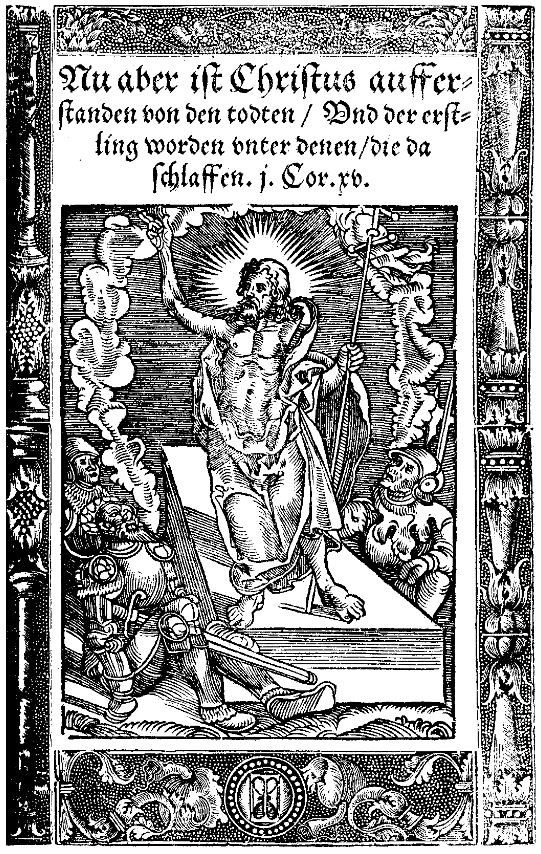
* The artwork titled "Christ Was Indeed Raised From the Dead" was in a book by Luther, Martin (1483-1546, ed) titled, "Geystliche Lieder / mit einer newen Vorrede D. M. Luth.".
The resurrected Christ is shown victorious over death. Roman soldiers in full armor and with impressive weapons are seated and lying on the ground. The artist of this engraving is the Monogrammist HA.
Courtesy of the Digital Image Archive, Pitts Theology Library, Candler School of Theology, Emory University.
>How does Paul mention himself?
* 1 Corinthians 15:8-11 "and last of all he appeared to me also, as to one abnormally born. For I am the least of the apostles and do not even deserve to be called an apostle, because I persecuted the church of God. But by the grace of God I am what I am, and his grace to me was not without effect. No, I worked harder than all of them--yet not I, but the grace of God that was with me. Whether, then, it was I or they, this is what we preach, and this is what you believed."
* "and last of all he appeared to me also" -From the time perspective of the writing of this letter.
* as to one abnormally born" -Paul was not part of the original group of apostles. He had not lived with Christ as the others had. His entry into the apostolic office was not "normal." Furthermore, at his conversion he was abruptly snatched from his former way of live (Acts 9:3-6). (NIV Study Bible)
* "For I am the least of the apostles" -Honest humility based on his past sins forgiven through Christ.
* "do not even deserve to be called an apostle" -Paul supplies his reason for this statement. Add to this, Jesus' appearance in Acts 9:1-8 to Paul came several years after the resurrection (~ 30 or 33 A.D.) The apostles before Paul had lived with Jesus for over three years, even Judas' replacement (Acts 1:15-26). In Galatians, Paul reveals that shortly after conversion he left Damascus and was in the desert learning from the Spirit and perhaps from Jesus, concerning Jesus' teaching (Galatian 1:11-17).
* "because I persecuted the church of God" -Paul was so against Jesus.
>Why did he include himself among the resurrection witnesses?
* "But by the grace of God I am what I am, and his grace to me was not without effect." -Paul includes himself not only because Jesus did appear to him, but Jesus' appearance had major effect in his life.
* "Whether, then, it was I or they, this is what we preach, and this is what you believed." -The gospel.
* Happy Spiritual Birthday!
Apostle Paul listed some of the people who saw the resurrected Christ before 55 A.D., when this letter was written. He includes himself, "last of all" and the "least of all" (5-8).
Jesus came to Paul when he was known as Saul in approx. 35 A.D. (Acts 9:3-19; 22:6-21; 26:13-23), approx. 5 years after Pentecost, the day of the great outpouring of the Holy Spirit (Acts 2). Paul converted from Judaism to faith in Jesus the Messiah when Jesus came to him on his way to persecute Christians in Damascus. Three days later, Paul was baptized by the disciple Ananias. The Holy Spirit entered Paul. Paul was born again. Thus, Paul called his spiritual birth "abnormal".
All those who come to faith in Jesus Christ are spiritually born again as the Holy Spirit becomes one with our soul and enters our body. We are born again by the grace of God (John 3:3-8). That day is our spiritual birthday.
The spiritual birth is not without effect (10). The Spirit enables us with gifts as we work for the good of the body of Christ. It is not us that works, but the grace of God that is with us. What effects has and will God enabled you to do today?
Listen to the above comments on 1 Corinthians 15:8-11.
II. The Necessity of the Resurrection (15:12-19)
>4. What kind of people say that there is no resurrection?
* 1 Corinthians 15:12 "But if it is preached that Christ has been raised from the dead, how can some of you say that there is no resurrection of the dead?"
* Acts 23:8 "The Sadducees say that there is no resurrection, and that there are neither angels nor spirits, but the Pharisees acknowledge them all."
* Many reasons exist for not believing in the resurrections from the absorbed to twisted logic. Frankly, the basic problem is lack of faith in God. Some say, "Seeing is believing," which is an excuse for they believe in things they cannot see such as atoms, places they have not been, and people that lived before them merely on the word of others.
>Why?
* Rebuff All "No Resurrection" Claims.
Apostle Paul logically and completely disproves a "no resurrection" claim made by some in the Corinthian congregation (12, 16). Epicurean and Stoic Greek philosophers discredited the resurrection. (Acts 17:18) Jewish Sadducees also did not believe in the resurrection. (Matthew 22:23; Mark 12:18; Acts 23:8) That is why they were Sad-u-see?
Paul says they are ignorant of God. (33) Jesus said such false belief comes from not knowing the Scriptures or the power of God. (Matthew 22:29; Mark 12:18) It seems that those in Corinth who say there is no resurrection were influenced by these false doctrines. (33)
Perhaps, you still do not believe in life after physical death, even after reading the first 11 verses, previous BDBD, and reading the commentary at FreeBibleStudyHelp.com. Recently, someone who seems to be a believer asked a question to make people think in a group Bible Study, "What about all the people who, after dying and being brought back to life, claim that they have been to heaven or hell?"
My response, perhaps, was not what he expected or wanted to hear. "I know of a person who has been to both heaven and hell. He has given his testimony a few times since, and you would be surprised at the responses. As Jesus concluded the parable of Lazarus and the rich man, 'If they do not listen to Moses and the Prophets, they will not be convinced even if someone rises from the dead.'" (Luke 16:31)
A vast amount of evidence is in the Bible. Sure, personal testimonies of being in heaven and hell may make someone think. But in my experience, personal witnesses are as Jesus said. Acceptance of the physical resurrection to come, when the current body is replaced, comes by the will and power of the Holy Spirit. Pray for the Holy Spirit's testimony. Ask with all honesty and sincerity with a humble and repentant heart, and you will know.
Listen to the above comments on 1 Corinthians 15:12-19.
>How does Paul prove their claim false? (13)
* 1 Corinthians 15:13 "If there is no resurrection of the dead, then not even Christ has been raised."
* "resurrection" -The original Greek is the noun "anastasis" (a transliteration) from the root "anistem" meaning "standing up again" (literally) a resurrection from death (individual, genitive or by implication its author), or (figurative) a (moral) recovery (of spiritual truth). It is also translated "raised to life again", "resurrection", "rise from the dead", "that should rise", and "rising again". "Anastasis" appears 42 times in the New Testament to describe Jesus' resurrection, the future resurrection of all people, and a "rising" from a seat. (Matthew 22:23, 27:53; Mark 12:L8; Luke 14:14, 20:27; John 11:25; Acts 1:22, 2:31, 4:2, 33, 17:18, 32, 23:8, 24:15, 21; Romans 1:4, 6:5, etc.)
* "of the dead" -The original Greek is the adjective "nekros" (a transliteration) from an apparently primary "nekus" meaning "a corpse", "being dead", and "lifeless". It is used in the New Testament 132 times meaning "dead" (literal or figurative; also as noun).
* "raised" -The original Greek is the verb "egeiro" (a transliteration) probably akin to the base of "agora" (through the idea of collecting one's faculties). It means "to waken" (transitive or intransitive), "rouse" (literal from sleep, from sitting or lying, from disease, from death, or figurative from obscurity, inactivity, ruins, nonexistence). "Egeiro" is also translated "awake", "lift up", "raise (again, up)", "rear us", "rise (again, up)", "stand", and "take up".
* Solid logic is used to prove their claim false. Jewish rabbi and some Greek teachers also often used the particular to prove the general principle that it presupposed, as Paul is doing here. The particular Paul used was Jesus rose from the dead, something the Corinthian first believed when they became a believer in Jesus. (1-4)
>What would be some of the logical consequences if their argument was true? (14-19)
* 1 Corinthians 15:14-19 "And if Christ has not been raised, our preaching is useless and so is your faith.
More than that, we are then found to be false witnesses about God, for we have testified about God that he raised Christ from the dead. But he did not raise him if in fact the dead are not raised.
For if the dead are not raised, then Christ has not been raised either.
And if Christ has not been raised, your faith is futile; you are still in your sins.
Then those also who have fallen asleep in Christ are lost.
If only for this life we have hope in Christ, we are to be pitied more than all men."
* "our preaching is useless" -Going back to the very beginning of this chapter, the Apostles preached the gospel as of first importance. Since they preached we are saved through the gospel, that would be useless if Jesus' bodilly or otherwise resurrection did not happen.
>5. Why is the Christian's faith useless if Christ had not been raised?
* "you are still in your sins" -Jesus' sacrifice, the shedding of his blood for our sins would mean nothing if he did not rise from death, for that would show that he was not a perfect sacrifice. (Hebrews 7:1-10:18) Also, it would mean that Jesus would not have perfectly fulfilled all prophecy for the Messiah had to rise from the dead according to Scriptures, as Paul wrote earlier in this chapter.
* "If Christ has not risen from the dead, there is no proof that he has not been justly put to death. If he were a malefactor, God would not work a miracle to raise him from the dead. If he has not been raised from the dead, there is a presumption that he has been put to death justly; and, if so, consequently he has made no atonement; and ye are yet in your sins-under the power, guilt, and condemnation of them. All this reasoning of the apostle goes to prove that at Corinth, even among those false teachers, the innocency of our Lord was allowed, and the reality of his resurrection not questioned." (Adam Clarke's Commentary)
>How does the resurrection of Jesus demonstrate God's existence?
* Luke 23:46 "Jesus called out with a loud voice, 'Father, into your hands I commit my spirit.' When he had said this, he breathed his last."
* John 10:17-18 "The reason my Father loves me is that I lay down my life--only to take it up again. No one takes it from me, but I lay it down of my own accord. I have authority to lay it down and authority to take it up again. This command I received from my Father."
>How does Jesus' resurrection solve man's sin problem?
* When Jesus rose from the dead he appeared before God the Father as the perfect sacrifice. More on this in the next section. See quote before from the Letter to the Hebrews.
* Hebrews 9:11-14 "When Christ came as high priest of the good things that are already here, he went through the greater and more perfect tabernacle that is not man-made, that is to say, not a part of this creation. He did not enter by means of the blood of goats and calves; but he entered the Most Holy Place once for all by his own blood, having obtained eternal redemption. The blood of goats and bulls and the ashes of a heifer sprinkled on those who are ceremonially unclean sanctify them so that they are outwardly clean. How much more, then, will the blood of Christ, who through the eternal Spirit offered himself unblemished to God, cleanse our consciences from acts that lead to death, so that we may serve the living God!"
III. The Consequences of Jesus' Resurrection (15:20-28)
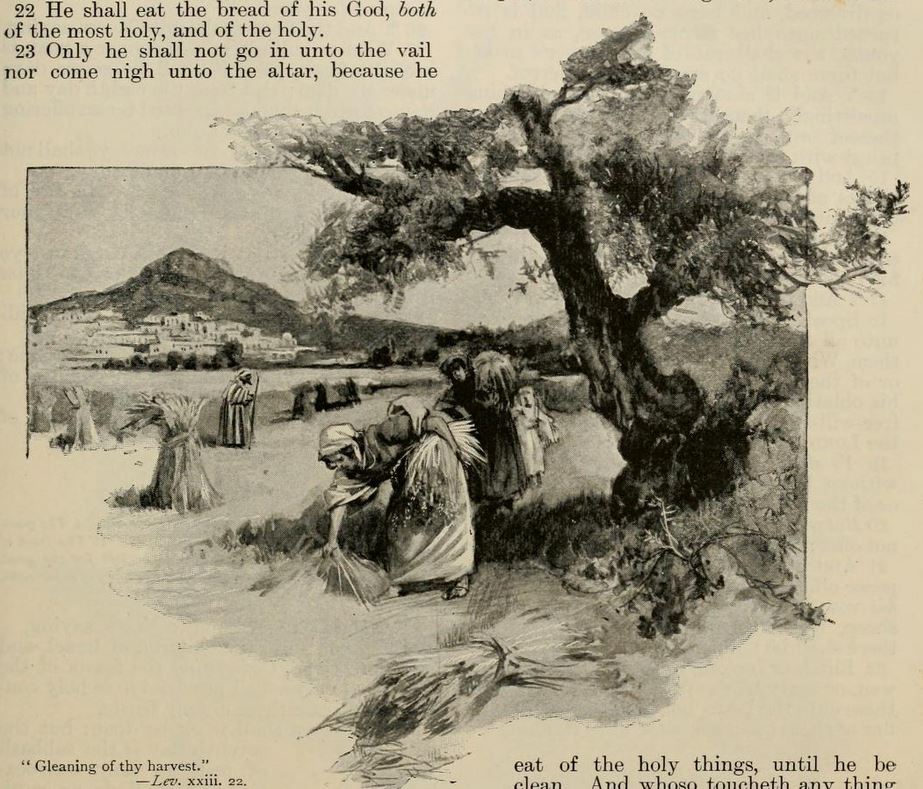
* The illustration is from the Art Bible, 1896, comprising the Old and New Testaments, with numerous illustrations. Publisher, London: G. Newnes. Sheaves are laying on the ground ready to be collected for storage as workers create more sheaves. Poor were allowed to pick up grain that fell to the ground and pull from stocks on the edges of the field according to the Levitical law as cited in the illustration.
>6. What is the significance of Paul's declaration, "Christ has indeed been raised"?
* 1 Corinthians 15:20 "But Christ has indeed been raised from the dead, the firstfruits of those who have fallen asleep."
* "But Christ has indeed been raised from the dead" -Fact accepted by faith. Paul gave two witnesses, Scripture and many, though not all, witnesses to Jesus' bodily resurrection in previous verses.
>What does it mean that he is the firstfruits?
* "firstfruits" -The original Greek noun "aparche" is used eight times in the New Testament. It comes from two words; "apo" meaning "separation" and "departure", and "archoman" meaning "a beginning of a procedure". Thus, the meaning of "aparche" is "the first harvested for use in a sacrifice".
The first sheaf of the spring harvest is given to the Lord which is from the barley harvest (Leviticus 23:10-11, 17, 20). The fall harvest is the wheat harvest. The sheaf, a small bound bundle, is collected and brought to the temple in a great procession where the priest is waiting for it. The sheaf is waved before the Lord and burned as a token that all the harvest belongs to the Lord and would be dedicated to him through dedicated lives. So Christ Jesus, who has been raised from the dead in a new resurrected glorified body, is the guarantee of the resurrection of all of God's redeemed people (1 Thessalonians 4:13-18). The second harvest, the wheat harvest, represents the bodily resurrection of all the saints.
"Although," says Dr. Lightfoot, "the resurrection of Christ, compared with some first fruits, has very good harmony with the first century Jews; yet especially it agrees with the offering of the sheaf, commonly called "omer", not only as the thing itself, but also as to the circumstances of the time. For first there was the Passover, and the day following was a Sabbatic day, and on the day following that the first fruits were offered. So Christ, our Passover, was crucified: the day following his crucifixion was the Sabbath, and the day following that, He, the first fruits of them that slept, rose again. All who died before Christ, and were raised again to life, died afterwards; but Christ is the first fruits of all who shall be raised from the dead to die no more."
I write more on the amazing timing of the exact year of Jesus' Passion and the fulfillment of these feasts in commentary for all four gospels concerning Jesus' death, burial, and resurrection; also in the commentary in the questoin below, and the commentary for Leviticus 23, link above.
* Jesus, the First Fruits.
Jesus has indeed been raised from the dead! (See previous BDBDs). Paul points out that Jesus is the first fruits of those who have fallen asleep. This is no mere miracle considering the Hebrew calendar and the year of Jesus' death, burial, and bodily resurrection.
The Passover, according to Old Testament law, was to be eaten at twilight on the 14th day of the Hebrew first month (Leviticus 23:9). The 15th day, the Lord's Feast of Unleavened Bread begins (Leviticus 23:10). Therefore, every year these two feasts fall on different days of the week. One year the Passover could be on a Monday, and the next year it could be on the Sabbath (our Saturday).
The Feast of First Fruits is when the high priest presents the first sheaf of the spring harvest to the Lord at the temple. The spring harvest is the barley harvest in the western Mediterranean lands. The priest is to wave the sheaf on the day after the Sabbath after the Passover (Leviticus 23:9-11). Then he is to burn it. Therefore, the Feast of First Fruits will always be on a Sunday, just as Easter is always on a Sunday! Jesus, as well as Scripture, says that he would be in the tomb three Hebrew days. (They start at sunrise and end at sunset.)
The combination of these could only be fulfilled that year, making Jesus the true first fruit of those who have fallen asleep. Only one year in Jesus' entire earthly life was it possible for all these to be fulfilled! In other words, the Passover had to be eaten on a Thursday evening, he had to be dead and in the tomb before sunset the next day, Friday, he had to remain in the tomb the entire Sabbath rest, and he had to rise on the third day at sunrise and appear before God his Father in heaven as the first fruit of those who will rise from the dead after him on that same day.
This is why the just risen Jesus told Mary Magdalene, "Do not hold on to me, for I have not yet returned to the Father." (John 20:17) After she left, he appeared in heaven to God his Father as the first fruit! Jesus perfectly fulfilled the law concerning the spring feasts, including the Feast of First Fruits.
Listen to the above comments on 1 Corinthians 15:20.
* Barley in the ripened stage.
* "of those who have fallen asleep" -Fallen asleep was used by Jesus in the raising of Jairus' daughter for physical death is not the end of life. (Luke 8:52) The church has used the phrase since because we believe as Jesus taught.
>What is the significance of the order of the resurrection? (23-24; 1 Thessalonians 4:13-18)
* 1 Corinthians 15:23-24 "But each in his own turn: Christ, the firstfruits; then, when he comes, those who belong to him. Then the end will come, when he hands over the kingdom to God the Father after he has destroyed all dominion, authority and power."
* 1 Thessalonians 4:13-18 "Brothers, we do not want you to be ignorant about those who fall asleep, or to grieve like the rest of men, who have no hope. We believe that Jesus died and rose again and so we believe that God will bring with Jesus those who have fallen asleep in him. According to the Lord's own word, we tell you that we who are still alive, who are left till the coming of the Lord, will certainly not precede those who have fallen asleep. For the Lord himself will come down from heaven, with a loud command, with the voice of the archangel and with the trumpet call of God, and the dead in Christ will rise first. After that, we who are still alive and are left will be caught up together with them in the clouds to meet the Lord in the air. And so we will be with the Lord forever. Therefore encourage each other with these words."
* "But each in his own turn:" -God has it all planned out.
* "Christ, the firstfruits;" -Commentary above, in Leviticus 23 commentary, and the gospels concerning Jesus' discourse with his disciples on the second coming.
* "then, when he comes, those who belong to him." -No time between his coming and the transformation of the saints.
* "after he has destroyed all dominion, authority and power." -Jesus will do this before the end.
* "Then the end will come, when he hands over the kingdom to God the Father"
* Our Turn for Bodily Resurrection.
Apostle Paul, inspired by the Holy Spirit, reveals the order of the transformation from an earthly body to a glorious spiritual body. Jesus is already transformed as the firstfruits of the barley harvest (23a). When Jesus comes again, those who put their faith and hope in him, those who belong to him, will be transformed into a body like Jesus' (23b). What good news!
Many have said that the Old Testament does not reveal the long gap between Jesus' glorious resurrection some 2,000 years ago, and our future glorious resurrection. They are wrong. The Mosaic law does reveal the long gap, and more, through the then-required celebration of the Israelite feasts. (Exodus 34:22-23; Leviticus 23; Numbers 9:1-14, 28:16-29:40; Deuteronomy 16:1-16)
The spring feasts were discussed in previous BDBD -Passover, the Feast of Unleavened Bread, the Feast of Firstfruits (aka Ingatherings) at the barley harvest (Exodus 34:22-23), and Pentecost (aka the Feast of Weeks). Jesus fulfilled and replaced the spring feasts, celebrated at the beginning of the Hebrew year, during his first coming
The other feasts are celebrated in the fall -the Feast of Trumpets, the Feast of Weeks with the firstfruits of the wheat harvest (Exodus 34:22), the Day of Atonement, and the Feast of Tabernacles. Jesus will fulfill these when he comes again. In between the spring and fall feasts is a long gap of several months where nothing happens.
The wheat harvest is our bodily resurrection from the dead when he comes again. Jesus often used wheat in parables to illustrate our resurrection (Matthew 13:24-30; Luke 3:17; John 12:23-26). Jesus concluded the Parable of the Weeds and Wheat with, "Let both grow together until the harvest. At that time I will tell the harvesters: First collect the weeds and tie them in bundles to be burned; then gather the wheat and bring it into my barn." (Matthew 13:30) Are you wheat or a weed?
Listen to the above comments on 1 Corinthians 15:23-25.
>7. How did death (spiritual death) come into human history? (21-22)
* 1 Corinthians 15:21-22 "For since death came through a man, the resurrection of the dead comes also through a man. For as in Adam all die, so in Christ all will be made alive."
* Through Adam's sin.
>How did the resurrection of the dead enter human history? (Romans 5:12-21)
* Romans 5:12-21 "Therefore, just as sin entered the world through one man, and death through sin, and in this way death came to all men, because all sinned-- for before the law was given, sin was in the world. But sin is not taken into account when there is no law. Nevertheless, death reigned from the time of Adam to the time of Moses, even over those who did not sin by breaking a command, as did Adam, who was a pattern of the one to come. But the gift is not like the trespass. For if the many died by the trespass of the one man, how much more did God's grace and the gift that came by the grace of the one man, Jesus Christ, overflow to the many! Again, the gift of God is not like the result of the one man's sin: The judgment followed one sin and brought condemnation, but the gift followed many trespasses and brought justification. For if, by the trespass of the one man, death reigned through that one man, how much more will those who receive God's abundant provision of grace and of the gift of righteousness reign in life through the one man, Jesus Christ. Consequently, just as the result of one trespass was condemnation for all men, so also the result of one act of righteousness was justification that brings life for all men. For just as through the disobedience of the one man the many were made sinners, so also through the obedience of the one man the many will be made righteous. The law was added so that the trespass might increase. But where sin increased, grace increased all the more, so that, just as sin reigned in death, so also grace might reign through righteousness to bring eternal life through Jesus Christ our Lord."
* Through Jesus' bodily resurrection from the dead.
* Adam and Jesus.
Do you need some happy, joyful, good news today? Well, if you care to take less than three minutes of thinking time, read on.
Through one man, Adam (who is called the son of God in Luke 3:38 because he had neither father nor mother), came man's subjection to mortality, sicknesses, physical death, and eternal death and misery in another world because he sinned. We are born in Adam. So also, it pleased God that through one man, Jesus, who became flesh of our flesh, who though he was the eternal and the only begotten Son of God, came the FREE gift of physical resurrection from death for those who believe in him and his power over death. (Hebrews 2:14) Anyone can become born again in Jesus.
As in Adam all, that were and are in him, became subject both to temporal death, and all the afflictions and miseries of this life, which are so many little deaths (Romans 8:36) and forerunners of natural death, or attendants upon it; and also to eternal death, which is the consequent of the guilt of sin (Romans 6:23). So in Jesus, that is, through the merits of his death, and through his resurrection, all that are in him, being chosen in him, given to him, and by faith implanted into him, are not only spiritually made alive, being passed from death unto life (1 John 3:14), but will also be raised from physical death unto eternal life.
The happy, joyful, good news is that you can live happily ever after eternally in paradise with someone who loves you and will continue to love you forever, Jesus.
Listen to the above comments on 1 Corinthians 15:21-22.
>What will the risen Jesus do in the process of destroying all his enemies? (25; Psalms 110:1)
* 1 Corinthians 15:25 "For he must reign until he has put all his enemies under his feet."
* Psalm 110:1 "The LORD says to my Lord: "Sit at my right hand until I make your enemies a footstool for your feet."
* "For he must reign until"
* "until I make your enemies a footstool for your feet."
>8. How does Jesus' resurrection foreshadow the final victory he will have at the end of time? (24; Isaiah 2:2-4; Micah 4:1-5)
* 1 Corinthians 15:24 "Then the end will come, when he hands over the kingdom to God the Father after he has destroyed all dominion, authority and power."
* Isaiah 2:2-4 "In the last days the mountain of the LORD's temple will be established as chief among the mountains; it will be raised above the hills, and all nations will stream to it. Many peoples will come and say, "Come, let us go up to the mountain of the LORD, to the house of the God of Jacob. He will teach us his ways, so that we may walk in his paths." The law will go out from Zion, the word of the LORD from Jerusalem. He will judge between the nations and will settle disputes for many peoples. They will beat their swords into plowshares and their spears into pruning hooks. Nation will not take up sword against nation, nor will they train for war anymore."
* Micah 4:1-6 "In the last days the mountain of the LORD's temple will be established as chief among the mountains; it will be raised above the hills, and peoples will stream to it.
Many nations will come and say, "Come, let us go up to the mountain of the LORD, to the house of the God of Jacob. He will teach us his ways, so that we may walk in his paths." The law will go out from Zion, the word of the LORD from Jerusalem.
He will judge between many peoples and will settle disputes for strong nations far and wide. They will beat their swords into plowshares and their spears into pruning hooks. Nation will not take up sword against nation, nor will they train for war anymore.
Every man will sit under his own vine and under his own fig tree, and no one will make them afraid, for the LORD Almighty has spoken.
All the nations may walk in the name of their gods; we will walk in the name of the LORD our God for ever and ever.
'In that day,' declares the LORD, 'I will gather the lame; I will assemble the exiles and those I have brought to grief.'"
* "Then the end will come" -End of all ages.
* "when he hands over the kingdom to God the Father" -All Jesus' work has been completed.
>What will be the victorious climax and consummation of the resurrection?
* 1 Corinthians 15:26-28 "The last enemy to be destroyed is death. For he "has put everything under his feet." Now when it says that "everything" has been put under him, it is clear that this does not include God himself, who put everything under Christ. When he has done this, then the Son himself will be made subject to him who put everything under him, so that God may be all in all."
* Psalm 8:6 "You made him ruler over the works of your hands; you put everything under his feet:"
* See also Psalm 110:1; Isaiah 9:6-7; Daniel 7:14.
* "The last enemy to be destroyed is death" -Not Satan as many believe. Satan will be thrown forever in the Lake of Fire before this, after he is locked up during the thousand year reign of Christ. Death will occur during the thousand years reign of Christ.
* "God" -The original Greek noun is "Theos" (a transliteration) used 1,343 times in the New Testament only referring to a deity.
* "so that God may be all in all." -Colossians 3:11 says the same about Christ and his body now, which is the church, thus, expressing no differentiation exist in Christ. God being all in all at the end does not mean that all things will be God for only God has no beginning. Nor does it mean that God being all in all includes the Devil, demons, and evil people who will be in the Lake of Fire for they resist God, even though they acknowledge God's existence (James 2:19). Their time of decision is not, it will not be at the time of their judgment, at the very end. Then will be to late. Someone might say, "Isn't God in every;thing now?" The answer is, "The point in these verses is that some are against God and Christ is correcting that. When Christ is finished with that God, God will be 'all in all'. Until then, as long as some are against God, though God is in control, he is not 'all in all'." Remember, death is the last enemy to be destroyed, not Satan and his demons.
* God's Reign, Death's Destruction.
A hierarchy exists now, and that order of majesty and power will be finalized at the end of time. The hierarchy that exists now consists of Jesus, the Son of God, and the Holy Spirit acting upon the will of the Father in the affairs of creation. To accomplish the work assigned to them, which they willingly and eagerly accepted, the Father placed "everything under Jesus' feet" (Psalm 8:6). When their work is finished, and all is as it should be, the Son himself will be made subject to him who put everything under him (25, 27a).
The Son will be made subject to the Father in the sense that administratively, after he subjects all things to his power, he will then turn it all over to God the Father, the administrative head. This is not to suggest that the Son is in any way inferior to the Father. All three persons of the Trinity are equal in duty and in dignity. The subordination referred to is one of function. The Father is supreme in the Trinity; the Son carries out the Father's will; the Spirit is sent by the Father and the Son to vitalize life, communicate God's truth, apply his salvation to people, and enable them to obey God's will.
Jesus said, "When you have lifted up the Son of Man, then you will know that I am [the one I claim to be] and that I do nothing on my own but speak just what the Father has taught me. The one who sent me is with me; he has not left me alone, for I always do what pleases him." (John 8:28-29)
And Jesus said, "I will not speak with you much longer, for the prince of this world is coming. He has no hold on me, but the world must learn that I love the Father and that I do exactly what my Father has commanded me." (John 14:30-31)
The last enemy to be destroyed is death. In Christ Jesus, death is no more. Therefore, what reason is there to remain our own ruler when another ruler exists that has the authority over death and will utterly and completely destroy it?
Listen to the above comments on 1 Corinthians 15:26-28.
IV. Because of Resurrection I Die Every Day (15:29-34)
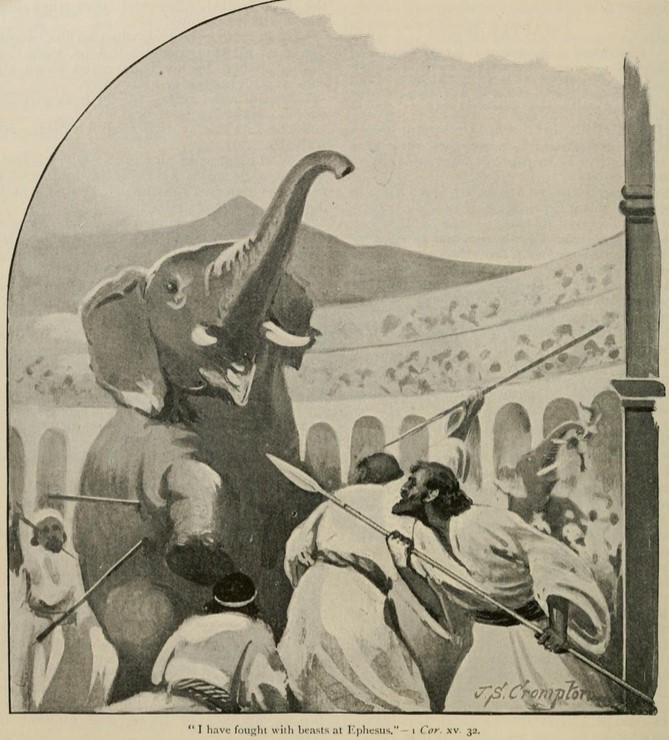
* The illustration is from the Art Bible, 1896, comprising the Old and New Testaments, with numerous illustrations. Publisher, London: G. Newnes. The artists signature, J.S. Crompton is in the lower right. The cited passage is 1 Corinthians 15:32. Apostle Paul with other men is depicted fighting off an elephant with a spear in an arena.
>9. What practical effect did resurrection faith have on the lives of Paul and the first Christians?
* 1 Corinthians 15:29-32 "Now if there is no resurrection, what will those do who are baptized for the dead? If the dead are not raised at all, why are people baptized for them? And as for us, why do we endanger ourselves every hour? I die every day--I mean that, brothers--just as surely as I glory over you in Christ Jesus our Lord. If I fought wild beasts in Ephesus for merely human reasons, what have I gained? If the dead are not raised, "Let us eat and drink, for tomorrow we die."
* "what will those do who are baptized for the dead" -No other reference to this practice exists and Paul does not expound upon the practice here. That, and since this is in the present tense, most believe this practice was being done only at Corinth at the time. Paul used this to say, "You believe there is no resurrection, and yet you conduct this practice. Your practice and your belief counter each other." Paul does not accept nor support the practice. He ignores refuting the practice because he wants to use it in his logical response to the main point, there is a resurrection of the dead.
* "why are people baptized for them?" -No one can act on behalf of another to save them in the other has not personally accepted the gospel. The gospel must personally be accepted. (1-4).
* "And as for us, why do we endanger ourselves every hour?" -Paul uses the plural.
* "If I fought wild beasts in Ephesus for merely human reasons," -Paul might have been forced to fight wild animals during his multi-year and several stays in Ephesus, though no record outside of this letter verifies if he is speaking metaphorically or practically except for perhaps Acts 19:23-41. (See introduction for a timeline from Paul's conversion to his arrest in Rome.) However, that passage says that the disciples would not let Paul speak before the crowd (Acts 19:30).
Luke in his book, The Acts of the Apostles does not mention Paul being in Ephesus before founding the Corinthian church. Paul, was going to passed through Ephesus during the end of his second missionary journey because Ephesus was the region's capital. However, he choose to stay. Apostle Paul probably fought the wild beasts during his two plus year stay in Ephesus. (16:8; Acts 18:1, 19-21, 19:1-41)
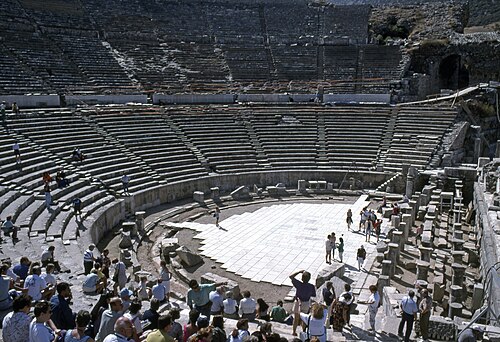
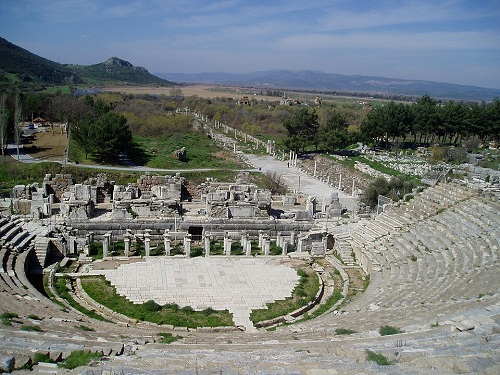
Ephesus had a long narrow stadium, roughly 755ft x 130ft (230m x 40m) including the track, that functioned as an arena. Located north of Mount Pion, the stadium was significantly expanded and refurbished during the reign of Emperor Nero (54-68 A.D.), making it a major venue for sports and gladiatorial combats in the mid-1st century A.D. The track is currently under grassy dirt. Also, The Great Ephesus Theatre mentioned in Acts 19:29, which could hold 24,000-25,000 spectators, was repurposed for violent gladiatorial games during the Roman period.
* "what have I gained?" -Paul is speaking of a future reward at the Bema Seat of Christ.
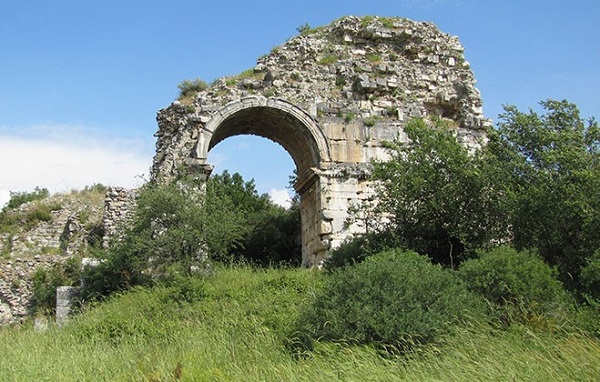
* The remains of the monumental entrance to the Ephesus Stadium, north of the archaeological site (by David John, my Favorite Planet). See comments in 9a for information.
>What does this teach us about how Christians who believe in the resurrection ought to live?
* "If the dead are not raised, "Let us eat and drink, for tomorrow we die."
* Luke 13:23-25 "Someone asked him, "Lord, are only a few people going to be saved?" He said to them, "Make every effort to enter through the narrow door, because many, I tell you, will try to enter and will not be able to. Once the owner of the house gets up and closes the door, you will stand outside knocking and pleading, 'Sir, open the door for us.' "But he will answer, 'I don't know you or where you come from.'"
* Hebrews 4:11 "Let us, therefore, make every effort to enter that rest, so that no one will fall by following their example of disobedience."
* Living for the flesh. Living only in this life. Living selfishly.
* We are not saved by works. But our works reveals we have faith that saves.
>What did Paul mean by, "I die every day"?
* I die every day" -Paul goes from the plural of verse 30, to the singular of self in verse 31. Paul means die to self.
* Die Every Day? What? Why?
With commands like "Anyone who does not carry his cross and follow me cannot be my disciple" (Luke 14:27), and "I tell you the truth, unless a kernel of wheat falls to the ground and dies, it remains only a single seed. But if it dies, it produces many seeds" (John 12:24), and "All men will hate you because of me, but he who stands firm to the end will be saved" (Mark 13:13), Jesus moves us forward in spiritual battle.
Apostle Paul took these commands seriously, for he told the congregation at Corinth, "I die every day - I mean that, brothers." (31)
When Paul said he fought "wild beasts" in Ephesus, the Roman capital city of Asia, he probably actually meant wild animals. Though the act is not mentioned elsewhere, the city did contain a 25,000-seat Great Theatre and a 755ft x 130ft (230m x 40m) sports stadium that included a U-shaped track that was used nine years later during Nero's empire-wide persecution of Christians (64 A.D).
Apostle Paul, the rest of the apostles, and many others gave up so much and endured so much for Jesus, the gospel, and the church. Why? More than one reason exists. However, the one reason that is noticed by God is for the love of God and others. These can be merely human reasons, but coupled with a hope of the resurrection of the dead through Christ, these two reasons bring on another meaning
Therefore, "Let us fix our eyes on Jesus, the author and perfecter of our faith, who for the joy set before him endured the cross, scorning its shame, and sat down at the right hand of the throne of God. Consider him who endured such opposition from sinful men, so that you will not grow weary and lose heart." Hebrews 12:2-3).
Listen to the above comments on 1 Corinthians 15:29-32.
* Two pictures of The Ephesus Great Theatre mentioned in Acts 19:29. See comments in 9a for information.
>10. How did resurrection faith answer and defeat the decadent and hedonistic ideas that prevailed in Paul's day? (32b)
* 1 Corinthians 15:33-34 "Do not be misled: 'Bad company corrupts good character.' Come back to your senses as you ought, and stop sinning; for there are some who are ignorant of God--I say this to your shame."
* "Do not be misled" -Christians can be mislead.
* "Bad company corrupts good character." -Isaiah 22:13. The quotation is also from a Greek comedy, "Thais", written by the Greek poet Menander, whose writings the Corinthians would know. The application of the quotation is that those who are teaching that there is no resurrection (12) are the "bad company", and they are corrupting the "good character" of those who holad to the correct doctrine. (NIV Study Bible)
* "Come back to your senses as you ought" -That is why we are to "be alert".
* Proverbs 13:20 "He who walks with the wise grows wise, but a companion of fools suffers harm."
>Who does Paul mean by "bad company"?
* "bad company" -Pulls off the straight and narrow path. The original Greek noun for "company" is "homilia" (a transliteration), also used in Luke 24:14 and Acts 24:6. The KJV and YLT translates "evil communications" a weak interpretation. "Homilia" conveyed in Paul's day, a familiar, ongoing -even daily, interpersonal exchanges, or interactions with others, rather than a formal monologue or public speech. Later, it came to also include the meaning of teaching.
* "for there are some who are ignorant of God" -They do not know God. God does not know them. These people was among them at their meetings.
* "I say this to your shame." -He says this to the good characters who were pulled away by the bad characters.
>How could the Corinthian Christians come to their senses and avoid being contaminated by bad company?
* "stop sinning" -Do what is right. Resist evil. Stop denying that there is a resurrection. Stop doubting the resurrection of Jesus.
* Bad Company Misleads.
Associating with bad people will ruin decent people. This does not mean we should disregard Jesus' example and prayer, "My prayer is not that you (God his Father) take them out of the world but that you protect them from the evil one. They are not of the world, even as I am not of it.Sanctify them by the truth; your word is truth. As you sent me into the world, I have sent them into the world." (John 17:15-18) Jesus gave his disciples a mission to go into all the world. However, we are not to keep a continual association with the bad company.
Being misled has a negative effect on oneself, others, one's character, and on the peace of mind and heart. Worse still, bad company can hinder our relationship with Jesus. That is why Jesus prayed for his disciples to be "sanctified by the truth". He also said, "Be on your guard against the yearst of the Pharisees, Sadducees, and that of Herod" (Matthew 16:6, 12; Mark 8:15; Luke 12:1).
Listen to the above comments on 1 Corinthians 15:33-34.