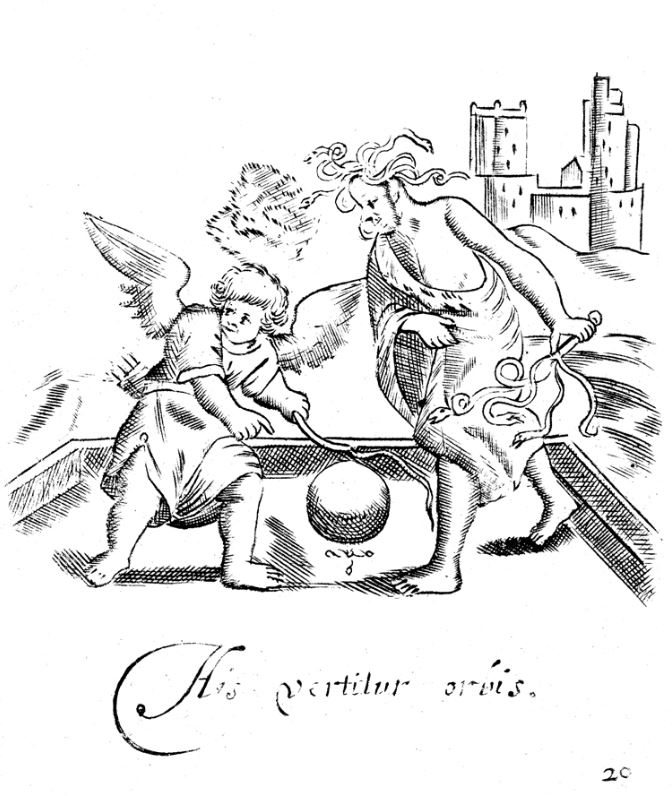
* The artwork "Medusa and Cupid" is by Quarles, Francis (1592-1644) from the book titled "Emblemes, by Fra. Quarles", now in public domain.
Both Medusa and Cupid attempt to grab the orb and the cross. Since Cupid cannot look at Medusa, he employs the use of a branch to guide the orb to his hands. The Latin phrase reads, "By these or on these the world revolves around or turns."
Courtesy of the Digital Image Archive, Pitts Theology Library, Candler School of Theology, Emory University.
>1. The Corinthians obviously wrote a letter to Paul asking a lot of questions including marriage. What is the first principle on marriage Paul established? (1-2)
* 1 Corinthians 7:1 "Now for the matters you wrote about: It is good for a man not to marry. But since there is so much immorality, each man should have his own wife, and each woman her own husband."
*
Chapter 7 Overview.
Chapter 7 is long, with a lot of advice about husbands and wives, marriage, divorce, and indirectly sex. Paul is answering questions they had, while continuing the subject at the end of the previous chapter. Corinth was the center of much immorality causing the new congregation to be confused about many things involving marriage and sex more than any other congregation Paul founded. Paul is addressing this unique problem in great detail (compare Ephesians 5:22-33; Colossians 3:18-19; 1 Timothy 3:2, 12, 4:1-5, 5:14). I know of no one who quoted this chapter at their wedding ceremony for this reason even though it deals with marriage. Instead, they quote from chapter 13 for it deals with love.
God is the origin of the unique relationship between a man and a woman which we call marriage. He designed it based on the relationship between the Father, the Son, and the Spirit. Marriage is for life (10-11). The husband belongs to the wife and the wife belongs to the husband according to the covenant of marriage (1-7). But what if the person is not a believer? Paul addresses that problem (12-16).
God unites a man and a woman so that they become one flesh. The union is meant for life (10-11). The union is in heart, mind, will, soul, and body. Marriage is based on love, respect, truth, trust, intimacy, sex, and is exclusive. It is dynamic and passionate. It is designed to be a form of worship. The marriage should remain for life, but at times it does not. Apostle Paul gives unique example of when someone is to divorce.
Apostle Paul goes into detailed reasons why a person should remain in the station of life they were in when they came to believe in Jesus. He not only applies this to marriage and being single, but also occupation (17-24). However, he does not say that is an absolute rule.
The apostle gives directions to virgins, single life (25-28, 36-38), trials of the married state (32-35), a reason to marry (8-9, 36-38), and directions to wives and widows (39-40). Indeed, this is a long chapter.
Listen to the above comments on 1 Corinthians Chapter 7 Overview.
* "Now for the matters you wrote about" -The Corinthian congregation had written him in response to the letter he wrote to them as was revealed in chapter 5:9. We do not have this letter today.
* "It is good for a man not to marry." -Elsewhere he says why. So that the person does not get tangled up in civilian matters, meaning family matters as opposed to always being at work for the Lord within the church. (2 Timothy 2:4)
* "But since there is so much immorality" -Meaning within the city of Corinth sexual immorality was everywhere. It was perhaps the main business within the city. He does not mean within the church. The constant exposure to sex would stimulate almost all men who were weak willed. Only a strong willed man could overcome and resist the lure of sex within Corinth. Every country has a city that is known for promiscuity more that others.
* "marry... so much immorality" -English translations include "marry", "sexual relations", "touch a woman", "relations"; and for the second part "so much immorality", "fornication", "sexual immorality is so common", "sexual immorality is occuring", and "temptation to sexual immorality".
* "should have his own... her own" -The original Greek does not have "own" before wife, but it does before husband; "echo heautou... echo idios aner" (a transliteration). However, the sentence is structured that implies both. Every English translation that I have has the word "own" before both except the YLT which has "her proper husband".
The sense is singular. Concubinage and polygamy are forbidden.
* A spouse must ensure not only pleasure during, but before, during, and after intercours. Have the desire that your spouse will have sexual and emotional ecstasy and complete satisfaction of their passion. Drunken sex is mostly not a pleasurable sex compared to sober passion.
* But Since
Corinth was on a peninsula. Ships needing to get from two important shipping seas would be taken across land at Corinth. Sailors would have several hours to explore the city as their ships traversed the land. The temple prostitutes for the goddess Aphrodite numbered in the hundreds, even thousands, at Corinth, profiting from the sailors. Rampant legal religious prostitution, though financially profitable, was socially and personally destitute.
New Christians in morally desolate Corinth sought Paul's guidance on secure living practices concerning marriage and sex. Apostle Paul knew the benefits of a celibate life. He also knew that this would be especially hard for the Corinthians who accepted Jesus as their Lord and Savior in Corinth. The city had so much immorality that each man should take a wife, and each woman should have a husband (2).
Marriage is so much more than sex. Paul is not saying that marriage is only about sex. He is simply addressing a matter for which they asked for his advice. He states in verse 6, "I say this as a concession, not as a command." He will have more to say on this later in the letter.
The young man and young woman who are dating and considering marriage, the newly married, and those who are struggling in their marriage need to know that sex is designed by God to be a part of married life, not the principal part of marriage. Sex is a part, not the whole of marriage. Sadly, modern society has placed such a high expectation on sex that sex is confusing and then disappointing to many, just as it was in Corinth. The relational aspects: love, joy, peace, patience, goodness, gentleness, self-control, romance, and intimacy are lost in the modern quest for constant sex. People are devastated in a quest for someone elses idea that life's goal is perfect sex all the time.
Listen to the above comments on 1 Corinthians Chapter 7:1-2.
>How does this explain why some denominations today have so much sexual immorality?
* Just as the Corinthian congregation was confused about marriage and sex because their culture was fixated on sexual gratification anytime and anyway at the greatest profit, so world culture today has confused many people and congregations on marriage and sex. They accept sins that go against God's design as proclaimed in the Bible and celebrate their freedom and diversity in a false grace. Other congregations all but ignore the subject of sex. Apostle Paul, as this letter proves, did not.
>2. What is a marital duty and how can it fall to that level? (3)
* 1 Corinthians 7:3 "The husband should fulfill his marital duty to his wife, and likewise the wife to her husband."
* "husband... wife" -Singular. Not plural. One husband. One wife. No more.
* "fulfill" -The Greek verb "apodidomi" translated "render" in the KJV and ASV, "fulfill" in the HCS and CSB, "satisfy" in GW, and "let... render" in YLT.
* "marital duty" -The Greek verb-noun pair "opheilo eunoia" translated "due benevolence" in the KJV, "due" in the ASV, "marital responsibility" in the HCS, "sexual needs in GW, "marital duty" in CSB, and "let... the due benevolence render" in YLT.
* When a husband and wife have emotions that separate, they will lose sexual desire and will for the other. The marriage can become only about sexual gratification. The body function continues even when love falters.
* Permanent abstention from sex deprives the other partner of his or her natural right and my be conducive to temptation. The causes of this problem are many and unique to each couple. Each have to work together to solve the problem. Often repentance, promise, and forgiveness is a necessary need in the solution. These are not easy.
>How does verse 4 reflect back to 6:16?
* 1 Corinthians 7:4 "The wife's body does not belong to her alone but also to her husband. In the same way, the husband's body does not belong to him alone but also to his wife."
* 1 Corinthians 6:16 "Do you not know that he who unites himself with a prostitute is one with her in body? For it is said, "The two will become one flesh."
* "The wife's body does not belong to her alone" -Because she is united with her husband in body and soul.
* "the husband's body does not belong to him alone" -Because he is united with his wife in body and soul.
* "but also to her husband... but also to his wife." -The marriage covenant establishes conjugal rights and exclusive possession of a spouse.
>What could happen if a spouse deprives the other? (5)
* 1 Corinthians 7:5 "Do not deprive each other except by mutual consent and for a time, so that you may devote yourselves to prayer. Then come together again so that Satan will not tempt you because of your lack of self-control."
* "lack of self control" -Controlling the physical body, will and desire, and emotions.
* Paul's point is because prostitution and promotion of sex is so rampant in the city, the Christian husband and wife should not hold back sex from their spouse. Doing so might place them to fall to the temptation of going somewhere else to quench the sexual passion, which would be a sin.
* "Do not deprive" -One exclusion is given here. However, another exclusion is given in the Mosaic law, when a woman is in her period.
* "Jewish teachers who were trying to formulate laws in this period differed on how long a man could vow to abstain from intercourse with his wife; one school said two weeks, and the other school said one week. Although Paul would not make longer abstinence grounds for divorce, as they did (10-13), he clearly wishes to limit even abstinence by mutual consent, leaving the specifics to the couple." (Bible Background Commentary - The IVP Bible Background Commentary - New Testament)
>What is a good reason to deprive by mutual consent and needs self control?
* "so that you may devote yourselves to prayer." -A time for personal devotion that will last more than a few hours, like a spiritual retreat which they both agree to.
* Practical Union.
"The two will become one flesh," so wrote Paul in 6:16, quoting Jesus, who added, "For this reason a man will leave his father and mother and be united to his wife... So they are no longer two, but one. Therefore, what God has joined together, let man not separate. Anyone who divorces his wife and marries another woman commits adultery against her. And if she divorces her husband and marries another man, she commits adultery." (Mark 10:7-12) Jesus, of course, was commenting on Genesis 2:24.
Verses 4-7 address another aspect of the marital covenant union: the duty each has to the other. Since they are united in flesh, they are responsible for each other's bodies. Jesus displayed his responsibility to the church by offering his body and blood so that his bride could have a new resurrected body. Our bodies are weak and decaying. We have a sinful nature. So he offered his body for our sake. In the same way, husbands and wives are to offer their bodies to one another. Apostle Paul explains this in this way in Ephesians 5:22-33.
Sex is not for self. Sex is for the benefit and gratification of the one with whom we made a marital covenant. When the Holy Spirit inspired the apostle to write, "...the body does not belong to her and him alone..." the model was Christ, who did not give his body for himself. The error made by the world is this: sex is self-gratification.
Another error made is that the world does not know how to have mutual consent to take time to pray alone. Praying together is important, but communing with the Lord alone is also wise (5). After all, our body is a temple, a place to worship as a couple and as an individual. Marital romance and intimacy are a form of worship as much as prayer, meditation, reading and studying the Bible, and acts of service in the name of Jesus.
The husband is to ask the Lord to help him take care of his wife's body, soul, and spiritual life. The wife is to ask the Lord to help her take care of her husband's body, soul, and spiritual life. Husband, ask your wife, "What can I do to help you today?" Wife, ask your husband, "How may I serve you today?" Better yet, look for an opportunity to surprise them by unexpectedly doing something to help them.
Listen to the above comments on 1 Corinthians Chapter 7:4-7.
>Is this a command? (6-7)
* 1 Corinthians 7:6 "I say this as a concession, not as a command. I wish that all men were as I am. But each man has his own gift from God; one has this gift, another has that."
* "I say this as a concession, not as a command." -The main reason it is a concession is because of the gift of self control is not evenly given.
* "I wish that all men were as I am." -He believed his was best. This does not mean it is the best for everyone. God gives gifts as he determines. The gift God gives the individual is the best for that individual.
* "But each man has his own gift from God;" -Paul's gift was self control. Others gift was a spouse.
* Matthew 19:10-12 "The disciples said to him, "If this is the situation between a husband and wife, it is better not to marry." Jesus replied, "Not everyone can accept this word, but only those to whom it has been given. For some are eunuchs because they were born that way; others were made that way by men; and others have renounced marriage because of the kingdom of heaven. The one who can accept this should accept it."
II. The Problems of the Married (7:8-24)
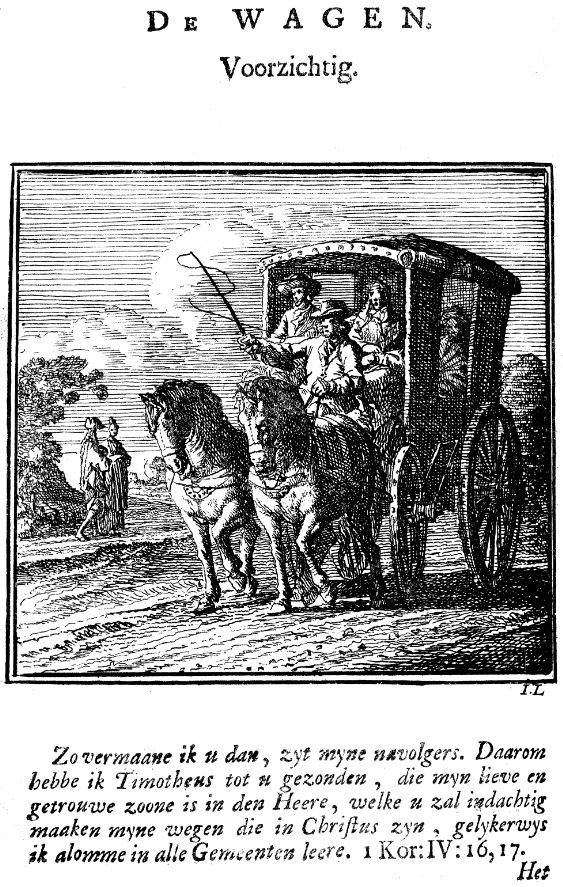
* The artwork "The Coach: Be Careful" is by Luiken, Jan (1649-1712 ) from the book titled "De Bykorf des Gemoeds : Honing zaamelende uit allerley Bloemen / Vervattende over de Honderd konstige Figuuren ; Met Godlyke Spreuken En Stichtelyke Verzen, Door Jan Luiken", now in public domain.
A coach harnessed with two horses and carrying three passengers is driven fast by its driver who urges the horses on with a whip. A couple on the side of the road discusses this scene. The Dutch artist and poet Jan Luiken (1649-1712), whose initials are at the lower right, was responsible for drawing and etching this emblem, as well as for the poem that accompanies it (below). The attendant Scripture text is 1 Corinthians 4:16-17.
Courtesy of the Digital Image Archive, Pitts Theology Library, Candler School of Theology, Emory University.
Motto: It does move easily, with pleasure, But sooner than one thinks, Harm has hit.
Poem:
Through the turning wheel of day and night,
We are on life's coach,
While sitting brought away,
And carried to the Eternity.
Yet with the power of the pulling animal,
In front of these wagon wheels,
A wise driver is also needed,
So that the load doesn't fall over.
The Driver must not a drunkard be,
Overcome by absent-mindedness,
Through gulping the world's wine,
Which many, however, dearly love.
As thus, dim by difficult tasks,
And outside the track made by wisdom,
Many Wagons do tip over,
Which have ended up on bumpy ground.
But he who, through the eye of Carefulness,
Wishes to arrive safely,
Makes sure that he rides with his Wagon,
On the road of all the truly Pious:
The golden course of faithful virtue,
That laid through the Earth,
Ends in Heavenly joy,
Thus is life's wish attained.
(Translation by Josephine V. Brown, with editorial assistance from William G. Stryker)
>3. What direction is given to the unmarried and widows? (8-9)
* 1 Corinthians 7:8-9 "Now to the unmarried and the widows I say: It is good for them to stay unmarried, as I am. But if they cannot control themselves, they should marry, for it is better to marry than to burn with passion."
* "Now to" -Paul is addressing a request in verses 8 and 9. They wanted to know what single people, especially widows should do, either remain single, or get married. There were such people, both male and female in the congregation.
* "the unmarried and the widows" -Even though Paul specifies widows they are different only in the fact that they were married and are now single because their spouse has died. They probably asked about both because they wondered if there might exist different "rules" for single and never married and single because of the death of a spouse.
* "It is good for them to stay unmarried, as I am" -This is Paul's belief in general. He believes dedication to the Lord fully is better. He explains why elsewhere.
* "But if they cannot control themselves," -He means control of their physical body, more specifically control of the sexual desire. God placed sexual desire in the human body so that we may enjoy sex as we obey the command, "be fruitful and increase in number." (Genesis 1:28) God blessed Adam and Eve. Part of the blessing is how he designed us to obey him. We have a choice to obey or reject. If we obey, we enjoy the pleasures that he has designed in advance.
* Is This For Me?
When a person is not married, the questions they ask themselves are, "Does God intend me to marry?" "Is there someone out there I am supposed to be with for the rest of our lives?" "Can I live alone?" "Am I designed to live alone?" "I know God is with me always, but sometimes I want to have a conversation with, walk hand in hand with, eat a meal with, and know the physical presence of someone I love and that loves me. God is with me in Spirit, not in the flesh at this time. Can I pay the price to be fully dedicated to God and remain single, serving Jesus only?" The widow faces similar and harder questions.
Perhaps the single person is open to marriage, has dated disappointment and hurt, and cannot endure those again. They do not want to be single, but have given up trying to find a good person.
Giving up is not the same as resolution. Apostle Paul is addressing the congregation's questions about a commitment to marry or remain single (8). The difference between giving up and resolution is prayer and faith. Giving up does not involve prayer and turning it over to God. Resolution involves faith and prayer. The one who makes a resolution trusts in God. Apostle Paul made a resolution. Should they?
Apostle Paul, addressing this matter that they wrote to him about (1a), considers something else, sexual passion. When God created Adam and Eve, he blessed them and gave them a command to be fruitful and increase in number (Genesis 1:28). Part of the blessing was sexual passion, pleasure, and instinct. The physical design of the nervous system reveals that the blessing was physical as much as emotional, for nerves are concentrated around the reproductive and arousal systems. (This also says so much about the sins of homosexuality and sex change.)
The man or woman, who God blesses to remain single, will be given the gift of self-control of sexual passion, pleasure, and instinct (9). If the gift of self-control is not given, then it can be sure that God does not have a single life in their future. Also, if jealousy and covetousness of the married enter the heart of the single, then they need to consider if they have been called to that vocation, or have chosen it of their own free will. They should pray about marriage.
Listen to the above comments on 1 Corinthians Chapter 7:8-9.
>Should the married remain so? (10-11; Matt. 19:3-6)
* 1 Corinthians 7:10 "To the married I give this command (not I, but the Lord): A wife must not separate from her husband. But if she does, she must remain unmarried or else be reconciled to her husband. And a husband must not divorce his wife."
* Matthew 19:3-6 "Some Pharisees came to him to test him. They asked, "Is it lawful for a man to divorce his wife for any and every reason?" "Haven't you read," he replied, "that at the beginning the Creator 'made them male and female,' and said, 'For this reason a man will leave his father and mother and be united to his wife, and the two will become one flesh'? So they are no longer two, but one. Therefore what God has joined together, let man not separate."
* Matthew 19:10-12 "The disciples said to him, "If this is the situation between a husband and wife, it is better not to marry." Jesus replied, "Not everyone can accept this word, but only those to whom it has been given. For some are eunuchs because they were born that way; others were made that way by men; and others have renounced marriage because of the kingdom of heaven. The one who can accept this should accept it."
* Paul is addressing a married couple who both are believers in Jesus as verse 12 states, "to the rest" meaning the rest of the married where one is not a believer.
* "To the married" -Paul is addressing a request related to verses 8 and 9 in versed 10 and 11 for both concern marriage. Verses 12 to 16 is a continuation of 10 and 11. Verses 17 to 24 is a general direction that helps in understanding the Lord's command Paul is repeating in verses 8 to 16.
* "not I, but the Lord" -Matthew 5:31-32, 19:1-12; Mark 10:1-12; and Luke 16:18. Jesus' teaching is virtually unique in antiquity. Not even the Jews taught this because of Moses provision allowing divorse. Jewish woman did leave their husbands and Jewish men divorced their wives. Roman socially elite could leave their spouse, but not divorce because almost all were arranged marriages for political and financial gain.
* "separate" -The original Greek verb is "chorizo" (a transliteration) translated either "depart", "leave", and "separate" both in verse 10 and 11. This is not the words used at the end of verse 12 often translated as divorce.
* Paul gave no opinion or comment of his own. Nor will I in this study.
* Malachi 2:13-16 "Another thing you do: You flood the LORD's altar with tears. You weep and wail because he no longer pays attention to your offerings or accepts them with pleasure from your hands.
You ask, "Why?" It is because the LORD is acting as the witness between you and the wife of your youth, because you have broken faith with her, though she is your partner, the wife of your marriage covenant.
Has not [the LORD] made them one? In flesh and spirit they are his. And why one? Because he was seeking godly offspring. So guard yourself in your spirit, and do not break faith with the wife of your youth.
"I hate divorce," says the LORD God of Israel, "and I hate a man's covering himself with violence as well as with his garment," says the LORD Almighty. So guard yourself in your spirit, and do not break faith.
>What example of loving commitment should the married always remember and learn? (Matt. 28:20b)
* Matthew 28:20b "And surely I am with you always, to the very end of the age."
* Divorce.
Apostle Paul responds to a request related to the one he addressed in the previous two verses. The subject is divorce. Paul repeats what the Lord Jesus taught concerning divorce (Matthew 5:31-32, 19:1-12; Mark 10:1-12; Luke 16:18)
The most notable quote comes from Apostle Matthew. Jesus told some Pharisees who came to test him, "Moses permitted you to divorce your wives because your hearts were hard. But it was not this way from the beginning. I tell you that anyone who divorces his wife, except for marital unfaithfulness, and marries another woman commits adultery."
The disciples said to him, "If this is the situation between a husband and wife, it is better not to marry." The disciples were shocked. We know that Peter was married. So at least he knew of the problems of marriage. But they all had witnessed their parents' relationship problems.
Jesus replied to them, "Not everyone can accept this word, but only those to whom it has been given. For some are eunuchs because they were born that way; others were made that way by men; and others have renounced marriage because of the kingdom of heaven. The one who can accept this should accept it."
Something for the married believer in Jesus to consider is his faithfulness to us. He promises us, "And surely I am with you always, to the very end of the age." (Matthew 28:20b) Cannot I follow his example in this?
Listen to the above comments on 1 Corinthians Chapter 7:10-11.
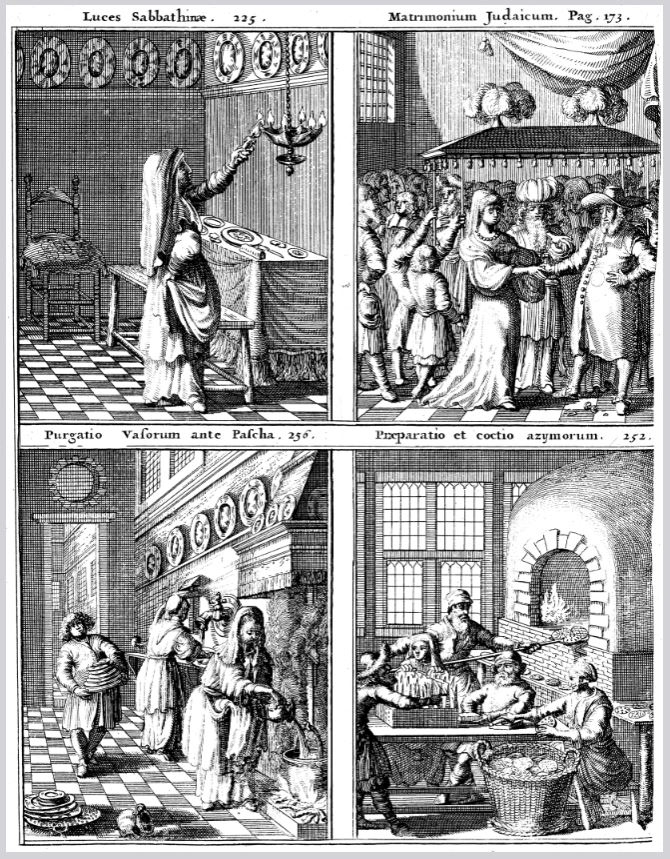
* The artwork "Jewish Rituals" is by Leusden, Johannes (1624-1699) from the book titled "Philologus Hebraeo-mixtus : unà cum spicilegio philologico, continente decem quaestionum & positionum praecipuè philologico-Hebraicarum & Judaicarum centurias / auctore Johanne Leusden ...", now in public domain.
This page illustrates four religious rituals of the Jewish faith.
In the upper left corner is a depiction of LUCES SABBATHINAE, or "Sabbath candles," and the ritual associated with them. In the same room where the Sabbath meal is eaten, a veiled woman lights suspended candles from a pre-existing flame of another candle. The simple decor of the room includes a wooden chair, bench, table, and decorative plates lining the walls. The Passover meal is laid out on a white tablecloth.
The upper left register depicts a MATRIMONIUM JUDAICUM, or "Jewish marriage" ceremony. In the forefront of the crowd standing underneath the marriage canopy (CHUPPAH), the bride and groom (CHATAN and KALLAH) hold hands as the rabbi recites either the betrothal blessing or Seven Blessings over a cup of wine.
Directly below is the illustration of PRAEPARATIO ET COCTIO AZYMORUM, or the "preparing and baking of bread." Men and women sit at a table kneading the dough and rolling it flat, while a man uses a wooden peel to retrieve the unleavened product out of the brick oven. The baked loaves or MATZA are placed in a large basket beside the preparation table.
The bottom left register shows two women in the process of PURGATIO VASORUM ANTE PASCHA, cleaning vessels or dishes before the Passover meal. One woman scrubs a plate underneath a running faucet, and another fills a pot of boiling water. A man carries in a stack of plates for washing, and several vessels lay on the ground in queue. "
Courtesy of the Digital Image Archive, Pitts Theology Library, Candler School of Theology, Emory University.
>4. If your spouse is not a believer should you divorce him or her? (12-13)
* 1 Corinthians 7:12 "To the rest I say this (I, not the Lord): If any brother has a wife who is not a believer and she is willing to live with him, he must not divorce her. And if a woman has a husband who is not a believer and he is willing to live with her, she must not divorce him."
* "To the rest I say this" -Who is left? He addressed the single in verses 8 and 9 and the married in verses 10 and 11. So who is left? Paul brings up the case, but frankly Paul, I believe this is a subcategory of the married in verses 10-11. Just being funny.
Paul means, "to the rest of the married". I give a good example of how it is easy to misrepresent scripture when it is broken down into small pieces.
* "I, not the Lord" -Jesus did not give direction on mixed marriages during his earthly ministry. Apostle Paul does not encourage it. (2 Corinthians 6:14) Here, Paul addresses if they became a believer after they married.
* "If any brother has a wife who is not a believer" -They married before one of them put their faith in Jesus, or perhaps one thought the other was a believer, but as it turns out was not a believer in Jesus. Or one final possibility, they are a believer, but have decided to engage in all kinds of immorality and unfaithfulness to their spouse and Lord. They impose an abusive relationship to their spouse, whether emotionally, verbally, and/or physically. The determination is everything they are doing against their spouse shows they are not a believer, yet in other things they appear to be a believer. Such mixed lifestyle display for the harmed spouse must be a determination that for me they are not a believer in Jesus.
* "she is willing to live with him" -Often, but not always, the unbeliever's lifestyle devolves into more sin. The separation between lifestyles brings arguments and disagreements. However, perhaps the unbeliever does refrain from immorality and depravity and wants to live a "clean" lifestyle. The unbeliever does not attend church, but accepts their believers commitment to Christ. I have seen both cases. More often though the believer laments because the difference in lifestyles causes a divide that was not present before they came to believe.
* "divorce" -The original Greek verb is "aphiemi" translated "divorce", "put away", "leave", and "send away" in this passage and "forgive" in other passages. It appears 146 times in the New Testament. "Apostasion" and "apostasiou" refers to a certificate of divorce in the four gospels, which contains the verb "apoluo", which technically did not mean divorce. It also means "putting away". The gospel passages record Jesus responded to the Pharisees about divorce in Jewish society according to the Mosaic law and Jewish tradition where certificates where used by the religious leaders due to receiving temple tax based on being single, married, and quantity of children. This was rather unique in ancient times. Certificates of marriage and divorce being common is new in human society. Roman elite did have certificates of marriage and divorce that were more like financial statements, not much different than today. The poor has no need for such certificates. Slaves were usually given permission to marry by their owners, and perhaps had certificates that stipulated any offspring would be owned by the master.
* Only in modern times, since the introduction of tax deductions for being married, a certificate of marriage is required and is common in most of the world to receive credit. Before this time common law marriage was more prevalent, though churches kept track of marriages before that. However, registering at a civil county government location was not required. So, a certificate of divorce was not needed if no certificate of marriage existed. Marriage was considered legal in many ways in ancient society, though most had some kind of ceremony with witnesses. To divorce was simply a matter of leaving one's spouse. Since males usually owned the property legally, they would "put out" their wife from the property.
* If not married Paul gives this direction in 2 Corinthians 6:14-16. "Do not be yoked together with unbelievers. For what do righteousness and wickedness have in common? Or what fellowship can light have with darkness? What harmony is there between Christ and Belial? What does a believer have in common with an unbeliever? What agreement is there between the temple of God and idols? For we are the temple of the living God. As God has said: "I will live with them and walk among them, and I will be their God, and they will be my people."
>What does verse 14 mean?
* 1 Corinthians 7:14 "For the unbelieving husband has been sanctified through his wife, and the unbelieving wife has been sanctified through her believing husband. Otherwise your children would be unclean, but as it is, they are holy."
* "has been sanctified through" -They are united in body for they are "one flesh" through their marriage(6:16). "Sanctified" is the Greek verb "hagiazo", the same word used in 6:11. A question is then, since they are one, is the one who does not believe sanctified which means "set apart" (John 17:17)? In what manner are they sanctified? "Sanctified" here is the Christian state because of marriage, not the moral lifestyle change for the unbeliever did not change their belief. Consider the difference between baptism and circumcision, to faith in Jesus and Abraham who was credited as righteous when he believed the promise. Marriage, baptism, and circumcision are sacraments, symbols of something happening inside. The marriage is sanctifying the unbeliever so that the marriage is set apart. They can live together. Consider also, if they were to have sex with another, then they commit adultery, violating their marriage bed, which is also holy, set apart only for them.
* "Otherwise your children would be unclean, but as it is, they are holy." -Paul, the writer, and Timothy, the bearer of the letter, were from a mixed family. Both Greco-Roman and Jewish law debated the status of children of socially mixed unions. As long as the children were with the parent of the believer, they would hear and see the gospel. Usually children stayed with the father. If the mother was the believer, the children would lose a chance to be influenced by their mother's faith in Jesus.
Some commentators write that this allows children of mixed religion marriages to enter a Christian church and be allowed to be a member of a congregation the same as if both parents are Christians. I find this strange and offensive, until I realize some in congregations who both are believers may look down on children of a parent whose spouse does not believe. Then, yes, it should be said that their children are of the same "class" as the parent whose spouse is not a Christian. Sadly, many modern churches are segmented by "classes" made up in some people's minds. But the New Testament writers are clear. There is not distinctions in Christ. All are the same.
* "holy" -The original Greek adjective "hagios" meaning "to make holy" is related to the verb "hagiazo" in the first part of the verse translated as "sancrified".
* Some say Paul is referring to infant or children baptism. However, Paul never mentions child baptism in any of his letters. Neither does the gospels speak of child baptisn. However, a child, according to the covenant given to Abraham called circumcision, was set to start shortly after birth. When circumcised, an infant was under the covenant which was confirmed personally at the age of twelve. So, from birth to twelve the child was under the covenant of circumcision, and thus holy.
* The unbelief of the one spouse does not make impure the believing spouse. Rather, it is the other way around. The believing spouse makes pure the unbelieving spouse. Pure has more power. The spouse that came to believe in Jesus need not be concerned that their spouse who choses not to believe in Jesus will nulify and take away their sanctification. The unbeliever cannot do that. The beleiver has the Holy Spirit and that is more power than all the devils and unbelief in the universe.
* Titus 1:15. Though marriage and sex are pure, the impure and unrepentant sinner make their sex impure by their very impure nature. Still, if their spouse becomes a believer, the believer becomes sanctified, and so does their marriage and sex through the spouse that believes in Jesus.
* "The passage, then, is a remarkable one, and drawn from the depths of theology; for it teaches, that the children of the pious are set apart from others by a sort of exclusive privilege, so as to be reckoned holy in the Church." (John Calvin and John Pringle, Commentaries on the Epistles of Paul the Apostle to the Corinthians, vol. 1, p. 243.)
* "But how will this statement correspond with what he teaches elsewhere - that we are all by nature children of wrath (Eph. 2:3), or with the statement of David, "Behold I was conceived in sin". (Ps. 51:7) I answer, that there is a universal propagation of sin and damnation throughout the seed of Adam, and all, therefore, to a man, are included in this curse, whether they are the offspring of believers or of the ungodly; for it is not as regenerated by the Spirit, that believers beget children after the flesh. The natural condition, therefore, of all is alike, so that they are liable equally to sin and to eternal death. As to the Apostle's assigning here a peculiar privilege to the children of believers, this flows from the blessing of the covenant, by the intervention of which the curse of nature is removed; and those who were by nature unholy are consecrated to God by grace. Hence Paul argues, in his Epistle to the Romans (11:16) that the whole of Abraham's posterity are holy, because God had made a covenant of life with him "If the root be holy," says he, "then the branches are holy also." And God calls all that were descended from Israel his sons: now that the partition is broken down, the same covenant of salvation that was entered into with the seed of Abraham is communicated to us. But if the children of believers are exempted from the common lot of mankind, so as to be set apart to the Lord, why should we keep them back from the sign? If the Lord admits them into the Church by his word, why should we refuse them the sign? In what respects the offspring of the pious are holy, while many of them become degenerate, you will find explained in the tenth and eleventh chapters of the Epistle to the Romans; and I have handled this point there." (John Calvin and John Pringle, Commentaries on the Epistles of Paul the Apostle to the Corinthians, vol. 1, 243.)
>What other direction is a mixed couple given? (15)
* 1 Corinthians 7:15 "But if the unbeliever leaves, let him do so. A believing man or woman is not bound in such circumstances; God has called us to live in peace."
* "But if the unbeliever leaves" -Further evidence of the antiquities pagan concept of marriage being different than modern times.
* "let him do so... God has called us to live in peace" -I know of a man whose wife, whom he thought was a believer, was planning to leave him for years, taking all the money and children, but not legally divorce him so she could continue to claim him on taxes and child support. She did all she could think of to make this happen, to the great harm of her husband. Many told him to divorce his abusive wife, including Bible teachers and pastors. He refused for years. The children witnessed much harm to him and were also abused by her plans. She became addicted to drugs and forced seperation. Eventually, they leagally divorced. It would have been better if he taken Paul's advice and let her leave from the beginning.
* "God has called us to live in peace." -When a spouse has decided to leave, making plans to do so, the longer the believer holds on, the more peace turns into abuse. An abusive marriage is not a place to remain in. Leave an abusive spouse. An abusive spouse is one who almost always does not believe in Jesus. How can the Holy Spirit dwell in an abusive spouse? That is not love.
* "peace" -God wants both to be at peace in the heart and mind.
>Why? (16)
* 1 Corinthians 7:16 "How do you know, wife, whether you will save your husband? Or, how do you know, husband, whether you will save your wife?"
* "save your husband... save your wife?" -A dilemma. A witness, not so much through words, but mostly though actions. God saves, but we can show God's love though our actions. We can display that we believe.
* Jesus sends us to be his witnesses to the ends of the earth. We witness by words. We witness by actions. We witness by the lives we live. We can witness to an unbelieving spouse.
* "How do you know" -We do not know who will heed the movement of the Holy Spirit as we witness to others.
* I Believe, My Spouse Does Not.
Apostle Paul continues his answer on their questions about marriage, giving advice that Christ Jesus did not speak about during his earthly ministry, a mixed religion marriage. What should a spouse do when they come to faith in Jesus and their spouse has not yet done so? Should they remain married to them or divorce them?
Actually, the Greek words translated "divorce" and "certificate of divorce" in the New Testament mean "put away" and "send away", not divorce as we know it. This is because, for most, becoming a married couple in antiquity was different from the modern era. Unless one was an elite, rich, or royal, they did not receive a legal document certifying their marriage from the government or any other institution. Common law marriage was the norm, the same as couples living together today without being legally married. Roman slaves were not allowed to marry, having only informal unions that their masters could end at any time. Most in ancient Greek and Roman societies separated when they "fell out of love". The owner of the property the couple lived in "sent away" their spouse.
So, the Corinthian believers asked Paul, "Should we send away our spouse who does not believe in Jesus?" Perhaps they were concerned that they would be influenced into a sinful lifestyle again. Paul's advice is to stay with the unbelieving spouse. Commentators are unsure as to how the unbelieving spouse is sanctified, "set apart", and their children are holy (a derivative of the Greek word translated sanctified), especially since Paul does not encourage marrying an unbeliever in 2 Corinthians 6:14-16.
One commentator does make the point that Apostle Paul, who wrote this letter, and young Timothy, who delivered it, were both children of mixed marriages. Both had mothers who were Jews, but fathers who were pagans. Both put faith in the God of Abraham while retaining their Roman citizenship. Their personal experience must have weighed heavily in Paul's decision to stay with the unbeliever, for their mother did, and it was to their benefit in the end. Similarly, how may children learn that one parent believes in Jesus, while the other does not, even though they may at least on occasion attend a congregation.
Listen to the above comments on 1 Corinthians 7:12-16.
>How does this further explain verse 14?
* Verse 16 seems to support the belief that the unbelieving spouse can come to believe through the witness of the believing spouse.
>5. What is important to all decisions in life? (17)
* 1 Corinthians 7:17 "Nevertheless, each one should retain the place in life that the Lord assigned to him and to which God has called him. This is the rule I lay down in all the churches."
* This is the third time Paul states this. In each example Paul states this. Paul is giving three examples where the general concept started in verse 12.
* "retain the place in life" -Keep status or vocation meaning "live as a believer in the circumstances you were in when becoming a believer". Don't make any sudden rash changes right away. The KJV poetically says, "let him walk".
* "This is the rule I lay down in all the churches." -He calls it a rule. Other English translations have "command" or "ordain".
* "churches" -The original Greek noun means "congregation" or "assembly" as in a religious gathering that has been called out.
>What example is given to support this statement? (18-19)
* 1 Corinthians 7:18-19 "Was a man already circumcised when he was called? He should not become uncircumcised. Was a man uncircumcised when he was called? He should not be circumcised. Circumcision is nothing and uncircumcised is nothing. Keeping God's commands is what counts."
* "circumcised" -The cutting off of the main foreskin. The Lord God instructed Abraham to do this to himself, and all his descendants and all in his household should do this to after Abraham lie with his wives servant at his wives suggestion.
* "Was a man already circumcised when he was called?" -A descendant of Abraham. Paul was a descendant of Abraham of the line of Benjamin.
* "He should not become uncircumcised" -Once the skin was cut off in Paul's day, it could not be put back on. Rather silly. Of course, Paul may mean symbolically. If so, then he means the man should keep Jewish practices. This is possible because in Acts 15 the council in Jerusalem made a distinction between Jews and Gentile believers.
* "he was called" -To be called one must hear a voice.
* "Keeping God's commands is what counts." -Circumcision is only a sacrament that can be done while the heart remains far from God.
>Is this a hard set command?
* 1 Corinthians 7:20 "Each one should remain in the situation which he was in when God called him."
* Verse 17, 20, and 24 repeats this, each section, each point has the same general concept. In verse 17 he calls it a rule. Concerning being a slave he says, "do not let it bother you -- although if you can gain your freedom, do so." The point is obviously, be content with your life. God knows.
* "should retain" -No sudden changes to circumstances. We should stop sinning and obey God's commands (19). But other things should remain the same.
* "remain in the situation" -Other English tranlations have "abide in the calling", "remain in the condition", "remain in the life situation", and "abide in the same calling". This can be seen as occupation since being a slave or freeman follows. However, since Paul repeats it three times, he more likely means life circumstances in general.
* "called" -Other English translations also have called.
* No matter the life circumstances, no matter where we live, no matter our social status, no matter our heritage, no matter anything, God calls people to a life of salvation and obedience in Christ Jesus by the power of the Holy Spirit
* We retain no matter what. We enjoy God and serve him. That changes. We obey. That changes. Life style changes. But status, life circumstances, social status, and heritage do not change, at least not right away in most people's case.
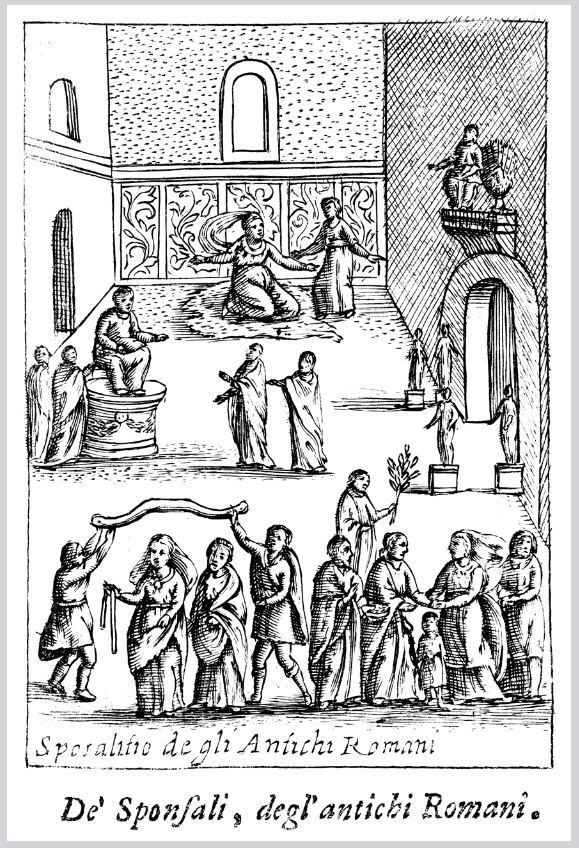
* The artwork "Roman Marriage" is by Rossi, Filippo de', fl. (1645) from the book titled " Descrizione di Roma moderna formata nvovamente / con le autorità del cardinal Baronio, Alfonso Ciaconio, D'Antonio Bosio, Ottavio Panciroli, e d'altri celebri autori accennati nella lettera al lettore ... Distinta in quattordici rioni, abbellita con figure nuoue di rame, & accresciuta di molte notizie istoriche.", now in public domain.
This page illustrates an ancient Roman marriage.
Courtesy of the Digital Image Archive, Pitts Theology Library, Candler School of Theology, Emory University.
>6. What other example is given to reinforce not getting excited about our status qua? (21)
* 1 Corinthians 7:21 "Were you a slave when you were called? Don't let it trouble you--although if you can gain your freedom, do so."
* "slave" -Historians says that 20 to 30% of the entire Roman Empire were slaves in the first century. Italy had the highest percentage of slave versus freeman, up to 40%.
* "Don't let it trouble you" -Be content.
* "although if you can gain your freedom, do so." -Improving one's life is good and when possible should be done.
* "We know that in all things God works for the good of those who love him, who have been called according to his purpose." (Romans 8:28)
* 2 Corinthians 9:8
* Retain, Be Content, Part 1.
The general principle is given. Retain the place in life the Lord assigned me. Retain the place God has called me. As God distributes when called, I am to walk it as a believer in Christ Jesus. This implies two things. First, God was in control of my life before he called me, when he called me, and forevermore. Second, I am to be content with where God placed me this moment, every moment, till there are no moments left for me. That is the general principle.
Proverbs 19:23 states, "The fear of the LORD leads to life: Then one rests content, untouched by trouble."
Paul gives a silly religious example. A circumcised man should not seek to be uncircumcised. Physically, in Paul's day, that would have been impossible. An uncircumcised man should not seek to be circumcised. A direction given by all the apostles at the council in Jerusalem early in the church. Every believer knew this (Acts 15).
Though there are practices to the religious example to be followed, Apostle Paul gives this silly religious example to illustrate the general principle, "Each one should remain in the situation which he was in when God called him." (20) Each Christian is to live contentedly for the Lord in whatever economic, social and religious situation in life God has placed them. If a Jew, live as a Messianic Jew contentedly. If a Roman or Greek Christian, live as such contentedly.
Listen to the above comments on 1 Corinthians 7:17-20.
>How should we view our life no matter what? (22)
* 1 Corinthians 7:22 "For he who was a slave when he was called by the Lord is the Lord's freedman; similarly, he who was a free man when he was called is Christ's slave."
* "slave... freedman" -A play on words, made possible by the Lord Jesus. The slave is freed by the Lord, and thus has all the privileges of everyone else called by the Lord. There is no difference between slave and free in Christ.
* "called by the Lord" -Paul does not say the modern common phrase, "saved by the Lord." Paul literally heard Jesus. So, he literally was called. Most do not literally hear the voice of Jesus. Most hear the voice of a messenger, a Christian who was sent. A few, like myself came to believe through written word, a book. After reading the Gospel of John I read the booklet, Power For Living. The calling I received was from written words, not a literal voice. Still, we all are called.
* "Freeman... free man" -In the first play of words Paul uses "freedman", past tense. In the second he uses "free man". This is the only place the Greek noun translated "freedman" is used in the New Testament. The Greek adjective translated "free man" is used 23 times in the New Testament. The other English translations that I have have the same words here with a slight variation if the phrasing of the second one. This different use of words is not a matter of English structure. The second Greek word refers to "a citizen who can go at liberty". The first Greek word is a person who is "freed away".
* Paul's point is to beat down the haughty attitude of the free, and to give comfort to the slave. The free man considered themselves greater than the slaves. Today is much the same. The more money and possession one has, the more pride many have. The theif pride sneaks in their soul and steals the rich man's soul.
>What could happen? (23)
* 1 Corinthians 7:23 "You were bought at a price; do not become slaves of men."
* Already stated in 6:20, but for a different purpose.
* "do not become slaves of men. -That is, "Do not regard yourselves as the slaves of men. Even in your humble relation of life, even as servants under the laws of the land, regard yourselves as the servants of God, as obeying and serving him even in this relation, since all those who are bought with a price - all Christians, whether bond or free - are in fact the servant (slaves) of God. (Albert Barnes, Notes on the New Testament: I Corinthians, ed. Robert Frew (London: Blackie & Son, 1884-1885) p.125)
* "slaves of men" -Many kinds of slavery exist. Physical, social, and religious are the most common. Some are forced into slavery such as young Joseph, others sell themselves into slavery. We should not make ourselves slaves in anyway.
>What is the final verdict? (24)
* 1 Corinthians 7:24 "Brothers, each man, as responsible to God, should remain in the situation God called him to."
* "Brothers, each man" -Paul addresses them as "brothers" several times in this letter, an endearing greeting. The 1984 NIV (and other translations) has "brother". Later NIV translations adds "and sisters" which is not in the directly in the original Greek, because of pressures from women advocate groups.
* "as responsible to God" -Of all the versions that I have, the NIV is the only one that has this phrasing.
* "should remain in the situation God called him to." -Repeated yet again.
* Retain, Be Content, Part 2.
The subject Paul is continuing is mixed-religion marriages: a Christian with a non-believer. He is given illustrations to show the basic concept applies to more than mixed-religion marriages. The basic concept is repeated a third time in verse 24, "Brothers, each man, as responsible to God, should remain in the situation God called him to." This is also stated in verses 17 and 20. The illustration given in these verses is that of being a slave and a freeman.
If the person became a believer in Jesus when they are a slave, remain a slave and be content with that (21). The short letter to Philemon addresses a runaway slave, Onesimus, who became a believer in Jesus while Paul was in chains. Paul sent the runaway slave back to his owner, instructing him to accept the man as a believer, and consider releasing the man from slavery. (Philemon 1:12-16)
Of note, the advice here given is that if a chance to gain freedom is offered to the slave, they should take it. Improving the condition and circumstances of our lives is not wrong. What is wrong is not accepting and being content wherever God has placed me.
How can I be content in all and every situation? Know my place with Christ. Though slave to man, I am free in Christ. Though slave to no man, I am slave to Christ, and better because of it, for I was bought by Christ Jesus from slavery to sin and death with the blood of Christ, and so I am free to live as a slave to him. Far better to be a slave to Jesus than a man who believes he lives free, but is actually a slave to sin and death. Praise be to God. My eyes are opened.
Listen to the above comments on 1 Corinthians 7:21-24.
III. The Problems of the Unmarried (7:25-40)
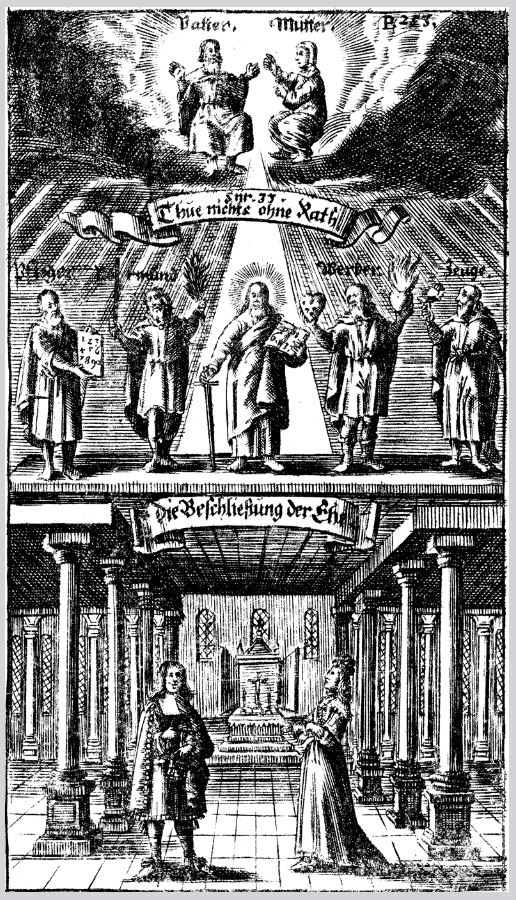
* The artwork "Advice on Marriage" is by Müller, Heinrich (1631-1675) from the book titled " Ungerahtene Ehe, oder vornemste Ursachen so heute den Ehestand zum Wehestand machen / vorgestellet von D. Heinrich Müllern, der heiligen Schrifft Prof. und Pastore bey der Kirchen S. Marien in Rostock.", now in public domain.
The bride and groom stand below while above them stand various counselors and guardians. At the top in the clouds are the father and mother. "
Courtesy of the Digital Image Archive, Pitts Theology Library, Candler School of Theology, Emory University.
>7. When receiving advice from anyone what is an important consideration? (25)
* 1 Corinthians 7:25 "Now about virgins: I have no command from the Lord, but I give a judgment as one who by the Lord's mercy is trustworthy."
* "Now about virgins" -The third subject the Corinthian congregation asked Apostle Paul for advice. "Virgins" in the original Greek is the noun "parthenos" (a transliteration) used 14 times in the New Testament, meaning "maiden", by implication "an unmarried daughter, one who has not had intercourse".
The Bible Background Commentary - New Testament notes, "The term translated "virgin" here was usually used for women, who were also the only ones expected to avoid premarital sex in Greco-Roman culture (outside Judaism). Paul seems to apply the term to both men and women, as do a few later writers."
Adam Clarke notes that the word in this paragraph could be either sex, as appears from 7:26-27, 32-34 and Revelation 14:4. He cites others that believe this too.
Adam Clarke further points out that in verse 36 the Greek word is supposed to mean the state of virginity or celibacy, and very probable reasons are assigned for it; and it is evident that persons of either sex in a state of celibacy are the persons intended.
* "I have no command from the Lord" -Like some others, Jesus did not say anything about what they asked. However, Paul, having the Holy Spirit and authority as an apostle will give his judgement "as one who by the Lord's mercy is trustworthy".
* "as one who by the Lord's mercy is trustworthy" -He was appointed as the apostle to the gentiles by Jesus.
* "judgment" -More like advice that can be trusted. Paul is not going further from Jesus' teaching and adding to it. He was asked for advice and he gives it stating that they can make a choice. So it is not a command.
>What crisis was Paul referring to in verse 26?
* 1 Corinthians 7:26 "Because of the present crisis, I think that it is good for you to remain as you are."
* "Because of the present crisis" -Persecution periodically breaks out. Persecution of Christians in the first century was characterized by intense, localized bursts of violence rather than continuous, empire-wide efforts, beginning with Jewish opposition in Judea and shifting to Roman hostility. Key events included Stephen's martyrdom (~35 AD), James martyrdom (~42 AD), the persecution under Nero (64 AD), Peter and Paul's martyrdom (64 AD), and restrictions under Domitian (90-96 AD). This letter was written in 55 or 56 AD.
First Century Persecution Periods
Jewish Sanhedrin/Opposition (c. 31-35 AD): Stephen was martyred (stoned) in Jerusalem for his preaching, followed by active persecution by Saul (Paul) of Christians in Jerusalem and Judea.
Herod Agrippa I (c. 42 AD): James, the brother of John, was executed by sword in Jerusalem.
Claudius (c. 49-52 AD): Jews, including early Jewish Christians, were expelled from Rome due to disturbances, possibly related to disputes about "Chrestus".
Nero (c. 64-68 AD): Following the fire in Rome, Nero scapegoated Christians, causing mass, sadistic killings, including burning them as torches, crucifixion, and throwing them to wild beasts. Tradition holds that Peter and Paul were martyred during this period.
Domitian (c. 90-96 AD): Christians were targeted for refusing to participate in emperor worship (offering incense to the emperor's genius).
* "I think that it is good for you to remain as you are." -Repeated again. He uses different words, but the point is all the same.
>What is true about all marriages? (27-28)
* 1 Corinthians 7:27-28 "Are you married? Do not seek a divorce. Are you unmarried? Do not look for a wife. But if you do marry, you have not sinned; and if a virgin marries, she has not sinned. But those who marry will face many troubles in this life, and I want to spare you this."
* "divorce"
* "But if you do marry, you have not sinned"
* "she has not sinned"
* "But those who marry will face many troubles in this life" -The next verse clarified this. He is not speaking about normal troubles of life that a married couple faces. He is speaking about what the Christians were facing in that period of time.
>8. How did Paul see the present considering eternity? (29-31; John 9:4)
* 1 Corinthians 7:29-31 "What I mean, brothers, is that the time is short. From now on those who have wives should live as if they had none; those who mourn, as if they did not; those who are happy, as if they were not; those who buy something, as if it were not theirs to keep; those who use the things of the world, as if not engrossed in them. For this world in its present form is passing away."
* John 9:4 "As long as it is day, we must do the work of him who sent me. Night is coming, when no one can work."
* "What I mean, brothers, is that the time is short" -The time given for doing the Lord's work. Jesus said somethings similar with the parable of talents and vineyards. John 9:4 records Jesus saying, "As long as it is day, we must do the work of him who sent me. Night is coming, when no one can work."
* "should live as if" -Five "as ifs" are given. Each rather different; wife, morn, happy, buy something, and use things of this world. They do not have similarity.
* "For this world in its present form is passing away." -So why live for the temporary pleasures it supplies?
* Passing Away Mindset.
The Corinthian congregation asked another question about a subject that Jesus did not give a command on while on the earth. The subject was about virgins. Should these young ladies marry or live a celibate life as they waited for the Lord Jesus to return, serving him and the congregation?
Paul, inspired by the Holy Spirit, gave advice, not a command. He left the decision open to the people involved. He suggested remaining in the place in life that the Lord assigned to them when called (26). Their decision would not be a matter of right and wrong. It is a matter of their present times of suffering and persecution (28). Areas of persecution spontaneously brought out throughout the Roman empire dislodging the life of many Christians during the first three centuries.
The time for doing the Lord's work has become increasingly short. Life is fleeting, as times of persecution remind us. Do not be unduly concerned with the affairs of this world (29-31) because material things are changing and disappearing (31). The Lord is coming. Make wise decisions.
Listen to the above comments on 1 Corinthians 7:25-31.
>What is true about the unmarried and the married? (32-34)
* 1 Corinthians 7:32 "I would like you to be free from concern. An unmarried man is concerned about the Lord's affairs--how he can please the Lord. But a married man is concerned about the affairs of this world--how he can please his wife-- and his interests are divided. An unmarried woman or virgin is concerned about the Lord's affairs: Her aim is to be devoted to the Lord in both body and spirit. But a married woman is concerned about the affairs of this world--how she can please her husband."
* "I would like you to be free from concern." -
* "devoted"
* "devoted to the Lord in both body and spirit."
* "affairs of the world"
>How does Paul determine that the unmarried are better off? (35)
* 1 Corinthians 7:35 "I am saying this for your own good, not to restrict you, but that you may live in a right way in undivided devotion to the Lord."
* "not to restrict you"
* "that you may live in a right way in undivided devotion to the Lord."
* Please Please Thee.
The year before I was born, an album and song were recorded that began a rock ' n ' roll group's very long, popular career. "Please Please Me" was the name of the Beatles' first album and first hit. The not-so-subtle request in the title stands in opposition to the selfless sacrifice presented in this paragraph.
The unmarried man is concerned about how he can please the Lord (32). The married man is concerned about how he can please his wife (33). The unmarried woman and a virgin are concerned about how they can please the Lord (34a). The married woman is concerned about how she can please her husband (34b). Each is devoted to please please someone else (35).
Apostle Paul's intent to display the benefit of remaining single, which is that they can be fully dedicated to the Lord (35). His desire, if the person is called to live an unmarried life and has self-control, is to remain single (1-2, 6, 9).
My intent is for myself to look at where I am now and set my devotions. Am I concerned about myself? My spouse? My Lord? Am I a branch producing fruit for the Lord, or do I need to prune unproductive, self-serving stems that suck time and energy away from pleasing my Lord and my spouse? Am I expecting my Lord and my wife to please please me? Am I devoted only to myself?
Listen to the above comments on 1 Corinthians 7:32-35.
>9. Is it wrong to be engaged and to marry? (36)
* 1 Corinthians 7:36 "If anyone thinks he is acting improperly toward the virgin he is engaged to, and if she is getting along in years and he feels he ought to marry, he should do as he wants. He is not sinning. They should get married."
* NIV text note for verses 36-38. Or, "If anyone thinks he is not treating his daughter properly, and if she is getting along in years and he feels she ought to marry, he should do as he wants. He is not sinning. He should let her get married. But the man who has settled the matter in his own mind, who is under no compassion but has control over his own will, and who has made up his mind to keep the virgin unmarried - this man also does the right thing. So then, he who gives his virgin in marriage does right, but he who does not give her in marriage does even better."
* Different meanings have been assigned to this verse. Calvin says Paul is addressing parents who had children under their authority. After hearing the advice in the verses above, they might keep their children from marriage. Here he leaves it open saying either choice is neither right or wrong. The parent should not deny marriage. This is what Calvin wrote.
The Bible Background Commentary - The IVP Bible Background Commentary - New Testament notes, "Scholars debate whether this passage addresses the fathers of virgins (see NASB) or their fiances (see NIV, NRSV, TEV); evidence within the text can be read either way. Parents arranged their children's marriages, usually with some input from the children; the father had the greatest measure of authority in the matter. "Full age" (see NASB) could mean midteens (parental arrangement of marriages allowed couples to wed at a younger age than in our culture); but the term normally means "beyond youth" and hence probably refers to a virgin older than usual. There is no evidence in this period for unconsummated "spiritual engagements," which became common in later Christianity, perhaps through the "fiance" reading of this passage."
Adam Clarke' notes three principal meanings. I will not repeat them for they are similar to what is mentioned already. After stating the three he writes, "It is generally supposed that these three verses relate to virgins under the power of parents and guardians and the usual inference is, that children are to be disposed of in marriage by the parents, guardians, etc. Now this may be true, but it has no foundation in the text..." (Adam Clarke's Commentary)
* "If anyone thinks he is acting improperly" -Keeping her unmarried to long, past the normal age of handing her off to be married in Greek/Roman culture which was between the ages of 12 to 20 years old.
* "virgin" -Same Greek word as in verse 25. See commentary, question 7a. Virgin is a daughter who did not have intercourse and was not given off into marriage yet.
* "the virgin he is engaged to" -Being engaged means arrangements have been made between the parents of both bride and bridegroom according to the custom of the area and religion which differed.
* "if she is getting along in years" -Some translations use vernacular of their time, like KJV and ASV use "if she is pass the flower of her age", the HCSB use "if she is past marriageable age", GW use "is old enough to get married", the CSB use "if she is getting beyond the usual age for marriage", and YLT use "if she may be beyond the bloom of age."
The point seems to be that the man in this paragraph, the father or guardian most likely, has been keeping the single person past their prime time to marry and now is having doubts about keeping her from being married. Apostle Paul might have been thinking of someone in particular in the congregation. Calvin says that lawyers define the age to be from twelve to twenty years of age "in Roman days". Mary, the mother of Jesus was a young virgin teenager engaged to Joseph.
>What considerations should be taken to remain unmarried? (37)
* 1 Corinthians 7:37 "But the man who has settled the matter in his own mind, who is under no compulsion but has control over his own will, and who has made up his mind not to marry the virgin--this man also does the right thing."
* "But the man who has settled the matter in his own mind"
* "who is under no compulsion"
* "but has control over his own will"
* "and who has made up his mind not to marry the virgin"
* "this man also does the right thing." -
>Is there a right and wrong decision here? (38)
* 1 Corinthians 7:38 "So then, he who marries the virgin does right, but he who does not marry her does even better."
* "he who marries the virgin does right"
* "he who does not marry her does even better."
>What other decisions in life might this also be true and how can this help you make decisions?
* Both Seem Right. What do I Do?
What can we do when we face a major life decision, and there are only two choices: do or do not do? Both seem right. So, which one do we choose? Can we be sure that we are making the best choice?
The Corinthian congregations' request for direction regarding virgins (25-38), especially in these three verses (36-38), falls into this life decision predicament. The limited passage deciphering is that they are asking if it is good and right for a virgin to marry, and should they marry off an engaged virgin, or should the virgin remain devoted to the Lord's work (whether male or female, does not matter).
(If you want to study the cultural aspects of 1st-century Roman society marriage rights, go to the comments on verses 25 through 36.)
The congregation went to Paul. He gave some advice. However, he left the decision up to them. Apostle Paul was not avoiding his responsibility as apostle to the Gentiles. He was deferring to the people involved because it is a case-by-case decision based on logic and emotions. As Paul reminded them in verse 25, "I have no command from the Lord."
We all face the hard decisions, when do and do not do both seem right. How do we know which is right? If the decision is not a sin, immoral, or unethical, then it would fall under this category of life-changing, hard-to-make decisions. When we are not harming others or ourselves, it also falls under this. However, if sacrificing ourselves to help others falls under the decision, then sacrifice self for the others. This is what Jesus taught.
When Paul wrote, "If anyone thinks he is acting improperly towards the virgin..." it seems Apostle Paul is kindly saying the person needs to give up their will for the virgin's benefit. Though a hard decision, the virgin should be allowed to marry the one they are engaged to if they so desire before they gets to far past the age their society deems they should be married. Sometimes, though there is neither a right nor a wrong decision, there is a better decision, and we choose not to make it because the best decision will hurt.
Listen to the above comments on 1 Corinthians 7:36-38.
>10. What should a widow consider? (39)
* 1 Corinthians 7:39 "A woman is bound to her husband as long as he lives. But if her husband dies, she is free to marry anyone she wishes, but he must belong to the Lord."
* "A woman is bound to her husband as long as he lives." -Jesus taught this to the Sadducees.
* "But if her husband dies"
* "she is free to marry anyone she wishes" -The church, nor anyone in the church can say who she marries. Even if the parent or guardian has as a child made a packed with another mother and father to marry their son or daughter, in the end the child should have have the say who they marry. However, often society rules dictate that the final say is the parent. Sadly some parents love money and power more than their children.
* "he must belong to the Lord." -The only requirement Paul gives.
>What principle does Paul repeat in verse 40?
* 1 Corinthians 7:40 "In my judgment, she is happier if she stays as she is--and I think that I too have the Spirit of God."
* "In my judgment"
* "she is happier if she stays as she is"
* "and I think that I too have the Spirit of God." -Sounds like Paul is countering someone or two in the congregation who when they make a statement pronounce that what they are saying is from the Holy Spirit.
* Widowed. Perplexed.
Apostle Paul finishes the Corinthian congregation's questions concerning the married, the young single -the virgins, those thinking about divorce, those thinking about marriage, and sex with advice concerning the covenant bond of marriage. Does the bond last beyond the grave? Can they marry another?
Paul states in verses 8 and 9 that it would be better if the unmarried and widows remain unmarried, but only if they can control sexual desire and passion (9). Here, he states that if a spouse dies, the ties that bind the married couple end. The remaining one is free to marry anyone they wish as long as the new spouse belongs to the Lord, that is, they believe Jesus is the Christ, the Son of God, the Creator God, the Savior. Though the apostle says he believes she should remain a single widow, as he did in verse 8.
Apostle Paul's statement that the union, that is, the binding of a man and woman when they marry is broken when one of them dies, that statement is taken from Christ Jesus' teaching to the Sadducees. One day, the Sadducees, who say there is no resurrection, came to Jesus with a question. They told a sad story about a woman who married consecutively seven men, who kept dying in turn. Then, they asked Jesus, "At the resurrection, whose wife will she be of the seven, since all of them were married to her?" (Matthew 22:23-28; Mark 12:18-23; Luke 20:27-33)
Jesus replied, "The people of this age marry and are given in marriage. - But those who are considered worthy of taking part in that age and in the resurrection from the dead will neither marry nor be given in marriage, and they can no longer die; for they are like the angels. They are God's children, since they are children of the resurrection." (Luke 20:34-36)
Therefore, when a person who is married dies, God, who created the marriage union-bond through the power of the Holy Spirit, ends the marriage union-bond. They await the resurrection to come at the beginning of the age to come. Paul explains the resurrection to come in greater detail in chapter 15.
Listen to the above comments on 1 Corinthians 7:39-40.
IV.THE MAN AND WOMAN RELATIONSHIP (EXTRA COMMENTARY)
* I started an unfinished manuscript titled "The Man-Woman Relationship -Sex, Marriage, and the Bible". The concept is a look at what the Bible says about marriage. Over the decades I was bewildered and frustrated by the lack of unbiased and pure scholarly Biblical books on the subject. The information below are part of 27 pages of notes and comments collected for reference and study as I worked on the manuscript. The manuscript has not been finished due to priorities conflicts.
* Understanding and improving relationships between men and women is often hard and confusing. Being in a relationship with someone from the opposite sex is sometimes great and other times hard to understand and navigate. The reason for this is because either we don't know where to turn to for an anchor in understanding the relationship, or we turn to the wrong anchor. Like a two-person ship suddenly coming on a violent storm without a rutter or anchor, so is a relationship between a man and a woman without truth to anchor and guide. We spin and toss in turbulent philosophies and wisdom until our ship crashes and sinks. The result leaves us drowning in confused, hurt, and broken lives and relationships.
Yet, this doesn't have to be. We don't have to sink and drown in confusing, conflicting, and incomplete relationship understandings, philosophies, ideas, psychology, and anthropology. An anchor of truth does exist. The truths governing the relationship between a man and a woman can be found in Genesis chapters 1 thru 3. These three chapters reveal what is needed to have a solid understanding of the relationship between a man and a woman. Truth exists. Understanding, accepting, and living by these truths will mend broken lives and relationships.
The relationship between a man and a woman is explored in this manuscript. The truth bases are found in Genesis chapters 1 thru 3 with the rest of the Bible as supporting evidence. Six man and woman relational truths are found in Genesis 1 thru 3.
PARASIDE AND PARADISE LOST
truth: Initial Identity.
Genesis 1:27 "So God created man in his own image, in the image of God he created him; male and female he created them."
Genesis 2:25 "The man and his wife were both naked, and they felt no shame."
Genesis 1:1 "In the beginning God created the heavens and the earth."
Genesis 2:4 "When the LORD God made the earth and the heavens"
truth: Blessing and Two Commands.
Genesis 1:28 "God blessed them and said to them, 'Be fruitful and increase in number; fill the earth and subdue it. Rule over the fish of the sea and the birds of the air and over every living creature that moves on the ground.'"
Genesis 2:15-17 "The LORD God took the man and put him in the Garden of Eden to work it and take care of it. And the LORD God commanded the man, "You are free to eat from any tree in the garden; but you must not eat from the tree of the knowledge of good and evil, for when you eat of it you will surely die."
truth: Very Good.
Genesis 2:18 "The LORD God said, 'It is not good for the man to be alone. I will make a helper suitable for him.'"
Genesis 2:20b-23 "But for Adam no suitable helper was found. So, the LORD God caused the man to fall into a deep sleep; and while he was sleeping, he took one of the man's ribs and closed up the place with flesh. Then the LORD God made a woman from the rib he had taken out of the man, and he brought her to the man. The man said, 'This is now bone of my bones and flesh of my flesh; she shall be called 'woman,' for she was taken out of man.'"
Genesis 1:31 "God saw all that he had made, and it was very good. And there was evening, and there was morning--the sixth day."
truth: Man and Woman Relationship Reality.
Genesis 2:24 "For this reason a man will leave his father and mother and be united to his wife, and they will become one flesh."
truth: Sin's Effects, Woman's Curse.
Genesis 3:15-16 "And I will put enmity between you and the woman, and between your offspring and hers; he will crush your head, and you will strike his heel." To the woman he said, 'I will greatly increase your pains in childbearing; with pain you will give birth to children. Your desire will be for your husband, and he will rule over you.'"
truth: Sin's Effect, Man's Curse.
Genesis 3:17-19 "To Adam he said, 'Because you listened to your wife and ate from the tree about which I commanded you, 'You must not eat of it,' Cursed is the ground because of you; through painful toil you will eat of it all the days of your life. It will produce thorns and thistles for you, and you will eat the plants of the field. By the sweat of your brow you will eat your food until you return to the ground, since from it you were taken; for dust you are and to dust you will return.'"
Genesis 3:21-24 "The LORD God made garments of skin for Adam and his wife and clothed them. And the LORD God said, 'The man has now become like one of us, knowing good and evil. He must not be allowed to reach out his hand and take also from the tree of life and eat and live forever.' So, the LORD God banished him from the Garden of Eden to work the ground from which he had been taken. After he drove the man out, he placed on the east side of the Garden of Eden cherubim and a flaming sword flashing back and forth to guard the way to the tree of life."
The most important of these six truths in regard to the man-womean relationship is the one truth that is overlooked and misunderstood the most. Knowing and accepting this one truth is the anchor in the storm of intellectual confusion concerning the relationship between a man and a woman. The anchor truth is, "a man will be united to his wife, and they will become one flesh" (Genesis 2:24).
Genesis 2:24 is the man-woman relationship governing comment that shines bright in the historical narrative of the Bible's first three chapters. All of Genesis 1 thru 3 is an historical account, except this one verse. Each sentence in the first three chapters explains what happens at the beginning except 2:24. Genesis 2:24 is a statement of fact, not a historical account of what happened in the beginning. This comment is given because it is very important and thus begs us to understand what it is saying.
The uniting and becoming one flesh of a man and a woman is purely the work of God according to Jesus. (Matt. 19:6, Mark 10:9) It is a reality. It is not a command, direction, law, nor suggestion. Just as gravity is a reality. So, the uniting of one individual man and one individual woman into one flesh is a reality. This union is God's design. This union is the governing truth of a relationship between a man and a woman.
The reality of the union between one man and one woman is for all humans every born no matter the circumstance of the union, their social status, their religious beliefs, and their location. The union is spirit, soul (mind, heart, will), and body. The union as originally created by God was designed for one man and one woman for life. Adding or subtracting to this union is immorality, whether it be in spirit, in soul, or in body. Morality being what God says is right and wrong concerning this union. Once a man and a woman have intercourse in spirit, soul, and body they and only they were meant to be untied. Neither diminishing this union nor adding a third person to it was God's design nor intent. Both are immorality.
The union that starts with sexual intercourse may result in conception. According to Genesis 1 thru 3 the children born of this union are the responsibility of the man and woman until the male child leaves his father and mother and is united to this wife. Children are a temporary responsibility of the relationship between a man and a woman. Children are not part of the united man and woman.
However, changes came. Adam and Eve sinned. Death entered their world. Sin complicated the sacred relationship between a man and a woman. The introduction of sin and death did not change the reality of God's initial design for their relationship. However, sin did complicate the union. Here in lay the source of our confusion, broken lives, and relationships; sin and death entered the relationship between men and women.
* I will refrain on moving into the next section, "The Origin of the Relationship Between a Man and a Woman." If the Lord is willing, I will finish the manuscript and post it on this site.