* The engraving titled in Latin "SIC HIS QVI DILIGVNT" is from a book "De vltimo fine hominis. : Dispvtatio theologica, in catholica ac celebri Academia Dilingana, anno M.D.XXCIV. die 25. Aprilis publicè proposita. / praeside R.P. Joanne Pelecyo Societatis Iesv, s. theologiae Professore Ordinario. Respondente Thoma Metzgero Loubheimensi, artivm liberalivm ac philosophiae magistro, & s. theologiae studioso.
It is by Pelecyus, Joannes (1545-1623) and is now in public domain.
This title-page border encloses a printer's device, which uses the ancient Christian symbol of a pelican feeding her young from her pierced breast. Framing the image is the Latin motto SIC HIS QVI DILIGVNT ("Thus to those who love"), and the theme of love continues below in the quoted passage from I Corinthians 2:9 ("Eye has not seen, nor ear heard, neither has entered into the heart of man, what God has prepared for those who love him").
Courtesy of the Digital Image Archive, Pitts Theology Library, Candler School of Theology, Emory University.
>1. What immorality was a member of the Corinthian congregation committing? (1)
* 1 Corinthians 5:1 "It is actually reported that there is sexual immorality among you, and of a kind that does not occur even among pagans: A man has his father's wife."
*
Chapter 5 Overview.
Some avoid this chapter because some could be offended. I do not mean to offend. I am looking at Paul's instructions here to understand and thus to have hope, faith, and love to continue in my life.
Paul addresses sexual immorality in the congregation. Incest is specifically mentioned in 1 thru 5. He says that the man doing this should be put out of their fellowship. He equated it to handing the man over to Satan for the destruction of the flesh. (Lev. 20:11 says put him to death.) Yet, the man would be saved, for we are saved by grace through faith. In 2 Corinthians 2:5-11, Paul said to forgive him, love him, and bring him back into the fellowship because he stopped.
Paul then states that they were not to associate with believers who continually engage in 6 actions. He makes it clear that he is not including unbelievers. The actions are sexual immorality, greed, idolatry, slander, alcoholism, and swindling. I do not believe Paul is introducing the law. Rather, he is giving direction to help the congregation from falling into destructive yeast that would cause them to fall into harmful practices.
Sexual immorality is defined in Leviticus 18, 19:20-22, and 20 as 5 actions. Sexual immorality is defined as incest, adultery, homosexuality, bestiality, and during periods.
I am to help people, but only if they want to be helped. I am not and cannot force change on anyone. Forcing someone to stop a bad and even harmful habit when they have no desire to is a common mistake. Some who want change go through a 12-step program, a good tool God uses. I know that I continually need to check my motives and actions to see if I am guilty of any of these, for I am tempted to fall into some of these harmful actions from time to time. Resist the devil, and he will flee.
Listen to the above comments on 1 Corinthians Chapter 5 Overview.
* "It is actually reported" -Most likely the person who delivered a letter from the Corinthian congregation (16:17). Paul was probably at Ephesus, during his over two years stay there.
* "sexual immorality" -The original Greek noun is "porneia" (a transliteration) from the verb "porneuo" which includes adultery and incest. The KJV and ASV translates with the outdated, uncommon, and thus misleading word "fornication".
See question 4a for comments on another word (pornos) in verse 5:9 translated "sexual immorality". 6:9 also has the words "sexual immorality". Also, see the extra section at the end of this study for more commentary on the words "sexual immorality" and "sexually immoral".
* When determining what God considers sexually immoral and sexually immoral people the starting point must be to understand and accept what God made sex for and how it reveals the intimacy within the Trinity.
* "of a kind that does not occur even among pagans" -"Of a kind" reveals that several kinds of sexual immorality exists. More will be revealed later in the letter.
* "A man has his father's wife." -The careful wording reveals that it is not his mother. Either his mother died, or his father divorced and married another women, or his father had more than one wife, though the last was almost unheard of in Roman and Greek society. Most commentators believe his father died, and since his second (or third) wife was much younger, he married her. It is also probably this had something to do with inheritance, espeically if other children were involved.
>Why might the congregation be proud in letting this man be a member of their congregation? (2)
* 1 Corinthians 5:2 "And you are proud! Shouldn't you rather have been filled with grief and have put out of your fellowship the man who did this?"
* "And you are proud!" -They are proud of their grace and mercy.
* "filled with grief" -They should be filled with grief at the deformation of his father's bed, a violation according to Levitical law that even pagan are revolted at.
>What should have they done instead?
* "put out of your fellowship the man who did this?" -The KJV and ASV ends the sentence with, "...that he that hath done this deed might be taken away from you." The HCSB ends, "...so that he who has committed this act might be removed from your {congregation}". The brackets are included. The CSB ends, "...and remove from your congregation the one who did this?" YLT ends, "that he may be removed out of the midst of you who did this work,..."
* "your fellowship" -Rare to state the congregation is a fellowship. (Acts 2:42; 2 Corinthians 5:2; Galatians 2:9; 1 John 1:7)
>2. What does Paul mean by writing he is with them in spirit? (3-4)
* 1 Corinthians 5:3-4 "Even though I am not physically present, I am with you in spirit. And I have already passed judgment on the one who did this, just as if I were present. When you are assembled in the name of our Lord Jesus and I am with you in spirit, and the power of our Lord Jesus is present,"
* "Even though I am not physically present" -The meaning is obvious. He is not there. However, they can act on his behalf. When they do as he would do, they in effect were to think as if he was there.
* "I am with you in spirit" -The Greek noun is "pneuma" (a transliteration) used 385 times in the New Testament. This is a figurative, not literal use meaning "soul" by implication "vital principle" and mental "disposition". This is not the literal meaning, "spirit".
"Letter writers sometimes expressed their intimate concern for the readers by saying that, although they were "absent in body," they were with them "in spirit" or in mind. In some cases, the letter itself communicated the effect of the writer's presence. But this expression was always meant as a statement of intimacy, not of metaphysical presence." (Bible Background Commentary - The IVP Bible Background Commentary - New Testament)
* 2 Kings 5:26 and Colossians 2:5 could mean the same.
>What does he mean that he has passed judgment on the man?
* "I have already passed judgment on the one who did this" -Some people distinguish judging with discerning. Paul is acting as an elder of all the churches, that is, as an apostle. He has determined that this is the best thing to do. He is not condemning the man to hell as is seen in the second letter.
* "just as if I were present" -He said when they judge this way, he is in agreement with them.
* Passing judgment on another believer is no light thing. Paul is emphasizing that they are acting on behalf of the authority of Christ and him as an apostle. No light thing.
>What is meant by "the power of our Lord Jesus is present"?
* "the power of our Lord Jesus is present" -Jesus' power is present through his word and his Holy Spirit.
* Matthew 18:18-20 is Jesus giving this authority.
>What kind of assembly were they to enact the judgement on the man?
* "When you are assembled in the name of our Lord Jesus" -Either during their regular meeting day and time, or during a special meeting time. Most likely their regular meeting day and time. Something that would not be done today. However, Paul sees this as a very impact indent that must be dealt with publicly. Very unusual.
>Why might they be tempted to do this in a secret closed meeting?
* The man and they would be embarrassed.
* They would be admitting they were in error for letting the man stay in the congregation and Paul was right.
* Some were probably close to the man. Perhaps the woman was also a member or occasionally attended, but probably not.
>What is handing someone over to Satan? (5)
* 1 Corinthians 5:5 "hand this man over to Satan, so that the sinful nature may be destroyed and his spirit saved on the day of the Lord."
* "hand this man over to Satan," -Leviticus says kill the offenders (Leviticus 18:8; Deuteronomy 22:30, 27:20).
* "so that the sinful nature may be destroyed"
* "his spirit saved on the day of the Lord."
* Sinful Nature Destroyed.
Apostle Paul addresses another problem at the Corinthian congregation, their handling of a member who is engaging in sexual immorality of a kind that does not occur even among pagans (1). The woman involved, according to the phrase the apostle used, "father's wife", suggests that the woman was his step-mother. Some commentators have suggested that his father had passed and his son married her. However, that is unimportant, for it is not mentioned by Paul in his letter (though, perhaps in 2 Corinthians 7:12). The Old Testament prohibited such a marriage (Leviticus 18:8; Deuteronomy 22:30, 27:20).
The church leadership, if they had one at this time, had done nothing about the ongoing sin. In fact, the congregation was proud of their liberty, a distortion of grace (2). Not even the pagans had tolerance for the disgrace of a father's bed. The Roman orator Cicero states that incest was practically unheard of in Roman society.
Some modern congregations are betrothed in the distorted grace of another type of sexual immorality, which I will not address, for BDBD is intended to be a personal devotional.
So, considering tolerance with the continued sexual sin of even a casual friend, it is best to take Apostle Paul's direction, and meet with them in the name of your Lord Jesus, and as the power of our Lord Jesus is present. Hand this person over to Satan, that is, tell them you no longer consider them a friend because of their continuing in a sexual immorality that cannot be tolerated, especially since you will not live with a distorted grace. This seems harsh, for it is. Pray for them for quite some time, and you will see that distorted grace burns both.
Listen to the above comments on 1 Corinthians 5:1-5.
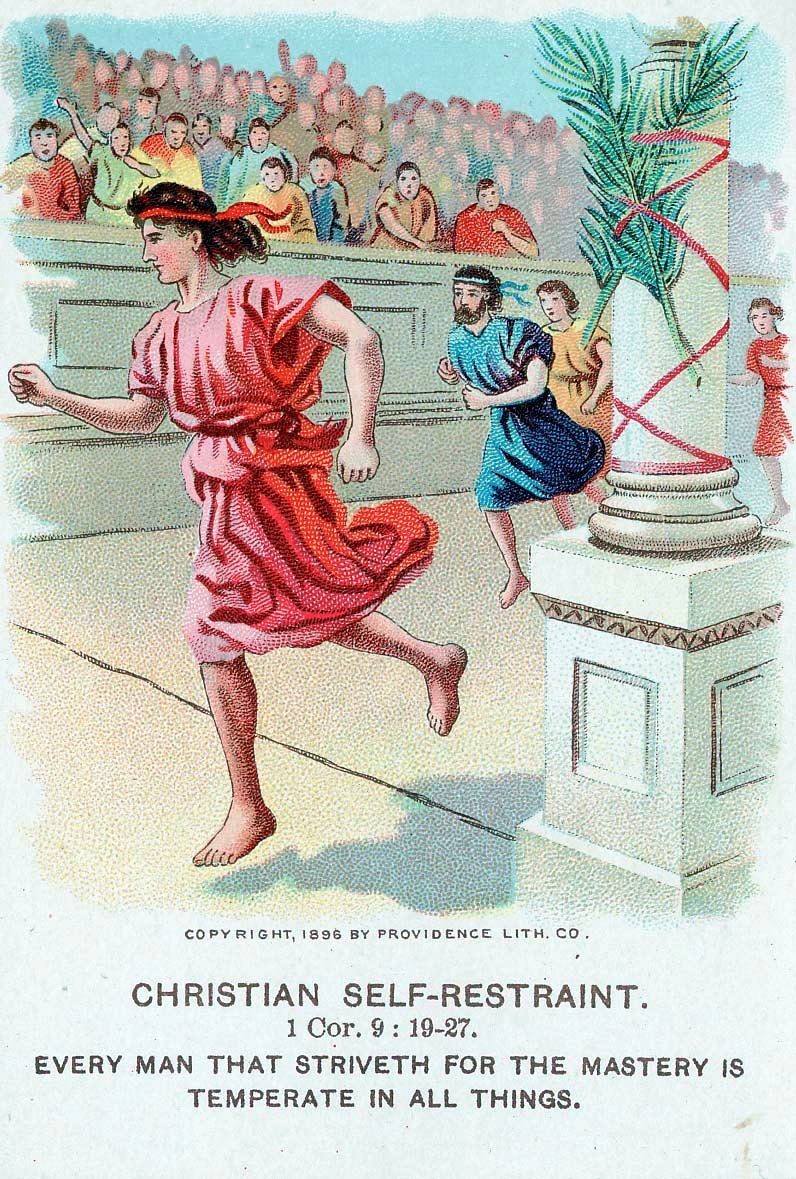
* The pointillism was created by an unknown author for the Providence Lithiograph Company in 1896. The trading card's reverse side had a short Bible study. Cards like this were used during children Sunday school.
>3. What is yeast compared to? (6-8; Luke 12:1-3)
* 1 Corinthians 5:6-8 "Your boasting is not good. Don't you know that a little yeast works through the whole batch of dough? Get rid of the old yeast that you may be a new batch without yeast--as you really are. For Christ, our Passover lamb, has been sacrificed. Therefore let us keep the Festival, not with the old yeast, the yeast of malice and wickedness, but with bread without yeast, the bread of sincerity and truth."
* "yeast" -One of the definitions of yeast in the American Heritage Bible is, "an agent of ferment or activity." Yeast in the Old Testament (Covenant) law was used in the Feasts (Holy Days) to represent sin by making bread without yeast (Exodus 13:3, 6-7, 15, 18; Leviticus 2:4-11, 23:6, 17; Numbers 28:17; Deuteronomy 16:3-4)
* Luke 12:1-3 "Meanwhile, when a crowd of many thousands had gathered, so that they were trampling on one another, Jesus began to speak first to his disciples, saying: "Be on your guard against the yeast of the Pharisees, which is hypocrisy. There is nothing concealed that will not be disclosed, or hidden that will not be made known. What you have said in the dark will be heard in the daylight, and what you have whispered in the ear in the inner rooms will be proclaimed from the roofs."
* "the yeast of malice and wickedness" -Here is an example of where the word "yeast" is substituted for "sin". Just as a little yeast will change the consistency, texture, look, and taste of bread; so even a little sin changes a person. With sin a person is not the same as if they were sinless. Their very nature is changed.
* "Be on your guard against the yeast of the Pharisees, which is hypocrisy" -Same as above. The word "yeast" is substituted for "sin".
>If someone were to be continually committing a sin and talking about it among the congregation, what effect would it have?
* "a little yeast works through the whole batch of dough" -Not only is the one person changed, but the rest of the congregation is affected.
* "Under the Christian dispensation we must be saved equally from Judaism, heathenism, and from sin of every kind; malice and wickedness must be destroyed; and sincerity and truth, inward purity and outward holiness, take their place.
The apostle refers here not more to wicked principles than to wicked men; let us keep the feast, not with the old leaven -the impure principles which actuated you while in your heathen state; neither with the leaven of malice and wickedness, radical depravity, producing unrighteousness in the life; nor with the persons who are thus influenced, and thus act; but with the unleavened bread, but with upright and godly men, who have sincerity, such purity of affections and conduct, that even the light of God shining upon them discovers no flaw, and truth-who have received the testimony of God, and who are inwardly as well as outwardly what they profess to be.
The word which we translate wickedness, is so very like to fornication, that some very ancient MSS have the latter reading instead of the former; which, indeed, seems most natural in this place; which we translate malice, includes every thing that is implied in wickedness whereas as being the subject in question, (see 5:1) would come more pointedly in here: Not with wickedness and fornication, or rather, not with wicked men and fornicators: but I do not contend for this reading." (Adam Clarke's Commentary)
>What Festival contains a sacrifices lamb and what kind of bread was to be eaten after it? (Lev. 23:4-8)
* "Passover" -See Commentary on other studies commentary in this letter.
* Leviticus 23:4-8 "These are the LORD's appointed feasts, the sacred assemblies you are to proclaim at their appointed times: The LORD's Passover begins at twilight on the fourteenth day of the first month. On the fifteenth day of that month the LORD's Feast of Unleavened Bread begins; for seven days you must eat bread made without yeast. On the first day hold a sacred assembly and do no regular work. For seven days present an offering made to the LORD by fire. And on the seventh day hold a sacred assembly and do no regular work."
* "Paul argues that the Corinthians should remain unleavened, just as bread does during the Passover season. (The Jewish people left Egypt in such haste after the first Passover that they did not have time to leaven their bread, and subsequent generations were commanded to celebrate the feast with unleavened bread in commemoration of the event.) The Jewish people were expecting a new redemption, like their first exodus from Egypt, when the Messiah came; Paul believes that the Messiah has come, and that this Messiah was himself the new paschal lamb." (Bible Background Commentary - The IVP Bible Background Commentary - New Testament)
>What does the bread without yeast represent?
* "the bread of sincerity" -Without yeast is not only no sin, but also doing the right thing. Sincerity is the quality or condition of being honest, genuine, and free of duplicity. Sincerity is a quality of being as much as truth is.
"The personal quality of living life from a pure motive without deceit. Associated with words or ideas like "truth", "genuineness" (2 Corinthians 8:8), "godliness" (2 Corinthians. 1:12), and preaching sincerely the gospel (2 Corinthians 2:17). It is also contrasted with words like hypocrisy, deceit, and wickedness." (Holman Bible Dictionary)
* "the bread of... truth" -Without yeast is not only no sin, but also doing the right thing. That which is reliable and can be trusted. The Bible uses truth in the general "factual" sense. Truth may designate the actual fact over against appearance, pretense, or assertion.
* Hold the Yeast.
Understanding the Biblical Holy Week (aka Passover Week) helps in understanding Paul's analogy. (Exodus 12:1-30, Leviticus 23:4-8; Deuteronomy 16:1-8; John 13:1-2, 18:27, 19:14)
Preparations were needed before Passover began. According to tradition, cleaning the location of any yeast was first. "Get rid of the old yeast," Paul repeats the Mosaic Law (7). Yeast is usually a symbol of sin in the Bible. (Matthew 16:11-12; Mark 8:15; Galatians 5:7-9)
After this, before Passover began, the Passover lamb was killed and prepared (7). Then, Passover began with the meal the evening before Passover day. The Passover lamb, bitter herbs, and unleavened bread (without yeast) were eaten that evening. Passover Day continued until evening the next day.
Jesus is our Passover Lamb who takes away sin. (7, John 1:29, 36) In his death on the cross, Christ fulfilled the true meaning of the sacrifice of the Passover Lamb (Isaiah 53:7). Jesus takes away yeast (sin).
The "Festival" is the Feast of Unleavened Bread, which follows Passover. (Leviticus 23:4-8) It lasts for the remainder of the week, symbolizing living the Christian life in holy dedication to God (Romans 12:1-2; 1 Peter 2:5) and not getting involved in such sins as malice and wickedness and incestuous marriages. We are to remain without sin.
Thus, Apostle Paul uses these Mosaic Feasts, just as John the Baptist did, to reveal God's plan for the church. We are to remain without sin (yeast).
Listen to the above comments on 1 Corinthians 5:6-8.
>4. What kind of proclaimed believer are we to not associate with? (9, 11; Acts 15:28-29)
* 1 Corinthians 5:9 "I have written you in my letter not to associate with sexually immoral people--"
* 1 Corinthians 5:11 "But now I am writing you that you must not associate with anyone who calls himself a brother but is sexually immoral or greedy, an idolater or a slanderer, a drunkard or a swindler. With such a man do not even eat."
* Acts 15:28-29 "It seemed good to the Holy Spirit and to us not to burden you with anything beyond the following requirements: You are to abstain from food sacrificed to idols, from blood, from the meat of strangled animals and from sexual immorality. You will do well to avoid these things. Farewell."
* "I have written you in my letter... but now I am writing" -A letter we do not have. Every commentary has a comment on whether or not this was another letter. Some have lots to say about that. But few have comments on the subject of sexually immoral.
* "sexually immoral" -The original Greek noun is "pornos" (a transliteration) from "pernemi" meaning "to sell", akin to the base of "piprasko" which contains the meaning of "prostitution, sex for profit" (specifically a male prostitute), "sex trade and trafficking". "Pornos" is also used in verse 10 (See comments in the next question.) and 6:9-10 (See comments for 7c). Overtime the meaning included female religious prostitution and other forms of immoral sex. See extra commentary at the end of this study.
See extra section at the end for more information on the words, "sexual immorality".
* When determining what God considers sexually immoral and sexually immoral people the starting point must be to understand and accept what God made sex for and how it reveals the intimacy within the Trinity.
* Association, Part 1.
Apostle Paul's first letter to the Corinthians is the third-earliest letter that we have today, 1 & 2 Thessalonians being earlier. In verses 9-10a, Paul has them recall an earlier letter that we do not have. That letter stated, "Do not associate with sexually immoral people." He adds here, "...not at all meaning the people of this world who are immoral, or the greedy and swindlers, or idolaters (He's defining unbelievers.)." (9)
However, in many other later letters, Paul writes the same thing as here: stay away from sexual immorality (i.e., 6:9; Ephesians 5:5; 1 Timothy 1:10; Hebrews 12:16, 13:4; and John's Revelation 21:8, 22:15).
Also, all the apostles, as is recorded in Acts 15, during the council in Jerusalem, gave only these restrictions to the gentile believers, "Abstain from food sacrificed to idols, from blood, from meat of strangled animals, and from sexual immorality." (Acts 15:28-29) Paul keeps reminding his fellow believers in Jesus and me of the same thing - avoid sexual immorality and don't place myself into temptation by associating with the believer who is sexually immoral, greedy, an idolater, or a slanderer, a drunkard, or a swindler (11).
Listen to the above comments on 1 Corinthians 45:9-11, part 1.
* Association, Part 2.
Apostle Paul lists Christians not to associate with. They call themselves a brother or sister in Christ Jesus, but continue to apply these six. They are sexual immorality, greed, idolatry, slander, drunkenness (substance addiction), and swindling (11). The confessed Christian knows these are sins, but does not resist committing them. The 5 Biblical sexual immorality were listed in the previous BDBD titled, "Chapter 5 Overview".
Greed is an excessive or reprehensible desire to acquire or possess more than what one needs or deserves, especially with respect to material wealth. In short, greed is covetousness (Exodus 20:17; Deuteronomy 5:21, 7:25; Hebrews 13:5;1 Timothy 6:9; Matthew 6:20). Hebrews 13:5 instructs, "Keep your lives free from the love of money and be content with what you have, because God has said, 'Never will I leave you; never will I forsake you.'"
Apostle Paul includes idolatry in the list of six sins that a person who calls themselves a brother or sister continues to commit, that I must avoid. Yes, idolatry. According to Colossians 3:5 and Ephesians 5:5, a greedy person is an idolater. Jesus said, "No one can serve two masters. Either he will hate the one and love the other, or he will be devoted to the one and despise the other. You cannot serve both God and Money." (Matthew 6:2) What do I desire more: God or money?
Slander is speaking critically of another person with the intent to hurt and to give false testimony. (Leviticus 19:16; Exodus 20:16; Deuteronomy) Slander is as habitual as the other five sins. "Every careless word said will need to be accounted for on judgement day," so said Jesus (Matthew 12:36).
Swindling (extortion, rapacious) is to cheat or defraud of money or property and to obtain by fraudulent means. I cannot think of one company that hired me that did not keep to what we negotiated, and many of them went to a congregation.
The often exclaimed Christian have heard that these six are sins, but do nothing to resist them in their hearts and minds. In their stubborn refusal, they resist the work of the Holy Spirit that desires to make them like Christ Jesus.
In my six decades, I have seen men and women who remain trapped by these sins, and yet remain popular in congregations because they are rich and pleasing to look at. While the righteous autistic and "strange person" cry lonely tears because they are isolated. I even heard a pastor say more than once that he told college students they do not have to associate with people they consider weird, even though they attend the same congregation as them. Are we not guilty too? (Matthew 18:10)
Listen to the above comments on 1 Corinthians 45:9-11, part 2.
>Does this refer to an unbeliever? (10)
* 1 Corinthians 5:10 "not at all meaning the people of this world who are immoral, or the greedy and swindlers, or idolaters. In that case you would have to leave this world."
* "not at all meaning the people of this world" -The people of this world are not of the Kingdom of Heaven where God is absolute ruler.
* "who are immoral" -The original Greek noun is "pornos" (a transliteration". See question above, "sexual immorality" and extra section at the end of this study.
The NIV, CSB, and HCSB renders the meaning is people with improper morals and/or bad morals in a general sense for they do not include the word "sexual" in the translation for "pornos" here as they do other places. So, the NIV, CSB, and HCSB translates are saying these people's morals in general are not of God. The KJV and ASV uses the outdated word "fornicators". YLT translates "whoremongers", also outdated.
* "or the greedy and swindlers, or idolaters" -Greedy and swindlers deal with people's possession and wealth. In a sense so does idolatry. Yet, Greek idolatry also involved prostitution. The three -wealth, religion, and prostitution were linked in ancient Greek and Roman society, not different than the immoral today.
* "In that case you would have to leave this world." -Because everybody "of this world" fall into at least one if not all of these.
>Why is this so? (12-13)
* 1 Corinthians 5:12-13 "What business is it of mine to judge those outside the church? Are you not to judge those inside? God will judge those outside. 'Expel the wicked man from among you.'"
* "What business is it of mine to judge those outside the church?" -Something Christians have not fully grasped and understood.
* "Are you not to judge those inside?" -The original Greek verb "krino" (a transliteration) is used twice in this sentence. It properly means "to distinguish" i.e. "decide" by implication to "try, condemn, and punish". Paul is speaking of a church judicial council just as Israel had. The middle ages had inquisitions which were mostly corrupt.
* "God will judge those outside." -Paul is clear that the congregation is not to get involved with those in society not in their congregation.
* "wicked man" -The original Greek words are "poneros" (a transliteration) meaning "essential character degenerate and diseased" and "devil", "evil", and "sinner".
II. Law Suites Before Non-Believers (6:1-11)
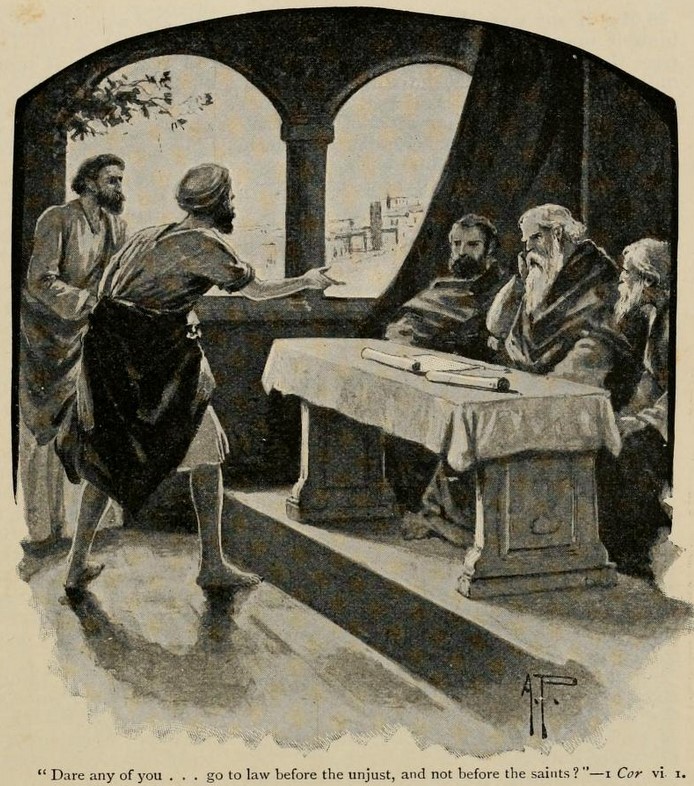
* The artwork is from the Art Bible.
>5. What was another problem among the Corinthian congregation? (1, 6)
* 1 Corinthians 6:1 "If any of you has a dispute with another, dare he take it before the ungodly for judgment instead of before the saints?"
* 1 Corinthians 6:6 "But instead, one brother goes to law against another--and this in front of unbelievers!"
*
*
Chapter 6 Overview.
Apostle Paul addresses two more problems in the Corinthian congregation in chapter 6. First, lawsuits against others in the congregation, and second, employing a prostitute. The points are rather straightforward. Yet, some good truths are also revealed within.
First, if there is a dispute between two believers, they should settle it among themselves (1-8). The Corinthian believers were going to court against each other. If the brothers and sisters cannot settle their differences on a one-to-one basis, another member of the congregation should intervene. Paul said it is very important to settle disagreements between brothers and sisters in the Lord. The same is true between husband and wife, and between parents and children. Jesus also taught peace and love to the disciples, who often argued about who was the greatest. (Mark 9:33-37)
Secondly, I am the temple of God, and my wife is the temple of God. Therefore, I should honor God with my body sexually (12-20). Sex is God's great gift to a married man and women only. When any man and a woman lie together, no matter the circumstances, they become one flesh. (16b). "One flesh" means one in body, mind, soul, and spirit. This union is sacred, designed by God (Genesis 2:24; Matthew 19:5; Mark 10:6-9).
God's design through sex is for the married and united couple never to be united with another, neither in body, mind, nor heart. The couple is to continually engage in building each other up in this sacred union blessed by the Holy Spirit. Looking at marriage statistics, couples I know, and my own life, I know this is truly great and yet takes effort, a determined will, and passion.
Because of the blessing of marriage and the sexual union, Paul emphasizes, "Flee from sexual immorality." (18) Self-control is a gift of the Holy Spirit we can choose to exercise. (1 Corinthians 7:5; Galatians 5:23; 2 Peter 1:6) All Christians have been given a gift to stay true to their spouse, whether married, engaged, or still waiting for the Lord Jesus to introduce them to the one whom He will unite them. Therefore, God has given us the ability to control our bodies, including keeping the marriage bed only with the one God unites us to. (Hebrews 13:4)
Listen to the above comments on 1 Corinthians Chapter 6 Overview.
* "take it before the ungodly for judgment" -Greek or Roman social courts.
* "one brother goes to law against another" -Both parties claim faith in Jesus and go to the same congregation. They have a disagreement and do not have peace. Disagreement is not so much a problem, for Paul and Barnabass disagreed about taking Mark on their second missionary journey to the point of going their seperate ways. The problem here is the believes are going to civil court, in from of non-believers.
>Who are the saints? (2-3)
* 1 Corinthians 6:2-3 "Do you not know that the saints will judge the world? And if you are to judge the world, are you not competent to judge trivial cases? Do you not know that we will judge angels? How much more the things of this life!"
* "the saints" -Means sanctified.
* One separated from the world and consecrated to God; one holy by profession and by covenant; a believer in Christ (Ps 16:3; Rom 1:7; Rom 8:27; Php 1:1; Heb 6:10).
The "saints" spoken of in Jude 1:14 are probably not the disciples of Christ, but the "innumerable company of angels" (Heb 12:22; Ps 68:17), with reference to Deut 33:2.
This word is also used of the holy dead (Mat 27:52; Rev 18:24). It was not used as a distinctive title of the apostles and evangelists and of a "spiritual nobility" till the fourth century. In that sense it is not a scriptural title.
(Illustrated Bible Dictionary: And Treasury of Biblical History, Biography, Geography, Doctrine, and Literature)
>When will they judge the world and the angels?
* "will judge the world?" -At the very end.
* "Do you not know that we will judge angels?" -At the very end.
* "angels" -The Hebrew and Greek (angelos) words mean "messenger". (Hebrews 1:14) They were created by God, but the timing of their creation is not revealed with one possible exception. Angels are not eternal for only God is eternal.
>Considering this, how should believers settle disagreements? (4-5)
* 1 Corinthians 6:4 "Therefore, if you have disputes about such matters, appoint as judges even men of little account in the church! I say this to shame you. Is it possible that there is nobody among you wise enough to judge a dispute between believers?"
* "Therefore" -Conclusion.
* "appoint as judges... judge a dispute between believers" -Paul is following Levitical and Jewish synagogue procedures.
* "wise enough" -Only qualification. This qualification is also one needed for an elder and deacon.
* Settle It Within.
The disputes Apostle Paul addresses are civil matters, not criminal. If it were criminal violations, the Roman state would be involved. (Romans 13:3-4) Also, Paul's declaration, "Why not rather be cheated?" (7), also indicates that the disputes were civil matters involving money and property. The Romans allowed Jews (Christians were still considered a Jewish sect) to settle their own property disputes according to Jewish law.
Now, in my sixty-plus years, I do not remember any Christians being close enough to have a dispute over money and property, except for one area: inheritance. A human constant seems to be the sudden sibling relationship change upon their parent's passing and the inheritance split. I first encountered this with my grandparents' death, on both sides. I found it rather shocking to see siblings that I thought had a good relationship suddenly change into strong, bitter disputes.
When I asked those older than I about this, they said, "Yes. Sibling cheating and wronging happen most of the time regarding inheritance. Buried past wrongs come to life. Greed comes from the cave of selfishness." Now that I am older, I can testify that this is true. The more possessions and wealth involve the longer the sibling has been planning and conceiving.
Make the decision now if you have siblings, "Why not be wronged? Why not rather be cheated?" Do not make an enemy of blood now, only to bleed grief into your old age. My grandmother chose to marry one of the poorest men in the town over family wealth because she considered love and happiness worth more than the wealth of her family. As years pass, that sibling will be more of a comfort than money and wealth.
Listen to the above comments on 1 Corinthians 6:1-8.
>6. How does the problems in the Corinthian churches indicated a deeper problem? (7-8)
* 1 Corinthians 6:7-8 "The very fact that you have lawsuits among you means you have been completely defeated already. Why not rather be wronged? Why not rather be cheated? Instead, you yourselves cheat and do wrong, and you do this to your brothers."
* "you have been completely defeated already."
* "Why not rather be wronged?" -Turn the other cheek.
* "Why not rather be cheated?" -Turn the other cheek.
>What kind of term is "defeated"?
* "defeated" -The original Greek noun is "hettema" also translated "fault", "diminishing", "deterioration" and "failure".
>7. What is the kingdom of God and who will not inherit it? (9a)
* 1 Corinthians 6:9a "Do you not know that the wicked will not inherit the kingdom of God? Do not be deceived:"
* "the wicked will not" -The original Greek adjective iv "adikos" (a transliteration) elsewhere translated "unrighteous", "unjust", and "heathen".
* "inherit the kingdom of God?" -The kingdom of God is where Jesus rules. A more detailed commentary is in 4:20 and 15:50.
* "Do not be deceived" -A believer can be deceived. Eve was without sin and, in her own words, said she was deceived. (Genesis 3:13) Jacob deceived Esau (Genesis 2:36) and Laban (Genesis 31:20, 26). Laban deceived Jacob before Jacob deceived Laban. (Genesis 29:25)
>How is a kingdom inherited?
* Through Christ who died for us.
>What actions do with wicked commit? (9b-10)
* 1 Corinthians 6:9b-10 "Neither the sexually immoral nor idolaters nor adulterers nor male prostitutes nor homosexual offenders nor thieves nor the greedy nor drunkards nor slanderers nor swindlers will inherit the kingdom of God."
* "sexually immoral" -The original Greek noun is "pornos" (a transliteration), also in 5:9 and 10. See comments in 4a for verse 5:9 and 4b for 5:10. Also see extra section at the end of this study.
* "nor idolaters" -The original Greek noun is "eidololatres" (a transliteration).
* "nor adulterers" -The original Greek noun is "moichos" (a transliteration). See extra section at the end of this study.
* "nor male prostitutes" -The original Greek noun is "malakos" (a transliteration). See extra section at the end of this study.
* "nor homosexual offenders" -The original Greek noun is "arsebijiutes" (a transliteration). See extra section at the end of this study.
* "nor thieves" -The original Greek noun is "keotes" (a transliteration).
* "nor the greedy" -The original Greek noun is "pleonektes" (a transliteration).
* "nor drunkards" -The original Greek noun is "methysos" (a transliteration).
* "nor slanderers" -The original Greek noun is "loidoros" (a transliteration).
* "nor swindlers" -The original Greek noun is "harpax" (a transliteration).
>8. Should wicked actions be in our past? (11)
* 1 Corinthians 6:11 "And that is what some of you were. But you were washed, you were sanctified, you were justified in the name of the Lord Jesus Christ and by the Spirit of our God."
* "some of you were"
* Yes for the true believers.
>How were we cleansed of our past sins and lives?
* "you were washed"
* "you were sanctified"
* "you were justified"
* "in the name of the Lord Jesus Christ"
* "and by the Spirit of our God"
>Should someone who has put their faith in Jesus get themselves dirty again?
* No, the New Testament writers are clear. We are to stop sinning.
>If we are defeated in sin, what should a believer do? (John 13:10; Gal. 6:1-2)
* John 13:10 "Jesus answered, "A person who has had a bath needs only to wash his feet; his whole body is clean. And you are clean, though not every one of you."
* Galatians 6:1-2 "Brothers, if someone is caught in a sin, you who are spiritual should restore him gently. But watch yourself, or you also may be tempted. Carry each other's burdens, and in this way you will fulfill the law of Christ."
* "you who are spiritual should restore him gently"
* "But watch yourself, or you also may be tempted"
* "the law of Christ"
* Washed, Sanctified, and Justified in Jesus, Part 1.
Apostle Paul, tells the Corinthian believers, "The very fact that you have lawsuits among you means you have been completely defeated already." (7a) Then, he defines the wicked, something he did in 5:9-11. Here, he lists sexually immoral, idolaters, adulterers, male prostitutes, homosexual offenders, thieves, greedy, drunkards, slanderers, and swindlers. Paul identifies three kinds of sexual immoral persons. (Also see Romans 1:26-27)
The wicked will not inherit the kingdom of God (9), a fact repeated often in the Bible. They will be filled with remorse, weeping a river of tears. (Matthew 8:12; 13:42, 50; 22:13; 24:51; 25:30; Luke 13:28) "Do not be deceived," he begins his warning (9).
The good news is there is hope for the wicked. As long as we breathe, there is hope for the sinner. Some of the Corinthian believers were locked in one or more of the wicked ways of life before they came to believe in the saving and redeeming power of Jesus, the Son of God (11). They were washed, sanctified, and justified in the name of the Lord Jesus Christ by the Spirit of God. Now the Kingdom of God is theirs. They have a wonderful inheritance that will never fade, spoil, rot, or be boring. They were born again.
The time to decide is now. Jesus is waiting for your positive reply.
Listen to the above comments on 1 Corinthians 6:9-11.
* Washed, Sanctified, and Justified in Jesus, Part 2.
Those in Corinth who put their faith in Jesus were washed, sanctified, and justified in the name of the Lord Jesus Christ by the Spirit of God. (11) What did Apostle Paul mean by washed, sanctified, and justified?
The original Greek word for washed is "apolouo" meaning "washed away", not "ablution". Ablution is a washing or cleansing of the body as part of a religious purification rite. (Mark 7:3, 8; Hebrews 9:10) Ablution is a general term for the ritual washing of the body or objects for purification, while baptism is a specific, one-time, Christian sacrament signifying spiritual rebirth and cleansing from sin. While both involve water, ablution is often repeated, whereas baptism is a singular act that symbolizes a transformative inner action (Acts 22:16; Ephesians 5:26; Hebrews 6:1-2). Hebrews 10:22 states, "let us draw near to God with a sincere heart in full assurance of faith, having our hearts sprinkled to cleanse us from a guilty conscience and having our bodies washed with pure water."
The original Greek word for "sanctified" is "hagiazo" meaning "make holy" and "separate, contrasting with the profane". Thus, God separates his people, dedicating them to him and his use through Jesus. (1:2; Romans 15:16; 1 Peter 1:2) The moral implications are stunning. Hebrews 13:12-16 reads, "And so Jesus also suffered outside the city gate to make the people holy through his own blood... Through Jesus, therefore, let us continually offer to God a sacrifice of praise--the fruit of lips that confess his name. And do not forget to do good and to share with others, for with such sacrifices God is pleased."
The original Greek word for "justified" is "dikaioo" meaning "brought into an unmerited right relationship with God". Simply put it is just-as-if I had never sinned. Paul wrote in 1:30, "It is because of God that you are in Christ Jesus, who has become for us wisdom from God--that is, our righteousness, holiness and redemption."
The common fact is that my status in Christ Jesus is all because of God. I did not deserve it. He did it anyway.
Listen to the above comments on 1 Corinthians 6:11.
III. Sexual Immorality (6:12-20)
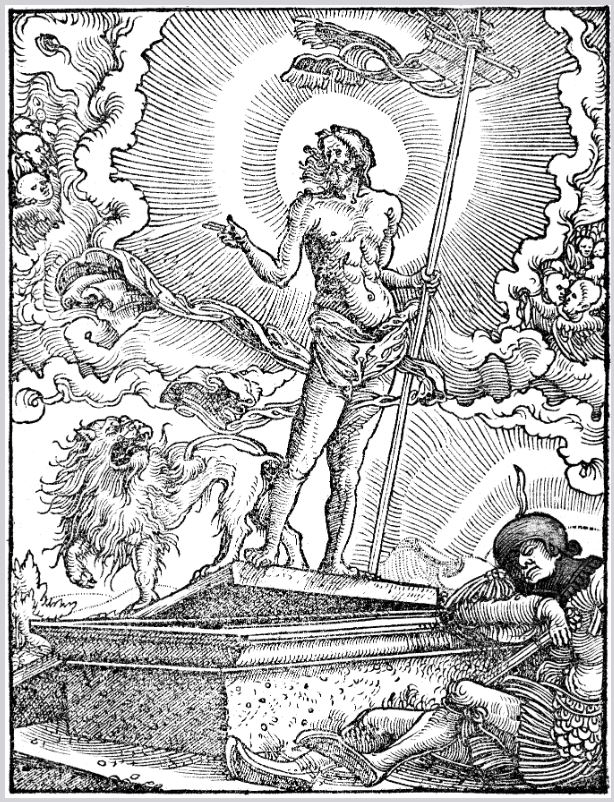
* Titled "The Resurrection of Jesus" from the book "Das Naw Testament : nach lawt der Christliche kirchen bewerte text, corrigirt, vu widerumb zu recht gebracht"
It is by Emser, Hieronymus (1478-1527) and is now in public domain.
Jesus raises from the dead. A lion is at his feet representing the Gospel of Mark.
Courtesy of the Digital Image Archive, Pitts Theology Library, Candler School of Theology, Emory University.
>9. In the statement "Everything is permissible for me" what two things did the Corinthians forget? (12)
* 1 Corinthians 6:12 "Everything is permissible for me"--but not everything is beneficial. "Everything is permissible for me"--but I will not be mastered by anything."
* "permissible" -"Permissible" in the NIV, CSB, and HCSB, and "lawful" in the KJV, YLT, and ASV is from the Greek verb "exesti" (a transliteration), a third person singular presumed indicative of a compound of "ek" and "eimi" strickly meaning "out of an abundance I can", or "from an abundance it is possible".
* "beneficial" -CSB has the same translation as the NIV. KJV and ASV translates "expedient". HCSB and GW has "helpful". YLT has "profitable".
* "mastered by anything" -The freedom that seems to exist in doing anything and everything does not exist. Vice, corruption, immorality, depravity, and lawlessness become habits that harm.
>Who are we to remember in everything we do? (13)
* 1 Corinthians 6:13 "Food for the stomach and the stomach for food"--but God will destroy them both. The body is not meant for sexual immorality, but for the Lord, and the Lord for the body."
* "sexual immorality" -The original Greek noun for "sexual immorality" is "porneia" (a transliteration). Same word as 19. See question 10c and the extra section at end of this study.
* "The body is not meant for sexual immorality" -The clarifying statement to this section. The two Greek proverbs stated were used to justify sex free of any moral rules. God made food for the body, an appetite for food, food to be pleasing, and food to satisfy the appetite.
* "The body is not meant for... for the Lord, and the Lord for the body" -Replacing the word "food" with "sex"; God made sex for body reproduction, an appetite for sex, sex to be pleasing, and sex to satisfy the appetite for sex. Just because God made sex to be between a married man and women does not mean we own the body. God still owns our body. He gave it to us as a gift for his set purpose. If we violate his purpose, he will take it away. He has place conditions on the gift of the body.
* What is the result of removing God's limitation to sex. In other words, God made sex for a reason. What happens when we go beyond its design intent? What if we do whatever we want? This leads to violent act of sexual aggression against everyone. A man will have forced violent sex with anyone, anywhere, anytime, and anyway he chooses. Women too will be guilty of heinous violent acts against others.
* Moral GPS.
Every human develops an automated subconscious and conscious system that guides their decisions and actions, though most of the time, we are unaware of that system. Human society and instinct cause us to develop a moral and ethical GPS. Some in the Corinthian congregation developed two cute Greek bywords based on their understanding of Christianity to teach their moral GPS standard. They are in these verses. Paul counters and corrects them.
First is the general byword: "Everything is permissible for me." They mean they have the right in Christ to do what they please, probably because of God's unlimited grace. They could be using or adapting this byword from a pagan philosophy. Many today still have this misconception of God's grace.
The apostle counters by observing that such "freedom" of action may not benefit the Christian. Ask rich King Solomon about the outcome of a sensual lifestyle. His reply is, "I thought in my heart, 'Come now, I will test you with pleasure to find out what is good.' But that also proved to be meaningless." (Ecclesiastes 2:1) A life without wise perimeters is destructive. A life without righteous rules will enslave me.
Second is a specific byword: "Food for the stomach and the stomach for food." They mean the bodily functions have no bearing on one's inner spiritual life, so the physical act of promiscuous sexual activity does not affect one's spiritual life.
Free use of the stomach and food does not serve a purpose. God made them and all of me for a purpose. If they are not used for his designed purpose and when that purpose is completed, he destroys them. All of my body is meant for the Lord, including the parts only meant for the married couple and reproduction, according to the first law, "Be fruitful and multiply". (Hebrews 13:4) They are blessed when used for those purposes.
One's moral GPS must be based on truth. If not, one will end up in a place no one wants to go.
Listen to the above comments on 1 Corinthians 6:12-13.
>10. With what body was Jesus raised from the dead with and how will we follow him? (14; Matt. 22:29-30; Luke 20:34-36)
* 1 Corinthians 6:14 "By his power God raised the Lord from the dead, and he will raise us also."
* Matthew 22:29-30 "Jesus replied, "You are in error because you do not know the Scriptures or the power of God. At the resurrection people will neither marry nor be given in marriage; they will be like the angels in heaven."
* Luke 20:34-36 "Jesus replied, "The people of this age marry and are given in marriage. But those who are considered worthy of taking part in that age and in the resurrection from the dead will neither marry nor be given in marriage, and they can no longer die; for they are like the angels. They are God's children, since they are children of the resurrection."
* "By his power God raised the Lord from the dead" -Paul will go into detail in chapter 15.
* "he will raise us also." -Paul will go into detail in chapter 15.<
>With whom are believers united spiritually and could be united physically? (16-17)
* 1 Corinthians 6:16-17 "Do you not know that he who unites himself with a prostitute is one with her in body? For it is said, "The two will become one flesh. But he who unites himself with the Lord is one with him in spirit."
* Genesis 2:24 "For this reason a man will leave his father and mother and be united to his wife, and they will become one flesh."
* When some Pharisees tested Jesus by asking him if divorce was lawful, Jesus quoted Genesis 2:24. (Mark 10:8) He concluded, "Therefore what God has joined together, let man not separate." (Mark 10:9) Jesus further clarified his statement to his disciples in secret, "Anyone who divorces his wife and marries another woman commits adultery against her. And if she divorces her husband and marries another man, she commits adultery."
* "body... flesh... spirit" -"Body" in the original Greek is the noun "soma", "flesh" in the original Greek is the noun "sarx", and "spirit" is the noun "pneuma" (transliterations).
The Greek word used for body is used in a very wide application, literal or figurative.
The Greek word for flesh is the only New Testament word used for flesh, refers to the meat of an animal and humans, apart from the skin and the soul. The flesh is natural humanity, not automatically sinful, but weak. Jesus said of his sleeping disciples on the night he was betrayed, "The spirit is willing, but the flesh is weak." (Matthew 26:41; Mark 14:38)
The spirit is a reality that I don't have the energy or time to go into know.
* Union.
Continuing his point in truth, countering a misrepresentation of grace, Apostle Paul presents the resurrected Christ and our future resurrection (14). Jesus was raised from the dead, and we will be bodily raised too. Why? We will be raised because we are united with him in body. Those who believe in Jesus has a been united in body with Christ himself (15). The connection I have with Christ Jesus is not just spiritual; it is also body and soul. (Ephesians 5:29-32) This is a profound mystery.
Consider this: the foundation and establishment of marriage between Adam and Eve was nothing new. Marriage is based on the essence of the Trinity. The Father, the Son, and the Spirit are one and yet three. The Trinity is a perfect union that is also a profound mystery for love cannot exist unless it is bestowed unto another. The Father loves the Son and the Spirit, and in them love exists. Adam and Eve were made one flesh in the image of the Trinity. The Spirit dwelling in them bound the couple one in soul and flesh.
Knowing this truth, Apostle Paul continues his case. When a person has sex with a prostitute (or anyone), they are united in body and soul. They are one flesh. Paul says, "Never unite the Lord with a prostitute" (15).
Verse 17 adds the specialty of Christ's bond with his beloved. We are united with him in spirit. This too is a profound mystery. (Ephesians 5:21-33) Sacrid and profane cannot be joined.
Listen to the above comments on 1 Corinthians 6:14-17.
>What then should we do? (18)
* 1 Corinthians 6:18 "Flee from sexual immorality. All other sins a man commits are outside his body, but he who sins sexually sins against his own body."
* "Flee from sexual immorality" -The original Greek noun for "sexual immorality" is "porneia" (a transliteration). Same word as 13. See extra section at end of this study.
* "All other sins a man commits are outside his body,"
* "sins sexually" -The original Greek verb is "porneuo" (a transliteration) from "porne". "Porneuo means "to indulge in unlawful lust in unlawful sex" and is associated with prostitution and idolatry. The general concept is sex outside the institution of marraige from a cultural concept. The concept of marriage in Jewish, Greek, and Roman society is commented on in study 5.
* "he who sins sexually sins against his own body."
>As a congregation makes a church hospitable, shouldn't all the more we not take care of our physical bodies? (19-20)
* 1 Corinthians 6:19-20 "Do you not know that your body is a temple of the Holy Spirit, who is in you, whom you have received from God? You are not your own; you were bought at a price. Therefore honor God with your body."
* "Do you not know that your body is a temple of the Holy Spirit"
* "who is in you, whom you have received from God"
* "You are not your own; you were bought at a price."
* Holy Spirit Onboard.
Almost everyone has been in an environment where they have experienced a sense of special presence. The ambiance was the combination of the comfort and warmth of the womb, the glorification and illumination of the heavens, and the serenity and beauty of a nature retreat. The Temple possessed such an environment as long as the Lord God made himself known there.
The Holy Spirit, sent from and of the Lord God, now dwells within the bodies of those who have accepted the gospel of Jesus Christ, calling on his name and calling him Master. My body is the temple of the Holy Spirit (19). I received the Spirit from God. My body is now God's Temple. I am not my own (19).
I was bought with the body and blood of Christ Jesus (20a). David, on behalf of Israel, bought the plot of ground where the Temple would be built from Araunah the Jebusite. (2 Samuel 24:22-25) Solomon bought the cedar from Lebanon. The gold made into furnishings and the stone cut into blocks for the walls were bought with war. Yet, the price Jesus paid to purchase me was more than all these. The temple that is me is worth more than Solomon's temple.
Apostle Paul's point is that Jesus' possession is the temple of the Holy Spirit, a sacred place, a place where his people are to experience his special presence. Therefore, we should keep ourself pure and flee sexual immorality. In doing so we honor God with our body (20b).
Listen to the above comments on 1 Corinthians 6:12-13.
IV. Sexual Immorality (EXTRA COMMENTARY)
* I started an unfinished manuscript titled "The Man-Woman Relationship -Sex, Marriage, and the Bible". The concept is a look at what the Bible says about marriage. Over the decades I was bewildered and frustrated by the lack of unbiased and pure scholarly Biblical books on the subject. The information below are part of 27 pages of notes and comments collected for reference and study as I worked on the manuscript. The manuscript has not been finished due to priorities conflicts.
OLD TESTAMENT
The book of Leviticus 18 through 20 gives various Mosaic Covenant laws and punishments for their violations. Chapter 18 defines six sexual immorality categories: 1) incest (close relative defined), 2) sex during a woman's period, 3) adultery, 4) homosexuality, 5) bestiality, and 6) sex with a slave girl.
OPENING DECLARATION (18:1-5):
Leviticus 18 starts with, "The LORD said to Moses, "Speak to the Israelites and say to them: 'I am the LORD your God. You must not do as they do in Egypt, where you used to live, and you must not do as they do in the land of Canaan, where I am bringing you. Do not follow their practices. You must obey my laws and be careful to follow my decrees. I am the LORD your God. Keep my decrees and laws, for the man who obeys them will live by them. I am the LORD." (Leviticus 18:1-5)
SIX SEXUAL IMMORALITY CATEGORIES (18:6-23):
INCEST
"No one is to approach any close relative to have sexual relations. I am the LORD.
"Do not dishonor your father by having sexual relations with your mother. She is your mother; do not have relations with her.
"Do not have sexual relations with your father's wife; that would dishonor your father.
"Do not have sexual relations with your sister, either your father's daughter or your mother's daughter, whether she was born in the same home or elsewhere.
"Do not have sexual relations with your son's daughter or your daughter's daughter; that would dishonor you.
"Do not have sexual relations with the daughter of your father's wife, born to your father; she is your sister.
"Do not have sexual relations with your father's sister; she is your father's close relative.
"Do not have sexual relations with your mother's sister, because she is your mother's close relative.
"Do not dishonor your father's brother by approaching his wife to have sexual relations; she is your aunt.
"Do not have sexual relations with your daughter-in-law. She is your son's wife; do not have relations with her.
"Do not have sexual relations with your brother's wife; that would dishonor your brother.
"Do not have sexual relations with both a woman and her daughter. Do not have sexual relations with either her son's daughter or her daughter's daughter; they are her close relatives. That is wickedness.
"Do not take your wife's sister as a rival wife and have sexual relations with her while your wife is living.
DURING A WOMAN'S PERIOD
"Do not approach a woman to have sexual relations during the uncleanness of her monthly period.
ADULTERY
"Do not have sexual relations with your neighbor's wife and defile yourself with her.
HOMOSEXUALITY
"Do not lie with a man as one lies with a woman; that is detestable.
BESTIALITY
"Do not have sexual relations with an animal and defile yourself with it. A woman must not present herself to an animal to have sexual relations with it; that is a perversion.
WITH A SLAVE GIRL
"If a man sleeps with a woman who is a slave girl promised to another man but who has not been ransomed or given her freedom, there must be due punishment. Yet they are not to be put to death, because she had not been freed. The man, however, must bring a ram to the entrance to the Tent of Meeting for a guilt offering to the LORD. With the ram of the guilt offering the priest is to make atonement for him before the LORD for the sin he has committed, and his sin will be forgiven." (Leviticus 19:20-22)
OPENING DECLARIATION REPEATED (18:24-28):
"Do not defile yourselves in any of these ways, because this is how the nations that I am going to drive out before you became defiled. Even the land was defiled; so I punished it for its sin, and the land vomited out its inhabitants. But you must keep my decrees and my laws. The native-born and the aliens living among you must not do any of these detestable things, for all these things were done by the people who lived in the land before you, and the land became defiled. And if you defile the land, it will vomit you out as it vomited out the nations that were before you.
PUNISHMENT (18:29-30; 20):
"Everyone who does any of these detestable things--such persons must be cut off from their people. Keep my requirements and do not follow any of the detestable customs that were practiced before you came and do not defile yourselves with them. I am the LORD your God.'"
Leviticus chapter 20 concerns the punishment for violations of the covenant laws including sexual immorality. They are death or being "cut off" from Israel. This punishment is for adultery (10), incest (11-12, 14, 17, 19-21), sex during a woman's period (18), homosexuality (13), and bestiality (15-16). Considering 19:20 "cut off" might be "put to death", rather than expelled from the community."
NEW TESTAMENT
The words "sexual immorality" are in the NIV translation 20 times; once in the Old Testament and 19 in the New Testament. The KJV does not use sexual immorality. Instead, the KJV sometimes uses the words "whoredom" and "fornication". The 20 NIV locations with sexual immorality are listed below along with some context and comments.
The NIV has other verses that refer to sex which do not have the Hebrew or Greek words that the NIV (and other new English) translates as "sexual immorality" adn the KJV translates into "fornication" or "whoredom".
Numbers 25:1-3. The Hebrew word "zana" translated as "whoredom" in KJV and "sexual immorality" in most newer translations. "Zana" here has to do with Israel men having intercourse with Moabite woman who invited them to the sacrifices and worship to their god (Baal).
Matthew 15:19. The Greek word "porneia" is used. Per Strong's Hebrew/Greek Dictionary the Greek word "porneia" comes from the Greek root word "porneuo" literally meaning "adultery" and "incest", figuratively idolatry. Strong reports that "porneia" is used 26 times in the New Testament. "Porneia" and "porneuo" are translated as "fornications" in KJV and "sexual immorality" in most newer translations. In Matthew 15 Jesus while explaining to his disciples the meaning of a parable states, "For out of the heart come evil thoughts, murder, adultery, sexual immorality, theft, false testimony, slander." "Porneia" is one of seven things coming from the heart that make us unclean. Jesus does not define sexual immorality. Sexual immorality is not the point of the teaching.
Mark 7:21 is the exact same event and teaching as Matthew 15:19. Again the Greek word "porneia" is used.
Acts 15:20. The Greek word "porneia" is used. In Acts 15:19-21 Peter states to the Jerusalem council, "It is my judgment, therefore, that we should not make it difficult for the Gentiles who are turning to God. Instead we should write to them, telling them to abstain from food polluted by idols, from sexual immorality, from the meat of strangled animals, and from blood. For Moses has been preached in every city from the earliest times and is read in the synagogues on every Sabbath." The four acts listed are regarding pagan idol religious activities and worship. SI is listed as one of four things the Gentile Christians are to abstain from. Peter does not define sexual immorality beyond the context of pagan worship.
Acts 15:29 is the same as Acts 15:20. The Jerusalem's council wrote in Acts 15:28-29 "It seemed good to the Holy Spirit and to us not to burden you with anything beyond the following requirements: You are to abstain from food sacrificed to idols, from blood, from the meat of strangled animals, and from sexual immorality. You will do well to avoid these things. Farewell." The council distinctly avoided calling these four directives either commandments or laws.
Acts 21:25 is a repeat of Acts 15:20. When Paul arrived at Jerusalem the Jewish Christians living there quoted the letter to the Gentiles in chapter 15 stating, "As for the Gentile believers, we have written to them our decision that they should abstain from food sacrificed to idols, from blood, from the meat of strangled animals, and from sexual immorality." He avoided calling these four directives either commandments or laws.
Romans 13:13. The Greek word "koite" is translated as "chambering" in the KJV and "sexual immorality" in newer translations. Paul wrote, "Let us behave decently, as in the daytime, not in orgies and drunkenness, not in sexual immorality and debauchery, not in dissension and jealousy." SI is listed as one of six things Christians are not to do. No specifics given. "Koite" is linked with the Greek word "aselgeia". "Aselgeia" is translated as "wantonness" in the KJV and "debauchery" in newer translations referring to lust and unrestrained sexual behavior.
1 Corinthians 5:1 The Greek word "porneia" is used. Paul writes, "It is actually reported that there is sexual immorality among you, and of a kind that does not occur even among pagans: A man has his father's wife." Paul is referring to the act of a man having his father's wife. It is assuming that the man in that congregation that is referred to was either adopted and his father was either dead or divorced, or the wife was from a second marriage to his father. Either way "porneia" here is incest.
1 Corinthians 5:9 & 10 "...not to associate with sexually immoral people..." (9) and "...the people of this world who are immoral..." (10). The original Greek noun in both is "pornos" (a transliteration) from "pernemi" meaning "to sell", akin to the base of "piprasko" which contains the meaning of "prostitution, sex for profit" (specifically a male prostitute), "sex trade and trafficking". "Pornos" is also used in 6:9 and 10. In the same sentence with a hyphen in the NIV is "...or the greedy and swindlers, or idolaters." (10). The KJV has "...or with the covetous, or extortioners, or with idolaters..."
1 Corinthians 6:9 "Neither the sexually immoral...". The original Greek noun is "pornos" (a transliteration) from "pernemi" meaning "to sell", akin to the base of "piprasko" which contains the meaning of "prostitution, sex for profit" (specifically a male prostitute), "sex trade and trafficking". Overtime the meaning included female religious prostitution and other forms of immoral sex. In the same sentence (included in the list in 9-10) are other sexual sins; "moichos" transltated "adulters", "malakos" translated "male prostitutes", and "arsenokoites" translated "homosexual offenders".
1 Corinthians 6:13 and 6:18. The Greek word "porneia" is used in verse 13 and "porneuo" is used twice in verse 18. The second time "porneuo" is linked with the Greek word "hamartano" meaning "sin". See comments in questions 9b and 10c. Paul wrote in 1 Corinthians 6:12-20, "Everything is permissible for me"--but not everything is beneficial. "Everything is permissible for me"--but I will not be mastered by anything. Food for the stomach and the stomach for food"--but God will destroy them both. The body is not meant for sexual immorality, but for the Lord, and the Lord for the body. By his power God raised the Lord from the dead, and he will raise us also. Do you not know that your bodies are members of Christ himself? Shall I then take the members of Christ and unite them with a prostitute? Never! Do you not know that he who unites himself with a prostitute is one with her in body? For it is said, "The two will become one flesh." But he who unites himself with the Lord is one with him in spirit. Flee from sexual immorality. All other sins a man commits are outside his body, but he who sins sexually sins against his own body. Do you not know that your body is a temple of the Holy Spirit, who is in you, whom you have received from God? You are not your own; you were bought at a price. Therefore, honor God with your body."
Paul's is addressing sexual intercourse with prostitutes calling it a sin. Paul also states that sexual intercourse is part of the "two will become one flesh" calling it bodily uniting. 6:18 is a general statement to flee from SI because SI is the only sin that is committed against our own body.
1 Corinthians 10:8. The Greek word "porneuo" is used. "Porneuo" is translated as "fornication" in KJV and "sexual immorality" in most newer translations. Paul wrote in 1 Corinthians 10:6-10, "Now these things occurred as examples to keep us from setting our hearts on evil things as they did. Do not be idolaters, as some of them were; as it is written: "The people sat down to eat and drink and got up to indulge in pagan revelry." We should not commit sexual immorality, as some of them did--and in one day twenty-three thousands of them died. We should not test the Lord, as some of them did--and were killed by snakes. And do not grumble, as some of them did--and were killed by the destroying angel."
Paul is referring to Israel's SI in connection to worshiping the golden calves. He states that this is an example as to why Christians should not commit this kind of SI. The OT event references SI acts committed by the Israelites during a pagan ritual that they invented. Most ancient idolatry involved SI of this kind. Those Israelites were killed.
Galatians 5:19. The Greek word "porneia" is used. Paul wrote in Galatians 5:19-21, 'The acts of the sinful nature are obvious: sexual immorality, impurity and debauchery; idolatry and witchcraft; hatred, discord, jealousy, fits of rage, selfish ambition, dissensions, factions and envy; drunkenness, orgies, and the like. I warn you, as I did before, that those who live like this will not inherit the kingdom of God." SI is stated as one of 15 sins that are from our sinful nature. No specific examples of what is SI is given. However, the other Greek words in verse 19 should be looked at.
"Sinful nature" in Greek is "sarx" translated in the KJV 147 times as "flesh" meaning human nature as opposed to our soul and spirit. "Sexual immorality, impurity and debauchery" are translated from the Greek words, "moicheia porneia akatharsia aselgeia" translated in the KJV as "Adultery, fornication, uncleanness, and lasciviousness". "Moicheia" is used only 4 times in the Bible and is always translated in the KJV as "adultery". "Porneia" is used 26 times in the Bible and is always translated in the KJV as "fornication". "Akatharsia" is used only 10 times in the Bible and is always translated in the KVJ as "uncleanness". "Lasciviousness" is used only 9 times in the Bible and is translated 6 times as "lasciviousness", twice as "wantonness" and once as "filthy". It can be assumed that here Paul is distinguishing sexual immorality from these three other sexual acts.
Ephesians 5:3. The Greek word "porneia" is used. Paul wrote in Ephesians 5:3-7, "But among you there must not be even a hint of sexual immorality, or of any kind of impurity, or of greed, because these are improper for God's holy people. Nor should there be obscenity, foolish talk or coarse joking, which are out of place, but rather thanksgiving. For of this you can be sure: No immoral, impure or greedy person--such a man is an idolater--has any inheritance in the kingdom of Christ and of God. Let no one deceive you with empty words, for because of such things God's wrath comes on those who are disobedient. Therefore, do not be partners with them."
"Porneia" is one of six acts that we are to "not even have a hint of." No specifics is given. In verse 5 the Greek word "pornos" is translated as "whoremonger" in the KJV and "immoral" in newer translations referring to a male prostitute and sex for profit. Because of the structure of the sentence here "sexual immorality" is prostitution.
Colossians 3:5. The Greek word "porneia" is used. Paul wrote in Colossians 3:5-10, "Put to death, therefore, whatever belongs to your earthly nature: sexual immorality, impurity, lust, evil desires and greed, which is idolatry. Because of these, the wrath of God is coming. You used to walk in these ways, in the life you once lived. But now you must rid yourselves of all such things as these: anger, rage, malice, slander, and filthy language from your lips. Do not lie to each other, since you have taken off your old self with its practices and have put on the new self, which is being renewed in knowledge in the image of its Creator." SI as one of several acts that are part of the "earthly nature" that we are to put to death. No specifics are given as to what SI is. "Akatharsia" is the next word after "porneia" and is translated "uncleanness" in the KJV and "impurity" in newer translations.
1 Thessalonians 4:3. The Greek word "porneia" is used. Paul wrote in 1 Thessalonians 4:3-8, "It is God's will that you should be sanctified: that you should avoid sexual immorality; that each of you should learn to control his own body in a way that is holy and honorable, not in passionate lust like the heathen, who do not know God; and that in this matter no one should wrong his brother or take advantage of him. The Lord will punish men for all such sins, as we have already told you and warned you. For God did not call us to be impure, but to live a holy life. Therefore, he who rejects this instruction does not reject man but God, who gives you his Holy Spirit."
Paul is referring to the then common pagan religious prostitution and married men having sexual intercourse with different people one night after another purely for physical satisfaction. "Passionate lust like the pagans (heathen)" in Greek is "pathos epithymia. ethnos" meaning acting on sexual stimulation caused by anybody and everybody without a meaningful "they will become one flesh" relationship with one another. "Brother" is "adelphos" in Greek and is sometimes translated as "brother or sister" referring to a believer, whether man or woman, as part of God's family.
Finally, "learn to control his own body" can also be translated "learn to live with your own wife" and "learn to acquire a wife". Paul's instructions here has to do with married couples going to someone else besides their spouse for sexual union. Some say Paul is shunning all sexual immoral acts in these verses, and then they make their own list of what they believe sexual immorality is. However, Paul is very specific in the instructions he is referring to and it can be assumed that it is fully in line with the words given at the Jerusalem council mentioned in Acts 15.
Jude 1:7. The Greek word "ekporneuo" is used translated "fornication" in the KJV and "sexually immorality' in newer translations. Jude is specifically writing about homosexual sin of Sodom and Gomorrah. He writes, "In a similar way, Sodom and Gomorrah and the surrounding towns gave themselves up to sexual immorality and perversion. They serve as an example of those who suffer the punishment of eternal fire."
Rev. 2:14. The Greek word "porneuo" is used. "Porneuo" is translated as "fornication" in KJV and "sexual immorality" in most newer translations. John refers to the OT pagan religious SI acts.
Rev. 2:20. The Greek word "porneuo" is used. "Porneuo" is translated as "fornication" in KJV and "sexual immorality" in most newer translations. John refers to the OT pagan religious SI acts the same as above.
Rev. 9:22. The Greek word "porneia" is used. John list sexual immorality in a list of several sinful acts that people didn't repent of. No specifics definition is given.