* The map of Corinth is from the NIV Study Bible, 1984. Used by permission.
1. Who is the sender of this letter?
* 1 Corinthians 1:1 "Paul, called to be an apostle of Christ Jesus by the will of God, and our brother Sosthenes,"
* "Paul" -Paul persecuted the church until Jesus called him to service for God (35 A.D.) two decades before this letter was written (55 A.D.), five years after Pentecost (30 A.D.). During his third missionary trip Paul stayed in Ephesus over two years (53-55 A.D.) using it as a missionary base for the rest of Asia minor and eastern Europe, including Corinth. (Acts 19:10) Ephesus was the capital of the area. Paul wrote this letter while at Ephesus, the second while in Macedonia. Paul ended his third missionary journey by going to Jerusalem with a gift from the mostly Gentile churches including Corinth. Paul was arrested and taken prisoner in Jerusalem. He would be sent Rome which took several years (Acts 23:23-26:32). During that time Paul was in house arrest. See the Introduction for more background information.
The name that Paul's parents gave him was Saul. Since he was from the tribe of Benjamin it can be assumed that he was named after the first king of Israel, Saul who was also a Benjamite. (1 Sam. 9:1-2) Paul's parents had high expectations for their son naming him such and Paul did all he could not to let his parents down as he himself testified, "though I myself have reasons for such confidence. If anyone else thinks he has reasons to put confidence in the flesh, I have more: circumcised on the eighth day, of the people of Israel, of the tribe of Benjamin, a Hebrew of Hebrews; in regard to the law, a Pharisee; as for zeal, persecuting the church; as for legalistic righteousness, faultless." (Phil. 3:4-6) However, after he meet Jesus he changed his name to Saul, which means little.
* Apostle Paul, through his letters and influence to Luke's Gospel, contributed more writings to the New Testament than any other.
*
Chapter 1 Overview.
Paul wrote this letter in the spring of 55 AD before Pentecost while he was at Ephesus during his 3rd missionary journey. Paul is dealing with problems concerning the young congregation as a whole and also with personal problems.
The first issue makes it clear that Jesus is the head of the church. I belong to him. I follow him. He was crucified for me. I was baptized into his name. I should not turn another into a kind of living idol.
I did not know God. I could not have known God unless he reveals himself to me. (21) Even if I were to study and learn from the wisest and most published person I would not know God. The world through its wisdom cannot know God.
I am saved through the cross of Christ. The cross of Jesus is foolishness to mankind. The cross of Jesus is a weakness to mankind. Mankind is wrong in both. The cross of Christ is God's strength and God's wisdom.
Christ crucified is the power of God and the wisdom of God.
Some have said I know a lot and am well studied. The more I study the more I see that I know little nor have much wisdom unless God reveals it to me. That what I don't know or understand I study a lot to learn a little more in hopes to understand that which I don't understand. Once I learn something it brings more questions and things that I do not understand. So more study, prayer, and thought is needed. Yes, I accept all I know has been revealed to me by God through his Spirit.
I am not strong physically even though I jog and go to the gym. I am not strong mentally nor emotionally though it may appear to be so from the outside. When trouble and problems come I try to face them with faith. Yet I worry and am concerned.
So for wisdom and strength, I go to God. I am weak. He is strong. I am not wise. He is all wisdom.
Listen to the above overview on 1 Corinthians chapter 1.
How does he identify himself?
* "called to be an apostle of Christ Jesus" -Paul was called by Jesus while he was traveling from Jerusalem to Damascus with signed orders from the Jewish religious establishment to arrest anyone who confessed the name of Jesus as the Messiah. (Acts 9:4)
* Paul wrote more about his past in his letter to the Galatians 1:13-24.
* "Christ Jesus" -Stated nine times in the first ten verses. "Christ" is English for the Greek, "Christos" (a transliteration), for the equivalent Hebrew "Messiah", all meaning "anointed". "Jesus" is English for similar Latin and Greek words for the Hebrew "Yeshua" (some say "Joshua"), a shorter name for the much older "Yehoshua" (a transliteration). See comments in question 2e for more information.
* Called to Be.
Apostle Paul's defined himself with, "called to be an apostle of Christ Jesus by the will of God". Apostle means sent on a mission with full authority of representation; an ambassador. Jesus chose twelve to be his apostles during his earthly ministry. (Mark 3:13-19) When Judas betrayed Jesus another was chosen to take his place. (Acts 1:12-26) Then Jesus called Paul, the fourteenth apostle. (Acts 9:1-30) Silas and a few others were also apostles. Apostles are the only ones that display all the gifts of the Holy Spirit in order to support the mission that God has given them. Apostles were personally sent by Jesus, learning directly from Jesus.
How we see ourselves is important. Do we see ourselves in the eyes of others, in our own eyes, or the eyes of Jesus? If we see ourselves in the eyes of Jesus, he will help us understand ourselves more when we study the Bible and pray.
After Jesus came to Paul and called him as an apostle, and after he changed his name (originally Saul), he saw himself in the eyes of Jesus. He later confessed, "But whatever was to my profit I now consider loss for the sake of Christ. What is more, I consider everything a loss compared to the surpassing greatness of knowing Christ Jesus my Lord, for whose sake I have lost all things. I consider them rubbish, that I may gain Christ and be found in him, not having a righteousness of my own that comes from the law, but that which is through faith in Christ-the righteousness that comes from God and is by faith. I want to know Christ and the power of his resurrection and the fellowship of sharing in his sufferings, becoming like him in his death, and so, somehow, to attain to the resurrection from the dead." (Philippians 3:7-11)
Wondering who you are? Trying to seek your true self? Not measuring up to how others define you? See how God sees you. Pray. Ask God to reveal him to you so you can see yourself in him. Read the Bible. See what he has already said about you.
Listen to the above comments on 1 Corinthians 1:1.
Why has he been appointed this?
* "by the will of God" -Everyone who every became and ever will put faith in Jesus does so by the will of God.
* Paul did not want it.
* The church did not expect it.
* His parents, neighbors, and friends would have been shocked.
* God, full of grace planned it from the creation of the world.
* So is the same for all of us.
Who was with him? (Acts 18:17)
* "and our brother Sosthenes" -Brother in Christ. The first believers saw themselves as family members.
* Acts 18:17 "Then they all turned on Sosthenes the synagogue ruler and beat him in front of the court. But Gallio showed no concern whatever."
* "Sosthenes" -A ruler of a synagogue in Corinth (Acts 18:17). He apparently assumed the post after Crispus, the former chief ruler, became a Christian under Paul's preaching (18:8). When an attempt to prosecute Paul legally failed, the citizens of the city took revenge and beat Sosthenes. Tradition holds that Sosthenes later was converted and became one of Paul's helpers. Whether the two are one person cannot be determined from existing evidence. (Trent C. Butler, "Sosthenes," in Holman Bible Dictionary)
2. Which congregation is called out as the recipient and how did he hear the gospel? (2a, 2:1; Acts 18:1-5, 11)
* 1 Corinthians 1:2a "To the church of God in Corinth, to those sanctified in Christ Jesus and called to be holy"
* 1 Corinthians 2:1 "When I came to you, brothers, I did not come with eloquence or superior wisdom as I proclaimed to you the testimony about God."
* Acts 18:1-5 "After this, Paul left Athens and went to Corinth. There he met a Jew named Aquila, a native of Pontus, who had recently come from Italy with his wife Priscilla, because Claudius had ordered all the Jews to leave Rome. Paul went to see them, and because he was a tentmaker as they were, he stayed and worked with them. Every Sabbath he reasoned in the synagogue, trying to persuade Jews and Greeks. When Silas and Timothy came from Macedonia, Paul devoted himself exclusively to preaching, testifying to the Jews that Jesus was the Christ."
* Acts 18:11 "So Paul stayed for a year and a half, teaching them the word of God."
* "Corinth" -Corinth, Greece (the inhabitants of which are called Corinthians) was an eminent city of Achaia, (later called the Morea, and now called Peloponnese) and was situated on an isthmus, or neck of land, between the Agean and Ionian Seas; so was very convenient for merchandise, and by merchandise came to great riches, which gave them great temptations to luxury, drunkenness, and prostitution via idolatry. Corinthians were very infamous for the latter, and grown to that impudence, that they made the increase of harlots a part of their prayers to their idols, and made the bringing of harlots into the city a part of their vows. Lais was a harlot among them, very famous in civil history. And as pride usually attended wealth, so they also were a people very proud. They were also anciently famous for pagan learning, and had among them Stoics and Epicureans, who laughed at the resurrection of the body, and looked upon incest, adultery, and fornication, as very venial things, if at all unlawful. (Matthew Poole, Annotations upon the Holy Bible, vol. 3 (New York: Robert Carter and Brothers, 1853), 538.)
* "the church of God" -Used only by Paul and only in Acts 20:28, here, and 2 Corinthians 1:1. Its Old Testament counterpart is the expression "assembly (or community) of the Lord" (Deuteronomy 23:1; Numbers 16:3, 20:4; 1 Chronicles 28:8).
* "To the church of God in Corinth" -The Greek noun "ekklesia" (a transliteration), translated "church" and "assembly" in most English Bibles, is better translated "congregation" because of many modern definitions for church. "Ekklesia" is from the root preposition "ek" meaning "out of" and the verb "kaleo" meaning "called" as in a command.
When Paul, a tent maker by trade, first arrived in Corinth he meet two Jews who were tent makers. When Paul was not working as a tent maker, he preached in the synagogue concerning Jesus, the Messiah and Son of God. Through this, God used Paul to call from among the Corinthians a congregation of faithful believers in Jesus. The symagogue ruins have been discovered and investigated by archaeologists. When those who believed in Jesus were forced out of the Jewish synagogue they probably meet in someone's house, or rented a meeting hall. Constructing a building would have been unwise because of periodic persecutions in the first through third centuries.
How are they identified?
* "to those sanctified in Christ Jesus" -The original Greek verb "hagiazo", translated "sanctified" in most English Bibles, means "set aside and made holy for a special purpose". Sanctification is the process of being made holy, resulting in a changed lifestyle for the believer in Jesus Christ. The English word sanctification comes from the Latin "sanctificatio", meaning "the act/process of making holy, consecrated".
* "called to be holy" -The original Greek adjective "hagios" (a transliteration) is either translated "holy" or "saints" meaning they are "pure" and "sacred". God called them from being impure and made them pure as Jesus is pure. We are not pure compared to the world. Rather, we are pure because of Jesus.
* Our identity in Jesus is sanctified and holy.
What does this personally mean to you?
* Jesus makes me holy. I do not make myself holy.
* Jesus sanctifies me. I do not sanctify myself.
* I have reason to thank and praise Jesus.
Who is addressed? (2b)
* 1 Corinthians 1:2b "together with all those everywhere who call on the name of our Lord Jesus Christ--their Lord and ours"
* "together with all those everywhere" -Paul saw others reading this besides the believers in Corinth.
* "who call on" -Meaning in prayer.
* "who call on the name of our Lord Jesus Christ" -Everything that is addressed in this letter is for believers. Nothing is addressed in this letter is to someone who is not a believer. See below for the original Greek.
* "their Lord and ours" -The plural word "ours" means that others were with him when he wrote this.
* To the Church of God.
Apostle Paul is writing to "the church of God." The Greek word for church can be better translated as "congregation" due to the many modern-day uses of the English word "church". The meaning behind the Greek word for "church" implies that God called people to come to His community of believers from among the people of that ancient Greek city with commanding authority.
God's congregation is defined in three ways. First, we are sanctified in Christ Jesus. The original Greek verb for "sanctified" means "set aside and made holy for a special purpose." Sanctification is the process of being made holy, resulting in a changed lifestyle for the believer in Jesus Christ. More than that, God has a set purpose for each of his people.
Second, God calls his congregation to be holy. The original Greek word for "holy" can also be translated as "pure", as Jesus is pure. God's people were impure. When God called us, he made us pure through the blood of Christ Jesus, through faith in Christ's atoning death on the cross (sometimes called positional sanctification), and by the work of the Holy Spirit in the lives of Christians (sometimes called progressive sanctification). Corinth was known for the immorality of religious prostitution throughout the Greek and Roman world. God called some, made them pure by grace through faith in Jesus, and enabled them to leave that lifestyle.
Third, God's community calls on the name of our Lord Jesus Christ. God calls us to have an active relationship with Him, every day, every hour, every moment.
The amazing fact of these truths concerning the congregation at Corinth is that Apostle Paul, in this letter, finds many faults with the young church. Still, he states all these things to be true. However, this is not so amazing because the truth in them is not based on us. Rather, they are based on God's work in and through us. God sanctifies me. God makes me holy. God makes the relationship with me so I can have communion with him. Not "what I did", its "what God has done for me".
Listen to the above comments on 1 Corinthians 1:2.
What does God's grace and peace mean to you? (3)
* 1 Corinthians 1:3 "Grace and peace to you from God our Father and the Lord Jesus Christ."
* "Grace and peace to you" -"Grace" adapts a standard Greek greeting, and "peace" a Jewish one. By pairing Jesus with the Father as the source of grace and peace in a wish-prayer (wish-prayers for the hearers were common in letter openings), Paul declares Jesus' divinity. (Craig S. Keener, The IVP Bible Background Commentary: New Testament (Downers Grove, IL: InterVarsity Press, 1993, 1 Co 1:3.)
* "from God our Father" -"God" in the original Greek is "Theos" (a transliteration), a noun, referring to any deity, as in the Greek Pantheon (i.e. the Twelve Olympians), and especially the Supreme Divinity as found in the Bible. The preposition "from" in the original Greek is "apo". The pronoun "our" in the original Greek is "hemon". The noun "Father" in the original Greek is "pater". All four words are very common words meaning exactly how they are translated in all English Bibles, "from God our Father".
* The Father and Jesus Christ.
Greeks' traditional religion did not see its gods as their fathers. When a Greek became a Christian, they accepted that the One and Only Supreme God was their Father.
The pronoun "from" which is applied to "God our Father" is also implied to be with "the Lord Jesus Christ", so that it would also read, "from the Lord Jesus Christ". Grace and peace come from God the Father and the Lord Jesus Christ. The grace and peace I receive through the Holy Spirit is a gift of the Father and Son.
Paul, in verses 1 and 2, uses the title "Jesus Christ" from the Greek "Iesous Christos" (and vice versa). (See comments in question 1b.) Here, Paul uses the phrase "Lord Jesus Christ" from "Kyrios Iesous Christos".
Greek culture traditionally did not believe any of their pantheon of gods were lords, let alone a Supreme Lord. They believed their gods were subject to fate just as humans were. Greeks did not worship a god as Christians and Jews do. Rather, they believed their gods had powers and abilities that humans do not have, but none of them were the creator of the cosmos (universe). The Greeks attempted to win the favor of one of their gods to convince that god to grant them a gift and/or favor with their unique power, not much different from the comic book group of heroes today. Which god they sought favor from depended on the special power the god had.
Christianity teaches the truth through the Holy Spirit. A Supreme God exists for eternity and beyond, God the Father. He has an eternal Son who is Lord of all, creator of all, including all humans. Jesus is the name God the Father, through the Spirit, gave to him when he came to the earth in the form of a human to redeem His people from sin and death. Through grace, not merit, Lord Jesus Christ, and God the Father give peace of soul.
Listen to the above comments on 1 Corinthians 1:3.
3. What was Paul thankful for? (4-6)
* 1 Corinthians 1:4-6 "I always thank God for you because of his grace given you in Christ Jesus. For in him you have been enriched in every way--in all your speaking and in all your knowledge-- because our testimony about Christ was confirmed in you."
* "I always thank God for you" -Opening praise. Most commentators say he is complimenting them in the standard of the day so they will better accept his rebukes later. This tactic is used today. However, Apostle Paul was sincere in his compliment. This letter, after all, is inspired by the Holy Spirit.
* "because of his grace given you in Christ Jesus" -"Grace" here is a general term referring to all the gifts God gave them because they believed the testimony about Christ Jesus.
* "For in him you have been enriched in every way" -Paul does mean every way and repeats this in verse 7. He does get specific, focusing on two gifts. But here, I believe, "every way" means just that.
* "in all your speaking and in all your knowledge" -Two gifts Paul will focus on several times later in the letter.
Why was it important to know that the gospel spoken to them was confirmed?
* "our testimony about Christ was confirmed in you" -The confirmation was inward and outward. Jesus promised that when a person believed he and the Father would dwell in that person -inward. Jesus also promised to send the Holy Spirit which will give gifts -outward.
* Gospel Effect Abuse.
The Apostle Paul had visited the city of Corinth around two years earlier, sharing his testimony about Christ. The congregation listened and believed in the Lord Jesus Christ. God's grace in the form of spiritual gifts confirmed that the good news was received. They were enriched in every way -especially with the gifts of speaking and knowledge. Paul, speaking in general terms, thanked God for this grace to the Corinthian congregation in Christ Jesus.
However, in highlighting these two gifts with thanksgiving, Apostle Paul proposed to dwell on the abuse of their speech and knowledge later in the letter, especially since the Corinthians prided themselves on their speech and knowledge (1:20, 3:18, 4:19, 13:1-14:40).
God confirms, or rather gives effect to the gospel in his congregation by our accepting it and setting our seal to the gospel's truth, through the inward power of his Spirit, and the outward gifts and miracles accompanying it. The gifts, however, can be abused.
God's gifts, given by the grace of God, that confirm the gospel of Christ when we believe, are many and great, far beyond the lists the apostles give in other letters. For example knowledge, stated in verse 2, is not in any of those gifts of the spirit lists. Some have but one gift their entire earthly life. Others have more gifts and/or the gifts they have change as they age. Whatever gift is given, whenever it is given through the Holy Spirit, is to be used in humility and fear to edify the church and those who will someday believe. When pride sets in, all is lost, and much harm is done in the end, just as happened to King Saul, who lost the crown and died a humiliating death.
Listen to the above comments on 1 Corinthians 1:4-7.
What do we eagerly wait for?
* 1 Corinthians 1:7-9 "Therefore you do not lack any spiritual gift as you eagerly wait for our Lord Jesus Christ to be revealed. He will keep you strong to the end, so that you will be blameless on the day of our Lord Jesus Christ. God, who has called you into fellowship with his Son Jesus Christ our Lord, is faithful."
* "you do not lack any spiritual gift" -Already stated in verse 5 that they "have been enriched in every way." In verse 3 he states, "grace and peace to you". These are included with "speaking and knowledge" in verse 5, as well as others meantioned throughout the this letter and the 2nd letter..
* "as you eagerly wait for our Lord Jesus Christ to be revealed" -They "eagerly" looked forward to Jesus coming again. Paul included Jesus' second coming during his stay with them. Jesus' second coming is part of the Gospel.
* Jesus' second coming was a high hope of the early church. The things of this world did not compare to Jesus coming again. Many of Jesus' parables, especially in the later part of his ministry concerned his second coming an his people eagerly waiting and watching for him, when pride set in after receiving the gift of the Spirit.
How can one be made and then remain blameless before that day?
* "He will keep you strong to the end" -God will keep them strong in faith in Jesus, faith in his redemption that was started with is first coming and is finished with his second coming.
* "so that you will be blameless on the day of our Lord Jesus Christ" -The congregation at Corinth came to faith in Jesus and that faith was confirmed as Apostle Paul stated earlier. So, here "blameless" means that they keep in the faith that they had when they firsts believed. They will be subject to trouble and trials, but God is faithful. He will keep them even when they fall. They may loose a reward, but they will escape the fire. "Blameless" because of Jesus their sins are gone.
* "God, who has called you into fellowship with his Son Jesus Christ our Lord, is faithful." -We have fellowship with Jesus always. This is because God is faithful to us, even when we are not faithful to him. God is true and consistant. God keeps his promises. God keeps his covenant, the new covenant in the blood of Jesus. He will not promise, and then fail to perform. (Philippians 1:6)
* God is Faithful.
The Holy Spirit, through Paul, made it clear in prior verses that each member of the young congregation was sanctified and called to be holy because of their faith in Jesus Christ. The Holy Spirit did so by giving them gifts to be used for the benefit of others. Collectively, they did not lack any spiritual gift (7).
Apostle Paul ends verse 7, "as you eagerly wait for our Lord Jesus Christ to be revealed." The members of the church were actively working in the church. However, their eager hope was for Jesus to come again. Jesus' parables teach us to keep our lamp burning as we await his coming as king. The things in this world do not compare to the coming king and the kingdom he will set up. That is why we are eager. We believe.
Even though the church at Corinth will be rebuked in this letter, the Holy Spirit makes it clear that God will keep them strong to the end (8). They will be blameless on the day of our Lord Jesus appearing (8). God is faithful (9).
What he started in us, he will complete. He calls us into fellowship with his Son, Jesus Christ our Lord (9). God the Father loves the Son (9). Jesus, the Son, loves us. The Father loves us as the Son loves us. We are one. We are weak. He is strong. God, the Father, will complete the new covenant made in the blood of his Son. This is God's promise to us because of his love for the Son and for us.
Listen to the above comments on 1 Corinthians 1:7-9.
II. Agree With One Another (1:10-17)
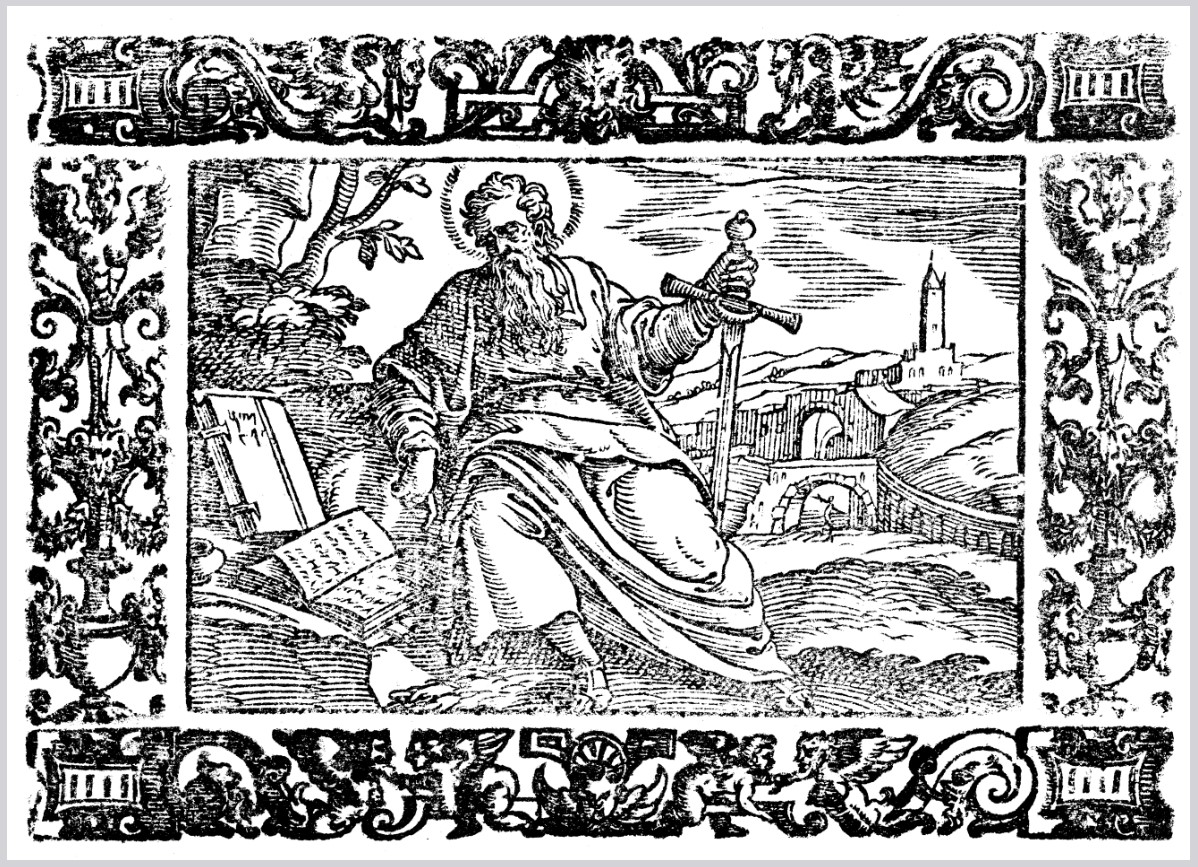
* The title page engraving titled "Paul" is from a book "Delle prediche quadragesimali Sopra l'Epistole, & Euangeli correnti, per igiorni di Quaresima, eperle due primi giorni di Pasqua. Con la vita dell'autore."
It is by Musso, Cornelio (1511-1574), now in public domain.
The Apostle Paul sits and holds a sword in one hand and points to a book, likely the scriptures, with the other hand. Romans 10 and 1 Corinthians 2 are the attending scriptures.
Courtesy of the Digital Image Archive, Pitts Theology Library, Candler School of Theology, Emory University.
4. What problem arose in the Corinthian congregation? (10)
* 1 Corinthians 1:10 "I appeal to you, brothers, in the name of our Lord Jesus Christ, that all of you agree with one another so that there may be no divisions among you and that you may be perfectly united in mind and thought."
* "I appeal to you, brothers, in the name of our Lord Jesus Christ" -Strong words.
* "that all of you agree with one another" -The KJV and ASV have "that ye all speak the same thing..." and similarly the HCSB has "that all of you agree in what you say". However, the concept is more in saying the same thing. Rather it is agreeing from the heart for if they say and yet still not believe from the heart, then there will still be divisions in the heart. Can one believe one thing in the heart and say another? One can always decide to hold a conclusion on the matter until a further time.
* "so that there may be no divisions among you" -"Division" is in all English translations that I have. The original Greek noun is "schisma" from "schizo", a primary verb meaning to split or sever (literal or figurative).
* "you may be perfectly united in mind and thought." -"United" is "joined together" in the KJV and ASV from the Greek verb "katartizo" from "kata" and a derivative of "artios". An example of what this means is a puzzle fitting together. If pieces are missing, then it isn't perfect.
What are some ways divisions can occur in a congregation?
* The problems within the Corinthian congregation is a good place to find some causes of division.
* Something on the outside but within the congregation like style of music, worship service format, look of the church, and children's ministry.
* A person within the congregation like lead pastor, an elder or group of elders, a deacon or group of deacons, an assistant pastor, a member or group of attendees. This would also include the roles of men, women, children, and the elderly.
* Something outside of church like politics, government, laws, social issues, and how and when to interact with those who do not attend the congregation or believe and worship as we do.
* The written word of God, which translation to use, how to interpret it, who teaches it, how to teach, when to teach, and where to teach.
* Doctrinal issues including how to and when to discipline violation of the congregational rules.
What does it mean to be "united in mind and thought"?
* "mind" -The English word "mind" or "understanding" in some Bibles is the Greek noun "nous" (a transliteration) probably from the base of the Greek verb "ginosko" meaning "intellect" as in "mind" (divine or human; in thought, feeling, or will) as in "to know" and/or what can be called part of the ego along with our conscience.
The human conscience is the part of our being that is aware of a moral and/or ethical aspect to one's conduct and thought together with the urge to prefer right over wrong. Another way to consider the human conscience it is is general a source of moral and/or ethical judgment or pronouncement. The human conscience is not the final judge of right and wrong which is only God's place.
* "thought" -The English word "thought" or "judgment" or "conviction" or "opinions" in some Bibles is the Greek "gnome" (a transliteration) from the Greek verb "ginosko" meaning "cognition: the mental process of faculty of knowing, including aspects such as awareness, perception, reasoning, and judgement."
* The Corinthian congregation needs to come to an agreement and once it is made everyone should accept it or leave the congregation. Many congregations have split over disagreements since the very beginning of the church age.
* Continually arguing, even after a decision is made can completely dissolve a congregation. Often the cults eventually dissipate. However, some remain for many centuries.
5. What was the source of quarrels at Corinth? (11-12)
* 1 Corinthians 1:11-12 "My brothers, some from Chloe's household have informed me that there are quarrels among you. What I mean is this: One of you says, "I follow Paul"; another, "I follow Apollos"; another, "I follow Cephas"; still another, "I follow Christ."
* "My brothers" -Jesus started the understanding that we are members of a family through calling us brothers. (Matthew 12:48-49, 19:29, 2:10; Mark 3:33-34; Luke 8:21; John 20:17)
* "Chloe's household" -Stephanas, Fortunatus, and Achaicus were probably the sons of Chloe (16:17).
* "quarrels" -"Eris" a Greek noun means "wrangling, contention, debate, strife, and variance."
* Quarrels.
Apostle Paul addresses the first problem among the believers in Jesus Christ at Corinth, divisions and quarrels. I believe the meaning of divisions here is "the condition of being divided in opinion, which leads to separate meetings and isolation of groups and individuals." All suffer with divisions and quarrels, especially the weak and vulnerable. But none more than Christ Jesus, who commanded, "Love each other as I have loved you. By this all may know that you are my disciples, and that I sent you." (paraphrased from John 15:12, 17, 12:34-35)
The Corinthian Christians began following Christian teachers and Christian doctrine. Apostle Paul thanked God for the gifts they received, especially speaking and knowledge in verse 5. They could cite their belief and proof of what they believed. Facts, figures, numbers, verses, and cite quotes from their favorite writer and speaker. What is the motive? Is their love in it?
Listen to the above comments on 1 Corinthians 1:10-12.
What answer to the questions in verse 13 could have avoided the quarrels?
* 1 Corinthians 1:13 "Is Christ divided? Was Paul crucified for you? Were you baptized into the name of Paul?"
* Christ is not divided. Only Jesus was crucified for our salvation. We are only baptized into the name of the Father, the Son Jesus, and the Holy Spirit.
Paul is reducing their position to its natural but absurd conclusion, a common technique in argument called a "reductio ad absurdum".
* "divided" -Paul means separated into two or more pieces. Jesus, when he was accused of casting out demons, stated that Satan's house is not divided. "If a house is divided against itself," he states, "it cannot stand. It will be ruined." (Matthew 12:25; Mark 3:24; Luke 11:17) If they continue to remain divided they will be ruined.
* "baptized into the name" -On face value, this is an unusual term. The baptism of Christ is being united with him in his death, burial, and resurrection. Yet, we say we are "baptized into the name of". The phrasing on face value is strange because it personifies "name", or rather equates the name of the person with the being of the person, in this case Christ. The phrasing comes from Jesus who told the disciples to baptize people "in the name of the Father, and of the Son, and of the the Holy Spirit." (Matthew 28:19; Acts 8:16, 19:5; Romans 6:3-4; Galatians 3:27-28)
6. What was Paul thankful for and why? (14-16)
* 1 Corinthians 1:14-16 "I am thankful that I did not baptize any of you except Crispus and Gaius, so no one can say that you were baptized into my name. (Yes, I also baptized the household of Stephanas; beyond that, I don't remember if I baptized anyone else.)"
* "I am thankful that I did not baptize any of you" -Baptism was not part of Apostle Paul's mission (see below comment). Paul mentions baptism in a few letters besides this one. (Romans 6:4, Galatians 3:27; Ephesians 4:5, Colossians 2;12)
* Baptism was the office of the deacons (Acts 10:47-48) later in the church age. Jesus originally instructed the apostles to baptize, but when the seven first deacons were appointed, the duty fell on them (Acts 6:1-7).
* "Crispus and Gaius" -Several commentaries contain the same thought of these two men. I will quote one, Adam Clarke, who quotes Dr. Lightfoot (1828-1889), a famous English biblical scholar and Bishop of Durham known for his commentaries on Paul's Epistles. "None of those who now live in Corinth, except Crispus, the ruler of the synagogue (Acts 18:8), And Gaius, the same person probably with whom Paul lodged, (Romans 16:23). Dr. Lightfoot observes: "If this be Gaius, or Caius, to whom the third epistle of John was written, which is very probable when the first verse of that epistle (3 John 1) is compared with Romans 16:23, then it will appear probable that John wrote his first epistle to the Corinthians. I wrote, says he, unto the Church -What Church? Certainly it must have been some particular Church which the apostle has in view, and the Church where Gaius himself resided. And if this be true, we may look for Diotrephes (3 John 9) in the Corinthian Church; and the author of the schism of which the apostle complains." (Adam Clarke's Commentary)
* Crispus and Gaius were probably baptized by Paul because they were two of the first converts in Corinth.
* "Stephanas" -Stephanas is only mentioned in this letter and this chapter, verses 15-17.
* "so no one can say that you were baptized into my name." -I read in a commentary that ancient Greece secret societies' ritual practices had an understanding that a person who introduced and initiated them into the cult would be considered their parent (patron), a kind of father within their cult, and thus this was part of the origination of the division problem in Corinth. Along with this Baptism would be used to confuse the new convert into joining a division within a congregation. They do not have proof for this statement. However, such actions are still done within secret societies today. Several congregations I attended had people in them who used such in-gathering practices to form their own secret groups to gain influence and power over the deacons, elders, and pastors.
To Paul, what was his first priority? (17, 15:1-8; Mark 16:15-16)
* 1 Corinthians 1:17 "For Christ did not send me to baptize, but to preach the gospel--not with words of human wisdom, lest the cross of Christ be emptied of its power."
* 1 Corinthians 15:1-8 "Now, brothers, I want to remind you of the gospel I preached to you, which you received and on which you have taken your stand. By this gospel you are saved, if you hold firmly to the word I preached to you. Otherwise, you have believed in vain. For what I received I passed on to you as of first importance: that Christ died for our sins according to the Scriptures, that he was buried, that he was raised on the third day according to the Scriptures, and that he appeared to Peter, and then to the Twelve. After that, he appeared to more than five hundred of the brothers at the same time, most of whom are still living, though some have fallen asleep. Then he appeared to James, then to all the apostles, and last of all he appeared to me also, as to one abnormally born."
* Mark 16:15-16 "He said to them, "Go into all the world and preach the good news to all creation. Whoever believes and is baptized will be saved, but whoever does not believe will be condemned."
* Paul's first priority was to preach the gospel in establishing new congregations in cities where the gospel had not been preached and/or an organized church had not been established.
What is yours?
* Cross and Baptism.
Apostle Paul supports his call for unity with two basic concepts given by Jesus Christ: the cross of Christ and baptism in the name of the Father, Jesus the Son, and the Holy Spirit. (Matthew 3:11, 28:19; John 1:25-33, 14:26). The church of God in Corinth would have known both from the very beginning of their walk with Jesus.
Apostle Paul asks questions, a common teaching method in ancient Greece, to help them logically come to the proper conclusion about why they should remain united. Christ is not divided. Jesus is the only one who was crucified for our salvation. Jesus was the only one they were baptized into.
When Paul arrived in Corinth, he preached the gospel, which they received and on which they took their stand. He did not employ human wisdom, which many in the congregation took pride in. He taught the cross of Christ simply and sweetly. By this gospel they were saved, if they hold firmly to the word. What is the gospel? Paul will repeat the gospel in detail in chapter 15. Here are verses 3-4, "...Christ died for our sins according to the Scriptures, that he was buried, that he was raised on the third day according to the Scriptures..."
Listen to the above comments on 1 Corinthians 1:13-17.
III. Boast in the Lord (1:18-2:5)
* The engraving titled "The Rope Walker" is from a book "Spiegel van het menselyk bedryf : vertoonende honderd verscheiden ambachten, konstig afgebeeld en met godlyke spreuken en stichtelyke verzen verryke / door Jan en Kasper Luiken"
It is by Luiken, Jan (1649-1712) and is now in public domain. The rope walker walks backwards while twisting the hemp that is wrapped around his waist; in the background left, several workmen make a cable. The Dutch artist and poet Jan Luiken (1649-1712) was responsible for drawing this emblem and for creating the motto and poem that follow. Jan Luiken and/or his son Casper Luiken (1672-1708) were responsible for its etching. The attendant scripture text is 1 Corinthians 1:18-25.
Courtesy of the Digital Image Archive, Pitts Theology Library, Candler School of Theology, Emory University.
The motto is "The walking is bad, But the work is right." The accompanying poem is:
The wrong walking of the pious man,
In the eye of him, who doesn't understand,
Serves nevertheless a good trade,
Which in a storm stands in good stead;
Then life's ship remains secure,
On its twisted cables.
(Translation by Josephine V. Brown, with editorial assistance from William G. Stryker)
7. What are two ways that people see Jesus' crucifixion? (18-19)
* 1 Corinthians 1:18-19 "For the message of the cross is foolishness to those who are perishing, but to us who are being saved it is the power of God. For it is written: 'I will destroy the wisdom of the wise; the intelligence of the intelligent I will frustrate.'"
* The quote is from Isaiah 29:14. Isaiah 29:13-14 "The Lord says: 'These people come near to me with their mouth and honor me with their lips, but their hearts are far from me. Their worship of me is made up only of rules taught by men. Therefore once more I will astound these people with wonder upon wonder; the wisdom of the wise will perish, the intelligence of the intelligent will vanish.'"
* "For the message of the cross" -The cross is action. The cross is a message. Jesus said so when he foretold his disciples that he would be arrested, die, be buried, and rise from the dead in many ways.
* "it is the power of God" -Power to save.
* A person sees Jesus cross either as foolishness or God's salvation.
What two wisdoms are there and what is the outcome of each? (20-21)
* 1 Corinthians 1:20-21 "Where is the wise man? Where is the scholar? Where is the philosopher of this age? Has not God made foolish the wisdom of the world? For since in the wisdom of God the world through its wisdom did not know him, God was pleased through the foolishness of what was preached to save those who believe."
* "the world through its wisdom did not know him" -Man's wisdom cannot lead a person to Christ. Man's wisdom leads to destruction.
* "God was pleased through the foolishness of what was preached to save those who believe" -God is the only way to know God. God's wisdom leads to life.
* "save those who believe" -God gives the message through the Son. The Son's messengers repeat his message. If the message is believed a person is saved. If the message is rejected the person is not saved. The Holy Spirit moves the heart when the message is delivered. However, a person when they hear the message, they can rejected the moving of the Holy Spirit. This is blasphemy of the Holy Spirit which is the only unforgivable sin (Matthew 12:31).
* The Problem: A Wrong Idea of God.
Ask people on the street, scroll through social media, and talk with anyone on a college campus about God, and you will find a wide range of ideas and understandings about God. The types of people and their comments about God would not be much different from the ideas people had in Paul's time, 2,000 years ago. I know because I have done this.
The "wise man" is a Gentile philosopher in general. The "scholar" is the Jewish teacher of the religious law. The "philosopher of this age" is the Greek skilled in elaborate and devious argumentation who engages in long and subtle disputes (sophist).
Paul, in verses 18, 20-21, is quoting Jesus as he quotes Isaiah 29:14 in verse 19. Luke 10:21 states, "At that time Jesus, full of joy through the Holy Spirit, said, 'I praise you, Father, Lord of heaven and earth, because you have hidden these things from the wise and learned, and revealed them to little children. Yes, Father, for this was your good pleasure.'"
Elsewhere, Paul instructs Timothy and Titus to learn so they may have a good understanding of the faith they believe in. However, here he tells the Church in Corinth that the basis of the faith we share is found in the message and action of the cross of Christ. Let go of that, and I am letting go of the fundamental message of my Lord Jesus Christ, who teaches, "For the Son of Man did not come to be served, but to serve, and to give his life as a ransom for many." (Mark 10:45) Jesus reveals the "message of the cross".
Listen to the above comments on 1 Corinthians 1:18-21.
How is God's way to know him, Christ crucified, a stumbling block to miracle and/or wisdom seekers? (22-23)
* 1 Corinthians 1:22-23 "Jews demand miraculous signs and Greeks look for wisdom, but we preach Christ crucified: a stumbling block to Jews and foolishness to Gentiles,"
* "Jews demand miraculous signs" -Miraculous sings that that say this is God and this is God's righteousness and that is God's salvation such as at Mount Sinai and the giving of the Law.
* "Greeks look for wisdom" -That leads to righteousness that is salvation. How to determine what is right and wrong and how to chose right and reject wrong.
* "we preach Christ crucified" -Paul will go into great detail in chapter 15. Paul states this now because it counters the folly of the error of most in the young Corinth congregation. They forgot the foundation is Christ crucified which does not follow man's logic.
* "a stumbling block... foolishness" -Jesus being crucified to make us righteous so we can have communion with God does not fit into either Jewish or Greek "religions".
What do both fail to accept? (24-25)
* 1 Corinthians 1:24-25 "but to those whom God has called, both Jews and Greeks, Christ the power of God and the wisdom of God. For the foolishness of God is wiser than man's wisdom, and the weakness of God is stronger than man's strength."
* "to those whom God has called" -God's call is the only way to come to know the truth. Otherwise all would remain in foolish ideas.
* "Christ the power of God and the wisdom of God" -Paul, full of the Spirit, counters both errors.
* Miracle Mania - Wisdom Insanity.
A person will experience God's miracle and then foolishly ask for a miracle as proof that God's miracle is true because the ego loves power and the praise of men more than God. A person can hear pure wisdom and unfutable knowledge and refuse to concede to them because pride loves imperfection and insanity more than truth.
Jesus came full of grace and truth (John 1:14, 17), performing many miraculous signs before and among many people, including the Jewish religious leaders (John 4:48, 7:31, 9:16, 11:47, 12:37). Similarly, the apostles performed miraculous signs (Acts 2:43, 5:12, 14:3). Still, many refused to believe, though a few did.
Jesus sent his apostles, including Apostle Paul, with the message of the gospel. Apostle Paul's custom was to go into the synagogue and reason with them from the Scriptures, "explaining and proving that the Christ had to suffer and rise from the dead. 'This Jesus I am proclaiming to you is the Christ,' he said. Some of the Jews were persuaded..., as did a large number of God-fearing Greeks and not a few prominent women." (Acts 17:3-4) Still, many refused to believe.
To those whom God has called, both Jews and Gentiles (the Corinthian Church had both), Christ is the power of God and the wisdom of God. The foolishness of God is wiser than man's wisdom, and the weakness of God is stronger than man's strength. Therefore, I will always remember to preach Christ crucified, died, buried, rose from the dead, and he will come again soon... very soon.
Listen to the above comments on 1 Corinthians 1:22-25.
8. Take a sincere look at what you were like before Christ called you considering verse 26.
* 1 Corinthians 1:26 "Brothers, think of what you were when you were called. Not many of you were wise by human standards; not many were influential; not many were of noble birth."
* "think of what you were when you were called" -Paul gives examples to ponder: wisdom, social influence, and social status.
What are the three reasons that God chose such things according to verses 27-29?
* 1 Corinthians 1:27-29 "But God chose the foolish things of the world to shame the wise; God chose the weak things of the world to shame the strong. He chose the lowly things of this world and the despised things--and the things that are not--to nullify the things that are"
* "to shame the wise"
* "to shame the strong"
* "to nullify the things that are"
What is the final reason from our perspective? (29)
* 1 Corinthians 1:29 "so that no one may boast before him."
* Designed humility.
* Not Much of Anything.
Take a self-assessment is the theme of these verses. The congregation at Corinth had become conceited. God revealed truth to them, and it boosted their pride. They began thinking too much of themselves. They forgot who they were when God called them. They forgot God was the one who built them up.
Not many were wise by human standards (26). Not many were influential. Not many were of noble birth. Paul sums up their social status prior to a relationship with God as foolish, weak, and despised (27, 28). Why? So that we cannot boast before him.
I always need to remember who I am before God. I need to remember where God called me from. God reminded King David when he was called from, a shepherd, the lowest in his family. Humility is important, especially before God.
Listen to the above comments on 1 Corinthians 1:26-29.
9. What is the only way to be in Christ Jesus? (30)
* 1 Corinthians 1:30 "It is because of him that you are in Christ Jesus, who has become for us wisdom from God--that is, our righteousness, holiness and redemption."
* "It is because of him" -God the Father. Jesus said, "No one comes to the Father except through the Son." (John 14:6) and "No one knows who the Father is except the Son and those to whom the Son chooses to reveal him." (Luke 10:22)
* "that you are in Christ Jesus" -A part of the body of Christ.
* "who has become for us wisdom from God" -Jesus is the wisdom of God.
* Acts 4:12 "Salvation is found in no one else, for there is no other name under heaven given to men by which we must be saved."
Who then is Jesus to true believers?
* "who has become for us wisdom from God" -Jesus being wisdom from God is perhaps the central point Paul is making to counter and stop their arguments that are caused by the knowledge that has boasted their egos. The have knowledge, but they have lost focus of Jesus, God's wisdom given to all believers.
* The statement concerning Christ Jesus in verse 30 is just one aspect of Jesus for the believe. More exists.
What does it mean in more detail?
* "righteousness" -Relationship with God made right because I have been made righteous through Jesus.
* "holiness" -I have been made holy, sanctified, through Jesus.
* "redemption" -Jesus has redeemed me (paid the price) to secure the release from a meaningless empty way of life without God that was leading me to eternity completely without God and his good influence.
Can you or anyone then say that they came to know God through their own power or wisdom? (31)
* 1 Corinthians 1:31 "Therefore, as it is written: "Let him who boasts boast in the Lord."
* "boast" -Glorify.
* Boast In the Lord.
Many reasons can be found to boast in me and my abilities. Yet none are valid for God makes them all possible. God supplies the ability. God supplies the health. God supplies the environment. God supplies the skills. God supplies the resources. God supplies the proper weather. God supplies the food and water. God supplies the resources in people and money. God supplies the time. God supplies the wisdom. These are all worldly.
Spiritually God is all in all for the believer. He is our righteousness, holiness and redemption. He is the way, the truth, and the life. He is the first and the last. He is the beginning and the end. He made the way. He is the way. It is because of God that I am in Christ Jesus. God set the plan, and the plan is Jesus. So, what reason can be found to boast in me and my abilities since he has and will do it all? Whatever I have he has supplied.
Listen to the above comments on 1 Corinthians 1:30-31.
10. What simple way can and should the gospel be preached? (2:1, 3-4a)
* 1 Corinthians 2:1 "When I came to you, brothers, I did not come with eloquence or superior wisdom as I proclaimed to you the testimony about God."
* 1 Corinthians 2:3-4a "I came to you in weakness and fear, and with much trembling. My message and my preaching were not with wise and persuasive words"
* "I did not come with eloquence"
* "or superior wisdom"
* "I came to you in weakness and fear" -Some commentators say this is the on and off illness he had that he mentions elsewhere.
* "and with much trembling" -See about.
* "the testimony about God." -Paul gave a testimony about God meaning the gospel of Jesus Christ. The Apostle John speaks of the testimony of God. (John 5:9-10) John said God's testimony about the Son is in our hearts.
1 John 5:9-12 says, "We accept man's testimony, but God's testimony is greater because it is the testimony of God, which he has given about his Son. Anyone who believes in the Son of God has this testimony in his heart. Anyone who does not believe God has made him out to be a liar, because he has not believed the testimony God has given about his Son. And this is the testimony: God has given us eternal life, and this life is in his Son. He who has the Son has life; he who does not have the Son of God does not have life."
Who is the core of the gospel? (2)
* 1 Corinthians 2:2 "For I resolved to know nothing while I was with you except Jesus Christ and him crucified."
* "Jesus Christ and him crucified." -The core of the gospel. 1 Corinthians 15:3-4 also states this.
Who really makes it possible for anyone to hear the gospel and why? (4b-5)
* 1 Corinthians 2:4b-5 "but with a demonstration of the Spirit's power, so that your faith might not rest on men's wisdom, but on God's power."
* "a demonstration of the Spirit's power" -When they believed the Holy Spirit moved them. This was evidenced visually in their countenance and experienced in their being.
* John 3:8 records Jesus saying, "The wind blows wherever it pleases. You hear its sound, but you cannot tell where it comes from or where it is going. So it is with everyone born of the Spirit."
Can you preach the gospel this way? (John 4:28-30, 39-42)
* John 4:28-30 "Then, leaving her water jar, the woman went back to the town and said to the people, "Come, see a man who told me everything I ever did. Could this be the Christ?" They came out of the town and made their way toward him."
* John 4:39-42 "Many of the Samaritans from that town believed in him because of the woman's testimony, "He told me everything I ever did." So when the Samaritans came to him, they urged him to stay with them, and he stayed two days. And because of his words many more became believers. They said to the woman, "We no longer believe just because of what you said; now we have heard for ourselves, and we know that this man really is the Savior of the world."
* The Spirit of God is the one who moves the heart of both the one giving and receiving the testimony of Christ Jesus.
* The Spirit's Power.
The Spirit of God was promised and still is promised to be the means by which a person comes to faith in Jesus. Wisdom and elegant words were not promised and is not promised to be the means.
One of the reasons believers in Jesus give for not witnessing to their faith in Jesus is they are afraid that they will say things that will drive people away from faith in Jesus. The simple fact is that most likely they are just afraid for themselves.
When Paul arrived in Corinth, he kept his witness concerning Jesus simple. He states, "I resolved to know nothing except Jesus Christ and him crucified." Paul made it all about Jesus.
The Spirit works in and through us according to his good work. All I need is a willing heart to share. Pray to be used to deliver the message of Jesus Christ and him crucified.
Listen to the above comments on 1 Corinthians 2:1-5.