I. David's First Attempt to Bring the Ark of the Lord to Jerusalem (13:1-14:17)
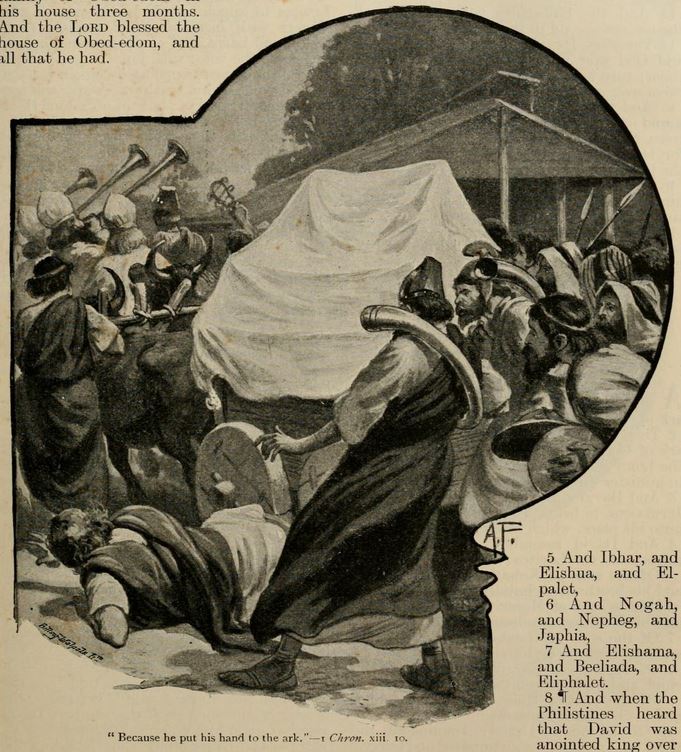
* The illustration is from the Art Bible, 1896, comprising the Old and New Testaments, with numerous illustrations. Publisher, London: G. Newnes. 1 Chronicles 13:10 is cited.
>1. What did David ask Israel? (1-3) What was their response? (4) Who did David call together? (5) Why was this so important for all Israel to know throughout history?
* 1 Chronicles 13:1-5 "David conferred with each of his officers, the commanders of thousands and commanders of hundreds.
He then said to the whole assembly of Israel, "If it seems good to you and if it is the will of the LORD our God, let us send word far and wide to the rest of our brothers throughout the territories of Israel, and also to the priests and Levites who are with them in their towns and pasturelands, to come and join us.
Let us bring the ark of our God back to us, for we did not inquire of it during the reign of Saul."
The whole assembly agreed to do this, because it seemed right to all the people.
So David assembled all the Israelites, from the Shihor River in Egypt to Lebo Hamath, to bring the ark of God from Kiriath Jearim."
* 2 Samuel 6 also records David bringing the Ark of the Lord to Jerusalem.
* Psalm 132 is a good reference to this passage.
* "David conferred" -A good leader knows others will possesses strengths and abilities that are better than his abilities in those areas and go to them for advise and direction. A proud leader will not and bring everything to ruin, pain, and death.
* "If it seems good to you" -He let the decision up to the will of the people. He presented the advise of the wise and the king.
* "if it is the will of the LORD our God," -David let the people know that he inquired the will of the Lord too.
* "the ark of our God" -The ark of the Covenant is the name of the original container for the Ten Commandments (the center of the Old Covenant), Arron's staff, and some manna. The Ark was the central symbol of God's presence with the people of Israel.
The Hebrew word for ark means "box", "chest", and "coffin". (Genesis 50:26; 2 Kings 12:9-10) The Ark of the Lord God was special order built by God to Moses. (Exodus 25:10-22, 31:2, 7, 35:30-35, 37:1-9) The build order was given during Moses' first climb up Mt. Sinai and built after all the tabernacle specifications had been communicated and completed. (Deuteronomy 10:1-5).
Numbers 10:35-36 is called "The Song of the Ark" and speaks of its wilderness function. Numbers 10:33, 35-36 is the acount of the ark being used in battle. Numbers 14:39-45 reveals the Israelites trying to move into the promised land when the ark did not move and were defeated. Jeremiah 3:16-17 and Psalm 132:7-8 refer to the Ark as a temporary symbol of the Lord God's dwelling with is people.
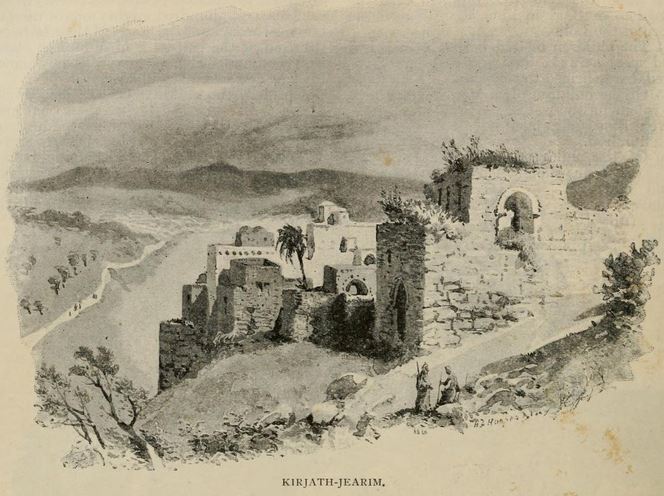
* "Kiriath Jearim" -Kiriath-Jearim was located at modern Abu Gosh nine miles north of Jerusalem. It was on the border where Dan, Benjamin, and Judah joined before Dan began their migration northward (Josh. 15:9,60; 18:14-15). Dan's army camped there in their search for new territory (Judg. 18:12). After the Philistines returned the ark of the covenant, it was kept at Kiriath-Jearim for a time (1 Sam. 6:21-7:2). (Holman Bible Dictionary) See picture from the Art Bible below.
*
The Ark Was A Symbol.
The Ark of God symbolized the Lord God's presence with the people of Israel. The only thing in this chest-shaped artifact was two stone tablets that had the covenant between the Lord God and Israel carved into them. The people were to inquire of the Lord before the Ark.
David was the king of Israel. He moved to Jerusalem. He loved the Lord God and had inquired of the Lord God often through the high priest of God. He wanted to move the Ark to Jerusalem, so the Lord would be close to him. A man of God desires to be with the Lord at all times.
While moving the Ark from Baalah of Judah (Kiriath Jearim) to Jerusalem, a man who was not a priest touched the Ark and died 9, 10). He had good intentions. His intentions were not what killed him. Rather, the Lord gave Moses specific instructions on how the Ark was to be moved. David and the Israelites had not followed those instructions.
The Lord God is holy. He is to be honored and awed. He is due respect. David learned the hard way that fear of the Lord is the beginning of wisdom (12). He blesses those who honor him (14). He curses those who dishonor him. The fear of the Lord brings about obedience and blessing.
Listen to the above Chapter 13 Overview.
* The illustration is from the Art Bible, 1896, comprising the Old and New Testaments, with numerous illustrations. Publisher, London: G. Newnes.
>2. Describe the procession while the Ark was moved from Hebron to Jerusalem. (6-8) What can we learn about worship and praise? (Eph. 5:19-20, Col. 3:15-17)
* 1 Chronicles 13:6-8 "David and all the Israelites with him went to Baalah of Judah (Kiriath Jearim) to bring up from there the ark of God the LORD, who is enthroned between the cherubim--the ark that is called by the Name.
They moved the ark of God from Abinadab's house on a new cart, with Uzzah and Ahio guiding it.
David and all the Israelites were celebrating with all their might before God, with songs and with harps, lyres, tambourines, cymbals and trumpets."
* Ephesians 5:19-20 "Speak to one another with psalms, hymns and spiritual songs. Sing and make music in your heart to the Lord, always giving thanks to God the Father for everything, in the name of our Lord Jesus Christ."
* Colossians 3:15-17 "Let the peace of Christ rule in your hearts, since as members of one body you were called to peace. And be thankful. Let the word of Christ dwell in you richly as you teach and admonish one another with all wisdom, and as you sing psalms, hymns and spiritual songs with gratitude in your hearts to God. And whatever you do, whether in word or deed, do it all in the name of the Lord Jesus, giving thanks to God the Father through him."
* "who is enthroned between the cherubim" -A representative of what is in heaven.
* "the ark that is called by the Name." -For it represented the Lord God with Israel./p>
* See 2 Samuel study 2 comments, section III for 2 Samuel chapter 6 for more comments including a historical account of the movement of the Ark from the time it was brought into the promised land till this event.<
* "on a new cart" -Taking after what the Philistines did, not what the Lord God told Moses told the Israelites to do.
* "celebrating with all their might before God" -Whole hearted worship done the wrong way did not stop the Lord God's anger.
* "with songs and with harps, lyres, tambourines, cymbals and trumpets." -Nothing wrong existing is using these. The error was using the cart instead of priest carrying the Ark on poles. The priest were in error, not the musicians, though most of the musicians were Levites.
>3. Why did Uzzah die? (9-10; 1 Sam. 6:19; Num. 4:15; 1 Chron. 15:15) How did David respond? (11-13) What did God teach? (14)
* 1 Chronicles 13:9-14 "When they came to the threshing floor of Kidon, Uzzah reached out his hand to steady the ark, because the oxen stumbled.
The LORD's anger burned against Uzzah, and he struck him down because he had put his hand on the ark. So he died there before God.
Then David was angry because the LORD's wrath had broken out against Uzzah, and to this day that place is called Perez Uzzah.
David was afraid of God that day and asked, "How can I ever bring the ark of God to me?"
He did not take the ark to be with him in the City of David. Instead, he took it aside to the house of Obed-Edom the Gittite.
The ark of God remained with the family of Obed-Edom in his house for three months, and the LORD blessed his household and everything he had."
* 1 Samuel 6:19-20 "But God struck down some of the men of Beth Shemesh, putting seventy of them to death because they had looked into the ark of the LORD. The people mourned because of the heavy blow the LORD had dealt them, and the men of Beth Shemesh asked, "Who can stand in the presence of the LORD, this holy God? To whom will the ark go up from here?"
* Numbers 4:15 "After Aaron and his sons have finished covering the holy furnishings and all the holy articles, and when the camp is ready to move, the Kohathites are to come to do the carrying. But they must not touch the holy things or they will die. The Kohathites are to carry those things that are in the Tent of Meeting."
* 1 Chronicles 15:14-15 "So the priests and Levites consecrated themselves in order to bring up the ark of the LORD, the God of Israel. And the Levites carried the ark of God with the poles on their shoulders, as Moses had commanded in accordance with the word of the LORD."
* 2 Samuel 6:6 "When they came to the threshing floor of Nacon, Uzzah reached out and took hold of the ark of God, because the oxen stumbled."
* "the threshing floor of Kidon" -Kidon (NIV spelling and Chidon others) means "crescent sword", or "firm", or "prepared". 2 Samuel 6:6 is a parallel passage that has "Nacon". The designations are either a place name or the name of the owner. Kidon (aka Chidon) is given as the owner's name in Chronicles, but not in 2 Samuel.
* "Gittite" -A Gittite is a citizen of Gath. Goliath was a Gittite.
* The man who died, Uzzah, was not at fault as much as the men who had made his disrespect possible, which included the priest and David, for they did not follow the Law given through Moses concerning moving the Ark. If they had, he would not have died. Yes, he should not have touch the Ark for he was not a Levite. But others were at fault too.
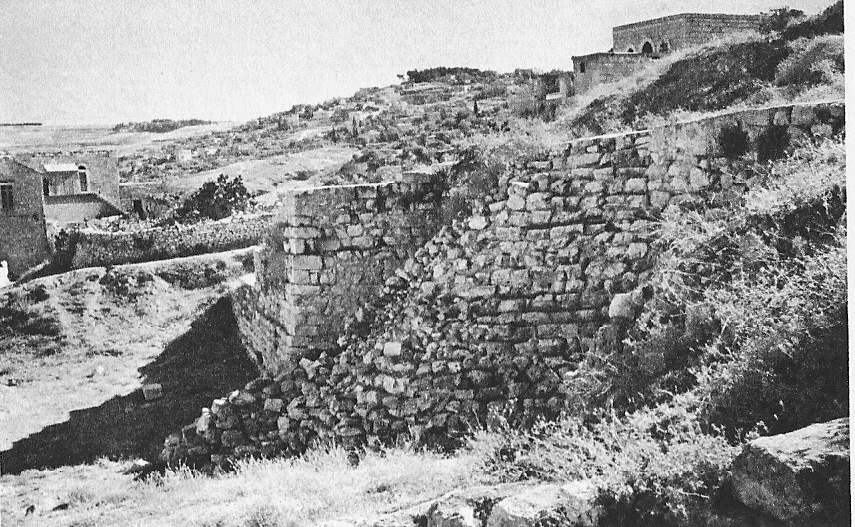
* After almost three thousand years of oblivion, and in the course of excavations which have often presented the archaeologists with considerable difficulties, these meager and insignificant-looking fragments of walls are all that have so far come to light from the time when David captured Jerusalem and his son Solomon built its temple. On the east side of the "city of David" lie side by side the remains of the Jebusite fortress and a square tower dating from Solomon's day-venerable mementoes of Jerusalem in the time of the monarchy. (The Bible as History in Pictures, Werner Keller)
>4. What do David's alliance with Hiram and David's taking more concubines and wives tell us about the customs of the age? (15:1-7) Why was it important for David to know God's will upon himself and his kingdom? (2)
* 1 Chronicles 14:1-7 "Now Hiram king of Tyre sent messengers to David, along with cedar logs, stonemasons and carpenters to build a palace for him.
And David knew that the LORD had established him as king over Israel and that his kingdom had been highly exalted for the sake of his people Israel.
In Jerusalem David took more wives and became the father of more sons and daughters.
These are the names of the children born to him there: Shammua, Shobab, Nathan, Solomon,
Ibhar, Elishua, Elpelet,
Nogah, Nepheg, Japhia,
Elishama, Beeliada and Eliphelet."
* 2 Samuel 5:11-12 also records David's alliance with Hiram. David's concubines are also recorded in 2 Samuel 5:13-16.
* "Hiram king of Tyre" -David's kingdom received international recognition.
* "Tyre" -Tyre was a celebrated commercial city of Phoenicia, on the coast of the Mediterranean. Its Hebrew name "Tzor" signifies a rock; which well agrees with the site of Sur, the modern town, on a rocky peninsula, formerly an island. There is no doubt that, previous to the siege of the city by Alexander the Great, Tyre was situated on an island; but, according to the tradition of the inhabitants, there was a city on the mainland before there was a city on the island; and the tradition receives some color from the name of Palætyrus, or Old Tyre, which was borne in Greek times by a city on the continent, thirty stadia to the south. (Smith's Bible Dictionary: Comprising Antiquities, Biography, Geography, Natural History, Archaeology and Literature)
* "a palace for him." -After being a shepherd boy in the wilderness, a warrior on the battlefield, an exile in abandion desert towns, and Judah's leader in Hebron, David wanted a place for him and his ever expanding family to live.
*
The Lord Blessed Israel Through David.
The Lord God was blessing David in all he did. David inquired before he went to battle with the Philistines (10, 14). "Shall I go and attack..." Though defending one's territory seems obvious when an enemy attacks David inquired anyway. The Lord was fighting in the battle (15).
At one time, I was jealous of David at this point in his life. He was king. He was building a palace. He had wives and children. He was winning battles. Most of all is that the Lord God answered his prayers and was fighting with him in battles. Yes, it is true David was not always living like this. Still, I was jealous of David at this time in his life.
Jealousy implies that I want something different in my life. And because I want changes and do not see them happening, I wonder why God isn't answering my prayers.
Was David living such a life to be jealous of? How did he feel when the Philistines raided the Valley of Rephaim (9) not once but twice (13)? These were the same people he had aligned with around 10 years earlier when he was in exile because of Saul. I suspect David was hurt and shocked. I am not jealous of the attacks that lead to victories.
When things are going well, and something bad seems to keep happening, I need to remember to inquire of the Lord and know that God has a victory in store if I obey him. It must have been just as hard for David to wait under the balsam trees (14) as it is for me to wait for the Lord to begin the fight. Yet he did. So here I am,
Listen to the above Chapter 14 Overview.
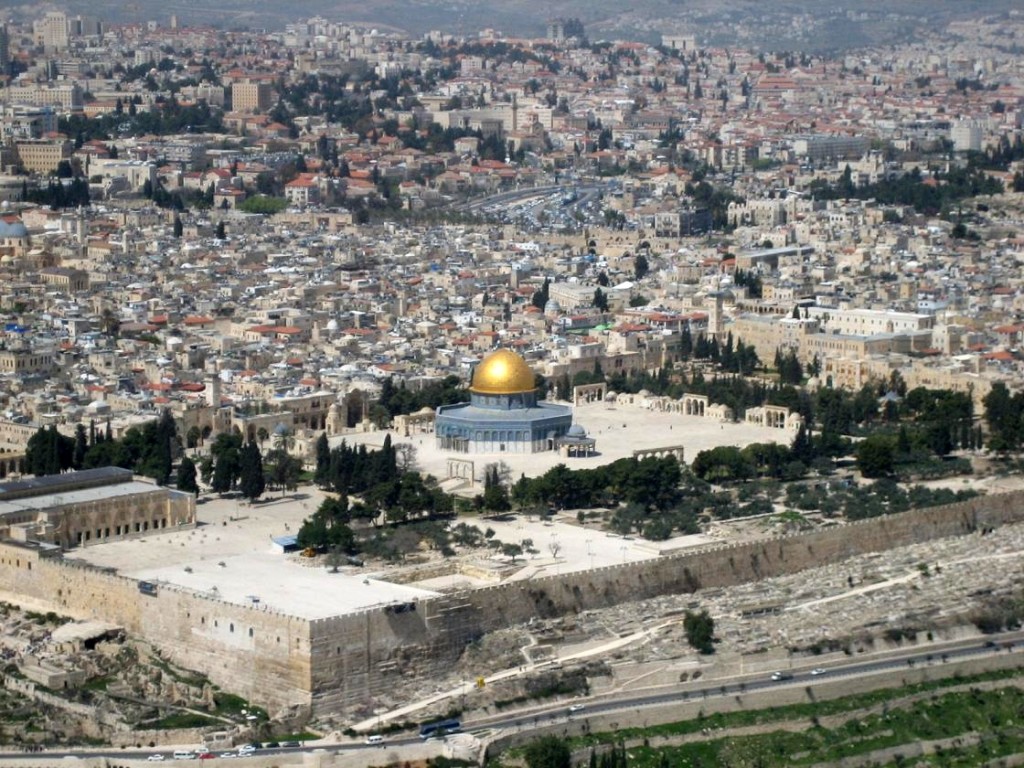
* The modern temple mount.
>5. What else did have to deal with at this time? (8-17) When the Philistines came to attack and kill David what did he do? Who did David credit for the victory? What can we learn how battles are won?
* 1 Chronicles 14:8-17 "When the Philistines heard that David had been anointed king over all Israel, they went up in full force to search for him, but David heard about it and went out to meet them.
Now the Philistines had come and raided the Valley of Rephaim;
so David inquired of God: "Shall I go and attack the Philistines? Will you hand them over to me?" The LORD answered him, "Go, I will hand them over to you."
So David and his men went up to Baal Perazim, and there he defeated them. He said, "As waters break out, God has broken out against my enemies by my hand." So that place was called Baal Perazim.
The Philistines had abandoned their gods there, and David gave orders to burn them in the fire.
Once more the Philistines raided the valley;
so David inquired of God again, and God answered him, "Do not go straight up, but circle around them and attack them in front of the balsam trees.
As soon as you hear the sound of marching in the tops of the balsam trees, move out to battle, because that will mean God has gone out in front of you to strike the Philistine army."
So David did as God commanded him, and they struck down the Philistine army, all the way from Gibeon to Gezer.
So David's fame spread throughout every land, and the LORD made all the nations fear him."
* 2 Samuel 5:17-26 also record David defeating the Philistines.
* "they went up in full force to search for him" -Another form of international recognition of David's kingdom.
* "So David's fame spread throughout every land" -The main point in bringing up Hiram and the Philistines.
* "the LORD made all the nations fear him." -God was doing this for his people. David, the Bible says elsewhere, was fully away that God was increasing his kingship on behalf of Israel.
II. David's Second Attempt to Bring the Ark of the Lord to Jerusalem (15:1-29)
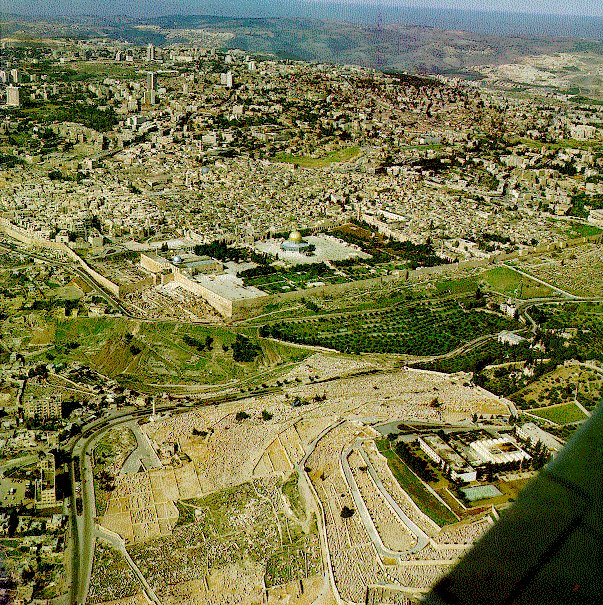
* A picture of Jerusalem. The Temple Mount is on the top/middle, the Kidron Valey is the green area running left to right just beneath it, and the Mount of Olives on at the bottom right.
>6. Why did David again decide to bring that ark to Jerusalem? (2 Samuel 6:12) How much different was David in bring the ark this time? (15:1-15) What can we learn about worship and praise? (15:16-24, Heb. 12:28-29) What did David do as the Ark moved through Jerusalem? (25-28)
* 1 Chronicles 15:1-15 "After David had constructed buildings for himself in the City of David, he prepared a place for the ark of God and pitched a tent for it.
Then David said, "No one but the Levites may carry the ark of God, because the LORD chose them to carry the ark of the LORD and to minister before him forever."
David assembled all Israel in Jerusalem to bring up the ark of the LORD to the place he had prepared for it.
He called together the descendants of Aaron and the Levites:
From the descendants of Kohath, Uriel the leader and 120 relatives;
from the descendants of Merari, Asaiah the leader and 220 relatives;
from the descendants of Gershon, Joel the leader and 130 relatives;
from the descendants of Elizaphan, Shemaiah the leader and 200 relatives;
from the descendants of Hebron, Eliel the leader and 80 relatives;
from the descendants of Uzziel, Amminadab the leader and 112 relatives.
Then David summoned Zadok and Abiathar the priests, and Uriel, Asaiah, Joel, Shemaiah, Eliel and Amminadab the Levites.
He said to them, "You are the heads of the Levitical families; you and your fellow Levites are to consecrate yourselves and bring up the ark of the LORD, the God of Israel, to the place I have prepared for it.
It was because you, the Levites, did not bring it up the first time that the LORD our God broke out in anger against us. We did not inquire of him about how to do it in the prescribed way."
So the priests and Levites consecrated themselves in order to bring up the ark of the LORD, the God of Israel.
And the Levites carried the ark of God with the poles on their shoulders, as Moses had commanded in accordance with the word of the LORD."
* The second attempt to bring the Ark of the Covenant to Jerusalem, aka The Ark of God and the ark of the LORD. 1 Chronicle chapter 15's account of the successful attempt to move the Ark to Jerusalem is greatly expanded over the material in 2 Samuel. Only 15:25-16:3 has a parallel (2 Samuel 6:12-19); the rest of the material is unique to the Chronicler and reflects his own interests, especially in the Levites and musicians (3-24).
* 2 Samuel 6:1-15 also records the second attempt to bring the Ark of the Lord to Jerusalem.
* 2 Samuel 6:12 "Now King David was told, 'The Lord has blessed the household of Obed-Edom and everything he has, because of the ark of God.' So David went down and brought up the ark of God from the house of Obed-Edom to the City of David with rejoicing."
* "After David had constructed buildings for himself in the City of David" -See 14:1-3 and 2 Samuel 7:1.
* "he prepared a place for the ark of God and pitched a tent for it." -David had made a new tent, probably as was prescribed by the Lord through Moses.
* "the descendants of Aaron and the Levites" -Aaron was a descendant of Levi. Aaron and his descendants were separated as special after the incident with the golden calf at Mount Sinai.
* "Kohath... Merari... Gershon" -The three clans of Levi are represented.
* "Elizaphan... Hebron... Uzziel" -Three distinct subgroups within Kohath.
* "consecrate yourself" -Exodus 29:1-37, 20:19-21, 40:31-32, and Leviticus 8:5-35 gives instructions on ritual washings and avoidance of ceremonial defilement.
* "It is because you, the Levites, did not bring it up the first time..." -David explained what was discovered concerning the failure the first time. The book of Samuel does not include this. Just who discovered this is unclear. Most likely David ordered a search in the Mosaic law for an answer. They should have known, except the Israelites had not moved the ark since they took it with them to battle the Philistines. (1 Samuel 4:1-22, 7:1-2)
*
The Ark of the Lord Moved to Jerusalem.
David knew that the Ark of the Lord that housed the covenant with Israel, was to be in the capital city of the Lord God's people. David wanted the symbol of the Lord's presence to be near him. So a second time he gathered the community together to accomplish the task (1). This time he was going to do it in the way the Lord told Moses it was to be done (2). The Levites were to do it (11). So they had to prepare themselves as the Lord prescribed (12).
One of the things that the Levites were sure to do was to sing and play musical instruments (16, 19). Music has always been and always should be an important part of my worship. The Lord created music. He created men and women with an appreciation for and the ability to express ourselves in melody and rhythm.
During my teenage years, I played percussion: snare drum, drum set, and other instruments. I also occasionally sang. I still enjoy music and praising the Lord Jesus in song. I have thought of using these talents in a church setting. I was part of a choir for a while. After many years, I attempted to use my percussion talent during Sunday service. It didn't work well, in part because I was ramping up work on FreeBibleStudyHelp.com, the blog, and the podcasts.
Listen to the above Chapter 15 Overview.
* 1 Chronicles 15:16-24 "David told the leaders of the Levites to appoint their brothers as singers to sing joyful songs, accompanied by musical instruments: lyres, harps and cymbals.
So the Levites appointed Heman son of Joel; from his brothers, Asaph son of Berekiah; and from their brothers the Merarites, Ethan son of Kushaiah;
and with them their brothers next in rank: Zechariah, Jaaziel, Shemiramoth, Jehiel, Unni, Eliab, Benaiah, Maaseiah, Mattithiah, Eliphelehu, Mikneiah, Obed-Edom and Jeiel, the gatekeepers.
The musicians Heman, Asaph and Ethan were to sound the bronze cymbals;
Zechariah, Aziel, Shemiramoth, Jehiel, Unni, Eliab, Maaseiah and Benaiah were to play the lyres according to alamoth,
and Mattithiah, Eliphelehu, Mikneiah, Obed-Edom, Jeiel and Azaziah were to play the harps, directing according to sheminith.
Kenaniah the head Levite was in charge of the singing; that was his responsibility because he was skillful at it.
Berekiah and Elkanah were to be doorkeepers for the ark.
Shebaniah, Joshaphat, Nethanel, Amasai, Zechariah, Benaiah and Eliezer the priests were to blow trumpets before the ark of God. Obed-Edom and Jehiah were also to be doorkeepers for the ark."
* Hebrews 12:28-29 "Therefore, since we are receiving a kingdom that cannot be shaken, let us be thankful, and so worship God acceptably with reverence and awe, for our "'God is a consuming fire.'"
* "the Levites to appoint their brothers as singers to sing joyful songs, accompanied by musical instruments: lyres, harps and cymbals." -Some look down on musical instruments.
* "Obed-Edom" -Also in 18, 21, 24. See 13:13.
* "the priests were to blow trumpets before the ark of God" -Also 16:6. Two silver trumpets were ordered to be made at the command of the Lord to Moses and Israel. (Numbers 10:1-10. The purpose outlined in Numbers 10 was for when the people are go gather, the elders are to gather, the Israel camp is moving to a new location, at times of rejoicing (feasts and New Moon festivals), and when they are to bo into battle. Only the sons of Aaron, the priests, are to blow the trumpets.
* 1 Chronicles 15:25-28 "So David and the elders of Israel and the commanders of units of a thousand went to bring up the ark of the covenant of the LORD from the house of Obed-Edom, with rejoicing.
Because God had helped the Levites who were carrying the ark of the covenant of the LORD, seven bulls and seven rams were sacrificed.
Now David was clothed in a robe of fine linen, as were all the Levites who were carrying the ark, and as were the singers, and Kenaniah, who was in charge of the singing of the choirs. David also wore a linen ephod.
So all Israel brought up the ark of the covenant of the LORD with shouts, with the sounding of rams' horns and trumpets, and of cymbals, and the playing of lyres and harps."
* "seven bulls and seven rams were sacrificed." -Thanks giving offering.
* "Now David was clothed in a robe of fine linen... David also wore a linen ephod." -Also in 2 Samuel 6:14. Samuel wore a linen ephod when he was a boy. (1 Samuel 2:18) The priest King Saul ordered Doeg to kill wore linen ephod. (2 Samuel 22:18) The Chronicler, however, points out that David and the rest of the Levites in the procession were wearing a robe of fine linen, further associating him with the dress of the cultic functionaries. The author(s) wanted the readers to see David as a priest-king, a kind of Messianic figure (Psalm 110; Zechariah 6:9-15)
* "with the sounding of rams' horns and trumpets" -Rams horns are added with the trumpets. See comments above about the trumpets.
* The parade was very noisy, like a crowded amusement park.
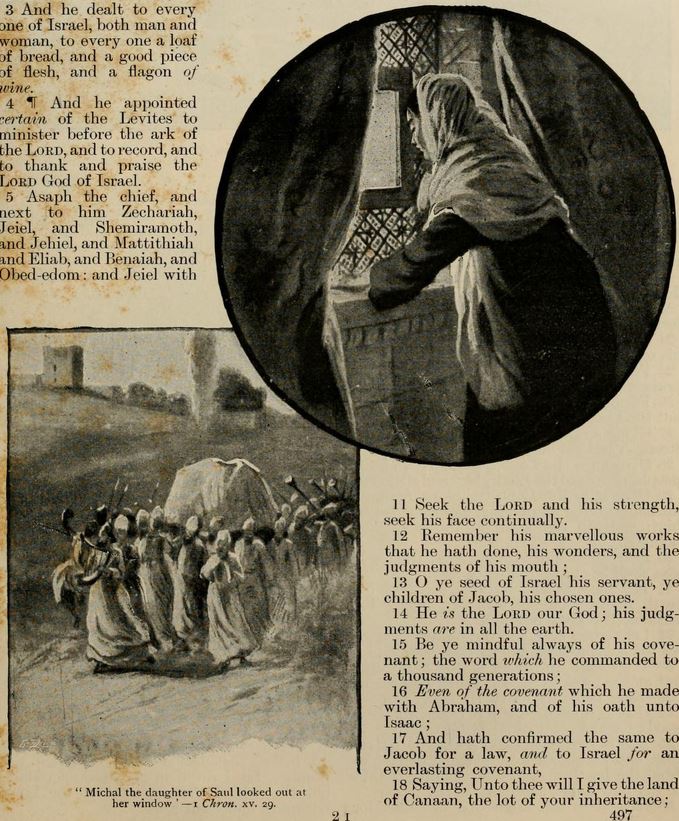
* The illustration is from the Art Bible, 1896, comprising the Old and New Testaments, with numerous illustrations. Publisher, London: G. Newnes. 1 Chronicles 15:29 is cited.
>7. What was the real reason for Michal's contempt for David? (29, 2 Samuel 6:16) What was her pretended reason? (2 Samuel 6:20) What was the outcome? (2 Samuel 6:23)
* 1 Chronicles 15:29 "As the ark of the covenant of the LORD was entering the City of David, Michal daughter of Saul watched from a window. And when she saw King David dancing and celebrating, she despised him in her heart."
* 2 Samuel 6:20-23 records more of Michal, Saul's daughter and David's first wife' response to David's conduct during the Ark moving through Jerusalem.
* "Michal daughter of Saul" -When they were young, after David killed Goliath and David was invited to live in King Saul's household as his private musician, David fell in love with her. Saul used this and used it to have David kill many Philistines in the hopes of David being killed. Saul said he would give the man who did what he requested her hand in marriage. David did and they were married. When Saul tried to kill David, she did not leave with David. She lied to her father and deceived him by putter her idol in her bed pretending it was David, to buy David some time to get away. Many years later, when David was king, she was brought back to David. She had not changed, but grew worse.
* "watched from a window" -She did not join the procession. She must have not been a believer. I cannot see why she would not have been allowed since she was a queen.
* "she despised him in her heart" -2 Samuel records she complained about his disrobing. Silly because, as stated here, David was wearing the same distinguished rob and linen ephod as the rest of the procession. She taught the king should be the best dressed. 2 Samuel and here point out she was really just despising his leaping and dancing before the Lord.
* Often people disguise their feeling for us behind a rude false insult.
III. David's and the People's Joy (16:1-43)
>8. Where did the ark of God set in Jerusalem? (16:1) What did David do? (2-4) What were the priests to do? What can be learned about communion with God?
* 1 Chronicles 16:1-6 "They brought the ark of God and set it inside the tent that David had pitched for it, and they presented burnt offerings and fellowship offerings before God.
After David had finished sacrificing the burnt offerings and fellowship offerings, he blessed the people in the name of the LORD.
Then he gave a loaf of bread, a cake of dates and a cake of raisins to each Israelite man and woman.
He appointed some of the Levites to minister before the ark of the LORD, to make petition, to give thanks, and to praise the LORD, the God of Israel:
Asaph was the chief, Zechariah second, then Jeiel, Shemiramoth, Jehiel, Mattithiah, Eliab, Benaiah, Obed-Edom and Jeiel. They were to play the lyres and harps, Asaph was to sound the cymbals,
and Benaiah and Jahaziel the priests were to blow the trumpets regularly before the ark of the covenant of God."
* Psalm 132 is a good reference to this passage.
* This is a continuation the bringing the ark in the previous chapter.
* David is further associated with the priests in his supervision of the sacrifices and his exercising the priestly prerogative of blessing the people (Numbers 6:22-27)
* "they presented burnt offerings and fellowship offerings before God... Then he gave a loaf of bread, a cake of dates and a cake of raisins to each Israelite man and woman." -The baked goods provided by David were for the sacrificial meal following the fellowship offerings. (Leviticus 3:1-17, 7:1-21, 28-36)
*
Fellowship Offerings.
Bringing the Ark of God to Jerusalem was not a matter of sitting it down and walking away. First, they presented burnt offerings and fellowship offerings before God.
A burnt offering was for sin. It was a somber occasion. The one bringing the offering was to lay a hand upon the animal so as to identify that the animal was taking the person's place and then to kill it. The one who made this sacrifice did so to restore the relationship with God and to atone for some sin. Burnt offerings were made often.
A fellowship offering (peace offering) showed one's desire to have fellowship with God. It was a celebration. As with the burnt offering, the individual laid a hand on the animal and killed it. The priest received the breast and the right thigh (Lev. 7:28-36), but the the one who offered was given much of the meat to have a meal of celebration. Various types of bread were offered and kept by the priest(s).
Jesus is the ultimate burnt and fellowship offering. (Heb. 7:27) He willingly laid down his life in place of animals. Like a burnt offering he is my offering for sin. Like a fellowship offering, he is my access to peace with God and the peace of God. The Lord's Supper is a remembrance of Jesus' sacrifice laid down for me. (Matt. 26:26-29)
Second, David ensured that the people had food to eat on their journey back home (3). David took this from his own wealth. A good host ensured his guests are taken care of.
Lastly, David appointed priests to minister before the Ark of the Lord every day. They were to pray, give thanks, and praise the Lord (4). My relationship with Jesus is an ongoing effort on my part. I am to apply effort, time, and heart to daily commune with the Lord. I can sing and play instruments (5). I can set up reminders to minister before the Lord. This is why the priests blew trumpets (6), this is why churches use to ring bells. I can set up reminders in my house, in my car, at my place of employment.
Listen to the above comments 16:1-6
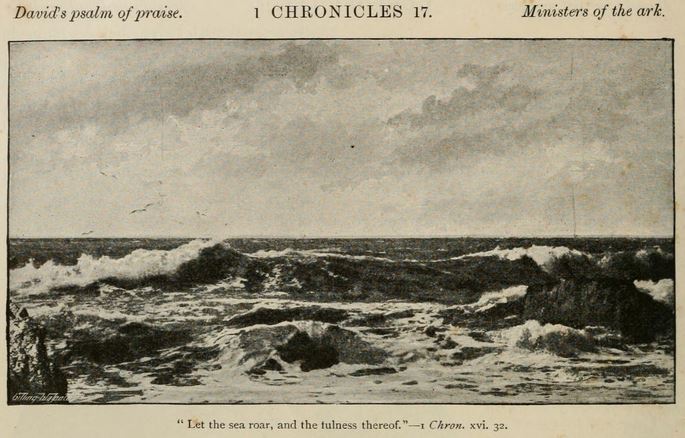
* The illustration is from the Art Bible, 1896, comprising the Old and New Testaments, with numerous illustrations. Publisher, London: G. Newnes. The title in the upper left hand corner is "David's Psalm of Praise". The title in the upper right hand corner is "Ministers of the Ark". 1 Chronicles 16:32 is cited.
>9. Review David's psalm. (7-36) What topics does it cover? How is the Lord revealed? How is the Lord's relationship with Israel revealed?
* 1 Chronicles 16:7-36 "That day David first committed to Asaph and his associates this psalm of thanks to the LORD:
Give thanks to the LORD, call on his name; make known among the nations what he has done.
Sing to him, sing praise to him; tell of all his wonderful acts.
Glory in his holy name; let the hearts of those who seek the LORD rejoice.
Look to the LORD and his strength; seek his face always.
Remember the wonders he has done, his miracles, and the judgments he pronounced,
O descendants of Israel his servant, O sons of Jacob, his chosen ones.
He is the LORD our God; his judgments are in all the earth.
He remembers his covenant forever, the word he commanded, for a thousand generations,
the covenant he made with Abraham, the oath he swore to Isaac.
He confirmed it to Jacob as a decree, to Israel as an everlasting covenant:
"To you I will give the land of Canaan as the portion you will inherit."
When they were but few in number, few indeed, and strangers in it,
they wandered from nation to nation, from one kingdom to another.
He allowed no man to oppress them; for their sake he rebuked kings:
"Do not touch my anointed ones; do my prophets no harm."
Sing to the LORD, all the earth; proclaim his salvation day after day.
Declare his glory among the nations, his marvelous deeds among all peoples.
For great is the LORD and most worthy of praise; he is to be feared above all gods.
For all the gods of the nations are idols, but the LORD made the heavens.
Splendor and majesty are before him; strength and joy in his dwelling place.
Ascribe to the LORD, O families of nations, ascribe to the LORD glory and strength,
ascribe to the LORD the glory due his name. Bring an offering and come before him; worship the LORD in the splendor of his holiness.
Tremble before him, all the earth! The world is firmly established; it cannot be moved.
Let the heavens rejoice, let the earth be glad; let them say among the nations, "The LORD reigns!"
Let the sea resound, and all that is in it; let the fields be jubilant, and everything in them!
Then the trees of the forest will sing, they will sing for joy before the LORD, for he comes to judge the earth.
Give thanks to the LORD, for he is good; his love endures forever.
Cry out, "Save us, O God our Savior; gather us and deliver us from the nations, that we may give thanks to your holy name, that we may glory in your praise."
Praise be to the LORD, the God of Israel, from everlasting to everlasting. Then all the people said "Amen" and "Praise the LORD." (7-23)
* Reference Psalm 105:1-15 for verses 8-22, Psalm 96 for verses 23-33, and Psalm 106:1, 47-78 for verses 34-36. The psalm is similar to various parts of the book of Psalms (i.e. 8-22 is Psalm 105:1-15, 22-33 is Psalm 96, 34-36 is Psalm 106:1, 47-48)
* The book of Samuel does not include this psalm of David.
* The use of the lengthy historical portion from Psalm 105 emphasizing the promises to Abraham would be particularly relevant to the Chronicler's postexilic audience, for whom the faithfulness of God was a fresh reality in their return to the land. The citation from Psalm 106 would also be of immediate relevance to the author(s) audience as those who had been gathered and delivered from the nations (35).
* Verse 15. Some Septuagint manuscripts; Hebrew "remember".
*
David's Psalm of Thanks, Part 1, 7-22.
David starts his psalm with a set of commands - give thanks, call, make known, sing praise, tell, glory in, seek, rejoice, look to, remember - all concerning the Lord. I need to set aside time to do just this. Sunday worship service in physical presence with other believers, such as was done when the temple was dedicated. I also should keep setting aside time in the morning to read and write Bible Daily Bread Devotionals on his word and then meditate.
The Lord God's judgments are in all the earth (14). Judgments here can also be translated as manner, cause, and ordinance. As I meditate the Spirit can remind me of the Lord's manner in my life for the last 24 hours. The Lord can remind me and have me ponder what he was doing in and around me. Perhaps there was something I missed, forgot, or understood incorrectly.
The Israelites were reminded of the forever covenant the Lord made with Abraham, Isaac, and Jacob (15-17). The Lord God kept his promise. They had inherited the land of Canaan (18).
When the Lord decreed to promise it seemed a far-fetched fantasy. They were a few outliners (19). They had no home (20). Yet, they believed God. They had incessant belief. The Lord protected Abraham, Isaac, Jacob, and his sons.
What plans does he have for me? Worship him and think about his promises to me in the morning, in the early morning. Pray to him with my love before I end the day.
Listen to the above comments 16:7-22
* "splendor of his holiness" -Psalm 29:2.
*
David's Psalm of Thanks, Part 2, 23-36.
David continues his psalm during the first celebration with the Ark of the Lord in Jerusalem.
The glory and majesty of the Lord Jesus and his Father are declared in all the earth (23, 30, 31, 32, 33). The earth trembles before him, the heavens rejoice, the sea resounds, the fields jubilate, and the trees and forest sing. Lord, open my eyes to see the world you made declare your praise (24).
Jesus is coming to judge the earth (33). For some, there will be salvation (23, 35). They are the ones who joined all creation in declaring the glory and majesty of the Lord (34, 35). They gave thanks to the Lord, for he is good; his eternal love they accepted (34).
For others, there will be wrath and anger. They are the ones who others needed to be saved from (35). They did not declare the glory and majesty of God, though they knew the heavens and the earth declared his majesty. They are the ones who rejected the Lord's salvation and love. The Lord God is to be feared (25).
As I begin this day, my soul is trying to decide which attitude to bring throughout the day: sink into bitterness and a disgruntled spirit, or be raised to praise and joy. With His word as the life to anchor my soul, I choose to join all the heavens and earth and declare his glory among the nations (23).
Listen to the above comments 16:23-36
>10. What were to responsibilities of the Levites and priests? (37-43) What is the difference between the tabernacle and the temporary structure for the ark? (39)
* 1 Chronicles 16:37-43 "David left Asaph and his associates before the ark of the covenant of the LORD to minister there regularly, according to each day's requirements.
He also left Obed-Edom and his sixty-eight associates to minister with them. Obed-Edom son of Jeduthun, and also Hosah, were gatekeepers.
David left Zadok the priest and his fellow priests before the tabernacle of the LORD at the high place in Gibeon
to present burnt offerings to the LORD on the altar of burnt offering regularly, morning and evening, in accordance with everything written in the Law of the LORD, which he had given Israel.
With them were Heman and Jeduthun and the rest of those chosen and designated by name to give thanks to the LORD, "for his love endures forever."
Heman and Jeduthun were responsible for the sounding of the trumpets and cymbals and for the playing of the other instruments for sacred song. The sons of Jeduthun were stationed at the gate.
Then all the people left, each for his own home, and David returned home to bless his family."
* tabernacle... in Gibeon" -The tabernacle remained at Gibeon until Solomon's construction of the temple in Jerusalem (2 Chronicles 1:13, 5:5), when it was stored within the temple. The existence of these two shrines -the tabernacle and the temporary structure for the ark in Jerusalem (1) -accounts for the two high priests: Zodok serving in Gibeon and Abiathar in Jerusalem (18:16, 27:34).
*
Two Places of Worship Until the Temple was Built.
The Lord God thru Moses required the Israelites to establish a place for them to approach him physically and offer sacrifice. He had the ark built and a tent to place the ark in. The Lord thru Moses also established specific people, the men of the Levite tribe to perform the sacrifices and keep up the place where the Israelites were to meet.
David chose one Levite, Asaph to be the high priest (37). He served at the Ark of the Lord in Jerusalem. The high priest lead the other priest and performed a few important specific annual offerings. David also chose others to work with Asaph (38).
David also chose Zadok the priest to serve at the tabernacle at Mount Gibeon not far from Jerusalem until Solomon, David's son finished the temple in Jerusalem (39-41). The tabernacle of the Lord was a tent where the Israelites were to meet with the Lord.
The work of the Lord is important "for his love endures forever" (42). A daily time to thank God for his enduring love for me is right and good. For me, it is in the morning writing Bible Daily Bread Devotionals. Having a routine and being organized makes doing so easier and more peaceful. Working with others weekly on special occasions like Sundays and other special days is also important.