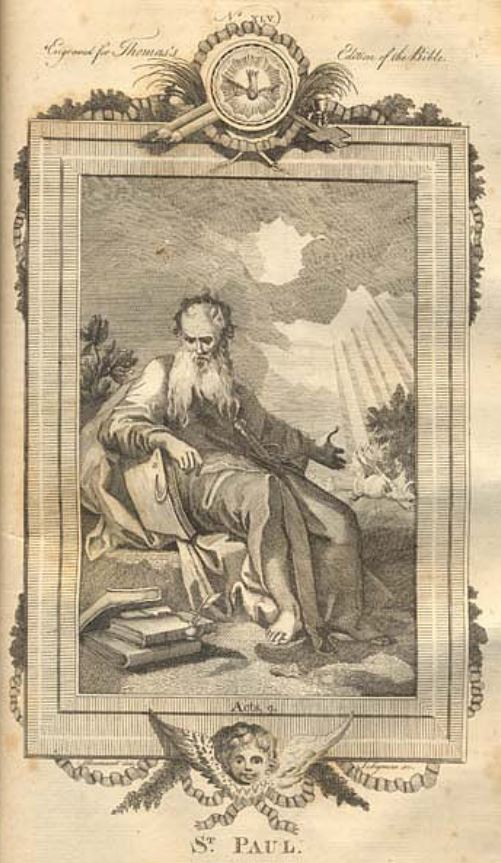
* The illustration is from the famous Isaiah Thomas Bible. It was the first illustrated Bible printed in America. It was published in 1791 in Worcester, Massachusetts.
>1. Who is the sender of this letter? (1, 10:1)
* 2 Corinthians 1:1 "Paul, an apostle of Christ Jesus by the will of God, and Timothy our brother, To the church of God in Corinth, together with all the saints throughout Achaia:"
* 2 Corinthians 10:1 "By the meekness and gentleness of Christ, I appeal to you--I, Paul, who am "timid" when face to face with you, but "bold" when away!"
*
Chapter 1 Overview.
Paul wrote this letter to the young congregation at Corinth shortly after the previous one. He wrote it as he neared the end of his third missionary journey in the very late 55 AD while residing in the Roman province of Macedonia. Paul wanted to visit Corinth to the south again, but had not done so, and thus explained and apologized for his delays.
Verses 21 and 22 are moving. God makes me "stand firm in Christ. He anointed (me), set his seal of ownership on (me), and put his Spirit in (my) heart as a deposit, guaranteeing what is to come." God's grace is wonderful and precious.
I am not the one who does any of this. God does it all. I am weak in faith and my actions prove it. Yet God in his grace makes me stand firm in Christ.
When I accepted Jesus as my personal Savior and asked him to take full control of my life God anointed me with the Holy Spirit. The Spirit entered me. It was something entirely new to me. It was pleasant, loving, powerful, and warm. I was anointed.
Seals of ownership are used to this day. A rancher's seal of ownership is called a brand. He or she puts the brand on a metal plate. The plate is heated and pressed against the steer hide. This burns the brand on the steer. The brand is a claim of ownership.
God burned his brand on my hide. This is what happened when I first believed. God branded me with the Holy Spirit. Now when the Holy Spirit moves in my spirit just as he did the day I first believed, I know that I am his and he is mine. I feel his guarantee of what is to come. These movements are small in comparison to what is to come. With them, I am encouraged to continue in troubles and hardship just as Paul did.
Listen to the above Chapter 1 Overview.
* "Paul" -Paul persecuted the church until Jesus called him to service for God (35 A.D.) two decades before this letter was written (55 A.D.), five years after Pentecost (30 A.D.). During his third missionary trip Paul stayed in Ephesus over two years (53-55 A.D.) using it as a missionary base for the rest of Asia minor and eastern Europe, including Corinth. (Acts 19:10) Ephesus was the capital of the area. Paul wrote this letter while in Macedonia. Paul ended his third missionary journey by going to Jerusalem with a gift from the mostly Gentile churches including Corinth. Paul was arrested and taken prisoner in Jerusalem. He would be sent Rome which took several years (Acts 23:23-26:32). During that time Paul was in house arrest. See the Introduction for more background information by using the link at the top of the page.
The name that Paul's parents gave him was Saul. Since he was from the tribe of Benjamin it can be assumed that he was named after the first king of Israel, Saul who was also a Benjamite. (1 Sam. 9:1-2) Paul's parents had high expectations for their son naming him such and Paul did all he could not to let his parents down as he himself testified, "though I myself have reasons for such confidence. If anyone else thinks he has reasons to put confidence in the flesh, I have more: circumcised on the eighth day, of the people of Israel, of the tribe of Benjamin, a Hebrew of Hebrews; in regard to the law, a Pharisee; as for zeal, persecuting the church; as for legalistic righteousness, faultless." (Phil. 3:4-6) However, after he meet Jesus he changed his name to Saul, which means little.
* Apostle Paul, through his letters and influence to Luke's Gospel, contributed more writings to the New Testament than any other.
>How does he identify himself?
* "an apostle of Christ Jesus" -Apostle means sent. Jesus sent Paul. Paul was called and sent by Jesus while he was traveling from Jerusalem to Damascus with signed orders from the Jewish religious establishment to arrest anyone who confessed the name of Jesus as the Messiah. (Acts 9:4, 15)
* Paul wrote more about his past in his letter to the Galatians 1:13-24.
* "Christ Jesus" -Stated as "Christ Jesus" once and "Jesus Christ" three times in the first nineteen verses (1, 2, 3, 19). "Christ" is English for the Greek, "Christos" (a transliteration), for the equivalent Hebrew "Messiah", all meaning "anointed". "Jesus" is English for similar Latin and Greek words for the Hebrew "Yeshua" (some say "Joshua"), a shorter name for the much older "Yehoshua" (a transliteration). See comments in question 3a for more information.
* How we see our identity is important. We should see our identity first and foremost in the eyes of God. Paul identified himself by his appointed place and occupation. Adam saw himself as a son of God appointed to work a garden. So, this is right. We should say, "I am (_) in Christ, appointed as (_) in Christ."
>Why has he been appointed this?
* "by the will of God" -Everyone who every became and ever will put faith in Jesus does so by the will of God.
* "God" -"God" in the original Greek is "Theos" (a transliteration), a noun, referring to any deity, as in the Greek Pantheon (i.e. the Twelve Olympians), and especially the Supreme Divinity as found in the Bible.
* Paul did not want it.
* The church did not expect it.
* His parents, neighbors, and friends would have been shocked.
* God, full of grace planned it from the creation of the world.
* So is the same for all of us.
>Who was with him? (Acts 18:1-5; and 2 Cor. 1:19; and 1 Cor. 1:1, 4:17, 16:10-11)
* Acts 18:1-5 "After this, Paul left Athens and went to Corinth. There he met a Jew named Aquila, a native of Pontus, who had recently come from Italy with his wife Priscilla, because Claudius had ordered all the Jews to leave Rome. Paul went to see them, and because he was a tentmaker as they were, he stayed and worked with them. Every Sabbath he reasoned in the synagogue, trying to persuade Jews and Greeks. When Silas and Timothy came from Macedonia, Paul devoted himself exclusively to preaching, testifying to the Jews that Jesus was the Christ."
* 2 Corinthians 1:19 "For the Son of God, Jesus Christ, who was preached among you by me and Silas and Timothy, was not "Yes" and "No," but in him it has always been "Yes."
* 1 Corinthians 1:1 "Paul, called to be an apostle of Christ Jesus by the will of God, and our brother Sosthenes,"
* 1 Corinthians 4:17 "For this reason I am sending to you Timothy, my son whom I love, who is faithful in the Lord. He will remind you of my way of life in Christ Jesus, which agrees with what I teach everywhere in every church."
* 1 Corinthians 16:10-11 "If Timothy comes, see to it that he has nothing to fear while he is with you, for he is carrying on the work of the Lord, just as I am. No one, then, should refuse to accept him. Send him on his way in peace so that he may return to me. I am expecting him along with the brothers."
* "Timothy" -Timothy was similar to Paul. Paul was also half Jew by his mother. Perhaps Paul saw in Timothy a younger version of himself. Timothy would be Paul's companion, scribe, and aid for a long time.
Timothy was from Derbe and Lystra located in the Roman province Cilicia, the same region Paul was from.
Timothy's mother was a Jew. His father a Greek and perhaps not influential in his life, thus making Timothy timid in nature meaning he lacked confidence in his ability to carry out the mission given him. He was well spoke of and underwent circumcision for ministry purposes even though he knew he didn't need to. He went with Paul on mission journeys. Paul considered him a son of faith. He was gifted for ministry though young and thus some considered him inexperienced. He took interest in other's welfare. He became the pastor (Latin for shepherd) for the congregation in Ephesus. He stood up against false doctrine being taught there, having the gift of discernment. He remained loyal to Paul, and the gospel he preached to the end of Paul's life. He was sincere, easily discouraged, sentimental, powerful, emotional, and leadership quality.
Timothy was a third generation Christian. His grandmother and mother were probably converted on Paul's first missionary journey. Timothy would have been a young lad then. Timothy joined Paul for the first time on Paul's second missionary journey.
Timothy had joined Paul on his second missionary journey. He had stayed in Corinth during Paul's third missionary trip. (Acts 18:5) Timothy was in Ephesus with Paul for perhaps two years. Then, when Paul was lead to collect an offering for the poor in Jerusalem, Paul sent Timothy ahead of him to Macedonia in company with Erastus (Acts 19:21-22) intending himself to follow them, and expecting that they would visit Achaia, including Athens and Corinth. Timothy was with Paul when he was arrested in Jerusalem, though he was not arrested. Timothy followed Paul to Rome and was probably the scribe who wrote some of Paul's letter as Paul dictated them while in prison and/or house arrest.
* "our brother" -Apostle Paul called the congregation brothers many times in the first letter.
* Paul wrote to Timothy, "I have been reminded of your sincere faith, which first lived in your grandmother Lois and in your mother Eunice and, I am persuaded, now lives in you also." (2 Tim. 1:5)
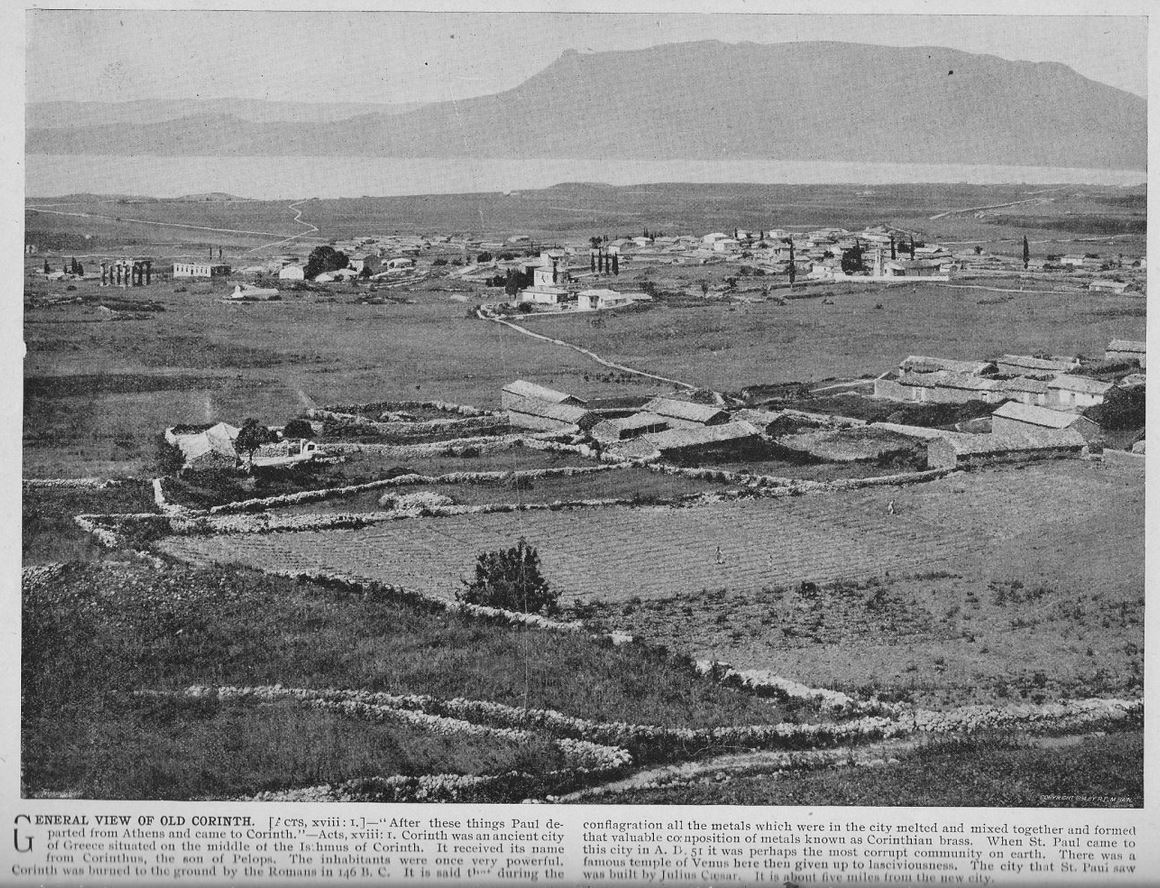
* The general photo of Corinth is from The New Testament: Illustrated and Explained. Published in 1895 by the N.D. Thompson Publishing Company. It is a highly regarded antique edition notable for pairing the biblical text with over 100 historical photographs of actual locations described throughout the scriptures.
The photos were captured by Robert E.M. Bain, the images feature scenes from major biblical events and locations, including Bethlehem, Nazareth, Jerusalem, the Jordan River, Damascus, Ephesus, and Athens. It includes extensive notes and explanations by Drs. John Brown and Josiah Porter, along with descriptive text for the photographs written by the Rev. James W. Lee. The creators intended the visuals to "make the actual earthly existence of Christ very real indeed" by grounding the parables and teachings in the physical reality of the region.
>2. Which congregation is the recipient?
* "To the church of God in Corinth" -See map of first-century Corinth in question 8 comments at the bottom of this study.
When Paul, a tent maker by trade, first arrived in Corinth he meet two Jews who were tent makers. When Paul was not working as a tent maker, he preached in the synagogue concerning Jesus, the Messiah and Son of God. Through this, God used Paul to call from among the Corinthians a congregation of faithful believers in Jesus. The symagogue ruins have been discovered and investigated by archaeologists. When those who believed in Jesus were forced out of the Jewish synagogue they probably meet in someone's house, or rented a meeting hall. Constructing a building would have been unwise because of periodic persecutions in the first through third centuries.
* 1 Corinthians 2:1 "When I came to you, brothers, I did not come with eloquence or superior wisdom as I proclaimed to you the testimony about God."
* Acts 18:1-5 "After this, Paul left Athens and went to Corinth. There he met a Jew named Aquila, a native of Pontus, who had recently come from Italy with his wife Priscilla, because Claudius had ordered all the Jews to leave Rome. Paul went to see them, and because he was a tentmaker as they were, he stayed and worked with them. Every Sabbath he reasoned in the synagogue, trying to persuade Jews and Greeks. When Silas and Timothy came from Macedonia, Paul devoted himself exclusively to preaching, testifying to the Jews that Jesus was the Christ."
* Acts 18:11 "So Paul stayed for a year and a half, teaching them the word of God."
* "Corinth" -Corinth, Greece (the inhabitants of which are called Corinthians) was an eminent city of Achaia, (later called the Morea, and now called Peloponnese) and was situated on an isthmus, or neck of land, between the Agean and Ionian Seas; so was very convenient for merchandise, and by merchandise came to great riches, which gave them great temptations to luxury, drunkenness, and prostitution via idolatry. Corinthians were very infamous for the latter, and grown to that impudence, that they made the increase of harlots a part of their prayers to their idols, and made the bringing of harlots into the city a part of their vows. Lais was a harlot among them, very famous in civil history. And as pride usually attended wealth, so they also were a people very proud. They were also anciently famous for pagan learning, and had among them Stoics and Epicureans, who laughed at the resurrection of the body, and looked upon incest, adultery, and fornication, as very venial things, if at all unlawful. (Matthew Poole, Annotations upon the Holy Bible, vol. 3 (New York: Robert Carter and Brothers, 1853), 538.)
>How are they identified?
* "the church of God" -Used only by Paul and only in Acts 20:28, here, and 1 Corinthians 1:2. Its Old Testament counterpart is the expression "assembly (or community) of the Lord" (Deuteronomy 23:1; Numbers 16:3, 20:4; 1 Chronicles 28:8).
>What does "church" mean?
* "church" -The Greek noun "ekklesia" (a transliteration), translated "church" and "assembly" in most English Bibles, is better translated "congregation" because of many modern definitions for church. "Ekklesia" is from the root preposition "ek" meaning "out of" and the verb "kaleo" meaning "called" as in a command.
* "To the church of God in Corinth" -The community of believers in Jesus in Corinth, in communion with God, were the local representatives of the universal church that exist throughout the ages in many locations.
When Paul, a tent maker by trade, first arrived in Corinth he meet two Jews who were tent makers. When Paul was not working as a tent maker, he preached in the synagogue concerning Jesus, the Messiah and Son of God. Through this, God used Paul to call from among the Corinthians a congregation of faithful believers in Jesus. The symagogue ruins have been discovered and investigated by archaeologists. When those who believed in Jesus were forced out of the Jewish synagogue they probably meet in someone's house, or rented a meeting hall. Constructing a building would have been unwise because of periodic persecutions in the first through third centuries.
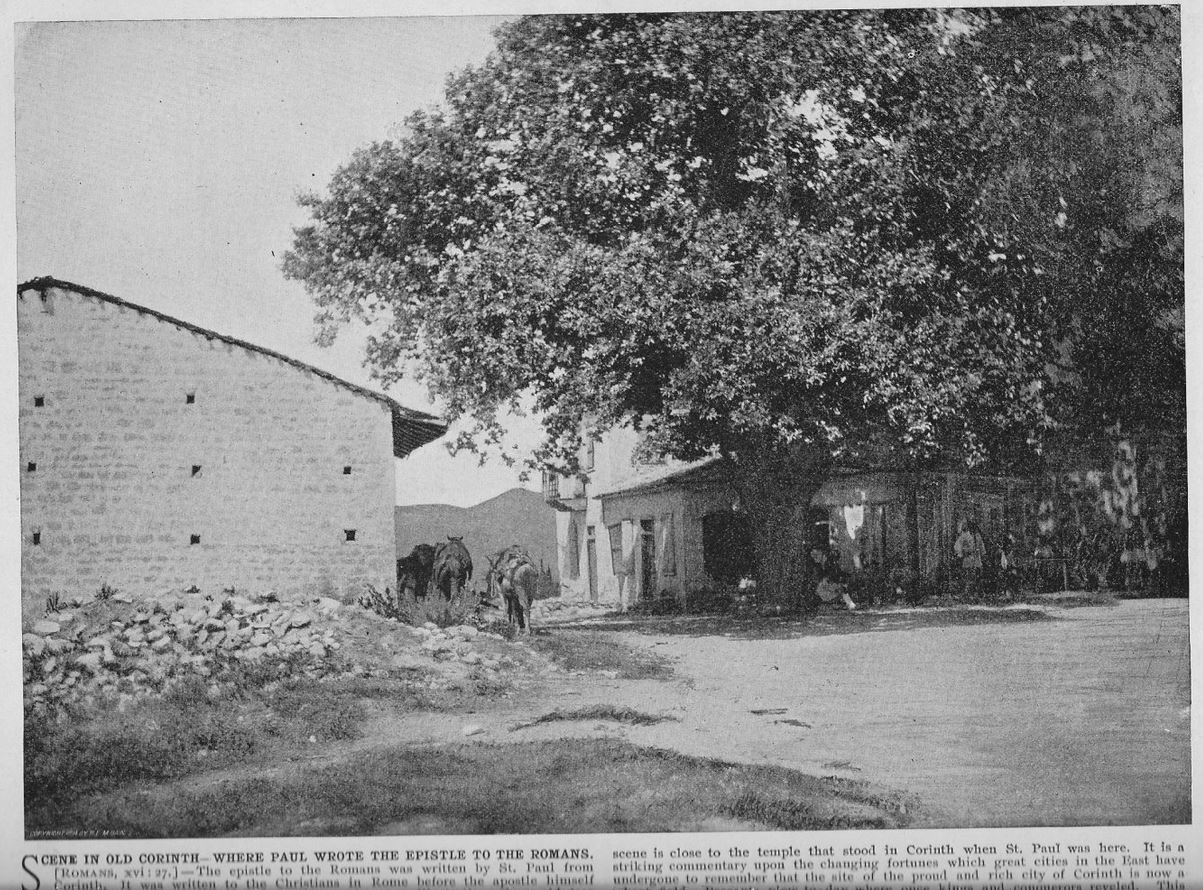
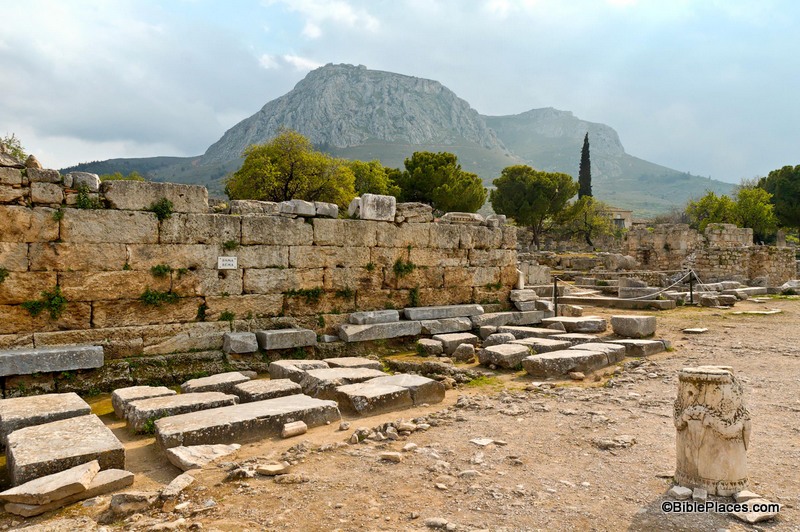
* The photo of Corinth is from The New Testament: Illustrated and Explained. Published in 1895 by the N.D. Thompson Publishing Company. It is a highly regarded antique edition notable for pairing the biblical text with over 100 historical photographs of actual locations described throughout the scriptures.
The photos were captured by Robert E.M. Bain, the images feature scenes from major biblical events and locations, including Bethlehem, Nazareth, Jerusalem, the Jordan River, Damascus, Ephesus, and Athens. It includes extensive notes and explanations by Drs. John Brown and Josiah Porter, along with descriptive text for the photographs written by the Rev. James W. Lee. The creators intended the visuals to "make the actual earthly existence of Christ very real indeed" by grounding the parables and teachings in the physical reality of the region.
>Who else is this addressed to?
* "together with all the saints throughout Achaia" -The letter is not just for the Corinth congregation. Either this letter was circulated throughout Achaia where copies would have been made, or most likely, copies would have been made in Corinth and delivered to other locations like Athens. A congregation also existed in Cenchrea, the eastern port of Corinth. (Romans 16:1) Others must have existed in the region.
* "all the saints" -The original Greek adjective for "saints" is "hagios" (a transliteration) from "hagos" (a transliteration). "Hagios" meaning conveys "sacred" (physical pure, moral blameless or religious, ceremony consecrated). It is more commonly translated "holy".
"Saints" is another term for God's people, meaning "those who have been set apart as holy to the Lord." (Romans 1:7) The basic idea of the Greek for this word is "holiness." All Christians are saints in that they are positionally "set apart" to God and are experientially being made increasingly "holy" by the Holy Spirit.
* "throughout Achaia" -Achaia was the Roman province comprising all the territory of modern Greece, south of the Roman province of Macedonia, where Paul was located when he wrote 2 Corinthians. Athens and Corinth are in Greece. Athens and the Aegean Sea were between Corinth and Ephesus, where Paul had sent his letters to gather together a collection for the poor in Jerusalem. The letter to and from Corinth from Ephesus may have come via Athens if the letters traveled by boat.
In the first century AD, Corinth was significantly more prosperous and commercially active than Athens. While Athens remained the cultural and intellectual capital of Greece, Corinth served as the wealthy administrative capital of the Roman province of Achaia. See map link at the top.
>3. What is the true source of grace and peace mean? (2)
* 2 Corinthians 1:2 "Grace and peace to you from God our Father and the Lord Jesus Christ."
* "Grace and peace to you" -"Grace" adapts a standard Greek greeting (John 4:2; Galatians 1:3; Ephesians 1:2), and "peace" a Jewish one (John 14:27, 20:19; Galatians 1:3; Ephesians 1:2). By pairing Jesus with the Father as the source of grace and peace in a wish-prayer (wish-prayers for the hearers were common in letter openings), Paul declares Jesus' divinity. (Craig S. Keener, The IVP Bible Background Commentary: New Testament (Downers Grove, IL: InterVarsity Press, 1993, 1 Co 1:3.)
* "from God our Father" -"God" in the original Greek is "Theos" (a transliteration), a noun, referring to any deity, as in the Greek Pantheon (i.e. the Twelve Olympians), and especially the Supreme Divinity as found in the Bible. The preposition "from" in the original Greek is "apo". The pronoun "our" in the original Greek is "hemon". The noun "Father" in the original Greek is "pater". All four words are very common words meaning exactly how they are translated in all English Bibles, "from God our Father".
* "Lord Jesus Christ" -Paul, in verses 1 and 2, uses the title "Jesus Christ" from the Greek "Iesous Christos" (and vice versa). (See comments in question 1b.) Here, Paul uses the phrase "Lord Jesus Christ" from "Kyrios Iesous Christos".
Greek culture traditionally did not believe any of their pantheon of gods were lords, let alone a Supreme Lord. They believed their gods were subject to fate just as humans were. Greeks did not worship a god as Christians and Jews do. Rather, they believed their gods had powers and abilities that humans do not have, but none of them were the creator of the cosmos (universe). The Greeks attempted to win the favor of one of their gods to convince that god to grant them a gift and/or favor with their unique power, not much different from the comic book group of heroes today. Which god they sought favor from depended on the special power the god had.
Christianity teaches the truth through the Holy Spirit. A Supreme God exists for eternity and beyond, God the Father. He has an eternal Son who is Lord of all, creator of all, including all humans. Jesus is the name God the Father, through the Spirit, gave to him when he came to the earth in the form of a human to redeem His people from sin and death. Through grace, not merit, Lord Jesus Christ, and God the Father give peace of soul.
*
God the Father and our Lord Jesus Christ.
Greeks' traditional pagan religion did not see its gods as their fathers. When a Greek became a Christian, they accepted that the One and Only Supreme God was their Father.
The pronoun "from" which is applied to "God our Father" is also implied to be with "our Lord Jesus Christ", so that it would also read, "from our Lord Jesus Christ". Grace and peace come from God the Father and our Lord Jesus Christ. The grace and peace I receive through the Holy Spirit is a gift of the Father and Son.
Paul, in verses 1 and 2, uses the title "Jesus Christ" from the Greek "Iesous Christos" (and vice versa). (See comments in question 1b.) Here, Paul uses the phrase "Lord Jesus Christ" from "Kyrios Iesous Christos".
Greek culture traditionally did not believe any of their pantheon of gods were lords, let alone a Supreme Lord. They believed their gods were subject to fate just as humans were. Greeks did not worship a god as Christians and Jews do. Rather, they believed their gods had powers and abilities that humans do not have, but none of them were the creator of the cosmos (universe). The Greeks attempted to win the favor of one of their gods to convince that god to grant them a gift and/or favor with their unique power, not much different from the comic book group of heroes today. Which god they sought favor from depended on the special power the god had.
Christianity teaches the truth through the Holy Spirit. A Supreme God exists for eternity and beyond, God the Father. He has an eternal Son who is Lord of all, creator of all, including all humans. Jesus is the name God the Father, through the Spirit, gave to him when he came to the earth in the form of a human to redeem His people from sin and death. Through grace, not merit, Lord Jesus Christ, and God the Father give peace of soul.
Listen to the above comments on 2 Corinthians 1:2.
>How can we receive them? (John 1:14-18, 16:23-24)
* John 1:14-18 "The Word became flesh and made his dwelling among us. We have seen his glory, the glory of the One and Only, who came from the Father, full of grace and truth. John testifies concerning him. He cries out, saying, 'This was he of whom I said, 'He who comes after me has surpassed me because he was before me.'' From the fullness of his grace we have all received one blessing after another. For the law was given through Moses; grace and truth came through Jesus Christ. No one has ever seen God, but God the One and Only, who is at the Father's side, has made him known."
* John 16:23-24 "In that day you will no longer ask me anything. I tell you the truth, my Father will give you whatever you ask in my name. Until now you have not asked for anything in my name. Ask and you will receive, and your joy will be complete."
II. The God of All Comfort (1:3-11)
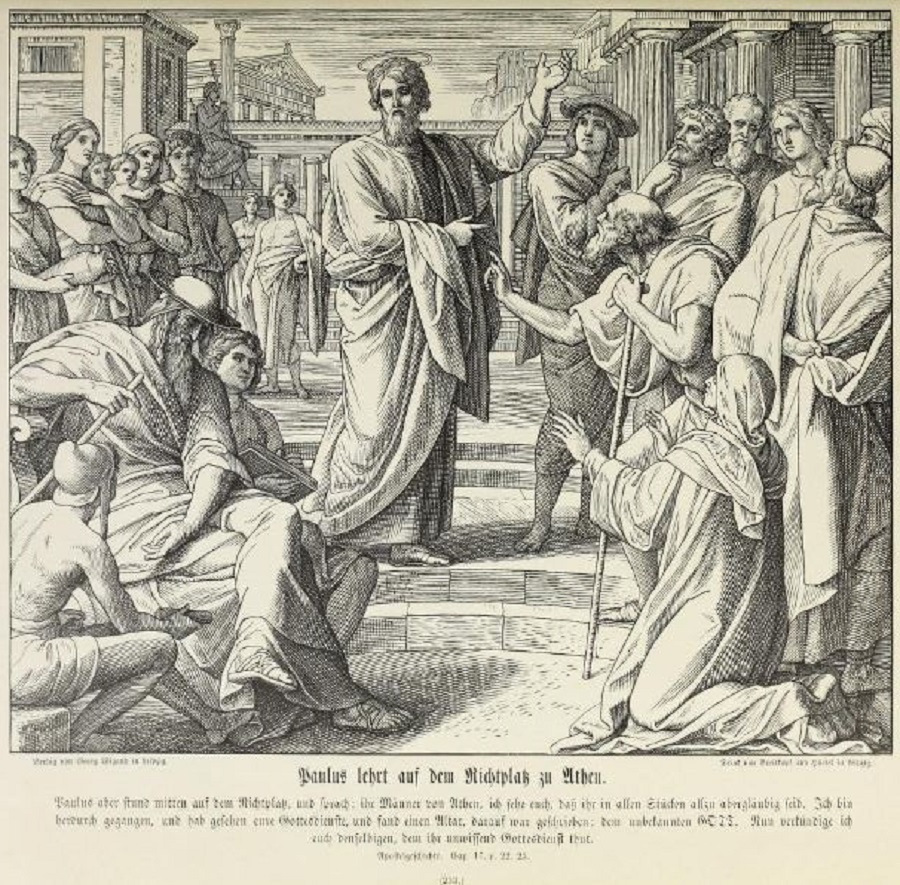
* The illustration is from "Die Bibel in Bildern" (The Bible in Pictures), a legendary 19th-century visual masterpiece featuring 240 exquisite woodcut engravings. It was created by the prominent German Nazarene artist Julius Schnorr von Carolsfeld, with accompanying text and explanations written by Heinrich Merz. Published initially between 1851 and 1860, this book became one of the most widely distributed and influential collections of biblical illustrations in history.
This illustration depicts Acts 17:22-23, Paul preaching in Athens just before he went to Corinth. Epicurean and Soic philosophers disputed with Paul as he preached the good news about Jesus and the resurrection. They took him and brought him to a meeting of the Areopagus and ask him to speak more about his new teaching.
>4. To whom does Paul give praise? (3)
* 2 Corinthians 1:3 "Praise be to the God and Father of our Lord Jesus Christ, the Father of compassion and the God of all comfort,"
* "Praise" -The KJV, ASV, YLT, and CSB have blessed. All other translations that I have, the newer ones, translate the Greek adjective "eulogetos" (a transliteration) as "praise". "Eulogetos", used eight times in the New Testament, is from the Greek verb "eulogeo", a compound word from "eu" and "logos" meaning "to speak well of, to bless (religiously)".
* "Praise be to the God and Father of our Lord Jesus Christ" -Paul just stated grace and peace to the congregation. Grace and peace goes out to the congregation. Now praise comes the object of the grace and peace to the source of the grace and peace. The adoration is a two way channel.
* The praise phrase is in other greetings. (Ephesians 1:3, 1 Peter 1:3)
* "the God and Father of our Lord Jesus Christ" -Same as verse 2, except it has "of our Lord Jesus Christ". See comments in question 3a above.
>Why is God referred to as the Father of Jesus? (Luke 1:34-37; Matthew 3:16-17, 17:5; John 17:24)
* Luke 1:34-37 "How will this be," Mary asked the angel, "since I am a virgin?" The angel answered, "The Holy Spirit will come upon you, and the power of the Most High will overshadow you. So the holy one to be born will be called the Son of God. Even Elizabeth your relative is going to have a child in her old age, and she who was said to be barren is in her sixth month. For nothing is impossible with God."
* Matthew 3:16-17 "As soon as Jesus was baptized, he went up out of the water. At that moment heaven was opened, and he saw the Spirit of God descending like a dove and lighting on him. And a voice from heaven said, "This is my Son, whom I love; with him I am well pleased."
* Matthew 17:5 "While he was still speaking, a bright cloud enveloped them, and a voice from the cloud said, "This is my Son, whom I love; with him I am well pleased. Listen to him!""
* John 17:24 "Father, I want those you have given me to be with me where I am, and to see my glory, the glory you have given me because you loved me before the creation of the world."
* John 1:16 "From the fullness of his grace we have all received one blessing after another."
* Virgin birth is defined as one who has not engaged in sexual intercourse and thus particular reference to the belief that Jesus was conceived in the womb of Mary by the miraculous action of God without a human father. (Holman Bible Dictionary)
In a prophecy concerning our Lord, Isaiah 7:14) says, "A virgin (R.V. marg., 'the virgin') shall conceive, and bear a son" (Compare Luke 1:31-35). The people of the land of Zidon are thus referred to by Isaiah 23:12), "O thou oppressed virgin, daughter of Zidon;" and of the people of Israel, Jeremiah 18:13) says, "The virgin of Israel hath done a very horrible thing." (Illustrated Bible Dictionary: And Treasury of Biblical History, Biography, Geography, Doctrine, and Literature)
>How is God described here?
* "the Father of compassion" -The original Greek phrase is "Patayr oyktirmos" where "oyktirmos" is the Greek noun that can also be translated "mercy", from the root verb "oikteiro" meaning "to exercise pity" and "to have compassion".
"This is a Hebrew mode of expression, where a noun performs the place of an adjective, and the phrase is synonymous nearly with "merciful Father." The expression has, however, somewhat more energy and spirit than the simple phrase "merciful Father." The Hebrews used the word father often to denote the author or source of anything; and the idea in phraseology like this is, that mercy proceeds from God, that he is the source of it, and that it is his nature to impart mercy and compassion, as if he originated it, or was the source and fountain of it-sustaining a relation to all true consolation analogous to that which a father sustains to his offspring. God has the paternity of all true joy. It is one of his peculiar and glorious attributes that he thus produces consolation and mercy." (Barnes' Notes on the New Testament)
* "the God of all comfort" -The original Greek phrase is "Theos pas paraklesis" where "paraklesis" is the Greek noun that can also be translated "consolation", "exhortation", and "intreat", from the root verb "parakaleo" meaning "to implore", "to hortatory", and "solace".
The comment above concerning a noun performs the place of an adjective, is also applied in this phrase with the same intent.
* "It was customary in the ancient world to include a prayer or offering of thanks to a deity in letters of substantial length (as most of Paul's extant letters are). One of the most common forms of Jewish prayer was a benediction or praise that began, "Blessed [praised] be God, who . . ."; this was a way of glorifying God for his works. A regular synagogue prayer addressed God as the "merciful Father" (so TEV here), which is what "Father of mercies" (cf. "Father of compassion"-NIV) means." (Bible Background Commentary - The IVP Bible Background Commentary - New Testament)
* Micah 7:18-19 "Who is a God like you, who pardons sin and forgives the transgression of the remnant of his inheritance? You do not stay angry forever but delight to show mercy. You will again have compassion on us; you will tread our sins underfoot and hurl all our iniquities into the depths of the sea."
>How does God's gift of comfort work in our lives of faith? (4)
* 2 Corinthians 1:4 "who comforts us in all our troubles, so that we can comfort those in any trouble with the comfort we ourselves have received from God."
* John 16:33 "I have told you these things, so that in me you may have peace. In this world you will have trouble. But take heart! I have overcome the world."
* "so that we can comfort those in any trouble" -We are to be like Christ.
* Psalm 94:17-19 "Unless the LORD had given me help, I would soon have dwelt in the silence of death. When I said, "My foot is slipping," your love, O LORD, supported me. When anxiety was great within me, your consolation brought joy to my soul."
*
God of All Comfort.
Today may contain a moment when the soul lies still, curled up in the smallest possible ball, seeking the serenity of the womb that the subconscious remembers. If not today, nature's future holds a grave lament. Life in the world makes this promise to all. No one is spared the pang of these scorpions.
Those who believe that the God and Father of our Lord Jesus Christ has compassion for us are promised comfort when the soul slowly leaks onto the floor. The God and Father of the Lord, our Lord, Jesus Christ, is the Father of compassion and the God of all comfort. "Look, I see you. I know you. I am with you, providing comfort in all your troubles."
"When you ascended on high, you led captives in your train; you received gifts from men, even from the rebellious-- that you, O LORD God, might dwell there. Praise be to the Lord, to God our Savior, who daily bears our burdens." (Psalm 68:18-19)
When he comforts us in all our troubles, let us not forget others. I can comfort those in any trouble with the comfort I myself have received from God. "Carry each other's burdens, and in this way you will fulfill the law of Christ." (Galatians 6:2)
Listen to the above comments on 2 Corinthians 1:3-4.
>5. What does it mean that "the sufferings of Christ flow over into our lives"? (5; 1 Peter 4:12-17)
* 2 Corinthians 1:5 "For just as the sufferings of Christ flow over into our lives, so also through Christ our comfort overflows."
* "the sufferings of Christ" -Ancient and modern Jews misinterpret the suffering of the Messiah spoken of in the Old Testament as meaning the trials, tribulations, and persecution of Israel and the Jews.
* 1 Peter 4:12-17 "Dear friends, do not be surprised at the painful trial you are suffering, as though something strange were happening to you. But rejoice that you participate in the sufferings of Christ, so that you may be overjoyed when his glory is revealed. If you are insulted because of the name of Christ, you are blessed, for the Spirit of glory and of God rests on you. If you suffer, it should not be as a murderer or thief or any other kind of criminal, or even as a meddler. However, if you suffer as a Christian, do not be ashamed, but praise God that you bear that name. For it is time for judgment to begin with the family of God; and if it begins with us, what will the outcome be for those who do not obey the gospel of God?"
* The Beatitudes and the Parables of Salt and Light that follow it at the beginning of Matthew's account of the Sermon on the Mountainside, is one of the sources of Paul's statement in verses 3-6. (Matthew 3:3-12)
* "flow over... overflow" -The original Greek verb in both phrases is the same, "perisseuo" (a transliteration) from the Greek adjective "perissos" (a transliteration). "Perisseuo" is used 39 times in the New Testament meaning "superabound" (in quantity or quality) and "unusually and excessively abundant". The image is the cup that Jesus drank (Matthew 26:42; 1 Corinthians 11:25-26; Jeremiah 49:12) being poured into so much and continually, so that it overflows to surrounding cups and filling them up too. The other cups are his followers cups that they drink.
* "the sufferings of Christ flow over into our lives" -We will drink the cup of suffering just as Jesus drank the cup of suffering. (1 Corinthians 11:25-26)
>What else overflows into our lives?
* "so also through Christ our comfort overflows" -When troubles and suffering comes into the life of Jesus' disciple, they draw near to him, calling on his name, and he comforts them. Their experience enables them with empathy. When they see others experience what they had experienced they, then they help them.
* "comfort" -The original Greek noun is "paraklesis", the same word as is verse 4. See comments in question 4c above.
* Love expressed towards others is learned. The fallen nature, the sinful nature does not know love, does not practice love until another shows them love. Hebrews 5:8 says, "Although he was a son, he learned obedience from what he suffered..." And love is what we are commanded to do.
* Paul, when he knew he was about to go to "sleep" (physical death) equated it to being poured out like a drink offering. (Philippians 2:17; 2 Timothy 4:6)
>What is one way that unity between Christ's followers is manifested? (6-7)
* 2 Corinthians 1:6-7 "If we are distressed, it is for your comfort and salvation; if we are comforted, it is for your comfort, which produces in you patient endurance of the same sufferings we suffer. And our hope for you is firm, because we know that just as you share in our sufferings, so also you share in our comfort."
* "which produces in you patient endurance of the same sufferings we suffer"
* "share in" -The original Greek noun is "koinonos" (a transliteration" from the Greek adjective "koinos". "Koinonos", used ten times in the New Testament, is also translated "partaker", "companion", "communion", "fellowship", "partner", and "partaker". The concept is a sharer, i.e. an associate.
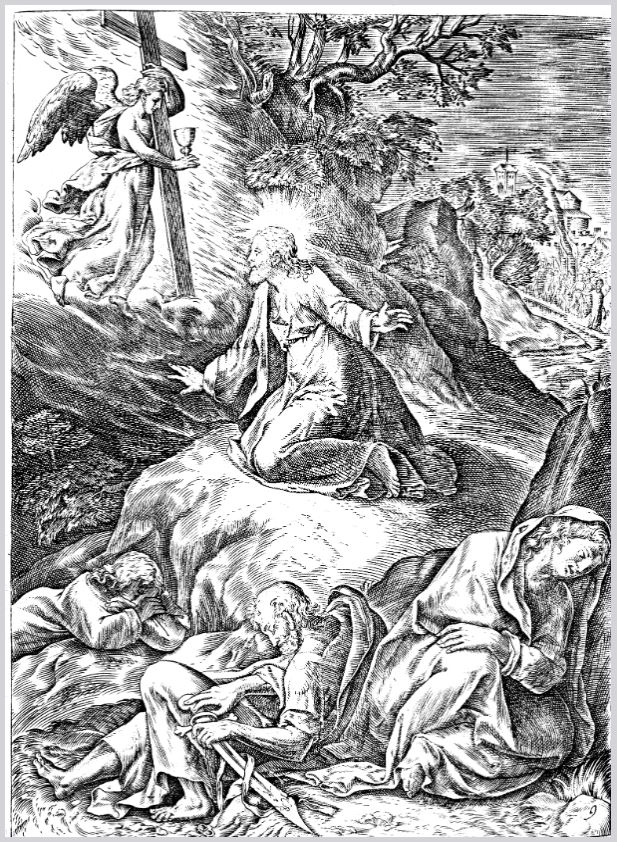
* The artwork "Garden of Gethsemane" is from a book by Ponce de Leon, Gundisalv. Maria, 16th cent. It's titled "Sanctissimi nominis Dei Sodalitas aduersus periuria et blasphemias / per D. Consaluum Ponce de Leon Hispalensem", now in public domain.
Jesus prays in the Garden of Gethsemane as his disciples, Peter (with the sword), James and John, sleep. An angel appears to Jesus to comfort him, holding the cup of suffering and a cross.
Courtesy of the Digital Image Archive, Pitts Theology Library, Candler School of Theology, Emory University.
*
My Cup Overflows.
"My Father, if it is not possible for this cup to be taken away unless I drink it, may your will be done," so Jesus prayed on the eve of his suffering and death. (Matthew 26:42) Later that night, he took the cup and said during the Last Supper, "This cup is the new covenant in my blood; do this, whenever you drink it, in remembrance of me." (1 Corinthians 11:25) All take the cup that Jesus drank from, and drink from it.
Imagine a cup with wine continually pouring into it and overflowing. Underneath the cup are more cups. The wine from the top cup spills into the cups below it. When they fill, they overflow into cups under them. This continues until a multitude of stacked cups fill and overflow, all receiving wine from the first cup, a pyramid of cups.
The wine that the cups receive is the sufferings and comfort of Christ (5). We share in sufferings (7; Acts 9:4; Colossians 1:24). The suffering comes first, and when we approach him, we receive his comfort. The comfort we are given is learned (6). "Although Jesus was a son, he learned obedience from what he suffered" (Hebrews 5:8)
The commandment we receive from the Son is love. Love and compassion are not part of the sinful, fallen nature. Apart from God, we did not know love. (1 John 3:10, 16) We need to learn love. And so we learn love through obedience. The wine of compassion we receive is learned and passed on. We drink from the cup of Christ as he taught us.
Listen to the above comments on 2 Corinthians 1:5-7.
>6. As the gospel was preached in the Roman province of Asia what happened? (8)
* 2 Corinthians 1:8 "We do not want you to be uninformed, brothers, about the hardships we suffered in the province of Asia. We were under great pressure, far beyond our ability to endure, so that we despaired even of life."
* Acts 9:11-12, 15-16 records to Lord telling Ananias to place his hands on him so Paul may see again and the Lord told Ananias, "I will show him how much he must suffer for my name."
* "We" -Throughout this letter Paul uses the editorial plural (we, us, our, ourselves). Except where the context plainly indicates otherwise, these plurals should be understood as referring to Paul alone. (NIV Study Bible)
* "about the hardships we suffered in the province of Asia" -Probably while in Ephesus for two years. (Acts 19) Paul, in the first letter, said he fought wild beasts in Ephesus. (1 Corinthians 15:32)
* "far beyond our ability to endure"
* "so that we despaired even of life" -Paul wanted to die. The original Greek verb for "despaired" is "exaporeo" implying "to be utterly at a loss, (i.e. despond)".
>What is a reason Christians suffer as they preach the gospel? (9)
* 2 Corinthians 1:9 "Indeed, in our hearts we felt the sentence of death. But this happened that we might not rely on ourselves but on God, who raises the dead."
* "in our hearts we felt the sentence of death" -The hardships he suffered he reckoned as almost being dead.
* "this happened that we might not rely on ourselves but on God" -Relying on God is a key point in the letter. (12:9-10)
* "who raises the dead" -God's power to raise the dead was discussed in detail in chapter 15 of the first letter to the Corinthian congregation.
* Matthew 10:22-23 "All men will hate you because of me, but he who stands firm to the end will be saved. When you are persecuted in one place, flee to another. I tell you the truth, you will not finish going through the cities of Israel before the Son of Man comes."
* Also in Mark 13:13 and Luke 21:17
>What is true about God's deliverance? (10)
* 2 Corinthians 1:10 "He has delivered us from such a deadly peril, and he will deliver us. On him we have set our hope that he will continue to deliver us,"
* "He has delivered us from such a deadly peril"
* "and he will deliver us
* "On him we have set our hope that he will continue to deliver us,"
>What happens when we pray "your kingdom come, your will be done on earth as it is in heaven"? (11; Matt. 6:10)
* 2 Corinthians 1:11 "as you help us by your prayers. Then many will give thanks on our behalf for the gracious favor granted us in answer to the prayers of many."
* Matthew 6:10 "your kingdom come, your will be done on earth as it is in heaven."
* "as you help us by your prayers"
* "Then many will give thanks on our behalf for the gracious favor granted us in answer to the prayers of many."
*
God Delivered, Answering Prayers.
Apostle Paul, God's chosen instrument to carry Jesus' name before the Gentiles and before the people of Israel (Acts 9:15), did not live a life that some Christians today would define as "the blessed life" and "the abundant life". While in the Roman province of Asia, which included the cities of Ephesus, Philadelphia, Colosse, Troas, and others, the apostle suffered hardships and felt the sentence of death in his heart. The great pressure was far beyond his ability to endure. He despaired even of life. Apostle Paul drank the cup of suffering that Jesus handed to him.
Paul received his suffering with mature faith. "This happened that we might not rely on ourselves but on God, who raised the dead." He felt dead. He experienced, therefore, a sort of resurrection. God delivered Paul from such a deadly peril. We will drink the cup of suffering and death with Jesus. God, whom we have set our hope, will deliver us too.
When suffering comes, we should ask others to pray for God to deliver (11). I know many who do not want others to know when they suffer. They do not want others to know they are weak. So they do not ask others to pray. If they do not know, they will not pray, and they will not give thanks for the gracious favor granted us in answer to their prayers. What a shame that pride robs others of this gift.
Listen to the above comments on 2 Corinthians 1:8-11.
III. Paul's Plans Change (1:12-2:4)
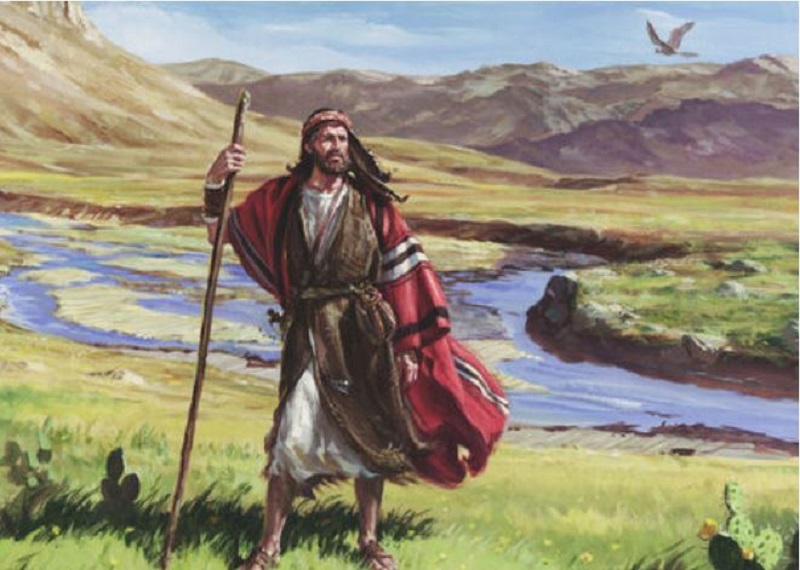
* Apostle Paul standing in a fertile valley with walking staff looking in one direction while trying to decide which way to go next. (Acts 20:1-6)
>7. In what did Paul and his companions boast? (12)
* 2 Corinthians 1:12 "Now this is our boast: Our conscience testifies that we have conducted ourselves in the world, and especially in our relations with you, in the holiness and sincerity that are from God. We have done so not according to worldly wisdom but according to God's grace."
* "Now this is our boast" -Boast here is in the sense of being a source of pride in something. Christians normally wouldn't think of being proud of anything, but rather humble. God reveals in the Bible humility is to be sought. Paul has been and still is using plural words; "our" and "we". Since when using "we" and "our" in verses 8 thru 11 he is clearly only referring to himself, then he is probably again only referring to himself for he is defending only himself and only his character to the Corinthians. Why is he using plural pronouns? Is it a form of detachment? Is it a form of humbling when at the same time boasting? See comments in question 6a. Jesus was accused on more than one occasion as appearing as his own witness and therefore his testimony was not valid. Jesus answer is stunning. (John 8:13-20)
*
Our Conscience Testifies.
Paul writes of his conscience. What is the conscience? The Greek noun for "conscience" is "syneidesis" from a prolonged form of the compound verb "sun-eido". "Suneido" means "to see completely" and "to understand" or "to become aware", it literally means "to be conscience of" and "to be informed of" implying this is done so by within our self.
When Adam and Eve ate the forbidden fruit they learned the meaning of right and wrong. Their conscience was awakened. Before the sin they did not understand what is was to do wrong from a personal perspective. They had the command to "not eat", but did not experience it till they did that which was forbidden. When they did what they were told not to do, their conscience was awaken and they mentally, physically, and spiritually experience the consequences. As Paul says here, their conscience testified that they had sinned. The more we sin, the more our conscience is burned, meaning it get harder and harder, we learn how to ignore the warning of the conscience. The conscience is always there, but we learn how to ignore it. So we way, "They have a burned conscience."
Conscience refers in general to that human moral awareness that judges an action right or wrong. The Hebrew word translated "heart" often refers to the conscience. (1 Samuel 24:5, 10; Job 27:6; Psalm 16:7, 73:21) The New Testament also translates a Greek verb that means "to know with" for conscience as "heart". (1 John 3:20-21) Paul is reviewing his previous action through his conscience.
Listen to the above comments on 2 Corinthians 1:12a.
* "we have conducted ourselves in the world" -Paul qualifies this with "in the world" meaning not only among believers, but with all people.
* "especially in our relations with you" -The Corinthian congregation.
* "in the holiness and sincerity that are from God" -Holiness (simplicity is in some translations) is opposed to double-mindedness; where there is a composition in a man, a mixture of truth and falsehood, fairness in speech and falsehood in heart or action. Sincerity is opposed to hypocrisy. They are said to be of God, because he is the God of truth, hath commanded, approves, works, and disposes the heart of man to them.
>How does God make it possible for us to also do that?
* "not according to worldly wisdom" -Paul brings up worldly wisdom because he knows and references in the first letter, that those who accuse him and brag about their knowledge, are doing so with a worldly point of view. Most believe they are mixing Greek philosophy with Jesus' teaching.
* "but according to God's grace" -Paul conducted himself in holiness (simplicity) and sincerity by the grace of God. Grace is unmerited divine assistance. God rendered this favor to Paul, and anyone he chooses, even though he need not do so.
* Romans 8:6 "The mind of sinful man is death, but the mind controlled by the Spirit is life and peace"
>How does Bible study help? (13-14a; 2 Peter 3:15-16)
* 2 Corinthians 1:13 "For we do not write you anything you cannot read or understand. And I hope that, as you have understood us in part, you will come to understand fully..."
* 2 Peter 3:15-16 "Bear in mind that our Lord's patience means salvation, just as our dear brother Paul also wrote you with the wisdom that God gave him. He writes the same way in all his letters, speaking in them of these matters. His letters contain some things that are hard to understand, which ignorant and unstable people distort, as they do the other Scriptures, to their own destruction."
* Paul letters needed to be studied to be understood. We can understand eventually, though not completely with a quick read.
* Ecclesiastes 12:9-12 "Not only was the Teacher wise, but also he imparted knowledge to the people. He pondered and searched out and set in order many proverbs. The Teacher searched to find just the right words, and what he wrote was upright and true. The words of the wise are like goads, their collected sayings like firmly embedded nails--given by one Shepherd. Be warned, my son, of anything in addition to them. Of making many books there is no end, and much study wearies the body."
* 2 Corinthians 1:14b "that you can boast of us just as we will boast of you in the day of the Lord Jesus."
* "that you can boast of us" -Some in the Corinthian congregation, perhaps most, can boast of Paul in the here and now. They can happily tell others that a great teacher, rabbi, has and is teaching them.
* "as we will boast of you" -Paul is still using "we" when speaking of himself. (See comments above.) Paul is saying he will boast of them before Christ on the day that the Lord Jesus will come.
* 1 Corinthians 3:12-15 "If any man builds on this foundation using gold, silver, costly stones, wood, hay or straw, his work will be shown for what it is, because the Day will bring it to light. It will be revealed with fire, and the fire will test the quality of each man's work. If what he has built survives, he will receive his reward. If it is burned up, he will suffer loss; he himself will be saved, but only as one escaping through the flames."
* 1 Thessalonians 2:19-20 "For what is our hope, our joy, or the crown in which we will glory in the presence of our Lord Jesus when he comes? Is it not you? Indeed, you are our glory and joy."
* "The day of the Lord is a familiar Old Testament image for the ultimate day of God's judgment, his final day in court when he settles the injustices of the world (e.g., Isaiah 2:12; Joel 1:15; Amos 5:18-20)." (The IVP Bible Background Commentary - New Testament)
* "On that day" and "that day" are other phrase interpreted as the same as "the day of the Lord". (Isaiah 2:11-12, 17, 20, 3:7, 18, 4:1-2; 10:20, 27; Haggai 2:23; Zechariah 2:11, 3:10; Zephaniah 1:8-10, 1:12-2:3) Isaiah chapters 2-4 includes the phrase seven times. The day of the Lord is a time of judgment and/or blessing as God intervenes decisively in the affairs of the nations.
* Calvin wrote about this passage, "By this I understand the last day, which will put an end to all the fleeting glories of this world. He means, then, that the glorying of which he is now speaking is not evanescent, as those things are that glitter in the eyes of men, but is abiding and stable, inasmuch as it will remain until the day of Christ. For then will Paul enjoy the triumph of the many victories that he had obtained under Christ's auspices, and will lead forth in splendor all the nations that have, by means of his ministry, been brought under Christ's glorious yoke; and the Church of the Corinthians will glory in having been founded and trained up by the services of so distinguished an Apostle." (Calvin's Commentaries)
Elsewhere Calvin wrote, "'The day of the Lord Jesus' has been added, that the faithful might be always watching, and not promise tomorrow to themselves. For we all labor under two very different evils -too much haste and slothfulness. We are seized with impatience for the day of Christ already expected; at the same time we securely regard it as afar off. As, then, the Apostle has before reproved an unreasonable ardor, so he now shakes off our sleepiness, so that we may attentively expect Christ at all times, lest we should become idle and negligent, as it is usually the case. For whence is it that flesh indulges itself except that there is no thought of the near coming of Christ?" (Calvin's Commentaries)
* J. Vernon McGee wrote, "There is some argument as to whether this takes place at the coming of Christ to establish His kingdom or at the end of the millennial kingdom. I am convinced that the Day of the Lord is an extended period of time which opens with the Tribulation, followed by the thousand-year reign of Christ, the brief rebellion led by Satan, and the judgment of the Great White Throne. Then, as we find in the Book of Revelation, the new heavens and the new earth come into view."
"The Day of the Lord will include judgment also. The "day of the Lord" is a familiar term in Scripture. The prophets used it, the Lord Jesus used it, and many of the New Testament writers used it. It is a technical term. The Day of the Lord begins in darkness, as the Old Testament prophets said -it begins with tribulation. It ends with this great atomic explosion, this great judgment of the earth by its being dissolved by fire. Between these two great events is the period of the seven years of tribulation, the coming of Christ to the earth to establish His kingdom, the millennial kingdom, the brief release of Satan and the rebellion of those who rally to him, Satan's final confinement, and the Great White Throne judgment of the lost. Then after the judgment of the earth, which Peter is describing, the new heaven and the new earth come into view." (J. Vernon McGee, Thru the Bible Commentary -Second Peter)
*
"In the day of the Lord Jesus"
"The day of the Lord Jesus", referring to Jesus' coming to assess the saints' actions while in the flesh, as Paul is using it here, is one day only. It can be understood as one twenty-four (24) hour day that starts at sunset, goes through dawn, the light period, and ends at sunset. It can only be Jesus coming and judging the saints.
"The day of the Lord Jesus" is not plural like "in the last days" used elsewhere. The single day here is Jesus' second coming, and the plural "in the last days" is the time before his second coming. "The day of the Lord" contains the harvest that Jesus and the apostles taught, and Paul is using here. (Matthew 13:30, 39, 21:34, 41, 25:24, 26; Mark 4:29, 12:2; Luke 20:10; John 4:35-36; Romans 1:13; and 1 Corinthians 9:10-11; Galatians 6:9; Revelation 14:15-16) "The last days", as Peter stated on Pentecost when he quoted Joel, started with Jesus' death and resurrection, the day of Pentecost, and will end when Jesus comes on "the day of the Lord". "The day of the Lord" starts the Lord's one-thousand-year reign.
Apostle Paul says that he will boast of the Corinthian congregation on the day of the Lord Jesus. When I, like Paul, stand before Jesus to give an account of what I did with my life and the gifts given to me, what can I show to Jesus? What can I boast about? Jesus will say, "What did you do with the talents I gave you?" He will say this to all he calls. "He who is given much, much will be expected."
Listen to the above comments on 2 Corinthians 1:14b.
* The Bema (judgment) Seat in ancient Corinth is an elevated blue and white marble platform located in the center of the city's agora (public square). Magistrates and governors used it to address the public, announce official judgments, award the winner of games, and observe the square. The site is where the Apostle Paul was tried by the Roman proconsul Gallio in 51-52 A.D. (Acts 18:12-17) Jesus' coming judgement is sometimes compared to the Corinth Bema Seat.
>How will our witness to unbelievers and service for the fellowship of believers be rewarded? (Matt. 16:27; and 2 Tim. 4:6-8)
* Matthew 16:27 "For the Son of Man is going to come in his Father's glory with his angels, and then he will reward each person according to what he has done."
* 2 Timothy 4:6-8 "For I am already being poured out like a drink offering, and the time has come for my departure. I have fought the good fight, I have finished the race, I have kept the faith. Now there is in store for me the crown of righteousness, which the Lord, the righteous Judge, will award to me on that day--and not only to me, but also to all who have longed for his appearing."
* 1 Thessalonians 5:2 "for you know very well that the day of the Lord will come like a thief in the night."
* 1 Corinthians 1:7-8 "Therefore you do not lack any spiritual gift as you eagerly wait for our Lord Jesus Christ to be revealed. He will keep you strong to the end, so that you will be blameless on the day of our Lord Jesus Christ."
*
Life of Holiness and Sincerity.
Some who falsely portrayed themselves as super apostles were attacking Paul's character. They claimed that the collection was not for the poor in Jerusalem as Paul claimed, but that Paul secretly planned to keep it for himself. They also claimed that Paul's writing was unintelligible (13-14). The super apostles said these are the reasons why Paul did not arrive in Corinth as he had said he would in the previous letter. (1 Corinthians 16:5-6)
Paul defended his trustworthiness by appealing to the witness of his own conscience and to the Corinthians' firsthand knowledge of his character. He had conducted himself in the world and the eighteen months while he was with them, in the holiness and sincerity that are from God and by the grace of God, not according to worldly wisdom.
The "day of the Lord Jesus" is often how the apostles refer to Jesus' second coming as king and judge. We will all stand before the Bema Seat of Christ and give an account of our actions while in the flesh, just as Jesus revealed in "The Parable of the Shrewd Manager". (Luke 16:2; Romans 14:10-12; Hebrews 13:17)
Therefore, I need to keep my character pure and sincere. When tempted to stray from these, I am to remember that God looks at my character. People determine a person's character. Even children see a person's character. Keep a noble character as Ruth did, who, it was said of, "All my fellow townsmen know that you are a woman of noble character." (Ruth 3:11)
Listen to the above comments on 2 Corinthians 1:12-14.
>8. What plan did Paul seriously make? (15-17)
* 2 Corinthians 1:15-17 "Because I was confident of this, I planned to visit you first so that you might benefit twice. I planned to visit you on my way to Macedonia and to come back to you from Macedonia, and then to have you send me on my way to Judea. When I planned this, did I do it lightly? Or do I make my plans in a worldly manner so that in the same breath I say, "Yes, yes" and "No, no"?"
* "Because I was confident of this" -Paul had said that his conscience bore witness to his conduct in holiness and sincerity. Now he will explain his side, his reason for not going to meet with the Corinthian congregation. He starts with a proclamation that he was being true and honest when he said he was coming. He tells them of his initial planned round about route from Ephesus in the east, to the Roman provinces in the west, and back to the east, to the Roman province of Asia.
* "I planned to visit you first so that you might benefit twice." -Paul planned to sail west and land in the Corinth port, meet the congregation there, travel north to congregations there, and then go back to Corinth, meet the congregation before setting sail to the east, and onto Judea where Jerusalem was located.
* "Macedonia" -The main congregations to the north of Corinth had sea ports, but his initial thought was to go to Corinth first so he could visit again upon his return.
* "When I planned this, did I do it lightly?" -Paul had other consideration that were just as important:
to give them a chance to think about what he wrote in the first letter (1:23-2:4)
the collection he personally started by sending out letters
the need for men to travel with him and the collection
the other congregation's needs
the need for an assistant
the need to arrive in Jerusalem by Pentecost, end of spring (Acts 20:16)
* Acts 20 records the looped trip to collected the offering for the poor in Judea.
* The map of Corinth is from the NIV Study Bible, 1984. Used by permission.
>What kind of decision must be made in regard to Jesus? (18-19)
* 2 Corinthians 1:18-19 "But as surely as God is faithful, our message to you is not "Yes" and "No." For the Son of God, Jesus Christ, who was preached among you by me and Silas and Timothy, was not "Yes" and "No," but in him it has always been "Yes."
* "For the Son of God, Jesus Christ... is always 'Yes'" -Meaning according to the next verse, God's promises are yes, meaning they are true and we believe them. Man's promises, such as Paul's may be changed and altered, but God's promises are always true, even though we may not always fully understand them.
* "who was preached among you by me and Silas and Timothy" -The gospel message Paul and others sent by Paul preached the gospel as he reminded them in the first letter. (1 Corinthians 15)
* Paul did visit them, but not in the way and timing he had originally planned. Instead, he went to the congregations north of them first. So his visit to them was delayed. (Acts 20:1-3a)
* We need to make plans knowing they will at times need to be altered. Be prepared.
>When God makes a promise what should our response be? (20)
* 2 Corinthians 1:20 "For no matter how many promises God has made, they are "Yes" in Christ. And so through him the "Amen" is spoken by us to the glory of God."
* "they are 'Yes' in Christ" -Through Jesus God's promises have been accomplished and will be accomplished.
* Believing the gospel, the congregation found the gospel to be altogether true and entirely free from ambiguity, and by their experience of its dynamic power they had proved it to be one great affirmative in Christ, in whom all God's promiees are "Yes". (NIV Study Bible)
* "Amen" -1 Corinthians 14:16 gives understand, "If you are praising God with your spirit, how can one who finds himself among those who do not understand say "Amen" to your thanksgiving, since he does not know what you are saying?"
The KJV's translation in the very old vernacular, "and in him Amen", misleads the modern reader. The "Amen" is proclaimed by the congregation of Christ at the end of an offering of prayer or praise. Paul is saying, "In" or "through" Christ is faithfulness to His word. Therefore, through Him is the immutable verification of it with an "Amen" spoken by his people. The whole range of Old and New Testament promises are secure in their fulfillment for us in Christ.
*
The "Yes" to the Gospel.
Paul's detractors intended to diminish the gospel Paul preached and replace it with their pseudo-gospel. (1 Corinthians 1:18-25, 31, 2:4, 3:18-23, 4:18-21, 9:1, 15) They claimed that Paul was lying about his intent to visit them, and so, his gospel was just as false. They said, "Do not listen to the liar Paul. Listen to us, for we know great secret things through the power of the Holy Spirit."
Paul explained his intended travel plans when he wrote the first letter (15-16), and that plan was not easy to make, nor was its announcement under pretenses (17). His original travel plans were as he said. Also, the gospel message he preaches is true. He is not a liar (18). When he said, "Yes," he meant it.
Apostle Paul preaches the Son of God, Jesus Christ, as did Silas and Timothy (19). Paul reminded them of the Gospel of Jesus Christ in 1 Corinthians 15. "...Christ died for our sins according to the Scriptures, that he was buried, that he was raised on the third day according to the Scriptures, and he appeared to many." (1 Corinthians 15:3-8) "By this gospel we are saved if we hold firmly to it." (1 Corinthians 2a) This is God's promise. This is not a false "Yes". This is true. Do you say, "Amen" to this gospel to the glory of God? (19) Do not believe those who preach a pseudo-gospel by discrediting the New Testament.
Listen to the above comments on 2 Corinthians 1:15-20.
>9. What does it mean to "stand firm in Christ"? (21a)
* 2 Corinthians 1:21 "Now it is God who makes both us and you stand firm in Christ."
* "Now it is God who makes both us and you" -God is the subject and we are the object.
* "stand firm in Christ" -"The term translated "stand firm" (NIV) or "establish" (NASB, NRSV, GW) or "confirm(ing)" (YLT) was often a business term confirming a sale; it is thus related to "down payment" ("deposit"-NIV) in 2 Cor. 1:22." (Bible Background Commentary - The IVP Bible Background Commentary - New Testament)
* "Christ" -The original Greek adjective is "Christos" (a transliteration) from the verb "chrio" meaning "contact", "rub", and "smear" implying consecrate to a religious office, service, or mission. "Christos" means "anointed". The equivalent Hebrew is "Messiah". Both the Greek and Hebrew are an epithet of Jesus.
* "Christ (and) He anointed us" -A play on the Greek words "christos" and "chrio" (transliterations). See note above and in the question below.
* 1 Corinthians 15:58 "Therefore, my dear brothers, stand firm. Let nothing move you. Always give yourselves fully to the work of the Lord, because you know that your labor in the Lord is not in vain."
* 1 Corinthians 16:13-14 "Be on your guard; stand firm in the faith; be men of courage; be strong. Do everything in love."
* 2 Corinthians 1:24b "it is by faith you stand firm."
>How does God enable us to stand firm? (21b-22)
* 2 Corinthians 1:21b-22 "He anointed us, set his seal of ownership on us, and put his Spirit in our hearts as a deposit, guaranteeing what is to come."
* The original Hebrew is, "kai (and) chrio (see above) hemas (us) theos ho (God who) sphragizo (seal) hemas kai didomi (given) arrabon pneuma en hemon kardia" (transliterations). Some treat this phrase (21b-22) as a new sentence (i.e. NIV, HCSB, CSB) and others with verses 21 and 22 as one sentance with a semicolon or comma before "and" and at the end of verse 21.
* "He anointed us" -"Anointed" is the Greek verb "chrio". See comments on "Christ" above. The anointing of kings, priests, and some prophets was accompanied by the gift of the Holy Spirit in the Old Testament.
* "set his seal of ownership on us" -See introduction to this study in question 1 above for comments on seal of ownership. A seal in ancient times was a signet containing a distinctive mark which stood for the individual who owned it. The earliest seals found so far date to before 3000 B.C. (Genesis 38:18, 41:42; 1 Kings 21:8)
* "and put his Spirit in our hearts" -A constant indwelling of the Holy Spirit, our testimony of God's acceptance.
>What is a deposit and how is the Spirit in our hearts one?
* "as a deposit" -Also in Ephesians 1:14. A side note: Emotions are but a small part of the deposit for the joy we have is said to go beyond experience for when we are weak He is strong, when we are boxed-in He sets us free, when we are suppressed He encourages.
* "guaranteeing" -A guarantee is something that assures a particular outcome or condition, a promise and an assurance, a pledge that something will be performed in a specified manner.
* "what is to come" -What we have now is only a small part, a down deposit. The full amount is yet to come. This is just a taste, not the full meal. We have a sample. The blessing of the Holy Spirit we have now is a portion, not the whole. We cannot imagine in part from what we have now.
*
Seal of Ownership.
"Stand firm in Christ!" The first place in Israel's history the command to "stand firm" is given is the Lord's answer through Moses to Israel concerning the approaching Egyptian army led by Pharaoh, "Do not be afraid. Stand firm and you will see the deliverance the LORD will bring you today. The Egyptians you see today you will never see again." (Exodus 14:13) The next time the command is heard was when Moabites, Ammonites, and Meunites came to make war on Jehoshaphat and Israel. While standing before the LORD at his temple in prayer, the LORD replied, "You will not have to fight this battle. Take up your positions; stand firm and see the deliverance the LORD will give you, O Judah and Jerusalem. Do not be afraid; do not be discouraged. Go out to face them tomorrow, and the LORD will be with you.'" (2 Chronicles 20:17)
King David, learning from the past and looking to the future we now live in, prophesied, "Some trust in chariots and some in horses, but we trust in the name of the LORD our God. They are brought to their knees and fall, but we rise up and stand firm. O LORD, save the king! Answer us when we call!" (Psalm 20:7-9) The Holy Spirit, through the apostle, reminds us, "Now it is God who makes both us and you stand firm in Christ." (21a)
Troubles and suffering will come and have come. God is with us, strengthening our knees. "How do I know this?" you may ask. God anointed us with a seal of ownership. The Holy Spirit in our hearts is a deposit, guaranteeing what is to come. The Holy Spirit, whom we experience life from and with, tells us that God is with us, and God strengthens our knees so we will stand firm in the Lord Jesus, as he wins the battle that is already won.
Listen to the above comments on 2 Corinthians 1:21-22.
>10. Since Paul knew the essence of the Christian faith how did he see his mission? (23-24)
* 2 Corinthians 1:23-24 "I call God as my witness that it was in order to spare you that I did not return to Corinth. Not that we lord it over your faith, but we work with you for your joy, because it is by faith you stand firm."
* "I call God as my witness" -Paul had somewhat deviated from verse 16 till now from the reason for not visiting as he had planned.
* "it was in order to spare you that I did not return to Corinth" -The reason why Paul changed his plans, but perhaps not the only one. His change was not by a fickle and insensitive attitude, but by love and concern for them. If he came right away he would have been obliged to use the severe and authoritative part of his function as apostle and founder of the congregation in dealing with all their problems including division and false teachings that had become harsh. He promised this in 2 Corinthians 13:2. So he stayed away a little longer. He gave them time to think about his first letter.
* "Not that we lord it over your faith" -"Lord it over" (NIV, CSB) is the verb "kyrieuo" in the original Greek translated "dominion over" in the KJV, "lordship over" in the ASV, "control of" in the HCSB, "control over" in GW, and "lords over" in YLT. The varied translations shows Paul, even as an apostle and founder of the congregation did not control matters of faith for faith is personal assurance of hope in Christ. Hope cannot be forced into or taken away from others' hearts. Hope only comes from and is sustained by God. Jesus commands his disciples not to lord over as the Gentiles do, but serve them. (Matthew 20:25-26; Mark 10:42-43; Luke 22:25-26)
* "it is by faith you stand firm."
>How did this dictate his decision on visiting the Corinthian believers? (2:1-2)
* 2 Corinthians 2:1-2 "So I made up my mind that I would not make another painful visit to you. For if I grieve you, who is left to make me glad but you whom I have grieved?"
* "So I made up my mind that I would not make another painful visit to you." -The change of plans included the desire not to make another change of plans. Paul had already made one painful visit to Corinth which we do not have a record of other than this letter. He wanted to avoid another such visit, though he could exhort his authority again (13:2-3). The occasion of the former visit is not given to us in Acts nor any of his other letters. It could not have been his initial visit to Corinth as the time when the church there was founded in response to the preaching of the gospel. (Acts 18:1-18) 2 Corinthians 12:14 and 13:1 clearly calls the coming visit a "the third time" (Acts 20:1-2), and 13:2-3 clearly states the former visit that is not recorded in Acts was a "the second time". Some state the second visit took place between the writing of 1 and 2 Corinthians, and others believe it occurred before 1 Corinthians was written. Both are speculation based on logistics and timing from the facts found in Acts, Galatians, and a few other of Paul's early letters. See the introduction to this letter for a timeline of Paul's walk with and for Christ by using the link at the top of this web page.
* "For if I grieve you"- By a rebuking visit shortly after the first letter.
* "who is left to make me glad but you whom I have grieved?" -They would be sad. He would be sad. It would have been a tragic visit.
>How did this dictate the content of 1 Corinthians? (2:3-4)
* 2 Corinthians 2:3-4 "I wrote as I did so that when I came I should not be distressed by those who ought to make me rejoice. I had confidence in all of you, that you would all share my joy. For I wrote you out of great distress and anguish of heart and with many tears, not to grieve you but to let you know the depth of my love for you."
* "I wrote as I did" -Some modern commentators incorrectly say that the second part of 2 Corinthians was actually a separate letter sent by Paul before the first half of 2 Corinthians. No proper and good evidence can be supplied.
* "I had confidence in all of you" -That they would agree with his points in the first letter. Paul will pick-up again on this point in 7:8 on, especially verse 12.
* This passage refers to a previous letter that had been sent to the Corinthians. The consensus of the church from the earliest times has been that this previous letter is 1 Corinthians. In more recent times, however, many believe that the reference is to an intermediate letter, written between 1 Corinthians and 2 Corinthians. Some advocates of this theory hold that the whole or in part, with the last four chapters of 2 Corinthians, contending these chapters are out of harmony with the earlier ones and that they fit the description of the letter written "out of great distress and anguish." There is, however, no historical evidence that the unity of 2 Corinthians was questioned or that its integrity was doubted prior to modern times. (NIV Study Bible)
*
Do Not Lord Over as Nonbelievers Do.
Apostle Paul stopped short of explaining his reasons for the change in travel plans at the end of verse 16. He momentarily diverted to a side point. Now he continues his explanation. Paul said he wanted to give them more time to think about what he had written in the first letter, hoping and praying they would change (1:23, 2:3-4). He did not want to lord his authority over their faith (1:24). He trusted God to work through their faith.
Paul was an apostle and the founder of the congregation in Corinth. Some would say he had every right to exercise authority over the group he founded. However, he knew Jesus' command to his apostles, "You know that the rulers of the Gentiles lord it over them, and their high officials exercise authority over them. Not so with you. Instead, whoever wants to become great among you must be your servant, and whoever wants to be first must be your slave- just as the Son of Man did not come to be served, but to serve, and to give his life as a ransom for many." (Matthew 20:25-28; Mark 10:42-45; Luke 22:24-27)
Authority can be used to gain unquestioned authority, often through threats, lies, and rumors. Unquestionable authority is then used to obtain absolute authority. I have witnessed this in business and congregations by people who are not originally the person in top authority, but eventually gain it because the one in top authority is afraid to lose what little authority they have left. Many are destroyed by this "lording over" authority.
Neither Jesus nor the apostles practiced "lording over" authority. Instead, he taught us through word and example to serve others. My advice to you is, if you are afraid of losing power and yet claim to be a disciple of Jesus, then consider if you truly follow Jesus or chase after power.
Listen to the above comments on 2 Corinthians 1:23-2:4.