I. I Will Tear the Kingdom From Your Son (11:1-13)
* A painting depicting Solomon's sin, bowing to an idol by The Providence Lithograph Company. The study card was used in Bible study. The back of the card had study notes and guides for the teacher. This study card is now in public domain.
>1. What was Solomon determined to hold fast to? (1-3)
* 1 Kings 11:1-3 "King Solomon, however, loved many foreign women besides Pharaoh's daughter--Moabites, Ammonites, Edomites, Sidonians and Hittites. They were from nations about which the LORD had told the Israelites, "You must not intermarry with them, because they will surely turn your hearts after their gods." Nevertheless, Solomon held fast to them in love. He had seven hundred wives of royal birth and three hundred concubines, and his wives led him astray."
* 2 Chronicles 8 and 9:13-28 briefly speaks of other things concerning Solomon's reign (his death is recorded at the end of chapter 9), but does not go into the detail as 1 Kings 10:14 through chapter 11 (his death is recorded at the end of chapter 11) and does not reveal his many sins and results of those sins.
* Solomon's excessive accumulation of silver and gold (10:14-25), his multiplication of horses (10:26-29), and multiplication of wives, concerns the warning given to Israel through Moses against these three forms of princely ostentation, all alike forbidden to an Israelite monarch. (Deuteronomy 17:14-20) Asking for a king was a problem for power temptation is that sin is left unchecked.
* "loved many foreign women besides Pharaoh's daughter" -Solomon married her for political reasons, specially to gain an important trade route city, Gezer, nineteen miles northwest of Jerusalem. (3:1, 9:16) She brought her Egyptian gods and practices with her. Solomon joined her pagan practices as God foretold. So did all the other foreign women he married, most for political reasons. Solomon put profit before God.
* "because they will surely turn your hearts after their gods." -Just as Eve lead Adam to sin.
* "love(d)" -The original Hebrew verb is "ahab" or "aheb" (transliterations), a primitive root. It means to have affection for (sexually or otherwise).
* "wives... concubines" -The distinction was based on who was their father, that is her royal line, now much they ruled and how wealthy they were. All this was about power and wealth, the things of tis world. Solomon having so many is saying he had so much power and wealth that everybody wanted some of it at any cost.
* Proverbs 31:1-3 some say Lemuel is Solomon though it could also apply to Samson and David. "The sayings of King Lemuel--an oracle his mother taught him: "O my son, O son of my womb, O son of my vows, do not spend your strength on women, your vigor on those who ruin kings."
* Ecclesiastes 7:27-28, "Look," says the Teacher, "this is what I have discovered: "Adding one thing to another to discover the scheme of things-- while I was still searching but not finding-- I found one [upright] man among a thousand, but not one [upright] woman among them all."
* Deuteronomy 7:3-4 "Do not intermarry with them. Do not give your daughters to their sons or take their daughters for your sons, for they will turn your sons away from following me to serve other gods, and the LORD's anger will burn against you and will quickly destroy you."
>What was the result? (4)
* 1 Kings 11:4 "As Solomon grew old, his wives turned his heart after other gods, and his heart was not fully devoted to the LORD his God, as the heart of David his father had been."
* "As Solomon grew old" -Not in his youth, not when he built the temple. Solomon marriage to Pharaoh's daughter was pledged while building the temple and finalized after it was built. Gezer was needed to transfer the large logs from the mountains of Lebanon to the Sea and then to Jerusalem. Their marriage took place when he started building his palace and he was still living in his father's palace. Then he realized that she could not live in David's house because the ark had been there, so he built her a palace too. When she moved into her palace, he began marrying other women and committed all the other sins he confesses to in Ecclesiastes.
* "his wives turned his heart after other gods" -A sin influencing generations of kings to come.
* "his heart was not fully devoted to the LORD his God" -Jesus said you cannot love both God and money.
* "as the heart of David his father had been." -He did not follow the advice of his father, a great societal sin in those days.
>How is it possible for those who are close to the Lord in earlier years to move away from him in later years? (1 Peter 5:8-9; Matt. 16:11-12; 1 John 2:15-17; 2 Tim. 4:9-10)
* 1 Peter 5:8-9 "Be self-controlled and alert. Your enemy the devil prowls around like a roaring lion looking for someone to devour. Resist him, standing firm in the faith, because you know that your brothers throughout the world are undergoing the same kind of sufferings."
* Matthew 16:11-12 "How is it you don't understand that I was not talking to you about bread? But be on your guard against the yeast of the Pharisees and Sadducees." Then they understood that he was not telling them to guard against the yeast used in bread, but against the teaching of the Pharisees and Sadducees."
* 1 John 2:15-17 "Do not love the world or anything in the world. If anyone loves the world, the love of the Father is not in him. For everything in the world--the cravings of sinful man, the lust of his eyes and the boasting of what he has and does--comes not from the Father but from the world. The world and its desires pass away, but the man who does the will of God lives forever."
* 2 Timothy 4:9-10 "Do your best to come to me quickly, for Demas, because he loved this world, has deserted me and has gone to Thessalonica. Crescens has gone to Galatia, and Titus to Dalmatia."
* Many have fallen for many reasons. The Lord God told three things would lead a king astray. This would apply to anyone who has power over others.
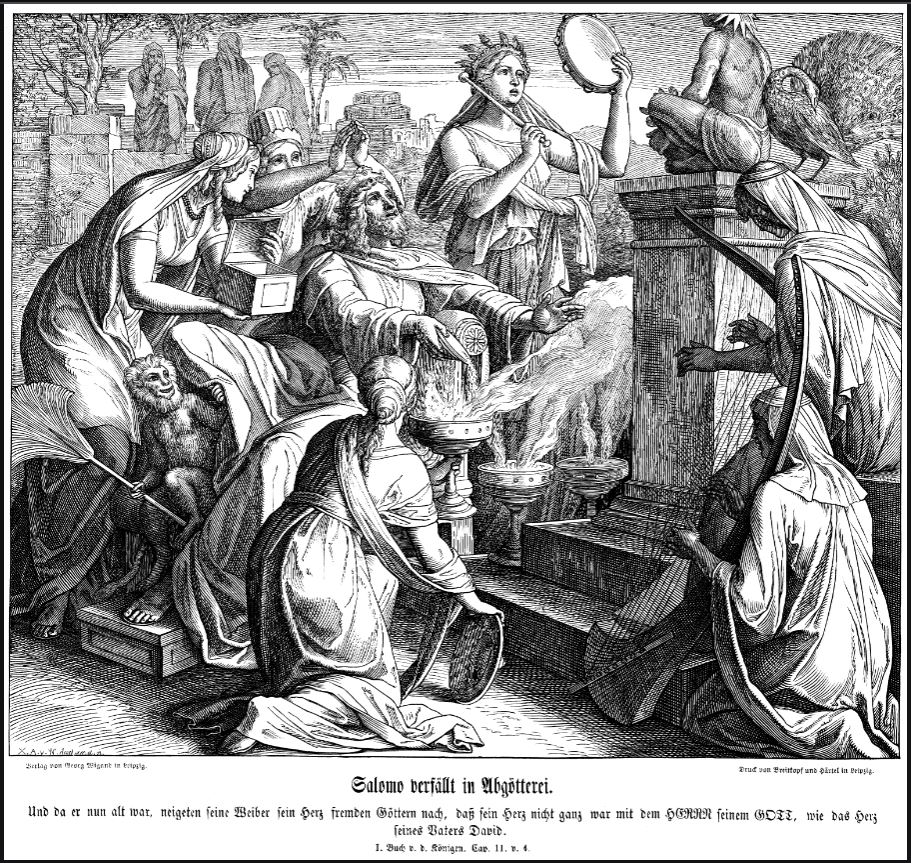
* Julius Schnorr von Carolsfeld's (1794-1872) depiction of King Solomon worshiping an idol at the urging of his wives, now in public domain. This is from the book, " Die Bibel in Bildern / von Julius Schnorr von Carolsfeld". Courtesy Pitts Theological Society.
>2. What evil did Solomon do? (5-6)
* 1 Kings 11:5-6 "He followed Ashtoreth the goddess of the Sidonians, and Molech the detestable god of the Ammonites. So Solomon did evil in the eyes of the LORD; he did not follow the LORD completely, as David his father had done."
* "Ashtoreth" -Canaanite fertility goddess, the consort of the storm god Baal. Her other names are Athtar, Astarte, and Ishtar. Ashtoreth/Astarte was known by the Greeks as Aphrodite.
* "Molech" -A variant of the Ammonite fire god Milcom were human sacrifice including children was common. (Leviticus 18:21)
* "Solomon did evil in the eyes of the LORD" -"Evil" is the Hebrew word "ra" from the verb "raa". (transliterations)
*
>How didn't Solomon remain the spiritual leader in his family? (7-8)
* 1 Kings 11:7-8 "On a hill east of Jerusalem, Solomon built a high place for Chemosh the detestable god of Moab, and for Molech the detestable god of the Ammonites. He did the same for all his foreign wives, who burned incense and offered sacrifices to their gods."
* "On a hill east of Jerusalem" -The mount of Olives.
* "Chemosh" -Moabite god that has similarities to Yahweh, Israelites God, except he is the god of the underworld (aka Nergal). (Jeremiah 48:7, 13:46)
* King Josiah defiled and destroyed this high place. (2 Kings 23:13)
* Solomon would do anything to ensure his family, as large and umbilical as it was, worshiped a god, any god. As he grew old he form was more important than substance. He had a form of religion, but denied its power.
>How can a husband and father be a spiritual leader in his family? (Gen. 35:2-5; 1 Cor. 11:1; 1 Peter 3:7)
* Genesis 35:2-5 "So Jacob said to his household and to all who were with him, "Get rid of the foreign gods you have with you, and purify yourselves and change your clothes. Then come, let us go up to Bethel, where I will build an altar to God, who answered me in the day of my distress and who has been with me wherever I have gone." So they gave Jacob all the foreign gods they had and the rings in their ears, and Jacob buried them under the oak at Shechem. Then they set out, and the terror of God fell upon the towns all around them so that no one pursued them."
* 1 Corinthians 11:1 "Follow my example, as I follow the example of Christ."
* 1 Peter 3:7 "Husbands, in the same way be considerate as you live with your wives, and treat them with respect as the weaker partner and as heirs with you of the gracious gift of life, so that nothing will hinder your prayers."
* The husband must have strong love, not violent love.
>3. What angers the Lord? (9-10)
* 1 Kings 11:9-10 "The LORD became angry with Solomon because his heart had turned away from the LORD, the God of Israel, who had appeared to him twice. Although he had forbidden Solomon to follow other gods, Solomon did not keep the LORD's command."
* "The LORD became angry with Solomon because his heart had turned away from the LORD" -God's anger is when he love something or someone more than God.
* "Although he had forbidden Solomon to follow other gods" -God says this in his Covenant with Israel. Yet, the Lord God specifically told Solomon.
* "Solomon did not keep the LORD's command." -Such is idol worship.
>How was his anger expressed in Solomon's life? (11)
* 1 Kings 11:11 "So the LORD said to Solomon, "Since this is your attitude and you have not kept my covenant and my decrees, which I commanded you, I will most certainly tear the kingdom away from you and give it to one of your subordinates."
* "Since this is your attitude and you have not kept my covenant and my decrees" -Poor attitude lead to poor life decisions and sins.
* "give it to one of your subordinates." -Within his ranks.
>What does verse 12 and 13 tell us about the Lord's love?
* 1 Kings 11:12 "Nevertheless, for the sake of David your father, I will not do it during your lifetime. I will tear it out of the hand of your son. Yet I will not tear the whole kingdom from him, but will give him one tribe for the sake of David my servant and for the sake of Jerusalem, which I have chosen."
* "for the sake of David your father" -David also sinned. However, he repented when rebuked. Yet, David and Israel had to live with the consequences of those sins.
* "I will not do it during your lifetime." -Perhaps given Solomon a chance to begin correcting all his errors and counter his sins.
* "but will give him one tribe" -Judah, though some of the Levites still at least for a while performed their duties at the Temple.
* "for the sake of Jerusalem, which I have chosen." -The city was important. God chose it as the place where people were to inquire of the Lord per Solomon's prayer.
>Does a parent's faith and love for the Lord ensure a same response from their children? (John 1:12-13)
* John 1:12-13 "Yet to all who received him, to those who believed in his name, he gave the right to become children of God-- children born not of natural descent, nor of human decision or a husband's will, but born of God."
* Each generation has a chose. Yet, a generation can suffer because of the former's generations decisions and actions.
*
I Will Tear the Kingdom From Your Son
2 Chronicles chapters 8 and 9:13-28 also record other events in Solomon's reign, but not his terrible sins and the results of those sins.
What leads people who start a life of faith in God and obedience to his will such as Solomon did, but later in life walk away from the straight and narrow road such as Solomon later confessed? Solomon's excessive accumulation of silver and gold (10:14-25), his multiplication of horses (10:26-29), and multiplication of wives (11:1-13) concern the warning given to Israel through Moses against these three forms of princely ostentation, all forbidden to an Israelite monarch. (Deuteronomy 17:14-20) The author is clear: Solomon ever-so-fast turned away from God to the riches and pleasures of this world and false religious practices. This warning was meant to keep Israel from asking for a king. They did, and King Solomon's sin badly influenced the nation. Though he spoke wisdom, he acted foolishly.
Solomon's walk away from the Lord seems to start with his alliance with Pharaoh, ruler of Egypt, before he asked for wisdom from the Lord. (3:1-3) Building the Temple, his and his wife's palaces, the palisade, and other buildings required large lumber that was only available on Mount Lebanon. (5:1-6, 8:11-18 ;2 Chronicles 2:1-10) After being harvested, the large lumber would need to be moved to Jerusalem, 150 straight miles (220km) through large hills and low valleys. A straight route through Israel's territory was an almost impossible route. The easiest route would be nearly twice as long, from the mountain to the sea, to the shores of Israel, through a city called Gezer, to Jerusalem. Egypt controlled Gezer at this time. Rather than going to war with Egypt to gain the city, Solomon chose to ally, and Pharaoh required him to marry one of his daughters. Solomon could have inquired of the Lord, but he did not. Rather, he relied on his intellect.
Solomon's political marriage to an Egyptian seems to be the beginning of a slow descent into grievous sins. The alliance and marriage seemed harmless. Yet, they were not, it was the beginning of many political alliance marriages with pagans. The Lord, through the author(s) of Kings, makes sure to list the three categories of sins he fell into after that. Solomon's confession of his seeking meaning in all kinds of sins after his marriage to Pharaoh's daughter is recorded in Ecclesiastes.
All decisions are important, especially who we marry. Good reasons to marry are not the only way to determine who to marry. Pray for the Lord God to impart wisdom. Solomon didn't pray for wisdom until after he cemented a political alliance with marriage to Egypt. After that, the rest became easy.
Listen to the above commentary on 11:1-13.
II. The Lord Raised Up Advisories Against Solomon (11:14-25)
>4. Why did an adversary enters Solomon's life? (14)
* 1 Kings 11:14 "Then the LORD raised up against Solomon an adversary, Hadad the Edomite, from the royal line of Edom."
* "an adversary"
* "Hadad the Edomite"
*
>What was Edom's history with Israel? (15-16)
* 1 Kings 11:15-16 "Earlier when David was fighting with Edom, Joab the commander of the army, who had gone up to bury the dead, had struck down all the men in Edom. Joab and all the Israelites stayed there for six months, until they had destroyed all the men in Edom."
*
*
*
*
>5. How was Hadad spared when David fought Edom? (17-18)
* 1 Kings 11:17-18 "But Hadad, still only a boy, fled to Egypt with some Edomite officials who had served his father. They set out from Midian and went to Paran. Then taking men from Paran with them, they went to Egypt, to Pharaoh king of Egypt, who gave Hadad a house and land and provided him with food."
*
*
*
*
>What was Hadad's life like in Egypt? (19-20)
* 1 Kings 11:19-20 "Pharaoh was so pleased with Hadad that he gave him a sister of his own wife, Queen Tahpenes, in marriage. The sister of Tahpenes bore him a son named Genubath, whom Tahpenes brought up in the royal palace. There Genubath lived with Pharaoh's own children."
*
*
*
*
>How did the Lord bring Edom back as an advisor to Israel and Solomon? (21-22)
* 1 Kings 11:21-22 "While he was in Egypt, Hadad heard that David rested with his fathers and that Joab the commander of the army was also dead. Then Hadad said to Pharaoh, "Let me go, that I may return to my own country." "What have you lacked here that you want to go back to your own country?" Pharaoh asked. "Nothing," Hadad replied, "but do let me go!"
*
*
*
*
>What can we learn about being content when all seems well? (Prov. 19:23)
* Proverbs 19:23 "The fear of the LORD leads to life: Then one rests content, untouched by trouble."
*
*
*
>6. Who was Rezon? (23-24)
* 1 Kings 11:23-24 "And God raised up against Solomon another adversary, Rezon son of Eliada, who had fled from his master, Hadadezer king of Zobah. He gathered men around him and became the leader of a band of rebels when David destroyed the forces [of Zobah]; the rebels went to Damascus, where they settled and took control."
*
*
*
*
>Where did he rule and for how long? (25)
* 1 Kings 11:25 "Rezon was Israel's adversary as long as Solomon lived, adding to the trouble caused by Hadad. So Rezon ruled in Aram and was hostile toward Israel."
*
*
*
*
>What can we learn about the Lord? (Deut. 8:5; Psalm 94:12-13)
* Deuteronomy 8:5 "Know then in your heart that as a man disciplines his son, so the LORD your God disciplines you."
* Psalm 94:12-13 "Blessed is the man you discipline, O LORD, the man you teach from your law; you grant him relief from days of trouble, till a pit is dug for the wicked."
*
*
*
III. Jeroboam Will Receive Ten Because Solomon Sinned (10:26-43)
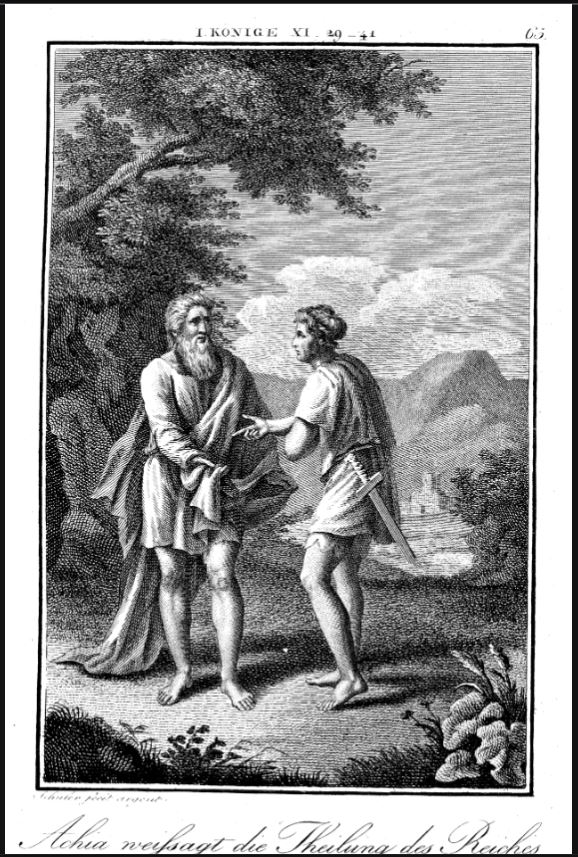
* The illustration, "Jeroboam and Ahijah" by Ewald, Johann Ludwig (1748-1822), is now in public domain. This is from the book, "Erklärung der hundert Kupfer der Heiligen Schriften des Alten Testaments / von J. L. Ewald".
Ahijah meets Jeroboam on the road and tells him that he will be given the kingdom of Israel. As a prophetic sign, Ahijah tears his new garment into twelve pieces and tells Jeroboam to take ten, representing the ten tribes of Israel that he will be given. The engraver, Carl Schuler, has placed his signature at the bottom left. As the numeral at the top right indicates, this is plate #65 in a series of illustrations. Courtesy Pitts Theological Society.
>7. Who was Jeroboam? (26)
* 1 Kings 11:26 "Also, Jeroboam son of Nebat rebelled against the king. He was one of Solomon's officials, an Ephraimite from Zeredah, and his mother was a widow named Zeruah."
* 2 Chronicles 10:1 thru 11:23 also records Jeroboam. 1 Kings gives more detail.
*
*
*
* Israel did not calculated a king's ascension and reign as other nations. After Israel and Judah split Judah kept calculating to "old way" and Israel switched and started calculating the way other nations did around them. Read The Mysterious Numbers of the Hebrew Kings by Edwin Richard Thiele for more understanding on how Israel and Judah calculated the dates of their king's ascension and reign.
>What did Solomon see in him? (27-28)
* 1 Kings 11:27-28 "Here is the account of how he rebelled against the king: Solomon had built the supporting terraces and had filled in the gap in the wall of the city of David his father. Now Jeroboam was a man of standing, and when Solomon saw how well the young man did his work, he put him in charge of the whole labor force of the house of Joseph."
*
*
*
*
>8. Did Jeroboam seek high position? (29-30)
* 1 Kings 11:29-30 "About that time Jeroboam was going out of Jerusalem, and Ahijah the prophet of Shiloh met him on the way, wearing a new cloak. The two of them were alone out in the country, and Ahijah took hold of the new cloak he was wearing and tore it into twelve pieces."
*
*
*
*
>Was it clear to him how he was going to become a leader? (31)
* 1 Kings 11:31 "Then he said to Jeroboam, "Take ten pieces for yourself, for this is what the LORD, the God of Israel, says: 'See, I am going to tear the kingdom out of Solomon's hand and give you ten tribes."
*
*
*
*
>Was the boundaries made clear to him? (32-33)
* 1 Kings 11:32-33 "But for the sake of my servant David and the city of Jerusalem, which I have chosen out of all the tribes of Israel, he will have one tribe. I will do this because they have forsaken me and worshiped Ashtoreth the goddess of the Sidonians, Chemosh the god of the Moabites, and Molech the god of the Ammonites, and have not walked in my ways, nor done what is right in my eyes, nor kept my statutes and laws as David, Solomon's father, did."
*
*
*
*
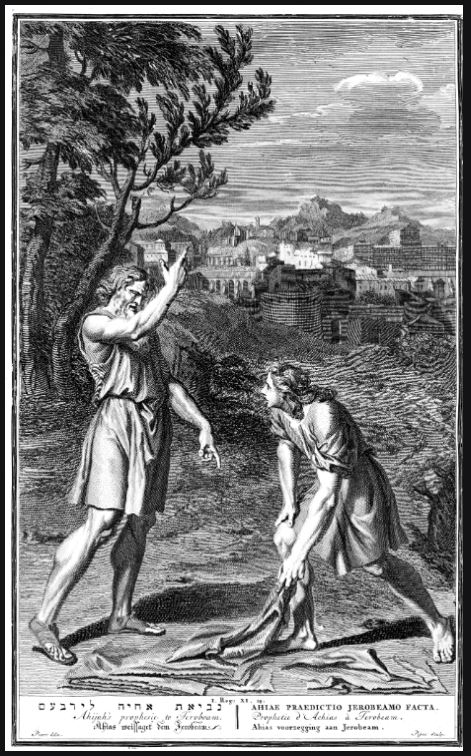
* The illustration, "Jeroboam and Ahijah Pointing" is now in public domain. This is from the book, "Taferelen der voornaamste geschiedenissen van het Oude en Nieuwe Testament en andere boeken, bij de heilige schrift gevoegt / door de vermaarde kunstenaars Hoet, Houbraken, en Picart getekent, en van de beste meesters in koper gesneden, en met beschrijvingen uitgebreid.".
Ahijah indicates the twelve pieces of his garment and points to heaven. Jeroboam takes pieces from the ground. Engraved by Nicolas Pigne from the design of Bernard Picart (1673-1733). Courtesy Pitts Theological Society.
>Is there anyone in a leadership position that the Lord didn't put there? (Psalm 22:27-28, 103:19)
* Psalm 22:27-28 "All the ends of the earth will remember and turn to the LORD, and all the families of the nations will bow down before him, for dominion belongs to the LORD and he rules over the nations."
* Psalm 103:19 "The LORD has established his throne in heaven, and his kingdom rules over all."
*
*
*
>9. Why did the Lord keep some of the kingdom in David's line? (34; 2 Samuel 7:11b-16)
* 1 Kings 11:34 "'But I will not take the whole kingdom out of Solomon's hand; I have made him ruler all the days of his life for the sake of David my servant, whom I chose and who observed my commands and statutes."
* 2 Samuel 7:11b-16 "I will also give you rest from all your enemies. "'The LORD declares to you that the LORD himself will establish a house for you: When your days are over and you rest with your fathers, I will raise up your offspring to succeed you, who will come from your own body, and I will establish his kingdom. He is the one who will build a house for my Name, and I will establish the throne of his kingdom forever. I will be his father, and he will be my son. When he does wrong, I will punish him with the rod of men, with floggings inflicted by men. But my love will never be taken away from him, as I took it away from Saul, whom I removed from before you. Your house and your kingdom will endure forever before me; your throne will be established forever.'"
*
*
*
>How was the kingdom to be divided? (35-37)
* 1 Kings 11:35-37 "I will take the kingdom from his son's hands and give you ten tribes. I will give one tribe to his son so that David my servant may always have a lamp before me in Jerusalem, the city where I chose to put my Name. However, as for you, I will take you, and you will rule over all that your heart desires; you will be king over Israel."
*
*
*
*
>How would Jeroboam remain king over the ten tribes of Israel? (38-39)
* 1 Kings 11:38-39 "If you do whatever I command you and walk in my ways and do what is right in my eyes by keeping my statutes and commands, as David my servant did, I will be with you. I will build you a dynasty as enduring as the one I built for David and will give Israel to you. I will humble David's descendants because of this, but not forever.'"
*
*
*
*
>Did the promise come right away and easily? (40)
* 1 Kings 11:40 "Solomon tried to kill Jeroboam, but Jeroboam fled to Egypt, to Shishak the king, and stayed there until Solomon's death."
*
*
*
*
*
Solomon Disciplined
>10. Why were only some of Solomon's life recorded in the Bible? (41)
* 1 Kings 11:41 "As for the other events of Solomon's reign--all he did and the wisdom he displayed--are they not written in the book of the annals of Solomon?"
*
*
*
*
>What does "rested with his fathers" mean? (42-43)
* 1 Kings 11:42-43 "Solomon reigned in Jerusalem over all Israel forty years. Then he rested with his fathers and was buried in the city of David his father. And Rehoboam his son succeeded him as king."