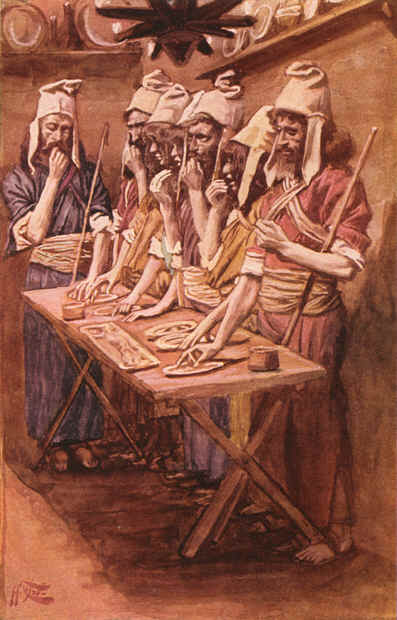
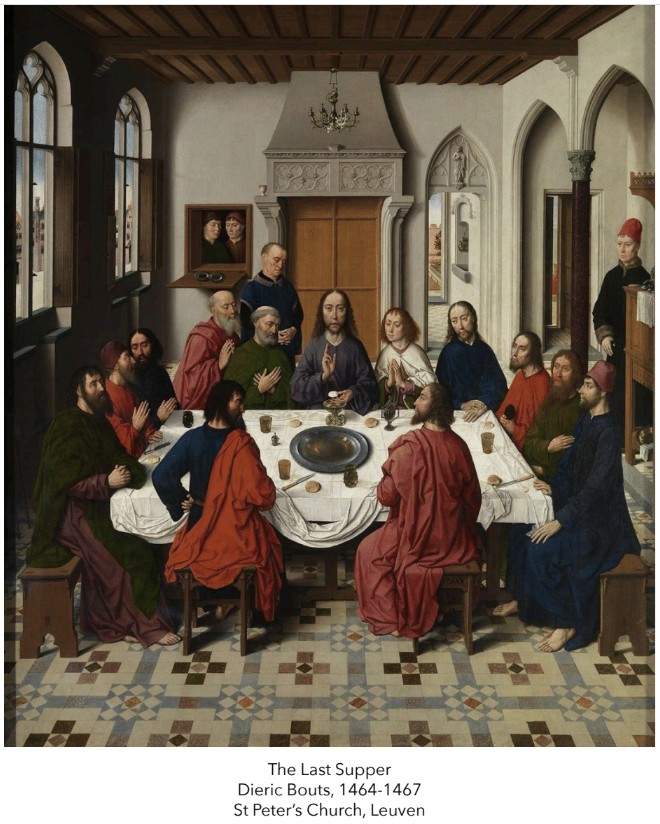
* The Jews' Passover, by James Tissot (1836-1902).
>1. Whose spiritual forefathers does Paul use as an example? (1a; Exodus 14:21-22, 16:11-12, 17:6, 19:5-9)
* 1 Corinthians 10:1a "For I do not want you to be ignorant of the fact, brothers, that our forefathers..."
*
Chapter 10 Overview.
Chapter 10 is a conclusion of Paul's comments in the previous 2 chapters. Paul is still answering the question is it right to eat meat offered to idols. I read about what took place in ancient temples built for various idols. It helps in understanding this question and Paul's answer.
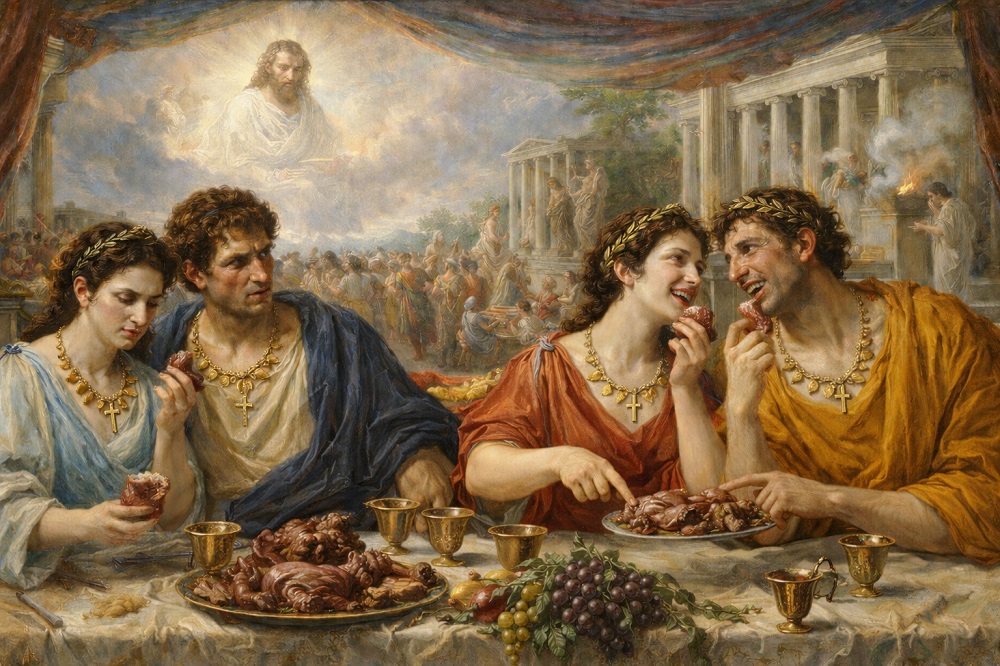
Idol worship started with slaughtering animals at the idol. The offering blood would pour out on the idol. Some would drink the blood. The meat would be prepared and the gatherers would eat. If any food was left over it would be sold in the marketplace. The food was paid for by the worshippers. The more money spent, the better meat choices and seats.
While they ate they would be entertained with dance usually very provocative and seductive. Again the more money spent the better performance and seats. After they ate and were entertained the worshipers would partake in dance and reverie. Idolatry included wild sensual parties and orgies. Many prostitutes were there. For the right price, an idol worshiper could purchase a prostitute. One temple in Corinth had 1,000 prostitutes.
Paul told the Christians in Corinth that they could eat the meat at the temple and that which was sold at the marketplace. However, he said that they should not partake in prostitution that included idol worship. Instead, they should stay true to their wives and husbands.
Paul uses ancient Israel as an example and a warning to the Corinthian congregation and me. Israel was lead out of Egypt by the grace of God. God gave Israel all kinds of gifts including mana, meat, protection, water, and promises. They were baptized when they went through the Red Sea. They were under the cloud canopy when they received the Old Covenant. Even though Israel received all this they fell from grace for various reasons including the same type of idolatry practiced in Corinth.
The church and I are in parallel with ancient Israel. I have received all kinds of gifts similar if not the same or better than Israel. I should take heed and learn not to grumble and complain nor give up and indulge in modern idolatry. I should not set my heart on evil things as Israel did. I should not test Christ.
Yet I need not fear for "he will not let me be tempted beyond what I can bear. But when I am tempted, he will also provide a way out so that I can endure it."
Listen to the above Chapter 10 Overview.
* Exodus 14:21-22 "Then Moses stretched out his hand over the sea, and all that night the LORD drove the sea back with a strong east wind and turned it into dry land. The waters were divided, and the Israelites went through the sea on dry ground, with a wall of water on their right and on their left."
* Exodus 16:11-12 "The LORD said to Moses, "I have heard the grumbling of the Israelites. Tell them, 'At twilight you will eat meat, and in the morning you will be filled with bread. Then you will know that I am the LORD your God.'"
* Exodus 17:6 "I will stand there before you by the rock at Horeb. Strike the rock, and water will come out of it for the people to drink." So Moses did this in the sight of the elders of Israel."
* Exodus 19:5-9 "Now if you obey me fully and keep my covenant, then out of all nations you will be my treasured possession. Although the whole earth is mine, you will be for me a kingdom of priests and a holy nation.' These are the words you are to speak to the Israelites." So Moses went back and summoned the elders of the people and set before them all the words the LORD had commanded him to speak. The people all responded together, "We will do everything the LORD has said." So Moses brought their answer back to the LORD. The LORD said to Moses, "I am going to come to you in a dense cloud, so that the people will hear me speaking with you and will always put their trust in you." Then Moses told the LORD what the people had said."
* "that our forefathers" -The Israelites who was lead out of Egypt and slavery to Mount Sinai.
>How does this equate with the Christian experience? (1b-4a; Jeremiah 31:31; Rom. 5:5, Matt. 28:19-20; Luke 22:19-20; John 6:56-58)
* 1 Corinthians 10:1b-4a "...were all under the cloud and that they all passed through the sea. They were all baptized into Moses in the cloud and in the sea. They all ate the same spiritual food and drank the same spiritual drink; for they drank from the spiritual rock that accompanied them, and that rock was Christ."
* Jeremiah 31:31 "The time is coming," declares the LORD, "when I will make a new covenant with the house of Israel and with the house of Judah."
* Romans 5:5 "And hope does not disappoint us, because God has poured out his love into our hearts by the Holy Spirit, whom he has given us."
* Matthew 28:19-20 "Therefore go and make disciples of all nations, baptizing them in the name of the Father and of the Son and of the Holy Spirit, and teaching them to obey everything I have commanded you. And surely I am with you always, to the very end of the age."
* Luke 22:19-20 "And he took bread, gave thanks and broke it, and gave it to them, saying, "This is my body given for you; do this in remembrance of me." In the same way, after the supper he took the cup, saying, "This cup is the new covenant in my blood, which is poured out for you."
* John 6:56-58 "Whoever eats my flesh and drinks my blood remains in me, and I in him. Just as the living Father sent me and I live because of the Father, so the one who feeds on me will live because of me. This is the bread that came down from heaven. Your forefathers ate manna and died, but he who feeds on this bread will live forever.""
* "were all under the cloud" -During the day the column was a cloud. During the night a fire to lead their way. The cloud produced a canapy to provide shade from the hot desert sun. God's protection and continual sign of his presence..
* "baptized into Moses in the cloud and in the sea" -The sea was the Red sea. They did not get wet in either, for like water baptism, they were symbols.
* "ate the same spiritual food" -Mana and qual.
* "drank the same spiritual drink" -The water from the split rock.
* "drank from the spiritual rock that accompanied them" -See note below, 2a.
* From the Artsy Bible.
>2. Who is Israel's true leader? (2b, 4b; Gen. 49:24-25; Deut. 32:3-4, 15-18)
* 1 Corinthians 10:2, 4 "They were all baptized into Moses... and that rock was Christ."
* Genesis 49:24-25 "But his bow remained steady, his strong arms stayed limber, because of the hand of the Mighty One of Jacob, because of the Shepherd, the Rock of Israel, because of your father's God, who helps you, because of the Almighty, who blesses you with blessings of the heavens above, blessings of the deep that lies below, blessings of the breast and womb."
* Deuteronomy 32:3-4 "I will proclaim the name of the LORD. Oh, praise the greatness of our God! He is the Rock, his works are perfect, and all his ways are just. A faithful God who does no wrong, upright and just is he."
* Deuteronomy 32:15-18 "Jeshurun (Israel) grew fat and kicked; filled with food, he became heavy and sleek. He abandoned the God who made him and rejected the Rock his Savior. They made him jealous with their foreign gods and angered him with their detestable idols. They sacrificed to demons, which are not God-- gods they had not known, gods that recently appeared, gods your fathers did not fear. You deserted the Rock, who fathered you; you forgot the God who gave you birth."
* "and that rock was Christ" -A few propose the rock moved, other point out the impossibility since the split rock was found. Most say that the following is meant that as the water flowed out of the rock it acted as a source of a river that flowed through the desert with the mouth around the rock being a small lake. Evedence of a lake with a river flowing out of it exists at the split rock in desert at Mount Sinai.
The image is the continual flow of water represents the continue presence of God with the Israelites, who supplied all their needs.
>Even though he rescued and provided for them, what happened to most? (5; Exodus 32:33-34; Num. 11:1, 14:20-24)
* 1 Corinthians 10:5 "Nevertheless, God was not pleased with most of them; their bodies were scattered over the desert."
* Exodus 32:33-34 "The LORD replied to Moses, "Whoever has sinned against me I will blot out of my book. Now go, lead the people to the place I spoke of, and my angel will go before you. However, when the time comes for me to punish, I will punish them for their sin."
* Numbers 11:1 "Now the people complained about their hardships in the hearing of the LORD, and when he heard them his anger was aroused. Then fire from the LORD burned among them and consumed some of the outskirts of the camp."
* Numbers 14:20-24 "The LORD replied, "I have forgiven them, as you asked. Nevertheless, as surely as I live and as surely as the glory of the LORD fills the whole earth, not one of the men who saw my glory and the miraculous signs I performed in Egypt and in the desert but who disobeyed me and tested me ten times-- not one of them will ever see the land I promised on oath to their forefathers. No one who has treated me with contempt will ever see it. But because my servant Caleb has a different spirit and follows me wholeheartedly, I will bring him into the land he went to, and his descendants will inherit it."
* Calvin wrote, "Beware of glorying in any peculiar privilege, as if you were in higher esteem than they were in the sight of God. For they were favored with the same benefits as we at this day enjoy; there was a Church of God among them, as there is at this day among us; they had the same sacraments, to be tokens to them of the grace of God; but, on their abusing their privileges, they did not escape the judgment of God. Be afraid, therefore; for the same thing is impending over you. Jude makes use of the same argument in his Epistle. (Jude 1:5.) (Calvin's Commentaries.)
* Not Pleased Parallel.
The lessons from the Old Testament are numerous. The apostles learned from Jesus, and the Holy Spirit revealed multiple truths within the historical accounts of the Old Testament. Apostle Paul learned the parallels between Israel that was led out of Egypt and slavery to Mount Sinai, our forefathers, and the new church. Paul conveyed this truth to the Corinthian congregation as a warning.
A cloud led the Israelites in the desert. They were under God's leadership and guidance. (Exodus 13:21-22; Numbers 9:15-23; 14:14, Deuteronomy 1:33; Psalm 78:14) The cloud led them through the Red Sea on the way to Mount Sinai. (Exodus 14:22, 29) These parallel the Christian baptisms of the Holy Spirit and water, both of God's leading. (John 3:5; Acts 22:16)
Manna is paralleled to the bread that Jesus said represents his body (Exodus 16:31; John 6:30-35, 6:49-51, 58; Luke 22:19). Jesus told the Jews after he fed the five thousand, "Your forefathers ate the manna in the desert, yet they died. -But here is the bread that comes down from heaven, which a man may eat and not die. -I am the living bread that came down from heaven. If anyone eats of this bread, he will live forever. This bread is my flesh, which I will give for the life of the world."
Similarly, the water from the rock for Israel parallels the wine that represents Jesus' blood poured out for the salvation of many. (Exodus 16:2-36, 17:6; Numbers 20:2-11, 7-13, 21:16) Jesus told us that the blood seals the new covenant. We drink it to remember Jesus. (11:25; Luke 22:20; John 4:14)
The fact is, before the old covenant was sealed at the foot of the mountain, God was not pleased with many Israelites, and they died. They were not part of the old covenant. Now it is the same with us; the apostle was inspired to warn. Should God become displeased with some in the congregation, He too will not allow them to be part of the sealing of the new covenant. More in the next verses and BDBD.
Listen to the above comments on 1 Corinthians 10:1-5.
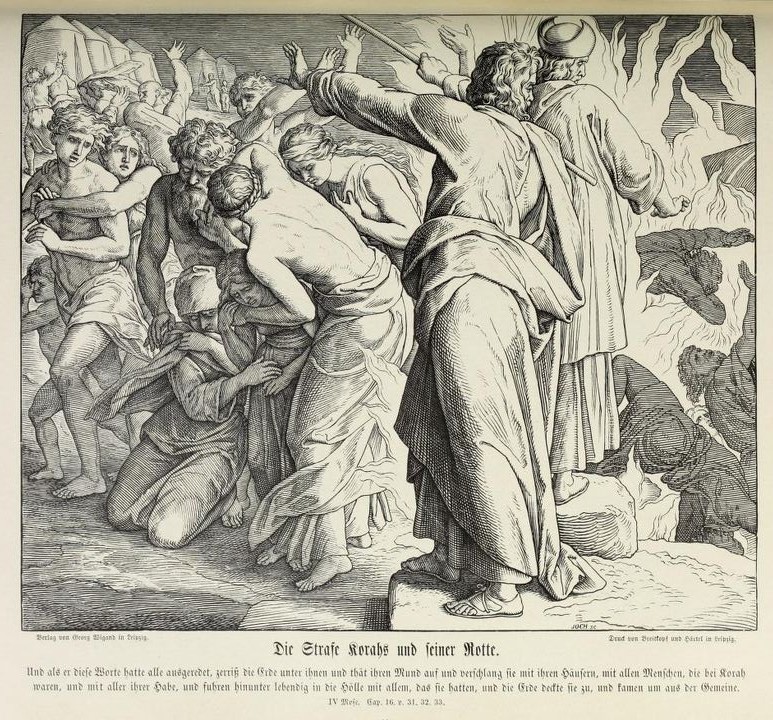
* The artwork depicts the punishment from God on the Israelites for their sins after they were lead out of Egypt and slavery. (Numbers 11:1-3, 16:35, 26:10, 61; Deuteronomy 32:22) Its from "The Picture Bible" (aka "The Bible in Pictures") by Julius Schnorr von Carolsfeld (1794-1872), published by Georg Wigandin in Leipzig, Germany in 1850 (in English in 1861).
>3. What can we learn not to do? (6)
* 1 Corinthians 10:6 "Now these things occurred as examples to keep us from setting our hearts on evil things as they did."
* "Now these things occurred as examples" -The rest of the chapter contains examples from Israel's Exodus and the change Jesus made to the Passover.
* "setting our hearts on evil things" -Against God and his will. When Adam and Eve sinned they set their heats on evil things.
>How can a Christian "sit down and indulge in pagan revelry"?
* 1 Corinthians 10:7 "Do not be idolaters, as some of them were; as it is written: "The people sat down to eat and drink and got up to indulge in pagan revelry."
* Paul quoted Exodus 32:5-6 which says, "When Aaron saw this, he built an altar in front of the calf and announced, "Tomorrow there will be a festival to the LORD." So the next day the people rose early and sacrificed burnt offerings and presented fellowship offerings. Afterward they sat down to eat and drink and got up to indulge in revelry."
* "Do not be idolaters" -Someone who makes a decision to follow, and makes a confession, can change their mind and sin. Such is what Judas did. Such is what many in Israel did. Judas loved money and what it could buy. Israel was full of sexual desire.
* Idolatry and sexual immorality are usually linked in the Old and New Testaments. False religions to this day are laden with sinful sex and marriages.
>How is sexual immorality wrong in all ages? (8)
* 1 Corinthians 10:8 "We should not commit sexual immorality, as some of them did--and in one day twenty-three thousand of them died."
* Exodus 32:28 'The Levites did as Moses commanded, and that day about three thousand of the people died."
* Numbers 25:1-18 speaks of the seduction of the Moab woman and Psalms 106:29 also speak of the plague.
* Perhaps the Moab woman could succeed in seducing the Israelite men because the Israelite women did not show their husbands respect and were reserved in pleasing their husbands. I am assuming that some, if not all of the Israelites that were seduced were married. Yet, it the end the men were at fault for the adultery for they did not express love to their wives. This would be the reason that Paul said earlier that the body is not their own, but it is their spouses and they are to please each other.
* Idolatry and Sexual Immorality.
Sexual immorality was rebuffed in 6:12-20, "Flee from sexual immorality," the Holy Spirit commands through Apostle Paul. Now again, the Spirit, through Paul, uses Israel's Exodus as an example, showing us what happens when one who is called by Christ and begins following Christ does not flee sexual immorality.
While Moses was on Mount Sinai receiving the commandments of the Covenant, the Israelites became impatient. They made excuses, built a gold idol that looked like a calf, worshipped it, feasted and drank, and got up to indulge in pagan revelry, that is, in an orgy. Their actions were the same as those of Greek pagans in Corinth.
False religious worship and sexual immorality almost always go hand-in-hand. Both the Old and New Testaments forbid these actions. "We should not commit sexual immorality, as some of them did - and in one day, twenty-three thousand of them died." (8) That is a stern warning. If you are in a group that is religious and practices and/or encourages un-biblical sex and marriages, get out now. Practice only one man and one woman under a covenant as Christ's covenant with the church.
There are many reasons a couple, bonded by their covenant of marriage, may experience problems. I recommend a good short book titled "Love & Respect: The Love She Most Desires; The Respect He Desperately Needs." The book is based on Ephesians 5:22-33 and Colossians 3:19. Add to these two verses the important coming chapter 13 concerning love. Begin practicing this kind of love, husband. Begin respecting your husband in this way, wife.
Listen to the above comments on 1 Corinthians 10:6-10.
>What does it mean to "test the Lord"? (9; Num. 21:4-6)
* 1 Corinthians 10:9 "We should not test the Lord, as some of them did--and were killed by snakes."
* Numbers 21:4-6 "They traveled from Mount Hor along the route to the Red Sea, to go around Edom. But the people grew impatient on the way; they spoke against God and against Moses, and said, "Why have you brought us up out of Egypt to die in the desert? There is no bread! There is no water! And we detest this miserable food!" Then the LORD sent venomous snakes among them; they bit the people and many Israelites died."
* We should not test the Lord, as some of them did" -The test was by speaking against God and against Moses. Doubting God's love and not trusting God. Trying to trick God into getting more, the things they had in Egypt when they were slaves.
* "and were killed by snakes." -Jesus referred to this incident. He said that he would be lifted up on a pole as the snake was to save the people from their sins. (John 3:14)
* "This murmuring of the people Paul speaks of as a tempting; and not without good reason, for tempting is opposed to patience. What reason was there at that time why the people should rise up against God, except this that, under the influence of base desire, they could not wait in patience the arrival of the time appointed by the Lord? Let us, therefore, take notice, that the fountain of that evil against which Paul here warns us is impatience, when we wish to go before God, and do not give ourselves up to be ruled by Him, but rather wish to bind him to our inclination and laws. This evil God severely punished in the Israelitish people. Now he remains always like himself a just Judge. Let us therefore not tempt him, if we would not have experience of the same punishment." (John Calvin and John Pringle, Commentaries on the Epistles of Paul the Apostle to the Corinthians, vol. 1 p. 325)
>When are we tempted to grumble? (10)
* 1 Corinthians 10:10 "And do not grumble, as some of them did--and were killed by the destroying angel."
* Numbers 14:26-29 "The LORD said to Moses and Aaron: "How long will this wicked community grumble against me? I have heard the complaints of these grumbling Israelites. So tell them, 'As surely as I live, declares the LORD, I will do to you the very things I heard you say: In this desert your bodies will fall--every one of you twenty years old or more who was counted in the census and who has grumbled against me."
* "And do not grumble, as some of them did" -The speaking against is the same as grumbling here. The Greek word here is the same Hebrew word in Numbers 14.
* 1 Corinthians 10:11 "These things happened to them as examples and were written down as warnings for us, on whom the fulfillment of the ages has come."
* "These things happened to them as examples" -Stated in verse 6, but with a different ending to the sentance. This verse is general.
* "and were written down as warnings for us" -Verse 6 says, "...to keep us from setting our hearts on evil things..." The two are the same.
>What does "the fulfillment of the ages has come"?
* "on whom the fulfillment of the ages has come." -The Bible splits up God's interaction with man into ages. God has given to the present age examples from past ages examples so we would not fail as they did, and not receive punishment and exclusion as they did.
* Romans 15:4; Hebrews 1:2.
>What is a common misconception of some who heard the gospel, believed it, but did not act upon it? (12)
* 1 Corinthians 10:12 "So, if you think you are standing firm, be careful that you don't fall!"
* "standing firm... fall" -A new illustration in the letter. However, not new to the Bible. Jesus called his disciples saying, "Follow me." So they walked, following him to learn from him, what he said and what he did. If they took their eyes off Jesus ever moving on, look at what has been accomplished and where they are as opposed to where they began, then they could stumble and fall and perhaps even lose sight of him and get lost, not knowing where to go next. Wouldn't this happen to an Israelite in the desert?
* Jesus said, "Why do you call me, "Lord, Lord," and do not so what I say? He also said, "If you love me you will keep my command."
>5. Does God test our faith as he tested the Israelites? (13)
* 1 Corinthians 10:13 "No temptation has seized you except what is common to man. And God is faithful; he will not let you be tempted beyond what you can bear. But when you are tempted, he will also provide a way out so that you can stand up under it."
* 1 Thessalonians 2:4 "On the contrary, we speak as men approved by God to be entrusted with the gospel. We are not trying to please men but God, who tests our hearts."
* "No temptation has seized you except what is common to man." -"Ancient teachers often pointed out that adversities come to everyone, and that one should not be proud but submit to what comes one's way. But whereas pagan writers emphasized human will, Paul emphasizes God's faithfulness." (Craig S. Keener, The IVP Bible Background Commentary: New Testament, Downers Grove, IL: InterVarsity Press, 1993)
* "And God is faithful" -To his people. He "provides a way out".
* "he will not let you be tempted beyond what you can bear." -Implying that when tempted, we have the ability to overcome. What the Lord visited Cain he said, "Sin is crouching at your door, but you must master it." Cain was tempted. He had the ability to resist. He did not.
* "so that you can stand up under it." -We have no excuse. God gives us the ability to remain standing. We must have the will and determination to resist.
>Why? (Luke 16:10-12)
* Luke 16:10-12 "Whoever can be trusted with very little can also be trusted with much, and whoever is dishonest with very little will also be dishonest with much. So if you have not been trustworthy in handling worldly wealth, who will trust you with true riches? And if you have not been trustworthy with someone else's property, who will give you property of your own?"
* God is seeing how will will respond. What decision will we make?
>If we fail a test can we blame God?
* No. He provides a way out. He never lets us be tempted more than we can overcome (bear).
>What should we do if we do fail when we are tested?
* Apostle John in his letter tells us.
* Jesus told his disciples when he washed his feet at the last supper. "You have been washed. You only need your feet cleaned."
* Best of Ages, Worst of Ages.
The fulfillment of ages came in Christ Jesus and continues (11). The day has begun and continues. The new age commences till this moment. The New Covenant in Christ's blood is now. The best of ages, the worst of ages, inaugurated by Christ's death, resurrection, and sending the Holy Spirit on Pentecost, and continues until Christ's coming and beyond, is my now. Today is the period of fulfillment, when all that God has been doing for his people throughout previous ages comes to its fruition in the Messiah (Mark 10:30).
The bridegroom stands waiting for his bride. He was crucified, so she will be white as snow (Isaiah 1:18). The happenings of ages past were written down for those called now as a warning (Psalm 102:18). The ones called should not think we stand firm (12). We need to be careful not to fall (12). We will be tempted (13). We will be tested (Psalm 66:10; Isaiah 48:10). All will be tempted. Temptation is not unusual, especially for those called (13; Hebrews 6:8).
Who can withstand all the tests? When the soldier is about to drive the nail into the hand, who will not scream stop? When they hurl stones, will I say, "Forgive them," and look to Jesus on the right hand of God? God is faithful; he will not let me be tempted beyond what I can bear. He will provide a way out so that I can stand up under it (13). I need to take the way he provides.
Listen to the above comments on 1 Corinthians 10:11-13.
II. Feasts and the Lord's Supper (10:14-22)
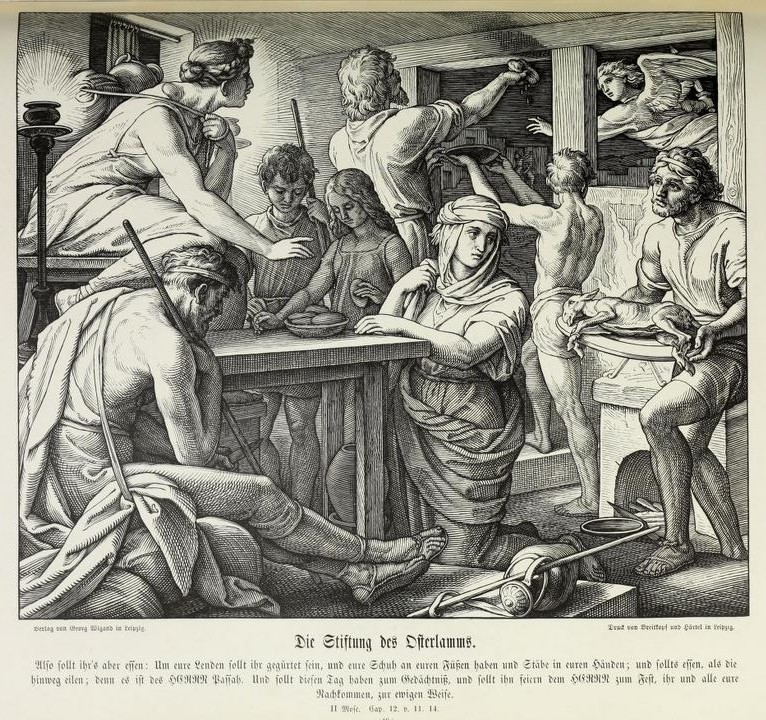
* "The First Israelite Passover" observed in Egypt from "The Picture Bible" (aka "The Bible in Pictures") by Julius Schnorr von Carolsfeld (1794-1872), published by Georg Wigandin in Leipzig, Germany in 1850 (in English in 1861).
>6. What remembrance given by Jesus does Paul mention? (14-17)
* 1 Corinthians 10:14-17 "Therefore, my dear friends, flee from idolatry. I speak to sensible people; judge for yourselves what I say. Is not the cup of thanksgiving for which we give thanks a participation in the blood of Christ? And is not the bread that we break a participation in the body of Christ? Because there is one loaf, we, who are many, are one body, for we all partake of the one loaf."
* "cup of thanksgiving for which we give thanks" -Four cups of wine (or grape juice) are formally required to be consumed during the Passover Seder. Each cup corresponds to one of the four expressions of redemption promised by God in the Book of Exodus (6:6-7) and represents freedom, joy, and celebration.
Cup 1: Sanctification (Kiddush): The opening cup, which sanctifies the festival.
Cup 2: Proclamation/Judgment (Maggid): Drunk after telling the story of the Exodus, often associated with the 10 plagues.
Cup 3: Redemption (Birkat Hamazon): Consumed after reciting the blessing for the meal.
Cup 4: Praise and Thanksgiving (Hallel): The final cup drunk after singing praises of God. Hallel is the root word of "Hallelujah".
* "flee from idolatry" -Paul is repeating what he said before.
* "participation... partake... part" -Key words in verses 14-22, repeated many times. The Greek noun repeated twice in verse 16 is "koinonia" is similar to the noun in verses 18 and 20 "koinonos" (transliterations). The KJV and ASV translates the first "communion" in verse 16 and the second "partakers" in verse 18 and "fellowship" in verse 20. The Greek verb "metecho" in verses 17 and 21 is translated "partakers" in the KJV. Other English translations have "sharing" and "share", and "fellowship".
* 1 Corinthians 6:17, "But whoever is united with the Lord is one with him in spirit."
* Blood and Body.
After presenting the parallels between Israel during the Exodus to the church as a warning to us, a command is given, "...flee from idolatry" (14). Building on this, Apostle Paul presents communion, (aka "The Lord's Supper") as the Messiah Jesus transformed the Passover for the New Covenant for the church into The Lord's Supper.
One of the cups drunk at the Jewish Passover is called the Thanksgiving Cup. Jesus took this cup and transformed it. He took the Thanksgiving Cup and turned it into a memorial of his blood sacrifice (Matthew 26:27; Mark 14:23; Luke 22:17). He said, "This cup is the new covenant in my blood; do this, whenever you drink it, in remembrance of me." (11:25) We are not literally drinking his blood. We are remembering the blood he shed for us. Jesus blood flows through all of us for it is taken from the same source and given to all those who believe in Jesus. All partake in the blood of Christ (16a).
During the first Lord's Supper, Jesus took one loaf and broke it into pieces. Each of those present ate a piece of the loaf. "This is my body given for you; do this in remembrance of me. Take and eat; this is my body." (11:24; Matthew 26:26; Mark 14:22; Luke 22:19) Through this, Jesus displayed that each believer is a part of the body of Christ. We come from the same loaf, which is Christ (17). This truth Paul has made earlier in the letter. All partake in the body of Christ (16b).
Just as the Trinity is three yet one. So, Christ in us is one, and we are many. Therefore, there should be no division in Christ. There should be no arguing. Where there are differences, it is better to practice love over winning the argument. Allow the Holy Spirit to answer prayers for the truth and love to win the argument.
Listen to the above comments on 1 Corinthians 10:14-17.
>What is Paul referring to in verse 18?
* 1 Corinthians 10:18 "Consider the people of Israel: Do not those who eat the sacrifices participate in the altar?"
* "Consider the people of Israel" -As found in the books of Moses, the first five books of the Bible.
* "Do not those who eat the sacrifices participate in the altar?" -The Levites were allowed a portion. The person who gave the offering were allowed a portion of the offering.
* Those who eat the sacrifices were identifying with God and worshiping him, who established the sacrifices and whose alter it was.
* Leviticus 7:15, 8:31 and Deuteronomy 12:17-18 states that the offering must be eaten at the place the Lord designates, not in their homes and it must be eaten the day it is offered.
>An idol is not a god, however, what is a hidden truth of offering to one? (19-20)
* 1 Corinthians 10:19-20 "Do I mean then that a sacrifice offered to an idol is anything, or that an idol is anything? No, but the sacrifices of pagans are offered to demons, not to God, and I do not want you to be participants with demons."
* "Do I mean then that a sacrifice offered to an idol is anything... No..." -An idol is not a god. They are stone and word. They have no real power.
* "or that an idol is anything? No..." -Somewhere earlier in 1 Corinthian commentary I wrote about the Greek Parthenon of gods. But I cannot find it now and neither can my search engine. Oh bother.
* "the sacrifices of pagans are offered to demons, not to God" -Demons look to those who offer sacrifices to idols to see how easily they can enter and control the person. They see in those offering an opportunity.
* "I do not want you to be participants with demons." -People, whether willingly or not willingly, whether knowingly or not knowingly, work in conjunction with demons. They partake, are in union with, the work of evil spirits. Evil spirit work against God. They try to disrupt the work of Jesus. Those who join in those work are therefore against God. Judas was against Jesus, though one of the twelve.
The 12 Major Greek Olympians gods and Their Powers
Zeus (Jupiter): King of the gods, ruler of Mount Olympus, sky, weather, thunder, and justice.
Hera (Juno): Queen of the gods, goddess of marriage, women, childbirth, and family.
Poseidon (Neptune): God of the sea, water, earthquakes, storms, and horses.
Athena (Minerva): Goddess of wisdom, strategic war, defense, and crafts.
Apollo (Apollo): God of light, the sun, prophecy, music, poetry, healing, and archery.
Artemis (Diana): Goddess of the hunt, wilderness, wild animals, and childbirth.
Ares (Mars): God of war, violence, bloodshed, and manly virtues.
Aphrodite (Venus): Goddess of love, beauty, desire, and pleasure.
Hephaestus (Vulcan): God of fire, blacksmiths, metalworking, and craftsmanship.
Hermes (Mercury): Messenger of the gods, god of travel, trade, theft, and speed.
Demeter (Ceres): Goddess of agriculture, harvest, fertility, and the seasons.
Dionysus (Bacchus) or Hestia (Vesta): Dionysus is often listed as the 12th Olympian, representing wine, theater, and fertility. Hestia, goddess of the hearth and home, is sometimes included instead.
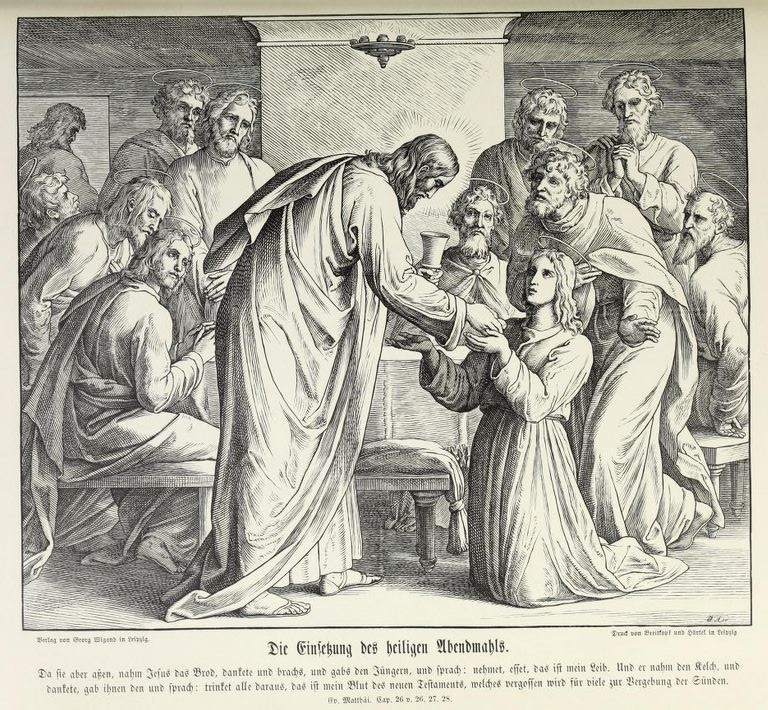
* A drawing depicting Jesus giving bread and a cup of wine to one the the twelve apostles. Judas is in the left back walking out the door. This is from "The Picture Bible" (aka "The Bible in Pictures") by Julius Schnorr von Carolsfeld (1794-1872), published by Georg Wigandin in Leipzig, Germany in 1850 (in English in 1861).
>7. What then are we not to do? (21)
* 1 Corinthians 10:21 "You cannot drink the cup of the Lord and the cup of demons too; you cannot have a part in both the Lord's table and the table of demons."
* "cup... table" -The represent fellowship and company of friends and lovers at a meal. We sit and enjoy a meal with family and friends. We share a cup and table. Jesus and demons are adversaries. How can we share a table with both? We would be a traitor as Judas was.
* Zechariah 1:14 "Then the angel who was speaking to me said, "Proclaim this word: This is what the LORD Almighty says: 'I am very jealous for Jerusalem and Zion,"
* Luke 22:3-4 "Then Satan entered Judas, called Iscariot, one of the Twelve. And Judas went to the chief priests and the officers of the temple guard and discussed with them how he might betray Jesus."
* Pagans spoke of the offering tables of their gods (e.g., the table of Serapis); most ancient Near Eastern temples had been equipped with such tables.
>What is this actually doing? (22)
* 1 Corinthians 10:22 "Are we trying to arouse the Lord's jealousy? Are we stronger than he?"
* "Are we trying to arouse the Lord's jealousy?" -The Lord loves us. He does not want to lose our affection and love to an idol, a piece of carved stone or wood. Jealousy here is vigilant in guarding what he loves and perhaps also intolerant of disloyalty or infidelity as a husband when his wife is unfaithful to the marriage covenant. The marriage covenant is to help us understand the covenant the Lord Jesus made with us.
* Psalm 79:5 "How long, O LORD? Will you be angry forever? How long will your jealousy burn like fire?"
* Zechariah 1:14 "Then the angel who was speaking to me said, "Proclaim this word: This is what the LORD Almighty says: 'I am very jealous for Jerusalem and Zion,"
>How does some of our modern day practices and acts equal the sacrifice of pagans?
* Partake in Christ, Partake Not is Demons.
The common subject in verses 14 through 22 is partake. Verses 14 through 17 establish that the Lord's Supper illustrates that as one body, the church partakes in fellowship with Christ Jesus. Verse 18 establishes that the temple sacrificial altar illustrates that, as one nation, Israel partook in fellowship with the Lord. Similarly, verse 20 establishes that idolatry is participating with demons (Deuteronomy 32:17, 37-39). Sitting at one's table means having fellowship with them. (Exodus 20:24, 24:5, 29:28; Malachi 1:7)
A sacrifice offered to an idol is nothing. An idol is nothing (19, 8:4; Isaiah 44:12-20, 45:20-25, 46:1-11; Psalm 106:28, 37; 1 John 1:3). However, since idolatry involves demons, how can a person who confesses in the name of Jesus and partakes of communion bread and wine also partake in things that involve demons? We cannot (21).
At this point, one might think, "What does this have to do with me in modern day? Temples? Idols? Demons? Sacrifices?" Since Christ is in the believer's body, since the Holy Spirit moves within a Christian's spirit, then that person is the temple of the living God (2 Corinthians 6:16), and offers their body as a living sacrifice, holy and pleasing to God - this is our spiritual act of worship. (Romans 12:1) We are known by what we partake of, what we have fellowship with, and where we spend our time. Do I offer myself to Jesus? Or perhaps something sinister?
Listen to the above comments on 1 Corinthians 10:18-22.
>8. What common Corinthian Christian phrase does Paul repeat and how does he counter? (23)
* 1 Corinthians 10:23 "Everything is permissible"--but not everything is beneficial. "Everything is permissible"--but not everything is constructive."
* 1 Corinthians 6:12 "Everything is permissible for me"--but not everything is beneficial. "Everything is permissible for me"--but I will not be mastered by anything."
* The ending of 6:12 is different than 10:23. Chapter 6:12-20 has to do with sexual immorality.
* Chapter 8 (the previous study commentary, section I) is where the subject of food sacrificed to idols begins.
* "permissible" -"Permissible" in the NIV, CSB, and HCSB, and "lawful" in the KJV, YLT, and ASV is from the Greek verb "exesti" (a transliteration), a third person singular presumed indicative of a compound of "ek" and "eimi" strickly meaning "out of an abundance I can", or "from an abundance it is possible".
* "beneficial" -CSB has the same translation as the NIV. KJV and ASV translates "expedient". HCSB and GW has "helpful". YLT has "profitable".
* "but not everything is constructive." -KJV and ASV have "edify not". HCSB, YLT, and CSB have "builds up". GW has "encourages growth". Personal freedom and desire for one's rights are not the only considerations. One must also consider "the good of others" (24, 8:1; Galatians 6:2) (NIV Study Bible)
* Greek teachers used criteria like "usefulness" to determine whether to undertake actions. Paul raises a rhetorical objection ("Everything is allowed") and then answers it ("But not everything is helpful"), as was common in ancient moral teaching. (Bible Background Commentary - The IVP Bible Background Commentary - New Testament)
>Whose benefit should we work for? (24)
* 1 Corinthians 10:24 "Nobody should seek his own good, but the good of others."
* Verse 33, 13:5, and Romans 15:1-2.
>Could a selfish Christian be equal to the sacrifice of pagans?
* Yes. The are sacrificing their life to themselves. They are making themselves god.
>9. Where did some of the meat in the market place come from in their society? (25-26)
* 1 Corinthians 10:25-26 "Eat anything sold in the meat market without raising questions of conscience, for, "The earth is the Lord's, and everything in it."
* "Eat anything sold in the meat market without raising questions of conscience" -One's own conscience because they know and believe that an idol is nothing, that is, the idol is not a god as it is advertised to be.
* 1 Timothy 4:4-5, 1:15.
* "without raising questions of conscience" -Many people in Roman and Greek culture could not afford meat. If they could it was the poor cuts sold at the markets. Being invited to someone's house that would be serving meat was an honor and delight.
* Seeking Other's Good Before Self.
Apostle Paul addresses eating meat offered to pagan idols, first addressed in chapter 8. There, he gave directions on eating the meat at the idol's temple (8:10). He said do not eat meat at the idol's temple, even though you rightfully know that an idol is nothing but stone and wood, because a fellow believer in Jesus with a weak conscience may see you there and be destroyed. (8:11).
Here, Apostle Paul, using the same Greek logical argument in 6:12, addresses buying the meat offered to an idol, but sold at the public markets called the "makellon" (aka by the archaic translation "shambles", an old English word for a slaughterhouse). (25) Though permissible, buying this meat there and eating it elsewhere may not be beneficial or constructive (23). The consideration remains: seek the good of others. Don't burn the conscience of others if they are too young in Christ to know there is nothing to an idol and its sacrifice (24, 8:4-8).
A mature servant in Christ does not seek their own good. Their hearts are set on glorifying God, enjoying him forever, and serving his church in holy fear of their master, Jesus. Yes, love will sustain us in sacrificial service. Yet, holy fear has its place in keeping us from succumbing to the temptations of selfish pursuit at others' expense.
Listen to the above comments on 1 Corinthians 10:23-26.
>What apparently was some of the Corinthian Christians concerned about? (27)
* 1 Corinthians 10:27 "If some unbeliever invites you to a meal and you want to go, eat whatever is put before you without raising questions of conscience."
* "If some unbeliever invites you to a meal and you want to go" -Some Christian groups will not to a meal of someone who is not a believer. They remain in their own community. They will not even witness to people they call themselves non-believers.
* Not quite, "What you do not know will not hurt you," but close. According to verses 25-26, they know it is ok. They don't ask because they don't want to damage the conscience of the non-believer. So its, "What you do not now will not hurt them. They will only ask themselves, 'I wander if they know this was offered to our god?'
* "without raising questions of conscience" -The non-believers conscience. Not their own.
* I assume that this had to be what Paul did when he first arrived in Corinth. He founded the congregation there. So, every place he ate that served meat probably was offered to idols. However, it is said that Jews had a small place that sold meat not offered to idols nor pork. But, when Paul visited someone not a Jew, he didn't know where they got it and did not ask so they would not be bothered in conscience. He would just say, "I did not know it was." In this, he would still be able to witness in word and action, as well as establish a relationship with them.
>If the source was made known why would it be best for them not to eat it? (28-30)
* 1 Corinthians 10:28-30 "But if anyone says to you, "This has been offered in sacrifice," then do not eat it, both for the sake of the man who told you and for conscience' sake-- the other man's conscience, I mean, not yours. For why should my freedom be judged by another's conscience? If I take part in the meal with thankfulness, why am I denounced because of something I thank God for?"
* Once the source was found out, consider the non-believer's conscience more important than your right.
* Consider the direction given at the Council in Jerusalem, "You are to abstain from food sacrificed to idols, from blood, from the meat of strangled animals..." (Acts 15:29). Was Paul going against this, countering this, or finding a loop hole to get around it?
Perhaps some may take this as a loop hole, evading the advice of the Council of Jerusalem with a technicality. However, the subject mater at hand is being invited over to someone's house who happens to be a non-believer like Peter was invited to Cornealis' household. They offer you to stay and eat a meal where they serve you meat. What do you do? Paul is saying, whether you know it or not eat the meat, but do not ask where it came from so that you can hopefully bring them to Christ. However, if they tell you it was sacrificed at a temple, then follow the Council in Jerusalem and abstain from eating it. Explain why you do not do so, though knowing full well, that an idol is nothing. That too must be explained, an idol is only stone or wood and no real god. This is a very good witness to the one true God.
* The Council in Jerusalem, recorded Acts 15 did not give reasons for their "requirements", or some translations have "necessary rules" and "necessary things". Paul's letter to Corinth is the best and perhaps only solid expounding of the "requirements".
>10. What should be our motivation? (31)
* 1 Corinthians 10:31 "So whether you eat or drink or whatever you do, do it all for the glory of God."
* "whatever you do" -The general principle appies to more than just eating meat sacrificed in the temple. This can apply to drinking wine, bear, and whiskey in moderation, if not an alcoholic). This can apply to all foods if not having an overeating and lack of exercise problem. This can apply to hobbies, habits, traditions, obligationsn, social groups, church activities, education, and occupation. This can apply to spending, hospitality, and charitable acts.
* "do it all for the glory of God."
* Conclusion.
>Who should we keep in mind? (32)
* 1 Corinthians 10:32 "Do not cause anyone to stumble, whether Jews, Greeks or the church of God--"
* "Jews" -Have not yet believed in Jesus as the Messiah.
* "Greeks" -Are still a pagan or atheist.
* "the church of God" -Can be translated "congregation of God" because of the multiple uses of "church" today. These are people who have put their faith in Jesus and live by their faith in him. They are active Christians.
* "Do not cause anyone to stumble" -Repeated.
>Why? (10:33-11:1)
* 1 Corinthians 10:33-11:1 "even as I try to please everybody in every way. For I am not seeking my own good but the good of many, so that they may be saved. Follow my example, as I follow the example of Christ."
* "even as I try to please everybody in every way" -Paul has stated this before.
* "so that they may be saved" -From the wrath of God.
* "Follow" -Earlier Paul gave an analogy of walking and not falling. Jesus said, "Follow me."
* For the Glory of God.
To answer the Corinthian congregation's question, "Is it acceptable to eat meat offered to idols?" (8:1), the Apostle Paul could have repeated the letter written by the apostles and elders of Jerusalem to the brothers, Gentile believers in Antioch, Syria, and Cilicia (Acts 15). However, that letter simply gave the general requirements, "You are to abstain from food sacrificed to idols, from blood, from the meat of strangled animals and from sexual immorality. You will do well to avoid these things." (Acts 15:29). No reasons or details were given. So, Apostle Paul, in love for the believers in Corinth, does so here.
The scenario in these verses was not unknown to Paul. After stating two general concepts (23-26), he starts his answer in the second person (27-29a), but ends in the first person, saying "my freedom", "I take part", "why am I denounced," and "I thank God" (29b-30).
Paul, when founding churches like the one in Corinth, was probably often invited to a Gentile house and served meat, not knowing where it came from, but could have assumed it came from a sacrifice to an idol. What did he do? He became uncircumcised to the uncircumcised and ate it without questions about where it came from to win the uncircumcised to Christ. He is telling the Corinthians to do the same.
"The earth is the Lord's, and everything in it." (26) Why not use everything that is the Lord's to win the hearts of men to the Lord? "So whether you eat or drink or whatever you do, do it all for the glory of God." (31) Now the next advice is not easy, "Do not cause anyone to stumble, whether Jews, Greeks or the church of God-- even as I try to please everybody in every way. For I am not seeking my own good but the good of many, so that they may be saved." (32-33)
Listen to the above comments on 1 Corinthians 10:27-33.