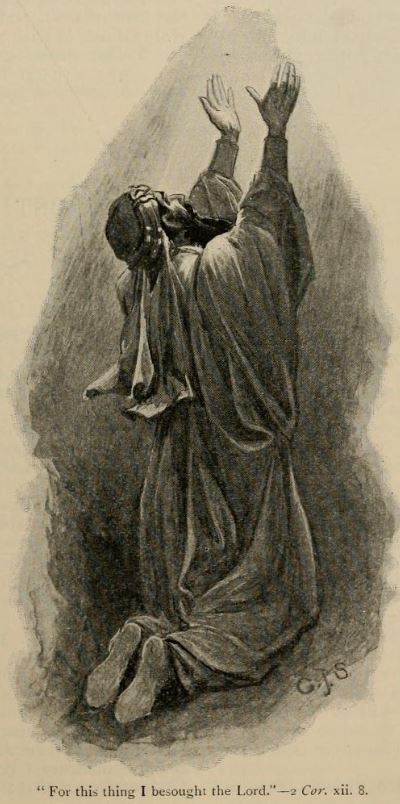
* The illustration is from the Art Bible, 1896, comprising the Old and New Testaments, with numerous illustrations. Publisher, London: G. Newnes. 2 Corinthians 12:8 is the source material of the scene.
>1. About what had Paul been boasting in the previous chapter?
* Paul boasting had consisted of his hardships, suffering, and dangers.
>How did he regard talk about visions and revelations from the Lord? (1)
* 2 Corinthians 12:1 "I must go on boasting. Although there is nothing to be gained, I will go on to visions and revelations from the Lord.
* "I must go on boasting." -Paul moves to another subject.
* "Although there is nothing to be gained" -Paul has stated his disdain for boasting, though his reason to do it was it was a last attempt to get them to change their ways and stop following the directions of false apostles. He will gain nothing from it. However, perhaps the congregation will change for the better.
KJV translates the first half of verse 1, "It is not expedient for me doubtless to glory."
ASV translates, "I must needs glory, though it is not expedient"
CSB and HCSB translate, "Boasting is necessary. It is not profitable..."
YLT translates, "To boast, really, is not profitable for me..."
GW translates, "I must brag, although it doesn't do any good."
* "visions" -(Luke 1:22), a vivid apparition, not a dream (Compare Luke 24:23; Acts 26:19; 2Co 12:1). (Illustrated Bible Dictionary: And Treasury of Biblical History, Biography, Geography, Doctrine, and Literature)
* "revelations" -An uncovering, a bringing to light of that which had been previously wholly hidden or only obscurely seen. God has been pleased in various ways and at different times (Heb 1:1) to make a supernatural revelation of himself and his purposes and plans, which, under the guidance of his Spirit, has been committed to writing. (See WORD OF GOD.) The Scriptures are not merely the "record" of revelation; they are the revelation itself in a written form, in order to the accurate presevation and propagation of the truth.
Revelation and inspiration differ. Revelation is the supernatural communication of truth to the mind; inspiration (q.v.) secures to the teacher or writer infallibility in communicating that truth to others. It renders its subject the spokesman or prophet of God in such a sense that everything he asserts to be true, whether fact or doctrine or moral principle, is true, infallibly true. (Illustrated Bible Dictionary: And Treasury of Biblical History, Biography, Geography, Doctrine, and Literature)
* "from the Lord" -Distinguishing from the devil who gives visions too.
>2. What does it mean to be "a man in Christ"? (2a)
* 2 Corinthians 12:2a "I know a man in Christ who fourteen years ago..."
* "a man in Christ" -The person is in the body of Christ. They are one with Christ.
* "fourteen years ago" -Paul in approx. 41 A.D., fourteen years before the writing of 2 Corinthians in 55 A.D., was caught up to the third heaven where he heard revelations and also inexpressible things. (Galatians 1:11-12; 2 Corinthians 12:1-7)
* "We do not know the details of this revelations. Paul is referring to something other than his experience on the road to Damascus. His point is that his words are more than his own speculations or ideas." (Life Application Bible Studies)
>Describe the spiritual experience which a certain "man in Christ" had. (2b-4)
* 2 Corinthians 12:2b-4 "... was caught up to the third heaven. Whether it was in the body or out of the body I do not know--God knows. And I know that this man--whether in the body or apart from the body I do not know, but God knows-- was caught up to paradise. He heard inexpressible things, things that man is not permitted to tell."
* Galatians 1:11-12 "I want you to know, brothers, that the gospel I preached is not something that man made up. I did not receive it from any man, nor was I taught it; rather, I received it by revelation from Jesus Christ."
* Ephesians 3:2-6 "Surely you have heard about the administration of God's grace that was given to me for you, that is, the mystery made known to me by revelation, as I have already written briefly. In reading this, then, you will be able to understand my insight into the mystery of Christ, which was not made known to men in other generations as it has now been revealed by the Spirit to God's holy apostles and prophets. This mystery is that through the gospel the Gentiles are heirs together with Israel, members together of one body, and sharers together in the promise in Christ Jesus."
* "was caught up to" -The Greek verb "harpazo" is used thirteen times in the New Testament, including 1 Thessalonians 4:17, were it is also translated as "caught up", there when describing believers meeting Jesus in the air at his second coming. It is a derivative of the Greek verb "haireomai", used three times, probably akin to "airo" meaning "to take for oneself". "Harpazo" means "to seize, snatch, or take away by force".
* "to the third heaven... paradise" -If the sky is the first and space, the place of planets and stars, is the second heaven, then he might be speaking of the place where Jesus is now.
* "Whether it was in the body or out of the body I do not know--God knows." -Paul is referring to his spirit and soul. When we die our spirit and soul depart from the body. Though at times God has taken prophets soul and spirit out of the body and then returned them to the body. When Jesus rose people from the dead, like Lazarus, their soul and spirit left the body and then returned.
* "I know that this man" -Paul had been and continues to refer to himself in the third person.
* "He heard inexpressible things, things that man is not permitted to tell."
>Why might this have happened to this man?
* Jesus gave him one-on-one teaching the same as Jesus taught the twelve apostles, preparing him for his mission.
*
Paradise.
How would I react if someone said, "I have been to paradise, the third heaven," as Paul did in these verses? He'd continue, "An angel came to my bedroom two separate nights while I was sleeping, reached out his hand, and when I took it, I was taken to paradise." I suppose my reaction would depend on why he is telling me this extraordinary story. Would I believe him? Certainly, I would have doubts unless he gave proof that he came from the presence of God.
Paul does not say an angel came to take him to paradise. He uses the Greek verb "harpazo", the same word used in 1 Thessalonians 4:17 to describe Jesus coming to take his people to meet him in the sky as he descends to earth. Paul said twice he did not know whether he was in the body or out of the body (2b, 3b), as was the man in the story I recalled. Would I believe Paul? This is not the first time Paul's visit to heaven is described. He also mentions it in Galatians 1:11-12, Ephesians 3:2-6, and he even hinted at it in his first letter to Corinth.
Why did Paul tell the congregation at Corinth about this event that happened shortly after his conversion? Why would anyone? Paul did not do it to gain anything for himself. (1) He wrote, "There is nothing to be gained for myself." He boasts of this in the third person (as he has been doing in most of the letter) as a last resort to persuade the congregation to change before he and others from other congregations arrive there. He brings up this event to show the gospel he preaches is more than his own speculations or ideas.
Many false prophets since Paul have said, "An angel came to me and revealed to me..." However, the teachings they give counter God's word through his Son, Jesus. The gospel Paul preached did not contradict Christ Jesus nor the Old Testament. Don't believe everyone who says, "I have been to paradise"; only believe the gospel according to Jesus and his apostles.
Listen to the above Chapter 12:1-4.
>3. Did Paul boast about his spiritual strength? (5)
* 2 Corinthians 12:5 "I will boast about a man like that, but I will not boast about myself, except about my weaknesses."
* "I will boast about a man like that"
* "but I will not boast about myself"
* "except about my weaknesses."
*
>Why would he not have been a fool even if he had boasted? (6)
* 2 Corinthians 12:6 "Even if I should choose to boast, I would not be a fool, because I would be speaking the truth. But I refrain, so no one will think more of me than is warranted by what I do or say."
* "Even if I should choose to boast"
* "I would not be a fool"
* "because I would be speaking the truth"
*
>4. Why did he not try to gain special recognition from talking about his spiritual experiences?
* "But I refrain, so no one will think more of me than is warranted by what I do or say."
*
>What did he talk about?
* Paul talked about his weaknesses, according to his own words.
>Why?
*
Boundaries.
Apostle Paul is going out of his way again and again not to go beyond a line where he would actually be boasting. He approaches the line from many directions. Yet, he does not go beyond it. I tire of counting the number of attempts Paul takes in making his point without crossing that line.
Humility and self-control within wisdom is the mark of a man who has a sincere and frank fear of his Lord. The only person who excelled beyond Paul's capacity was Christ Jesus, who without limit responded to continual attacks against his person, personality, and ministry with grace and truth.
Verses 5 and 6 appear to be a hidden claim that he is the man who was brought to paradise, whereas in verse 7 he makes it clear that he is indeed the man. Verse 7 is also clear that the fear of the Lord's discipline was real for Paul, for he was given a "thorn in the flesh" to keep him from conceit. So, Paul was very careful with his words, talking in the third person for most of this letter while at the same time keeping the desire to help the Corinthian congregation to stop listening to pseudo-Christians.
The Lord has done many amazing things in my life. I have shared some of them with others when asked to share my life testimony. I am not comfortable with revealing some things because of how people responded in the past. Also, following the example of humility set by Christ, I do not want to draw attention to myself, but to his exceeding grace and compassion. I seek the Lord's wisdom not to go beyond limits that establish that I am not the focus, but instead Christ Jesus is, his exceeding grace to me.
Listen to the above Chapter 12:5-7.
II. Paul's Thorn (12:7-9a)
>5. What had happened to him to counterbalance the great spiritual revelations which he had received? (7)
* 2 Corinthians 12:7 "To keep me from becoming conceited because of these surpassingly great revelations, there was given me a thorn in my flesh, a messenger of Satan, to torment me."
* "a thorn in the flesh" -"Thorn" is the Greek noun "skolops" only used here in the New Testament, from the Greek noun "skelos" used three times in the New Testament, always translated "leg".
"Flesh" is the Greek noun "sarx" used 151 times in the New Testament, 148 times translated as "flesh" in the KJV and twice as "carnal" and once as "carnally minded". Calvin wrote, "The word flesh is, in the Greek, in the dative. Hence Erasmus has rendered it 'by the flesh.' I (Calvin) prefer, however, to understand him as meaning, that the pricking of this goad were in his flesh."
Calvin goes on to cite other people's speculation as to what this "goad in the flesh" was; tempted lust, pains in the head, Hymeneus and Alexander and troubles through the devil, and then Calvin says "every kind of temptation, which which Paul was exercised, for flesh here, in my opinion, denotes, not the body, but that part of the soul which has not yet been regenerated. 'There was given to me a goad that my flesh might be spurred up by it, for I am not yet so spiritual, as not to be exposed to temptations according to the flesh.'" (Calvin's Commentaries)
* "messenger of Satan" -Messenger implies the source is not Satan. The assumption must be made it can only be God for who else would Satan follow the direction of. And why follow if he is God's enemy? Consider Job's case. (Job 2:7, 5:6; Luke 13:16; Philippians 1:29)
>Why did he believe that this problem had been given to him?
* "To keep me from becoming conceited" -Paul was kept from thinking to highly of himself. Conceited means "Holding or characterized by an unduly high opinion of oneself."
* "because of these surpassingly great revelations" -The ones he heard in paradise, the third heaven.
* "to torment me" -"Torment" is the Greek verb "kolaphizo" (present tense) used five times in the New Testament, translated by the KJV as "buffet". Buffet has not been used is this manner in many decades. "Kolaphize" is derivative of the base of the verb "kolazo". The meaning is to punish by rapping with the fist.
*
Thorn in My Flesh.
God protected Paul from the pit of conceit (7). Conceit is a word not in much use these days, probably because conceit, vanity, and pride are considered, at best, normal and, at worst, good mindsets. However, conceit ignores some blatant truths about the human condition, that is, my state of being. When self-truths are not accepted, I miss out on God performing character improvements and gaining peace of mind and heart.
Conceit, vanity, and pride ignore God's providence. I do not live in a self-fulfilling vacuum. I do not have the capability to control everything all at once all the time. In fact, I can control little. I can make decisions. Yet, my decisions do not make what I decide to happen. Many unforeseen things always happen that counter what I decided to do. A wise person can admit, "I spent most of my life planning for things that did not happen the way I planned." Foolishness is to believe that all the good and great things I do and say are by my design and total control. They happen because God wills them to happen.
Then there are the bad decisions that I make. The misspoke word, the promise I made and did not keep, the good thing I could have and should have done and did not, and then there is the wrong thing I chose to do and did not stop. Conceit ignores these and robs me of allowing God to create a godly character in me and thus gain contentment and rest.
Paul had experienced and done a lot of amazing things. He is the man who went to the third heaven (1-5). God performed miracles through him. He would have become conceited if God did not give him a thorn in his flesh, a small messenger of Satan, to torment him (7)." Paul wanted it to stop. He could not make it stop. He asked God to stop it. He did not. God revealed why the pain stayed." It kept him from becoming conceited.
I too have asked God to do things that were not answered in the way I asked and wanted. Perhaps they too are to keep me from being conceited and proud. God's NO can be good even though it means I will endure some pain.
Listen to the above comments on 12:7.
>6. What might be the problem that he describes as a thorn in his flesh?
* "Thorn" implies acute pain and "torment" implies shame as slaves are buffeted (1 Peter 2:20). Any suggestion is only speculation. "A thorn in the flesh maybe some extremely painful bodily disease whose symptoms recurred at intervals. Some, like Lightfoot, suggest epilepsy; others, like Farrar, ophthalmia; and Ramsay holds that it was malarial fever: Galations 4:13-15." (A Commentary on the Holy Bible: The One Volume Bible Commentary)
* Numbers 33:55 "But if you do not drive out the inhabitants of the land, those you allow to remain will become barbs in your eyes and thorns in your sides. They will give you trouble in the land where you will live."
* Ezekiel 28:24 "No longer will the people of Israel have malicious neighbors who are painful briers and sharp thorns. Then they will know that I am the Sovereign LORD."
* Calvin likens this as a goad used on oxen to control and motivate them. See other comments in 5a.
* Some believe the thorn was the illness mentioned in Galatians 4:13-14.
>Why does he call it a "messenger from Satan"?
* Paul is most likely thinking of Job's case as well as Numbers 33:35 and Ezekiel 28:24. Job did not wrong and yet Satan was allowed to torment him in many horrible ways, even with painful bodily sores.
>What did he do about it?
* 2 Corinthians 12:8 "Three times I pleaded with the Lord to take it away from me."
* Paul prayed, pleading with the Lord.
* "Three times"
* "I pleaded with the Lord"
* "to take it away from me.""
>7. How did the Lord answer his prayer? (9a)
* 2 Corinthians 12:9a "But he said to me, "My grace is sufficient for you, for my power is made perfect in weakness."
* "But he said to me" -Must have been an audible voice, though could have been through a messenger; angel or man. Most likely the answer was an audible voice. Not many hear a voice these days. The gift of being an apostle.
* "My grace is sufficient for you" -"Sufficient" translated by all English bibles is from the Greek verb "arkeo" also meaning "enough", "suffice", and "content".
* "for my power is made perfect in weakness." -"Power" translated by all English bibles I have except the KJV which has "strength".
>Why did God answer him this way?
* A better solution than to remove Paul's thorn. Human weakness provides the ideal opportunity for the display of divine power.
>What does this teach us about prayer?
* Like a child asking a parent, sometimes they say no. We may ask. However, we must understand that we may not get the answer we expect or want.
>About God?
* God is sovereign. God knows best. God's ways are above man's understanding.
>8. What is God's grace?
* "grace" -Unmerited divine assistance. A favor rendered by one who need not do so.
* John 1:17 "For the law was given through Moses; grace and truth came through Jesus Christ."
* Romans 5:15 "But the gift is not like the trespass. For if the many died by the trespass of the one man, how much more did God's grace and the gift that came by the grace of the one man, Jesus Christ, overflow to the many!"
* Romans 5:17 "For if, by the trespass of the one man, death reigned through that one man, how much more will those who receive God's abundant provision of grace and of the gift of righteousness reign in life through the one man, Jesus Christ."
* Romans 5:21 "so that, just as sin reigned in death, so also grace might reign through righteousness to bring eternal life through Jesus Christ our Lord."
>What does God mean by saying that his grace is sufficient? (1 Timothy 1:15; 1 Corinthians 15:10)
* 1 Timothy 1:15-16 "Here is a trustworthy saying that deserves full acceptance: Christ Jesus came into the world to save sinners--of whom I am the worst. But for that very reason I was shown mercy so that in me, the worst of sinners, Christ Jesus might display his unlimited patience as an example for those who would believe on him and receive eternal life."
* 1 Corinthians 15:10 "But by the grace of God I am what I am, and his grace to me was not without effect. No, I worked harder than all of them--yet not I, but the grace of God that was with me."
* All translations that I have render this passage the same.
III. God's Grace (12:9-10)
>9. What does it mean that God's power is made perfect in weakness?
* 2 Corinthians 12:9b "Therefore I will boast all the more gladly about my weaknesses, so that Christ's power may rest on me."
*
*
Perfect in Weakness.
Paul reveals weakness, "thorn in the flesh" and "messenger of Satan," as insults, hardships, persecutions, and difficulties. He delights in them for when he pleaded for the "thorn in his flesh" to be taken away, the Lord replied, "My grace is sufficient for you, for my power is made perfect in weakness." God was saying, "No. I will not take the thorn away. Instead, I will give you my love, favor, and strength to endure the thorn."
God's divine power, in upholding and supporting his people, is never so glorious as when we are under weaknesses. Peter wrote, "For it is commendable if a man bears up under the pain of unjust suffering because he is conscious of God. But how is it to your credit if you receive a beating for doing wrong and endure it? But if you suffer for doing good and you endure it, this is commendable before God. To this you were called, because Christ suffered for you, leaving you an example, that you should follow in his steps." (1 Peter 2:19-21)
Job received a thorn in the flesh at the hands of Satan at the behest of the Lord God. Job did not curse God. Job praised God. He did not like to suffer. He did not welcome it. He questioned why and desired his case be heard. Paul did not rebuke God. Yet, he did plead three times for his thorn to be removed.
A child of God should not be surprised when a thorn of the flesh comes. The Lord may take away. The Lord may not. Either way, we pray and know that through our weakness God's power is made perfect.
Listen to the above Chapter 12:7-10.
>What did Paul consider his weaknesses?
* Insults, hardships, persecutions, and difficulties. (10a)
>How could he delight in and actually thank God for not only his weaknesses but also his suffering?
* God's power is revealed and made perfect. (9)
>10. What did Paul mean by "When I am weak, then I am strong"?
* 2 Corinthians 12:10 "That is why, for Christ's sake, I delight in weaknesses, in insults, in hardships, in persecutions, in difficulties. For when I am weak, then I am strong."
* "When I am weak" -The Greek verb "astheneo" (a transliteration), used 36 times in the New Testament, is from the Greek adjective "asthenes" (a transliteration), used 25 times in the New Testament. "Astheneo" fundamentally meant "to be weak," "to be feeble," or "to be without strength." The word is a compound of the prefix a- (meaning "not" or "without") and the root "sthenos" (meaning "bodily power" or "vigor"). In the first-century world, particularly in the texts of the New Testament, this word carried both literal physical meanings and figurative or moral meanings.
* "for Christ's sake" -Not for wrong doing. Not for self. Not for another human. Not for society. Not for a cause. But for Christ Jesus.
* "then I am strong" -The Greek adjective "dynatos" (a transliteration), used 35 times in the New Testament, is from the Greek verb "dunamai" (a transliteration), used 210 times in the New Testament. "Dynatos" primarily meant "powerful," "able," "mighty," or "possible". The English words dynamo, dynamic, and dynamite come from this word. Depending on its use in the sentence "dynatos" can have several similar meanings including to described someone who possessed the strength, capacity, or inherent ability to perform a task and to described someone who was highly skilled, prominent, or exceptionally proficient in a specific area, such as speech or action.
>How can God's grace make a person strong?
*
When Weak, I am Strong.
You are not up to the job. You do not have what it takes. You are not pulling your weight. You are the lesser child. While your resume looks impressive, we have moved on to another candidate. Others exist who are smarter, stronger, better skilled, more experienced, have better degrees and credentials, have a better pedigree, look more pleasing, are more sociable, etc., etc., etc. You are a weak candidate. You are useless as is. And yet God says I am the perfect one for his purpose.
Though the world rejects us for these very reasons, we are exactly the type of people God is looking for; we have faith in him. It was not for no reason that Jesus told many, "Your faith has done this." Since God's power is made perfect in weakness (9), he chooses the lesser things by worldly standards to shame the greater things. Paul told the Corinthian congregation this in his first letter. (1 Corinthians 1:27).
Moses was rejected by Israel before God sent him to be the one who brought them out of Egypt. Ruth was a cursed Moabite and a widow when God called her to be King David's grandmother. Esther was a slave girl when God made her the queen of the most powerful nation in the world. David was the least of his family, the least of the Israelites, when God made him the greatest Israelite warrior and king. The twelve apostles were backwater fishermen, a tax collector, a zealot, and uneducated nobodies when Jesus appointed them to be his messengers to the ends of the earth.
All of these people and more were weak. God made them strong. Paul personally learned this. So he delighted in weakness. He bragged about insults, hardships, persecutions, and difficulties. He was weak. God took a weak vessel and made it strong. Is God weak? Is anything impossible for God? Jesus taught, "With man this is impossible, but with God all things are possible." (Matthew 19:26; Mark 10:27; Luke 1:37, 18:27) All that is required is faith as small as a mustard seed. (Matthew 17:20)
Listen to the above Chapter 12:10.
>How can grace change one's attitude toward suffering?