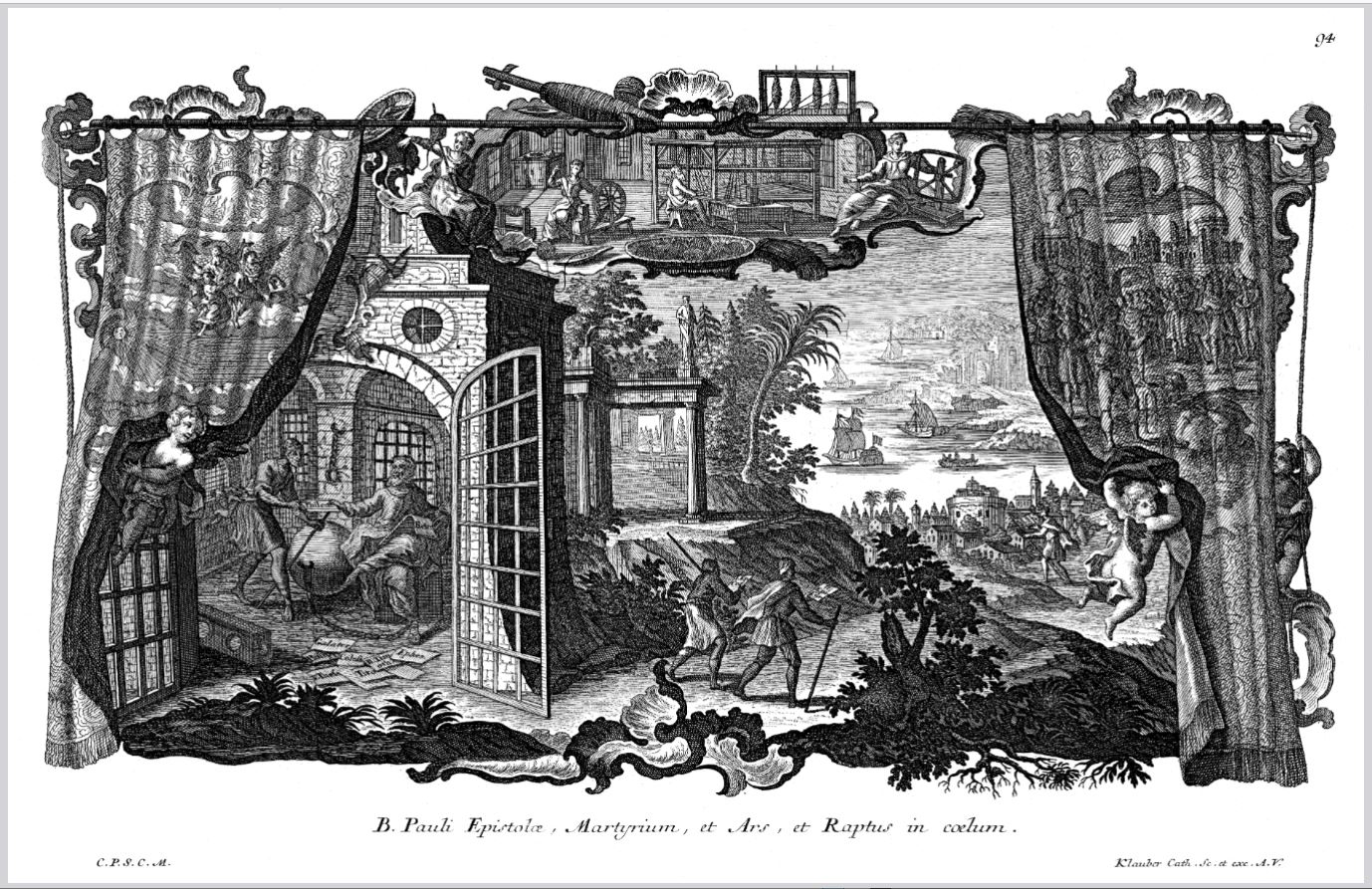
* The illustration titled "Paul's Epistles & Martyrdom" is now in public domain. The author and engraver's signatures are in the lower right and left. Courtesy of the Digital Image Archive, Pitts Theology Library, Candler School of Theology, Emory University.
>1. What characteristics did Paul use to show his motive? (1-2)
* 2 Corinthians 10:1-2 "By the meekness and gentleness of Christ, I appeal to you--I, Paul, who am "timid" when face to face with you, but "bold" when away!" I beg you that when I come I may not have to be as bold as I expect to be toward some people who think that we live by the standards of this world."
*
Chapter 10 Overview.
Paul expends most of the chapter explaining and defending his ministry of reconciliation. Others, especially from within the church, were trying to undermine him and his ministry. Verses 3 through 6 stand out. Here Paul defines his work allegorically. He sees his ministry as a spiritual war.
Jesus told his disciples, "Go into all the world and preach the gospel to all creation. Whoever believes and is baptized will be saved, but whoever does not believe will be condemned." (Mark 6:15-16) Paul's mission obeyed this imperative. Specifically, Jesus told him through Ananias at the mission call, "This man is my chosen instrument to proclaim my name to the Gentiles and their kings and to the people of Israel." (Acts 9:15-16)
Paul equates preaching the good news and proclaiming Jesus' name as waging a spiritual war. When I do so, whether through word or action, I am fighting the good fight.
Human war in this world physically destroys, harms, tears down, and kills. The weapons used to fight a physical battle include the tongue, hands, legs, swords, arrows, guns, gas, bombs, and many other types of physical malicious devices. The spiritual war does not use these weapons (4).
The spiritual fight is with words and loving actions. Whenever I follow Jesus' example and apply his teaching, I am using spiritual weapons. Jesus's words are divine power ready for my use (5), but only when led by the Spirit in love.
I do not always want to fight the good fight. Sometimes I am tired, lazy, and selfish. It is then that I become vulnerable to defeat. Thank God that he is the source of unending power. When I am weak, He is strong and enables me to fight on.
Listen to the above Chapter 10 Overview.
* From the mild tone of the first nine chapters, it appears that the majority of the Corinthians believers had been won over to Paul (7:6-13), after having been alienated by his Corinthians opponents. In this final section (chapters 10-13), however, Paul deals firmly with the slanders that have spread against him in Corinth by the remaining opposition. Those who wish to discredit him have been saying that he is bold at a distance, threatening to take severe disciplinary action, especially in his letters (cf., e.g., his warning that, if necessary, he will come "with a whip" in 1 Corinthians 4:18-21). But they say that he will not dare to be anything but weak and indecisive if he is present with them in person- in short, that he does not have the apostolic authority he claims to have. Paul is ready to prove otherwise, should the occasion demand, when he comes to Corinth for the third time (see 6, 10-11). His appeal to the meekness and gentleness of Christ is an indication of his own affectionate desire to show these same qualities when present with them. In any case, though weak in himself, Paul is strong in the Lord- as this whole letter explains- and those who are rebellious can expect to feel the force of his divinely given authority. (NIV Study Bible)
* "meekness" -The original Greek noun is "praotes" (a transliteration) used nine times in the New Testament also translated as "gentleness" and "humility". It did not denote weakness or cowardice; rather, it described controlled strength, a balanced disposition that restrained anger or power under pressure.
* "gentleness" -The original Greek noun is "pepieikeia" (a transliteration) also used in Acts 24:4 in the New Testament. It's origin, "epieikes" is translated as "suitbleness", by implication "equity", and "mildness". The term appears in the New Testament book of Acts (Acts 24:4), where a lawyer named Tertullus flatters the Roman governor Felix by asking him to listen with "epieikeia", translated in this context as "clemency," "kindness," or "generosity".
* "By the... of Christ" -Christ is the source. Meekness and gentleness are fruits of the Spirit. (Galatians 5:22-26) Before Christ came to him, Paul was not meek and gentle.
* Matthew 11:29 "Take my yoke upon you and learn from me, for I am gentle and humble in heart, and you will find rest for your souls."
* "'By the meekness and gentleness of Christ', in view of the meekness and mildness of the Redeemer, or desiring to imitate his gentleness and kindness. Paul wished to imitate that. He did not wish to have occasion for severity, he desired at all times to imitate and to exhibit the gentle feelings of the Savior. He had no pleasure in severity; and he did not desire to exhibit it." (Barnes' Notes on the New Testament)
* "I appeal to you--I, Paul... I beg you... I come I may not... I expect... I boast... I will not... I do not want to seem." -Paul does not address himself in the plural in verses 1-2 and 8-9. He does not use "we", "us", or "our" as before and in other places in this chapter.
* "timid when face to face with you, but..." -The original Greek is "prosopon men en hymin" (a transliteration). "Prosopn" means "face", "person", and "presence". "Men" is used 193 times in the New Testament, a primary particle, properly indicative of affirmation or concession, usually followed by a contrasted clause with "de", or here it is followed by "en". "Men" has several translations. "Men" functioned chiefly as a structural signpost to introduce a contrast, concession, or point-counterpoint balance. While it originally meant "indeed," "truly," or "surely" in Classical Greek, its primary role evolved into a procedural discourse marker used to alert the reader that a corresponding or opposing thought was coming next. "En hymin" means "with you" and "among you". Verse 10 quotes their exact words about Paul.
"KJV has "am base among you". The Greek word "tapeinos" (a transliteration) usually means "low, humble, and poor". Here it means timid, modest, the opposite of boldness. Such was formerly the meaning of the English Word base. It was applied to those of low degree or rank; of humble birth; and stood opposed to those of elevated rank or dignity. Now it is commonly used to denote that which is degraded or worthless, of mean spirit, vile; and stands opposed to that which is manly and noble. But Paul did not mean to use it here in that sense. He meant to say that they regarded him as timid, and afraid to execute the punishment which he had threatened, and as manifesting a spirit which was the opposite of boldness. This was doubtless a charge which they brought against him; but we are not necessarily to infer that it was true. All that it proves is, that he was modest and unobtrusive, and that they interpreted this as timidity, and want of spirit. (Barnes' Notes on the New Testament)
* "bold when away" -The original Greek verb for "bold" is "tharreo" (a transliteration) used six times in the New Testament. Verse 10 quotes their exact words about Paul.
>What does "live by the standards of this world" mean in this context? (Ezekiel 11:12)
* Ezekiel 11:12 "And you will know that I am the LORD, for you have not followed my decrees or kept my laws but have conformed to the standards of the nations around you."
* "towards some people" -Not all. Only those who are leading the rest astray.
* "live by the standards of this world" -Same as the phrases "live by the flesh", "according to the flesh", and "guided by human motives" in other English translations.
* 1 Corinthians 3:1-3 "Brothers, I could not address you as spiritual but as worldly--mere infants in Christ. I gave you milk, not solid food, for you were not yet ready for it. Indeed, you are still not ready. You are still worldly. For since there is jealousy and quarreling among you, are you not worldly? Are you not acting like mere men?
* 2 Corinthians 1:12 "Now this is our boast: Our conscience testifies that we have conducted ourselves in the world, and especially in our relations with you, in the holiness and sincerity that are from God. We have done so not according to worldly wisdom but according to God's grace."
* 2 Corinthians 1:17 "When I planned this, did I do it lightly? Or do I make my plans in a worldly manner so that in the same breath I say, "Yes, yes" and "No, no"?
* 2 Corinthians 5:16 "So from now on we regard no one from a worldly point of view. Though we once regarded Christ in this way, we do so no longer."
* 2 Corinthians 7:10 "Godly sorrow brings repentance that leads to salvation and leaves no regret, but worldly sorrow brings death."
* Titus 2:11-12 "For the grace of God that brings salvation has appeared to all men. It teaches us to say "No" to ungodliness and worldly passions, and to live self-controlled, upright and godly lives in this present age,"
>What kind of people would say that Christians like Paul "live by the standards of this world"? (Mark 8:15; Matt. 23:25-28)
* Mark 8:15 "Be careful," Jesus warned them. "Watch out for the yeast of the Pharisees and that of Herod."
* Matthew 23:25-28 "Woe to you, teachers of the law and Pharisees, you hypocrites! You clean the outside of the cup and dish, but inside they are full of greed and self-indulgence. Blind Pharisee! First clean the inside of the cup and dish, and then the outside also will be clean. Woe to you, teachers of the law and Pharisees, you hypocrites! You are like whitewashed tombs, which look beautiful on the outside but on the inside are full of dead men's bones and everything unclean. In the same way, on the outside you appear to people as righteous but on the inside you are full of hypocrisy and wickedness."
* Religious legalistic who judge other people when they do not have authority to do so.
*
Bold or Timid?
Is Apostle Paul making a threat, a warning, or presenting a proposal to the Corinthian congregation in these two verses? Since he is begging them (2), Paul is not threatening them. So, is this a warning or proposal?
Since Paul confesses that his words are in the meekness and gentleness of Christ, this is not even a warning. Rather, Paul is giving them a chance to correct those who have been claiming he lives "by the standards of the world".
What did they mean by claiming Paul lived "by the standards of this world"? Other translations include "according to the flesh", "in an unspiritual way", and "guided by human motives". The meaning depends on who is making the claim. The rest of the chapter through chapter 12 makes it clear that legalistic judgment teachers are saying that Paul is living sinfully, meaning he does not keep the Law given through Moses. The religious leaders made the same claim about Jesus, and soon they would try to kill Paul in Jerusalem because he "teaches all men everywhere against our people and our law and this place." (Acts 21:28)
Even today, some who claim Christ cannot or do not distinguish between the rules of men, the former Old Covenant, and the superior New Covenant made in the blood of Christ. They honor the old and set aside the new, and anyone who does not live by their rules, they make the same claim as Apostle Paul's detractors. Not only that, they sit in the seat of judgment, condemning all who "violate the laws of Moses". When the one appointed to judge by God comes, what will he say? I need to keep my heart meek and gentle by remaining yoked with Jesus. (Matthew 11:29)
Listen to the above comments on 10:1-2.
>2. Can the life of a follower of Jesus be placid, unpretentious, and unassuming? (3-4)
* 2 Corinthians 10:3-4 "For though we live in the world, we do not wage war as the world does. The weapons we fight with are not the weapons of the world. On the contrary, they have divine power to demolish strongholds."
* "we live... we do not" -Paul is using the plural to refer to himself. See comment in question 1a.
* "we live in the world" -Our physical body is in and interacts with the physical world. And our souls interact with creation including people, elements, and other beings. Jesus said, "Man does not live by bread alone." By this his point is we need God and bread to exist as long as we are in the physical body. Paul is specifically means people when he writes "the world". Jesus also meant people when he prayed at the Last Supper, "not take them out of the world". (John 17:6-26)
* "wage war" -Some say "spiritual war". This is a war of the soul which is the mind, emotions, and will. The victory is not to belittle and destroy the Christian opponents. Rather, we seek to win then to Christ and salvation through him.
* "we do not wage war as the world does" -They are motivated by hate, vengeance, and cruelty. We are motivated by love, forgiveness, and charity.
* "The weapons we fight with" -Paul is prepared for warfare; his weapons, however, are not the weapons prized by this fallen world and fashioned by human pride and arrogance. (NIV Study Bible)
* Matthew 10:34-36 "Do not suppose that I have come to bring peace to the earth. I did not come to bring peace, but a sword. For I have come to turn "'a man against his father, a daughter against her mother, a daughter-in-law against her mother-in-law-- a man's enemies will be the members of his own household.'"
* Matthew 26:50-54 (also Mark 14:46-49) Jesus replied, "Friend, do what you came for."
Then the men stepped forward, seized Jesus and arrested him. With that, one of Jesus' companions reached for his sword, drew it out and struck the servant of the high priest, cutting off his ear.
"Put your sword back in its place," Jesus said to him, "for all who draw the sword will die by the sword. Do you think I cannot call on my Father, and he will at once put at my disposal more than twelve legions of angels? But how then would the Scriptures be fulfilled that say it must happen in this way?"
* John 18:7-11 Again he asked them, "Who is it you want?"
And they said, "Jesus of Nazareth."
"I told you that I am he," Jesus answered. "If you are looking for me, then let these men go."
This happened so that the words he had spoken would be fulfilled: "I have not lost one of those you gave me."
Then Simon Peter, who had a sword, drew it and struck the high priest's servant, cutting off his right ear. (The servant's name was Malchus.)
Jesus commanded Peter, "Put your sword away! Shall I not drink the cup the Father has given me?"
>How do the weapons of the world compare to the weapons of God's children?
* "are not the weapons of the world" -The weapons of this world (Satan and his followers) are lies (often sprinkled with truth), deception, gossip, quarreling, satire, sarcasm, and cruel words. (12:20; Proverbs 16:28, 19:22, 20:19; John 8:44; 2 John 1:7)
* "On the contrary" -The Greek conjunction "alla" (a transliteration) translated elsewhere as "but", "rather", "nevertheless", and others.
* "they have divine power" -Ephesians 6:10-18 is a good exposition of the weapons the saints fight with. Hebrews 4:12 refers to the word of God as living and acting, sharper than any double-edged sword. Revelation 1:16, 2:12, 16, and 19:15, 21 say that Jesus' tongue is a sharp double-edged sword.
* "to demolish stronghold" -Strongholds are "arguments" and "every pretension" (5) defiantly raise "against the knowledge of God" (Romans 1:18-23), among which are the faulty reasoning by which the false apostles have been trying to shake the faith of the Christians in Corinth (1 Corinthians 2:13-14) (NIV Study Bible)
* Romans 1:18-23 "The wrath of God is being revealed from heaven against all the godlessness and wickedness of men who suppress the truth by their wickedness, since what may be known about God is plain to them, because God has made it plain to them. For since the creation of the world God's invisible qualities--his eternal power and divine nature--have been clearly seen, being understood from what has been made, so that men are without excuse.
For although they knew God, they neither glorified him as God nor gave thanks to him, but their thinking became futile and their foolish hearts were darkened. Although they claimed to be wise, they became fools and exchanged the glory of the immortal God for images made to look like mortal man and birds and animals and reptiles."
*
Weapons of War.
Who is on the side of the truth of Christ and who is not can be determined by the weapons they utilize. Words are the weapons of both sides. Jesus told Pilate that the reason he was born, the reason he came into the world, was to testify to the truth. (John 18:37) Jesus' double-edged sword is the word coming from his sharp tongue. (Hebrews 4:12; Revelation 1:16, 2:12, 16, 19:15, 21) The weapons of this world (Satan and his followers) are lies (often sprinkled with truth), deception, gossip, quarreling, satire, sarcasm, and cruel words. (12:20; Proverbs 16:28, 19:22, 20:19; John 8:44; 2 John 1:7)
The motivation that compels one to speak determines what is said. How words are said may not be as determinate as what is being said, for lies can be stated with a soft, sweet tongue and the truth can be shouted from the wilderness (Matthew 3:1, 7-12; Luke 3:7-9, 18-19).
The motivation of those representing the truth of Christ is love, joy, peace, patience, kindness, goodness, faithfulness, gentleness, and self-control. (Galatians 5:22-23). The motivation of those not on the side of truth is "sexual immorality, impurity and debauchery, idolatry and witchcraft, hatred, discord, jealousy, fits of rage, selfish ambition, dissensions, factions and envy, drunkenness, orgies, and the like." (Galatians 5:19-21)
Though the people of the truth live in the world, meaning interacting with others, we do not wage war as the world does. (3) Jesus commands me to interact with the world as his ambassador, witnessing to the truth. So examine myself. How do I engage with the world? What are my motives? I have been given divine power to demolish strongholds through the word of God. (4b) Is my heart and mind engaged properly in battles?
Listen to the above comments on 10:3-4.
>What is the nature of the conflict? (5)
* 2 Corinthians 10:5 "We demolish arguments and every pretension that sets itself up against the knowledge of God, and we take captive every thought to make it obedient to Christ."
* "We demolish arguments" -Truth and logic utilized.
* "every pretension that sets itself up against the knowledge of God" -A pretension is an specious allegation.
* "we take captive every thought to make it obedient to Christ" -Not meaning here our thoughts, but the false thoughts presented by others.
>3. What does verse 6 mean?
* 2 Corinthians 10:6 "And we will be ready to punish every act of disobedience, once your obedience is complete."
* "And we will be ready to punish" -Paul will use his authority if they do not take this chance to change themselves or others. They needed to do something.
* "every act of disobedience" -Action, word, and thought.
* "once your obedience is complete." -Obedience to God's authority in Christ.
>Is the spiritual battle internal or external?
* The verse is often used as referring to self and referring to our interaction with others. Keeping this in contexted of the surrounding verses, Paul is referring to the sharing of the gospel and other of God's truths.
*
Christian Combat.
Paul spoke of weapons Christians fight with in verses 3 and 4. They are not weapons of this world. The weapons of choice for Christians are like Jesus', which include words based in grace and truth.
Such truth demolishes arguments and every pretension that sets itself up against the knowledge of God. The knowledge of God is truth. God's truth humbles proud men. God's truth includes not only the condition and state of mankind, but also all the facts of the created universe. The gospel is embedded with God's truth.
Sharing the gospel enables us to take captive every thought to make it obedient to Christ. These thoughts are not only our own, but Paul is specifically writing about the thoughts of those who oppose truth. Through obeying Jesus' great commission, we engage in Christian combat. The Holy Spirit enables us in the good fight by reminding us of Jesus' words. So, am I a fighting saint or an ain't?
Listen to the above comments on 10:5-6.
II. Authority for Building Up (10:7-11)
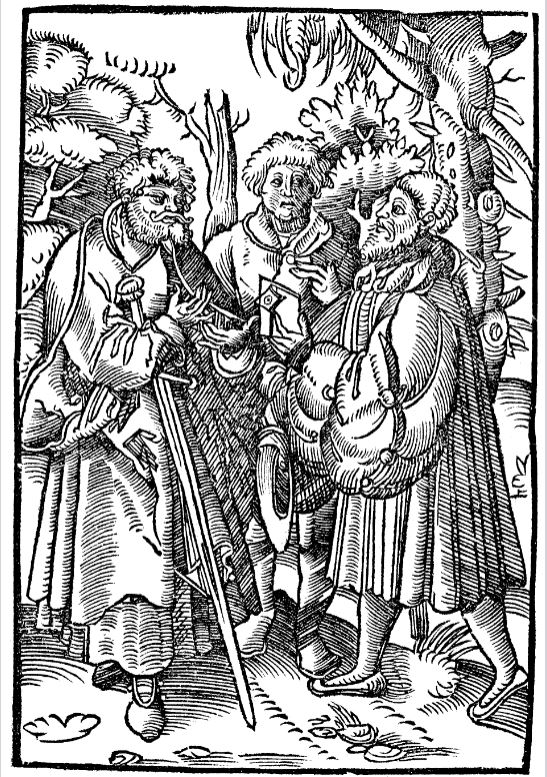
* The illustration titled "Paul Receives (or Sends) a Letter From Corinth" is now in public domain. Courtesy of the Digital Image Archive, Pitts Theology Library, Candler School of Theology, Emory University.
>4. In their assessment of people, including Paul, how were the Corinthians making their conclusions? (7a)
* 2 Corinthians 10:7a "You are looking only on the surface of things."
* 2 Corinthians 5:16 "So from now on we regard no one from a worldly point of view. Though we once regarded Christ in this way, we do so no longer."
* "You are looking only" -Paul is speaking specifically to the Corinthian congregation.
* "on surface of things" -How people look, their appearance, their clothes and adornment. How they sound when they speak, their vernacular, pitch accent, and cadence. What they have, their possessions and wealth. Their societal position, their rank. What is their occupation, their power. How they act in comparison to others in their society, their manners that work to advantages. Who they know, their peers, sponsors, and partners. Who they influence, their subjects, servants, and slaves. What they contribute to them personally, the external advantages they will gain from knowing them. If they are winners or losers, their craftiness and deceptions. The Corinthian congregation did not look at a person's character with high regard. They do not perceive how they treat others unless their interaction contribute to self-personal gain. The congregation did not compare them to Jesus.
* Matthew 20:25-28 (also Mark 10:42-45 and Luke 22:24-27) "Jesus called them together and said, "You know that the rulers of the Gentiles lord it over them, and their high officials exercise authority over them. Not so with you. Instead, whoever wants to become great among you must be your servant, and whoever wants to be first must be your slave-- just as the Son of Man did not come to be served, but to serve, and to give his life as a ransom for many."
* See comments in study 4, question 8a concerning "worldly point of view" in verse 5:16.
>How does God see people? (1 Chronicles 28:9; Proverbs 16:2; Luke 5:22)
* 1 Chronicles 28:9 "And you, my son Solomon, acknowledge the God of your father, and serve him with wholehearted devotion and with a willing mind, for the LORD searches every heart and understands every motive behind the thoughts. If you seek him, he will be found by you; but if you forsake him, he will reject you forever."
* Proverbs 16:2 "All a man's ways seem innocent to him, but motives are weighed by the LORD."
* Luke 5:22 "Jesus knew what they were thinking and asked, "Why are you thinking these things in your hearts?"
* God knows our deepest thoughts even before we think them. Jesus, being in very nature God, knows our deepest thoughts too.
>How should God's people view others? (John 7:24)
* John 7:24 "Stop judging by mere appearances, and make a right judgment."
*
Depth Perception.
Many parishioners in Corinth were "looking only on the surface of things", so Paul determined. Earlier, in 5:16-17, he claimed that he used to be the same, but now he no longer regarded anyone from "a worldly point of view." The reason is that those in Christ are "a new creation, the old has gone, and the new has come." (The two BDBDs for 5:16 and 17 go into detail on this subject.)
We know that outward masks can deceive, and outward presentation cannot give a definite perception of the character within. And yet, we put more effort into outward appearance than into inward character. And yes, it is false to have the attitude, "The inward character is God's concern. The outward appearance is my concern." Yet, that is what almost everyone thinks and does every day.
Perhaps that is why we judge outward rather than inward when we look at others. The flesh looks to the flesh. The soul looks to the soul and what it seems is ugly. The spirit looks to the spirit, and for most, what it sees is death. So we feed the flesh first, and ignore the soul and spirit.
Jesus says, "Now then, you Pharisees clean the outside of the cup and dish, but inside you are full of greed and wickedness (also self-indulgence in Matthew). Blind Pharisee! First clean the inside of the cup and dish, and then the outside also will be clean. You foolish people! Did not the one who made the outside make the inside also? But give what is inside [the dish] to the poor, and everything will be clean for you." (Matthew 23:25-26; Luke 11:39-41)
Listen to the above comments on 10:7a.
>5. Why can a judgment based on outward appearance be misleading and lead to God's disfavor? (7b; Isaiah 53:2-3; Mark 6:2-3)
* 2 Corinthians 10:7b "If anyone is confident that he belongs to Christ, he should consider again that we belong to Christ just as much as he."
* Isaiah 53:2-3 "He grew up before him like a tender shoot, and like a root out of dry ground. He had no beauty or majesty to attract us to him, nothing in his appearance that we should desire him. He was despised and rejected by men, a man of sorrows, and familiar with suffering. Like one from whom men hide their faces he was despised, and we esteemed him not."
* Mark 6:2-3 "When the Sabbath came, he began to teach in the synagogue, and many who heard him were amazed. "Where did this man get these things?" they asked. "What's this wisdom that has been given him, that he even does miracles! Isn't this the carpenter? Isn't this Mary's son and the brother of James, Joseph, Judas and Simon? Aren't his sisters here with us?" And they took offense at him."
* "If anyone is confident" -Paul is not saying it is wrong to be confident. Their confidence was in their rejection of Paul's first letter and holding onto their false beliefs because they believed they belonged to Christ and Paul did not, or at perhaps they were superior to Paul, and Paul was false.
* "that he belongs to Christ" -Probably echoes the claim to superior spiritually by the Christ party (1 Corinthians 1:12) and the false teachers in Corinth. Paul who had dramatically encountered and been commissioned by the risen Lord (Acts 9:3-9, 22:6-11, 26:12-18) and who received the gospel he preached "by revelation from Christ" (12:2-7; Galatians 1:11), asserts that he belongs to Christ just as much. (NIV Study Bible) Some commentators claim that the impostors claimed to have known Christ during his earthly life.
* "he should consider again that we belong to Christ just as much as he." -Paul did not challenge that they belonged to Christ. He only stated that he also belonged to Christ. I cannot recall a time that he clearly stated of a specific person who belonged to a congregation as not belonging to Christ. He did give many warnings that some, by their words and actions, were not living as they should, and thus putting a possible judgement in their future. The particular person or group of people Paul is referencing were false prophets, but he did not state that they were not Christians.
* NIV text note says, "or 'look at the obvious facts.'"
>What do you think those who were saying Paul was worldly look like? (Mark 12:38-39; Acts 15:5; Titus 1:10-11)
* Mark 12:38-39 "As he taught, Jesus said, "Watch out for the teachers of the law. They like to walk around in flowing robes and be greeted in the marketplaces, and have the most important seats in the synagogues and the places of honor at banquets."
* Acts 15:5 "Then some of the believers who belonged to the party of the Pharisees stood up and said, 'The Gentiles must be circumcised and required to obey the law of Moses.'"
* Titus 1:10-11 "For there are many rebellious people, mere talkers and deceivers, especially those of the circumcision group. They must be silenced, because they are ruining whole households by teaching things they ought not to teach--and that for the sake of dishonest gain."
* I suspect they were in the style of the elite and elegant in Greek and Jewish society. They looked impressive, intelligent, and religious.
>6. How had Paul countered the teaching from those who looked good on the outside, but on the inside were not of Christ? (8)
* 2 Corinthians 10:8 "For even if I boast somewhat freely about the authority the Lord gave us for building you up rather than pulling you down, I will not be ashamed of it."
* Jeremiah 1:10 "The Lord said to Jeremiah, 'See, today I appoint you over nations and kingdoms to uproot and tear down, to destroy and overthrow, to build and to plant.'"
* Hebrews 13:17 "Obey your leaders and submit to their authority. They keep watch over you as men who must give an account. Obey them so that their work will be a joy, not a burden, for that would be of no advantage to you."
* "For even if I boast somewhat freely" -Paul had done so in 1 Corinthians and in this letter.
* "for building you up" -Only referring to the believers in Jesus, not the world.
*
The Authority the Lord Gave Us.
In times such as ours, when authority is misused in government, business, education, and even the church, I need to set an example of what God says about authority. Paul stated clearly that the Lord came to him in a vision while he was on his way to persecute Christians in Damascus. Jesus told him to go to Damascus, and he would be told what he must do. Paul obeyed, learned of his mission, and thus received the authority for it. (Acts 9:1-18)
Paul said that God gives authority, "for building you up rather than pulling you down." The primary purpose of Paul's apostolic authority is constructive, for building up, not destructive, for pulling down (the same statement is made again in 13:10). The demands he makes in his letters are written so that they may put right what is amiss and so that things may be proper for his arrival, thus removing the need for severe action (pulling down) and preparing the way for edification (building up).
"All authority is located in God is the uniform witness of the Bible. People possess authority only as the Lord gives it (Rom. 13:1). Religious authority derives from the authority of the Father, as that authority is revealed in the Son, manifested by the Holy Spirit, and given to the church and the world through the Bible. While different approaches to that authority existed in church history and are practiced today, Scripture says all legitimate authority comes directly or indirectly from God.
"Such a position will have obvious implications for contemporary Christian faith and practice. The church and its ministry possess genuine religious authority only as they serve the mission of Jesus in faithfulness to the Bible and in building up the church (Matt. 28:18-20). The Christian accepts the truth of Scripture as authoritative by faith, and the command of Scripture as authoritative in obedience, and so demonstrates love for the Lord (John 14:15).
(Last 2 paragraphs by James C. Denison, Holman Bible Dictionary)
Listen to the above comments on 10:7b-8.
>Why wasn't he ashamed of doing this?
* "I will not be ashamed of it." -Shame comes from sin to those who are sensitive to God and truth. Paul would not be sinning. So he would not be ashamed.
* Paul was saying that if they didn't think about his authority and what he was saying, then they wouldn't change. However, it they would sincerely and with an open mind think about what he is saying, they would reconsider and change their thinking and thus, avoid being punished.
* Jesus said to the 72 before he sent them out, "He who listens to you listens to me; he who rejects you rejects me; but he who rejects me rejects him who sent me." (Luke 10:16)
>7. What was his motive in writing the first letter to the Corinthians? (9)
* 2 Corinthians 10:9 "I do not want to seem to be trying to frighten you with my letters."
* "I do not want to seem" -He means give the appearance and impression.
* "to be trying to frighten you with my letters."
* "letters" -Plural, implying that 1 Corinthians was not the only letter before this one, or that they read a letter or more addressed to another congregations such as 1 & 2 Thessanolians.
>What did those who opposed the gospel Paul preached have to say about him? (10)
* 2 Corinthians 10:10 "For some say, 'His letters are weighty and forceful, but in person he is unimpressive and his speaking amounts to nothing.'"
* "For some say" -Those who oppose Paul.
* "His letters are weighty and forceful" -Letters is plural. Thus, Paul had written and they received at least two letters before this one, and/or they are referring to the first one to Corinth and another letter to another congregation which could be 1st and 2nd Thessalonians.
* "but in person he is unimpressive"
* "his speaking amounts to nothing"
>What did they not realize? (11)
* 2 Corinthians 10:11 "Such people should realize that what we are in our letters when we are absent, we will be in our actions when we are present."
* "Such people should realize that what we are in our letters when we are absent"
* "we will be in our actions when we are present."
>How can this be applied to our life? (John 6:61-65)
* John 6:61-65 "Aware that his disciples were grumbling about this, Jesus said to them, "Does this offend you? What if you see the Son of Man ascend to where he was before! The Spirit gives life; the flesh counts for nothing. The words I have spoken to you are spirit and they are life. Yet there are some of you who do not believe." For Jesus had known from the beginning which of them did not believe and who would betray him. He went on to say, "This is why I told you that no one can come to me unless the Father has enabled him."
*
Not Pretense.
How many have been accused of making pretenses or false advertising and proven true? How many claim to be one thing and are not, motivated by ill profit? People at one time said, "What you see is what you get." Often what is presented is not what is promised and expected. So, we go about not believing what is said, and when someone says, "Their bark is worse than their bite," we believe it. These truths are learned in every generation, including Paul's.
While Paul was away from Corinth for nearly two years, some well-dressed, slick tongues came into the congregation saying, "Paul's letters are weighty and forceful, but in person he is unimpressive, and his speaking amounts to nothing." (10) They were doing all they could to get their hands on the offering collected for the poor.
Paul's speech and writing were plain, straightforward, and free from artificiality. Paul did not charge for his letters or oratory. The charitable gift was not for himself. So his detractors said, "His words are worthless," meaning he couldn't get a cent for it, so he gives it free of charge. "He talks tough, but he is a weakling in person."
"Not so," replies Paul. (11) When I arrive, if you keep this lip smacking up, you will realize your error and their deception.
From the beginning, some thirty years ago, I decided that FreeBibleStudyHelp.com would not charge, not advertise, and not collect and sell personal information. I also decided to present the Bible study materials as it says, without denominational influence, and not to sweeten it so more people would come. As time has passed, I am not ashamed of that decision, and I still work at keeping to that personal promise even though people don't pay for things; they often get the impression that it is cheap. So, be it. FreeBibleStudyHelp.com will remain free, and the truth will be presented even though sometimes Jesus' words, "Repent or perish," are kept on the site.
Listen to the above comments on 10:9-11.
III. Boast in the Lord (10:12-18)
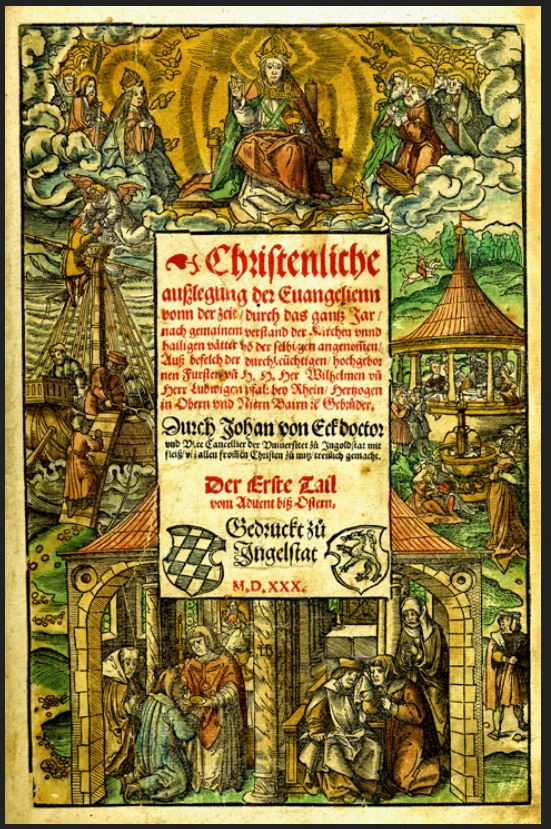
* The illustration titled "Path of Salvation" is now in public domain. The Early New High German text reads, "Christian explanation of the Gospels, from the time throughout the entire year, according to the common understanding of the Church and holy fathers accepted by the same. By command of the illustrious, high born Princes and Lords, Lord Wilhelm and Lord Ludwig, Counts Palatine of the Rhine, Dukes in Upper and Lower Bavaria, etc., Brothers. By Johann von Eck, Doctor and Vice-Chancellor of the University of Ingolstadt, with diligence, as to all pious Christians for their use, faithfully made. The First Part from Advent to Easter. Printed in Ingolstadt M.D.XXX. [1530]"
Courtesy of the Digital Image Archive, Pitts Theology Library, Candler School of Theology, Emory University.
>8. When is it wrong to classify and compare ourselves? (12)
* 2 Corinthians 10:12 "We do not dare to classify or compare ourselves with some who commend themselves. When they measure themselves by themselves and compare themselves with themselves, they are not wise."
* "We do not dare to" -The original Greek verb "tolmao" (a transliteration) is translated "dare" in some English translations. In the Koine Greek of the New Testament and contemporary early Christian literature, it denotes an external, objective act of bravery or defiance, rather than just an internal feeling of confidence.
* "ourselves" -Paul is using the plural Greek pronoun "heautou" to refer only to himself. The comment below places ... where the translation sentence structure caused them to use the word twice when it was only once in the original Greek.
* "classify" -The original Greek verb "enkrino" (a transliteration) is only used here. The KJV translates this "make... of the number", the ASV "bold to number", GW "put... in the same class", and YLT "make bold to rank". The rest agree with the NIVs translation. It carries the literal meaning of judging someone or something worthy of being admitted into a certain rank or category.
* "compare" -The original Greek verb "synkrino" (a transliteration) is used three times in the New Testament. All the English translations agree with the NIV. It means "judge together with"
* "ourselves with some who commend themselves" -"Commend" is translated from the original Greek verb "synistemi" (a transliteration) in all English translations I have except GW which has make their own recommendations". It is used sixteen times in the New Testament meaning "approve", "commend", "commendation", "compacted", "consist", and "prove".
* "themselves by themselves" -The false teachers and prophets who invaded Corinth believer that their is no standard higher than themselves.
* "they are not wise" -Compare to a higher standard. I can compare my past results with my most resent results to see if I improve. However, if I believe I have reached perfection, then I won't even do that.
*
Comparative Analysts.
A way to self-improve is to use comparative analysis. Comparative analysis is taking two or more things and comparing how they are alike and different. Some people use comparative analysis for self-improvement, and unfortunately, others use it for self-condemnation. A wise competitive runner and swimmer compare their times from one trial to the next to determine whether their training regimen is improving.
A human habit that knows no bounds of time, society, and race is comparing ourselves with others. In particular, we compare our actions with others. The self-delusional person who believes they are the pinnacle of perfection will compare themselves to themselves, meaning they measure themselves by their own rules, which they can easily keep. The one-eyed do not compare themselves to people with two eyes; they compare themselves with the blind. They compare themselves to birds of a feather and say, "Aren't I fine!" Worse yet, they compare themselves with a false standard and look down on those who did not follow the false standard.
The false teachers and prophets in Corinth were unwisely using comparative analysis in these false ways and commending themselves. Paul would have nothing to do with it.
Can a Christian utilize comparative analysis correctly? Besides the one already mentioned, yes! We can compare ourselves to Christ Jesus. We can determine if our thoughts and actions mimic those of Christ. I can keep my eyes on Jesus, the author and perfecter of my faith. Jesus says, "I have set you an example that you should do as I have done for you. I tell you the truth, no servant is greater than his master, nor is a messenger greater than the one who sent him. Now that you know these things, you will be blessed if you do them." (John 13:15-17)
Listen to the above comments on 10:12.
>When is it right? (13)
* 2 Corinthians 10:13 "We, however, will not boast beyond proper limits, but will confine our boasting to the field God has assigned to us, a field that reaches even to you."
* "We" -Again Paul uses the plural pronoun to refer to himself.
* "will not boast beyond proper limits" -He does not compare himself to himself. He knows there is a higher standard. He is humble about his state and status.
* "but will confine our boasting to the field God has assigned to us" -Paul is referring to the gospel field using Jesus' parable of the soils as reference. Paul is not saying the whole world, though the whole world is the field. Rather, he is confining the field to that which Jesus assigned to him.
* "a field that reaches even to you" -Corinth was a field that Paul planted in.
>How is this the same as the day we will stand before? (Matthew 25:23, 28-30)
* Matthew 25:23 "His master replied, 'Well done, good and faithful servant! You have been faithful with a few things; I will put you in charge of many things. Come and share your master's happiness!'"
* Matthew 25:28-30 "'Take the talent from him and give it to the one who has the ten talents. For everyone who has will be given more, and he will have an abundance. Whoever does not have, even what he has will be taken from him. And throw that worthless servant outside, into the darkness, where there will be weeping and gnashing of teeth.'"
* Matthew 9:37-38 "Then he said to his disciples, 'The harvest is plentiful but the workers are few. Ask the Lord of the harvest, therefore, to send out workers into his harvest field.'"
* Matthew 13:24 "Jesus told them another parable: 'The kingdom of heaven is like a man who sowed good seed in his field.'"
* Jesus taught that when he comes again all his people will need to give an account of the things we have done while in the body. Several parables, like the parable of the tenants, reveal that we will have to show the return on the investment he gave us. The investment is the gifts of the Spirit and the opportunities and places to invest them.
>9. What is the field that Paul was talking about in verse 13? (14-15)
* 2 Corinthians 10:14-15 "We are not going too far in our boasting, as would be the case if we had not come to you, for we did get as far as you with the gospel of Christ. Neither do we go beyond our limits by boasting of work done by others. Our hope is that, as your faith continues to grow, our area of activity among you will greatly expand,"
* "We are not going too far in our boasting"
* "as would be the case if we had not come to you"
* "for we did get as far as you with the gospel of Christ"
* "Neither do we go beyond our limits by boasting of work done by others"
* "Our hope is that, as your faith continues to grow"
* "our area of activity among you will greatly expand"
>How does this compare to Jesus' ministry? (Matthew 13:37-39)
* Matthew 13:37-39 "He answered, 'The one who sowed the good seed is the Son of Man. The field is the world, and the good seed stands for the sons of the kingdom. The weeds are the sons of the evil one, and the enemy who sows them is the devil. The harvest is the end of the age, and the harvesters are angels.'"
* Paul used the illustration taught by Jesus.
>What should we always remember as we work in our field? (16)
* 2 Corinthians 10:16 "so that we can preach the gospel in the regions beyond you. For we do not want to boast about work already done in another man's territory."
* "so that we can preach the gospel in the regions beyond you"
* "For we do not want to boast about work already done in another man's territory."
>10. What does boasting in the Lord have to do with preaching the gospel? (17)
* 2 Corinthians 10:17 "But, "Let him who boasts boast in the Lord."
* "Let him who boasts boast in the Lord." -The Lord is Jesus. Jesus does it all through us. Jesus makes it possible. Jesus gives us the ability and talents. Jesus controls history, present, and future.
>Whose commendation should we seek? (18)
* 2 Corinthians 10:18 "For it is not the one who commends himself who is approved, but the one whom the Lord commends."
* "For it is not the one who commends himself who is approved" -Saying, "I did all this," will not be accepted on the day of judgment. Jesus' parable has people claiming just these things and he said, "I do not know you." They are not welcome into the Kingdom of God.
* "but the one whom the Lord commends." -Not that I know Jesus, but that he knows me.
>How does seeking Jesus' commendation compel us to share the gospel to strangers?
*
The Time to Boast.
There is a time for everything, including boasting. A day will come when we will be able to boast about our work obeying the gospel. The time of the gospel is when efforts are made to expand the work of the gospel. Paul would boast, but only within the field God had assigned to him (13). His field was assigned when the Lord Jesus called him. He was sent to the Gentiles, and throughout his ministry, the Holy Spirit led him to the field where he was to share the gospel and raise those who believed to grow into mature believers in Jesus.
Paul got as far as Corinth in his ministry of reconciliation. (14) He had not yet gone beyond to Rome and Spain, though he wanted and prayed to. (15a; Romans 15:23-33) he hoped that as the congregation in Corinth continued to grow, his area of activity among then will greatly expand, so that he would entrust the leadership to the local congregation and move on to other places. (15b-16)
So when is the day to boast of the gospel work? The time to boast of the work done is at the judgment seat of Christ. All must stand before Jesus and give an account of the things done while in the flesh. Several of Jesus' parables teach this. (Luke 16:2) Romans 14:10-12 says, "You, then, why do you judge your brother? Or why do you look down on your brother? For we will all stand before God's judgment seat. It is written: 'As surely as I live,' says the Lord, 'every knee will bow before me; every tongue will confess to God.' So then, each of us will give an account of himself to God." Hebrews 13:17 says leaders "must give an account." Will you be able to boast that you advanced the gospel?